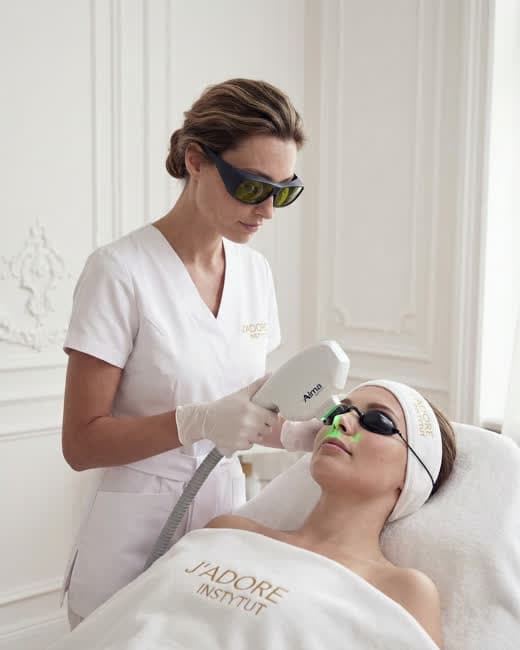
First, recall which type of lesion was treated with light.
The term "hyperpigmentation" covers sun spots, freckles, post-inflammatory marks, melasma, and lesions that should not be diagnosed solely based on a photograph. DYE‑VL can be used for selected pigment lesions, but the post-treatment reaction depends on their nature, depth, skin phototype, and settings. Recommendations for a lentigo should not be automatically applied to extensive melasma.
Before leaving, you should know what the goal was according to the person who qualified you, what reaction to expect in this specific area, and when your follow-up is scheduled. If the diagnosis was simply "it's brown, so we'll shoot it with light," an important safety element is missing. An unusual, growing, bleeding, irregular, or newly discoloured lesion requires a medical assessment, not cosmetic lightening.
Darkening of a spot may be a stage of the reaction, not a signal for a peel.
After the treatment, some pigment lesions temporarily become more contrasted. They may look like tiny darker dots, superficial "pepper spots," or a more pronounced fragment. In the following days, the appearance should be assessed according to the clinic's instructions. Do not assume that every spot must darken, or that the lack of such a reaction means the treatment was ineffective.
- Do not treat the darker surface as dirt or a layer to be removed. The most common mistake is interpreting its appearance this way.
- Do not reach for mechanical or chemical exfoliation methods. A brush, granular scrub, acid, retinoid, and vigorous rubbing can tear the renewing epidermis, increase inflammation, and prolong redness.
- Do not speed up skin exposure with a false shortcut. If you are prone to hyperpigmentation, inflammation itself can stimulate the formation of further post-inflammatory colour. Seemingly faster skin exposure is therefore not a shortcut to an even result.
The first wash should remove impurities without shifting the scales.
Cleanse your skin according to the aftercare card: usually with a mild product, lukewarm water, and your hands. Do not use a washcloth, brush, or a rough-textured towel. If the treatment included your hands or décolletage, remember that contact with detergent, perfume, and a bag strap can be just as significant as a facial product. After washing, dry the area by gently pressing.
Stinging upon contact with water that quickly subsides describes a different situation than increasing pain in a single spot. Observe the direction of the reaction. If every passing hour brings more discomfort, do not add product after product in search of relief. A photo in natural light and contact with the clinic allow for an assessment of the lesion without masking it with further layers.
Areas you touch unconsciously require separate consideration. A hand resting on your cheek, glasses sliding onto your treated nose, or a phone pressed against your face increase friction and transfer impurities. On your hands, detergents and frequent disinfection are a similar problem. You do not need to immobilise the area, but you should notice repetitive contact and limit it while the surface is reactive.
- wash briefly and without rubbing
- do not pick off dark spots with your fingernail
- do not roll the exfoliating surface with a towel
- avoid hot water and steam on the freshly treated area
- use only products approved in the recommendations
The cream should soothe the barrier, not conduct a second hyperpigmentation therapy.
After DYE‑VL, choose a simple, familiar, and well-tolerated formula. Its role is to improve comfort and support the barrier, not to intensively lighten. Products with acids, retinoids, strong vitamin C derivatives, irritating ingredients, or perfumes may sting more on freshly treated skin. Even a product you have used for months may not be right for the first evening.
Do not introduce a new serum just because the label says "for spots." If a reaction occurs, it will be unclear whether it was caused by the energy, the new ingredient, or their combination. A return to active treatment should take place according to the specialist's recommendations and only after the surface has calmed down. Dermatological medications require a separate decision; do not change their dosage based on a guide.
In the case of lightening therapy, a break does not mean abandoning the entire plan. It is a controlled stage that separates the reaction to light from the reaction to the preparation. When the barrier returns to normal, the specialist can schedule the order of reintroducing ingredients. Thanks to this, any stinging or new redness has a clearer cause, and the skin does not receive several methods acting through inflammation or exfoliation at the same time.
Regenerative care
Protects and simplifies observation
- mild cleansing product
- tested cream without stinging
- sun protection matched to your skin
- no mechanical removal of the surface
Accelerating care
Increases the number of stimuli
- acid on darker spots
- retinoid despite redness
- scrubbing for faster exfoliation
- several new serums simultaneously
Protection against radiation is part of the post-treatment plan, not a summer extra.
After a hyperpigmentation treatment, the skin should not receive another uncontrolled dose of radiation. Choose a protective product suited to the area and your tolerance, apply it evenly, and reapply according to the instructions. The filter itself does not replace shade, glasses, a hat, or clothing. Your décolletage is exposed with every movement of your top, and your hands remain exposed while driving.
A cloudy day does not eliminate all exposure, just as sitting by a window does not always mean full protection. The plan should include daily habits, not just your holiday. If a protective product stings after the treatment, do not quietly give up on protection. Contact the clinic to determine a tolerated alternative and additional methods of physical shielding.
Makeup should not hide a symptom that has not yet been assessed.
The desire to cover darker spots is understandable, especially when the treatment was performed before work or a meeting. The moment you return to makeup depends on the skin's reaction and the recommendations. If the surface is undamaged and calm, the clinic may allow a mild product; if there is oozing, blistering, or strong stinging, a covering layer will hinder assessment and may increase the risk of contamination.
Use clean applicators. A sponge carried in your cosmetic bag for months is not a good tool for freshly reactive skin. Do not rub in foundation with a polishing motion, and do not wash it off later with a strong oil that requires a long massage. If you cannot function without coverage, consider this when choosing your appointment date instead of forcing your skin to return faster.
First, photograph the concerning lesion without makeup. The clinic must see the true colour, borders, and skin surface.
Heat, exercise, and the swimming pool add factors that the procedure does not control.
Saunas and hot baths dilate blood vessels and raise skin temperature. Intense exercise adds sweat and friction, and the swimming pool involves contact with chlorine or other agents. None of these stimuli precisely lighten pigment treated with DYE‑VL. They can, however, increase discomfort, especially when the area remains red or swollen.
Determine your return to activities according to the instructions and the state of the surface. A calm walk in the shade is different from running in full sun. Washing your hands is different from soaking them in chlorinated water. If you do not know whether a specific activity is appropriate yet, describe it to the clinic instead of relying on the general slogan "no downtime."

Not every asymmetry of redness means a complication, but the direction of changes matters.
The reaction may be uneven because individual spots contain different amounts of pigment, and the operator adjusts the work to the specific area. One side of the face may also be more exposed to the sun or have different sensitivity. The mere fact that the cheeks do not look identical does not indicate a problem. It is important whether the redness and swelling are gradually subsiding.
Mark the point that concerns you on a photo with a marker, and take subsequent photos in similar light. Do not apply hot or accidentally frozen objects, do not puncture any blisters, and do not apply products from your home medicine cabinet without instructions. A change requiring assessment should remain legible for the person who knows the session parameters.
Blisters, severe pain, and symptoms of infection require contact
Call the salon when you experience increasing pain, extensive swelling, blistering, oozing, a clear burn, rapidly spreading redness, or a reaction that is significantly different from the one discussed. Fever, chills, purulent discharge, and a deterioration in your well-being require medical assessment. In the eye area, do not ignore vision disturbances, severe eye pain, or sudden swelling.
Provide the name of the treatment, the date, the area, the time the symptoms started, and any products applied after leaving. Do not wait for the scheduled follow-up just because the internet describes DYE‑VL as a gentle procedure. The technology may not breach the surface in a typical course, but any energy-based system requires a procedure for handling an atypical reaction.
Over the coming days, assess the surface, not the promise of "clear skin"
Treated spots may change their appearance before the skin tone begins to look more even. Do not set a deadline by which a spot "must disappear". The reaction depends on the type of change and the organism, and some pigmentation requires a broader plan including skincare, radiation protection, or another method. One session should not be presented as erasing the history of sun exposure.
Also pay attention to new darkening outside the treated spot. It may result from irritation, the sun, active skincare, or the nature of the pigmentation problem itself. Instead of increasing the strength of your cosmetics on your own, show the change at your follow-up. Melasma, in particular, can react unpredictably to heat and light, so it should not be treated like a single sun spot.
- Beginning
Redness and more visible pigment
Protect the area, do not rub it, and compare the reaction with the instructions received after the treatment.
- The following days
Spontaneous calming of the surface
Do not accelerate the fading of dark spots with acid or mechanical peels.
- After healing
Assessment of skin tone and diagnosis
The specialist compares the photos and decides whether the method matched the nature of the change.
Follow-up distinguishes a lack of effect from an incorrect diagnosis
If the spot has not lightened as expected, a stronger pulse is not necessarily the solution. First, you must verify the diagnosis, post-treatment exposure, skin phototype, the skincare used, and whether superficial pigment was actually treated. Another session without this analysis may increase inflammation without bringing you closer to the goal.
For your follow-up, bring a photo from before the treatment and photos of subsequent stages, taken without a filter. Tell us about scratching the spot, forgotten sun exposure, or returning to a retinoid — hiding this information makes safe plan adjustment difficult. Your subjective reaction is also important: burning, itching, tenderness, and how long the swelling persists.
It is worth comparing not only the colour but also the boundaries of the spot and its behaviour in the following days. Photos placed side by side in the same conditions will show whether the change is actually fading or only seems different due to make-up or warmer light. If the image deviates from what was expected, the follow-up may lead to a change in method or a referral for diagnostics, rather than an automatic repetition of pulses.
Do not have another session just because it was paid for in a package. The current state of your skin takes priority over the calendar.
Skincare should lead the skin to the follow-up without new marks
After DYE‑VL discolouration removal in Krakow, ask for written recommendations for the type of change diagnosed, not just for the device name. They should indicate how to wash, the correct protective product, the rules for returning to active ingredients, and a contact channel in case of an alarm reaction. This is especially important if you are undergoing dermatological therapy in parallel.
The Krakow location is at Karmelicka 45/2B, 31-128 Krakow, and its opening hours are Mon–Sat 8–20. For a later visit, save the urgent contact channel before you leave so that you do not assess an evening reaction solely based on a photo from a search engine.
Well-prepared post-treatment information also describes what to expect in photos. A phone automatically brightens the face, and bathroom light can deepen the brown colour. Take shots against the same wall, without a filter, from a similar distance, and without tensing the skin. If several spots were treated, do not choose a different one for comparison each time. Documentation is not for proving success; it is to show the progress and help notice a spot that behaves differently from the others.
Also remember that lightening a spot is not the same as changing your biological tendency for pigmentation. Hormones, inflammation, radiation, and individual reactivity still act after healing. Therefore, a long-term plan may include dermatological diagnosis, daily photoprotection, and carefully selected skincare. Another pulse is only one of the possibilities, not a mandatory response to every return of colour.
Do not assess the effect against fresh redness or after scratching the surface. The goal of the first few days is to preserve the barrier, limit radiation, and allow the treated spot to change without mechanical interference. If increasing pain, blistering, or oozing appears along the way, the plan immediately ceases to be purely cosmetic.