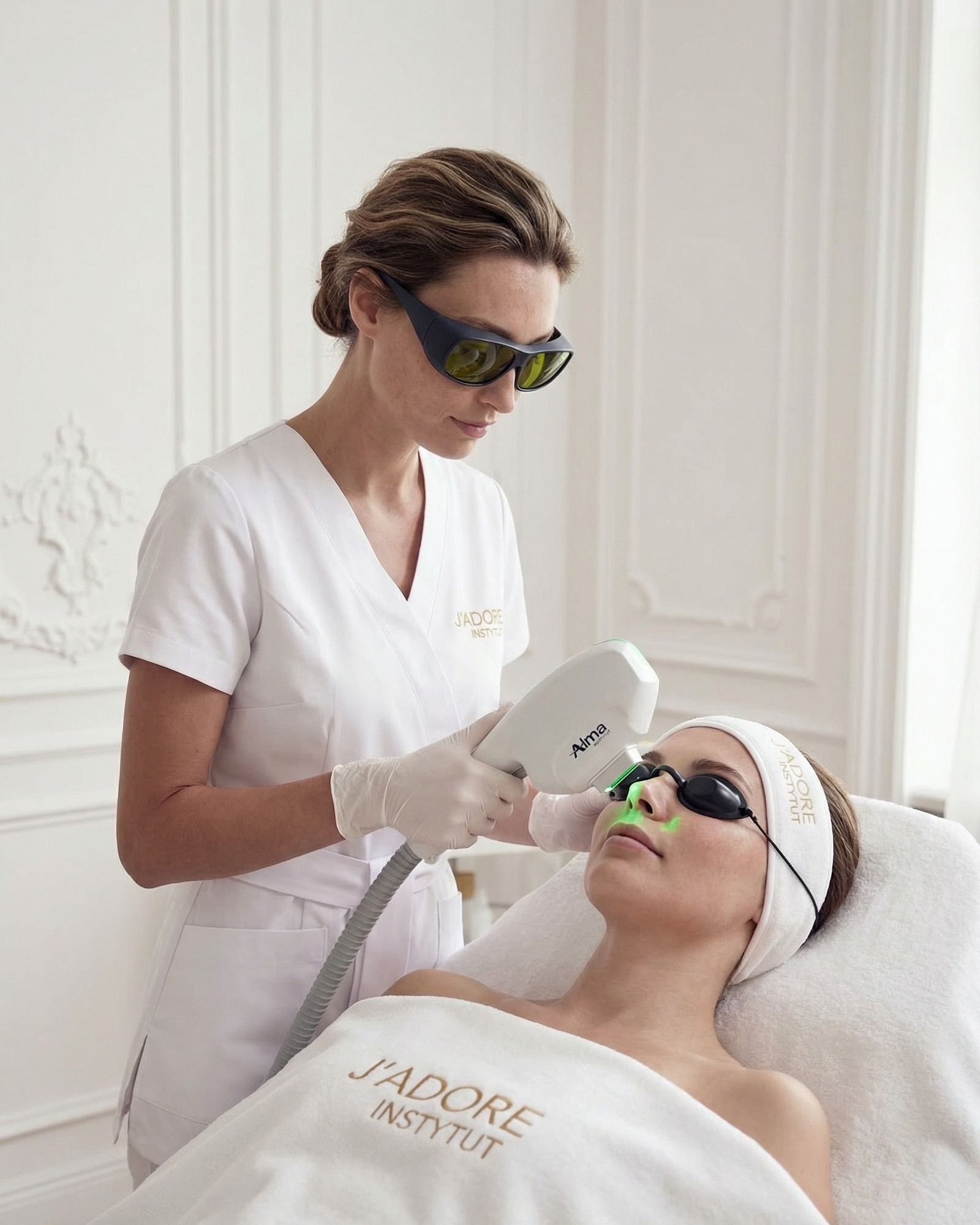
DYE-VL recognises colour but does not provide a diagnosis
The handpiece does not know if a brown area is a sun spot, post-inflammatory hyperpigmentation, melasma or a lesion requiring dermatoscopy. It reacts to the pigment. Therefore, before a flash occurs, the specialist assesses the shape, borders, distribution and history of the spot, your skin phototype, any tan and previous pigmentary reactions. A lesion that grows, bleeds, itches, has multiple colours or an irregular border must first be seen by a dermatologist.
The most predictable targets are usually selected, superficial pigmentary changes caused by the sun. Melanin is concentrated in them in a place that can be safely treated with appropriate contrast between the spot and the surrounding skin. A fresh tan reduces this contrast: the pigment is then located not only in the lesion but more broadly in the epidermis. The risk of unwanted energy absorption increases.
The final skin colour is not yet formed at the moment of the flash
The immediate image is easily distorted by redness, swelling, contact gel, the final cosmetic product and salon lamp light. A photo taken at this moment documents the safety and extent of the reaction, but it is not used to announce the result. A true comparison will be made after the skin has calmed down and natural epidermal turnover has occurred.
If a salon promises the complete disappearance of a lesion immediately after one pulse, it is confusing the mechanism with a marketing visualisation. The energy was delivered in a second; the biological response takes longer. This time cannot be accelerated by scratching the dark surface or using a home peel.
Darkening should correspond to the treated spots
The expected pigment reaction is usually pinpoint or follows the distribution of the lesions. The spot becomes coffee-coloured, more pronounced, and sometimes resembles fine dust on the skin's surface. This may be accompanied by moderate heat and redness, which gradually fade. Diffuse greying, white discolouration, blistering or severe pain do not fit the simple picture of "the pigment is working".
In the first few hours, do not add heat sources. A hot shower, sauna, intense workout and a heated car interior can increase redness and discomfort. Follow the aftercare provided after the treatment and observe the direction: the skin should be calming down, not burning more intensely.
Micro-exfoliation removes pigment without peeling off scabs
In the following days, dark points may become drier and gradually move towards the surface. A classic, raised scab does not always form. Sometimes you only see a fine, coffee-coloured mesh that comes off during gentle washing. The lack of spectacular peeling does not automatically mean the treatment is not working.
Home acids, retinoids, sonic brushes and granular peels are not a way to finish the treatment. A return to active substances is determined after comfort is restored. At this stage, simplicity has a specific function: it limits additional inflammation, which itself can leave pigment behind.
Initial lightening is assessed after the surface has calmed down
Compare photos without makeup, in the same place, with similar camera exposure. A phone automatically brightens the face when you stand against a dark background and dims it by a window. The technological difference can be greater than the skin difference. In the salon, constant lighting and marking the spots assessed from the beginning are useful.
A follow-up visit is not just for praising the result. The specialist checks which lesions have responded, whether post-inflammatory hyperpigmentation has appeared and how long the redness lasted. This knowledge determines further parameters or a change in method.
Different spots on one face can yield an uneven result
On your cheek, there may be a shallow sun spot, next to it a trace of inflammation, and above your lips diffuse melasma. A shared brown colour does not mean shared depth or biology. DYE-VL may clearly lighten the first target and not be the right tool for the third. The result assessed as a whole then seems "patchy", even though the plan was executed selectively.
This is why a map of lesions before the treatment is more important than a "full face" declaration. The specialist may skip an area, suggest a skincare stage, a peel or a dermatological consultation. One technology does not have to perform all tasks during the same visit.
The series should be based on the remaining pigment, not on a package
After the first session, some spots may respond strongly, others more weakly. The next appointment is set only after regeneration and an assessment of the full picture. Repeating pulses on skin that is still irritated does not safely accelerate the process. Instead, it increases the number of overlapping stimuli.
The number of visits depends on the type, depth and extent of the lesions, skin phototype, tolerance and sun protection. For one person, a single spot on the hand will be the priority; for another, photodamage on the cheeks and décolletage. Comparing them based solely on the number of sessions has no value.
If there is no expected direction after a properly planned stage, a revision of the diagnosis is needed. A good plan can stop the series. More of the same energy does not turn an incorrect target into a suitable one.

The sun can create new pigment despite a successful treatment
A lightened spot and the tendency for it to form are two different things. The treatment may limit a visible melanin cluster, but radiation still stimulates the skin's defence mechanisms. Without regular protection, new lesions may appear next to the old one or in a different place. This is not the "regrowth" of the exact same spot, but a continuation of photodamage.
Protection means a product with a high SPF and appropriate UVA protection, the correct amount, reapplication, shade, a hat and avoiding intentional tanning. A filter applied in the morning is not an all-day shield during a walk, driving a car and lunch on a terrace. Hands and the décolletage require the same consistency as the face.
Visible light and heat can be significant, especially in skin with a tendency to melasma. Therefore, the protection plan is selected more broadly than just for the weekend after the treatment. This is part of long-term pigment control, not a punishment for the visit.
The result on the hands and décolletage has different dynamics than on the face
The face usually receives the most care and is protected more often, although daily exposure is also high there. Hands are washed many times, wiped, exposed while driving and less frequently reapplied with filter. Dark points after DYE-VL can catch on clothing more easily there or be scratched off reflexively.
The décolletage reacts to the friction of underwear, perfume, hot showers and sun entering the neckline of a blouse. The assessment of the result must take these conditions into account. If two zones were treated during one visit, do not expect an identical day of peeling and the same shade of redness.
During the consultation before DYE-VL hyperpigmentation removal in Warsaw, show all zones before the scope is determined. The specialist may select different parameters, perform a test or stagger the work. The name of the service remains the same, but the skin of the hands does not become cheek skin because of it.
Makeup and photography can hide a lack of progress
Pay attention to the edge of the spot and its relation to the surroundings, not just the overall brightness of the photograph. Has the border become less visible? Does the area occupy the same surface? Did the centre and the periphery react similarly? With a diffuse lesion, uniformity may be more important than the disappearance of every point. The specialist interprets this together with the type of pigmentation.
Do not try to improve the documentation by intentionally tanning the surrounding skin. Greater contrast or a temporary reduction in it is not treatment, and radiation stimulates further melanin production. The same rule applies to self-tanner: before a follow-up, it hinders colour assessment and may postpone the next treatment. Say when it was used instead of trying to scrub it off intensely.
Also record the date of sun exposure, irritation or a new cosmetic. When the colour changes between follow-ups, such context helps distinguish the natural course from fresh melanocyte stimulation. Memory usually shortens several weeks to the sentence "nothing happened", even though there was a mountain hike, a hairdresser visit near the hairline or inflammation along the way. A short note does not replace an examination, but it protects the conversation from gaps. It also allows you to link the reaction to a specific zone, rather than attributing every change to the entire technology. Thanks to this, the next decision is based on the course, not on an impression from one morning.
A good result also includes the decision of what not to treat with light
The most impressive photo shows a spot that darkened, peeled and faded. The most responsible work is sometimes invisible: recognising a fresh tan, postponing the treatment when using a photosensitising medication, avoiding a tattoo or referring a lesion to a dermatologist. These decisions do not produce "before and after" material, but they protect the skin.
When assessing the result, therefore, ask not only "how much of the spot is left?". Check whether the skin has returned to comfort, whether lighter areas have formed, whether protection is possible in your lifestyle and whether a further pulse has a specific goal. Sometimes the next step is skincare, sometimes a different technology, and sometimes observation.
The most important takeaway is this: darker pigment after DYE-VL may mark the beginning of lightening. However, only a calm healing process that follows the expected pattern confirms you are on the right track. Do not pick at this intermediate stage. Do not ignore any signals that do not fit the expected recovery.