
Where the "laser isn't for dark skin" myth came from
This myth traces back to physics and to the equipment available decades ago. Early laser hair removal systems were designed around contrast between fair skin and dark hair — the greater the difference between skin pigment and hair follicle pigment, the more precise and safer the device's work. On fair skin, that contrast is clear. On dark skin, pigment in the skin "reads" to certain lasers almost the same way as pigment in the hair, which with some systems raised the risk of irritation, hyperpigmentation or burns.
Those early observations were real — but they concerned specific types of equipment, not lasers as such. The problem wasn't dark skin. It was an unsuitable tool. Nd:YAG is the answer to exactly this problem — a wavelength that penetrates deep into the skin and reaches the hair follicle while bypassing the epidermis's melanin layer. This isn't a compromise. It's a purpose-built solution.
How the laser "sees" skin and hair — no equations, just the logic
Understanding why Nd:YAG behaves differently on dark skin comes down to one principle: the laser targets pigment. That means melanin — the same pigment that gives colour to both skin and hair. Every laser emits a wavelength with specific characteristics, and tissues absorb that wavelength differently depending on their composition.
With systems strongly absorbed by surface melanin, dark skin effectively "competes" with the hair follicle. Both want to absorb the energy, but the follicle doesn't win — the skin does, because it's closer. The result: a risk of overheating surface tissue instead of precise work at the root. Nd:YAG avoids this problem: its wavelength is absorbed by melanin in the follicle, but much less by melanin in the epidermis. In other words, the laser "sees" deeper, and the skin along the way isn't as much of an obstacle.
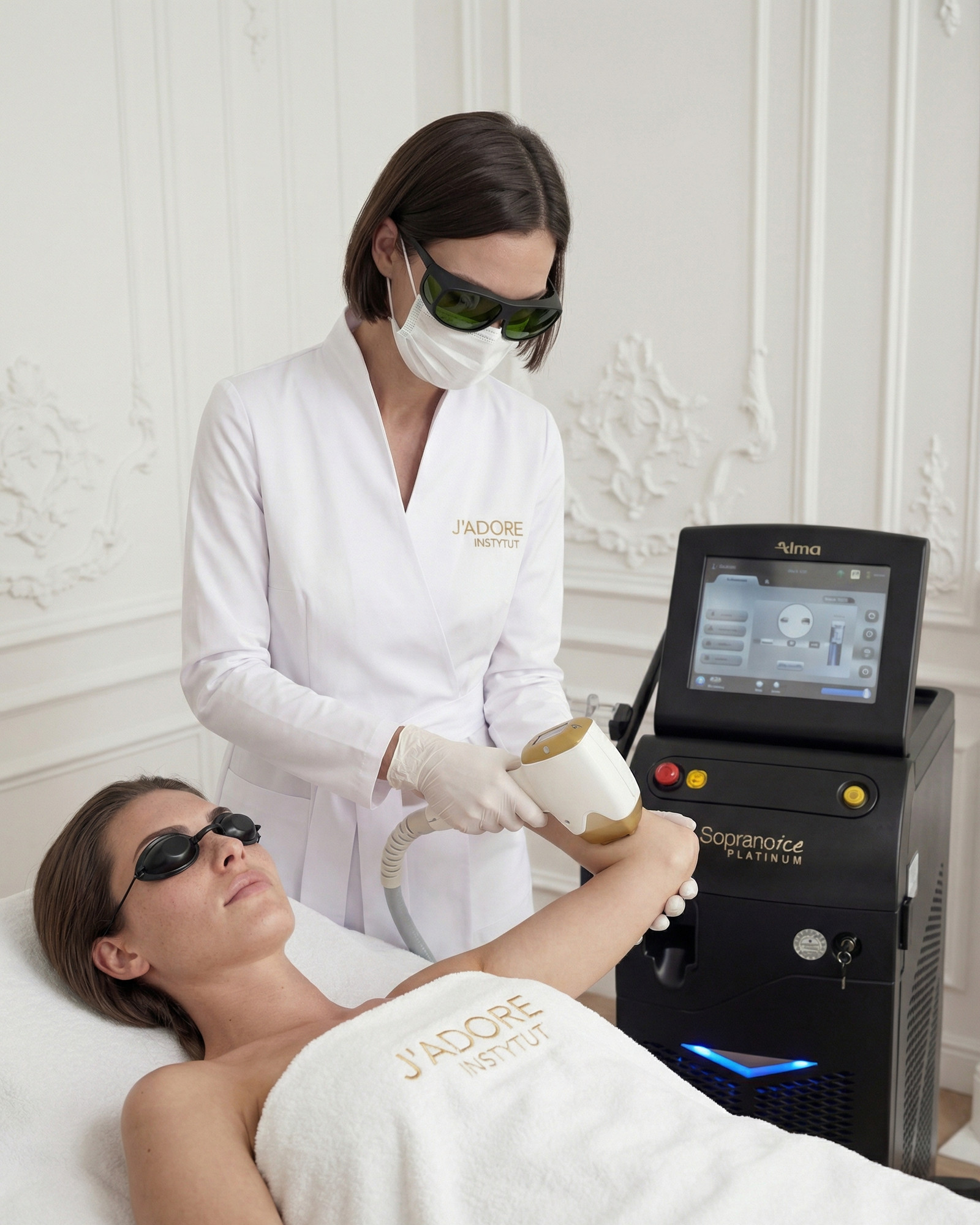
The second piece of the puzzle is cooling. The Nd:YAG handpiece works with an integrated contact-cooling system — this isn't a technical detail, it's a safety feature. Cooling the skin's surface during the pulse protects the epidermis while energy reaches deeper, where the follicle sits. On darker skin, this synchronisation matters even more.
Five myths about laser hair removal on dark skin tones
Myth 1: "Laser won't work because my skin is too dark." This is the opposite of reality. Nd:YAG is designed specifically for dark skin tones — from olive to deep dark. The question isn't "laser or not," but "which laser, and in whose hands." Dark skin isn't a contraindication. An unsuitable device is.
Myth 2: "Results on dark skin will be worse than on fair skin." Laser hair removal results depend on many variables — hair thickness, growth phase, hormones, session regularity. Skin colour isn't a predictor of effectiveness, provided the right system is chosen. With Nd:YAG and thick, pigmented hair (common with many dark skin tones), results can be very good, because a melanin-rich follicle is a clear target for the laser.
Myth 3: "Laser hair removal hurts more on dark skin." Sensation depends on the treatment area, hair thickness and pain threshold — not skin colour. Contact cooling, standard with Nd:YAG, significantly reduces discomfort. The feeling is often compared to a rubber band snap — more intense with thicker hair, milder with finer hair.
Myth 4: "Laser leaves hyperpigmentation on dark skin." This risk is real — but it applies to cases where the wrong equipment was used, settings were too high, or the treatment was performed on tanned skin. With the right system, proper assessment and adherence to aftercare (above all: no sun exposure before or after the treatment), the risk of hyperpigmentation is minimal. Complications that do occur stem from poor device selection, not from dark skin itself.
Myth 5: "I can always tan — nothing bad will happen." This is one of the most common mistakes. Tanned skin — regardless of skin tone — raises surface melanin levels and brings them closer to melanin levels in the hair. On dark skin, this effect is even stronger. The rule is simple: at least two weeks before the treatment, and throughout the whole series — zero intense sun and zero self-tanner. A treatment on tanned skin doesn't just mean lower effectiveness; it's a genuine risk of complications.
Nd:YAG vs other systems — how they differ when working with dark skin
Nd:YAG
Dedicated to skin tones IV–VI; safe on dark skin
- The wavelength penetrates deep — bypassing epidermal melanin
- Integrated contact cooling
- Safe on olive, brown and dark skin tones
- Effective on thick, pigmented hair
Diode / alexandrite laser
Optimal for skin tones I–III, sometimes IV
- High selectivity on fair skin with dark hair
- Fast work on large areas
- Good results on fair skin
There's no single "best" laser for everyone. The best laser is the right laser — matched to skin tone, hair type and treatment area. In clinics with several systems available, a specialist can choose the right tool instead of adapting you to whatever single device happens to be on hand. That's the first thing worth asking about during a consultation.
What a laser hair removal series looks like on dark skin — stages
- 01
Consultation & qualification
A specialist assesses your skin tone on the Fitzpatrick scale, along with hair thickness and colour, and takes a history (photosensitising medication, hormones, tanning history). They select the system and talk you through the series. This is the moment for all your questions — don't skip it.
- 02
Preparing for a session
No shaving the treatment area for several days beforehand (hair needs to be visible above the surface, or the clinic will advise otherwise); no waxing or tweezing for many weeks beforehand (it destroys the structure the laser needs to target); avoid sun and self-tanner for at least two weeks before each session.
- 03
The laser session
The area is shaved just before the treatment — either by the specialist or by you beforehand. Contact cooling stays active throughout. Duration depends on the treatment area. During each pulse, you feel a characteristic snap with warmth — intensity varies by area.
- 04
The first few days after a session
Skin may be slightly red or sensitive for a day or two. No tanning, sauna, swimming pool or intense exercise for 24–48 hours. SPF cream — essential if you're going out in the sun. Hair sheds gradually over 1–3 weeks — this is a normal part of the process, not a sign the treatment didn't work.
- 05
Further sessions and intervals
Laser hair removal requires a series — hair grows in phases, and the laser only affects hair that's actively growing. With typical cycles, results take several to a dozen or so sessions spaced a few weeks apart, depending on the area. Patience and consistency are the key to results.

Dark skin with light or grey hair — a genuine limitation
There's one case where every laser — including Nd:YAG — has a real limit to its effectiveness: light, red, grey or blond hair. The laser looks for melanin in the follicle. If there's barely any melanin there, there's nothing to target. This limitation has nothing to do with skin colour — it's about hair colour. Someone with dark skin and black hair is actually an ideal candidate for Nd:YAG — the contrast between skin and hair is strong, and the follicle is rich in melanin. Someone with fair skin and fair hair paradoxically has a harder profile than someone with dark skin and dark hair.
That said, if you have dark skin and hair that's naturally light, or has become lighter over time (for example after years of waxing, or due to hormonal changes) — a consultation matters even more. A specialist will assess how much melanin remains in the follicle and whether results would justify the treatment.
Before you book your first session — what's worth knowing
Three questions worth asking at any clinic before committing to a series. First: what equipment do you use, and why did you choose it for dark skin tones? A clinic that takes you seriously will explain this without hesitation. If the answer is "we have one laser for everything" — think twice about whether it's the right place for your skin.
Second: is there a consultation and skin tone assessment before the session? Good laser hair removal starts with a conversation, not "come in, shave, laser, goodbye." Qualification isn't a formality — it's the moment a specialist decides which settings suit your skin, and whether this particular day (tanned, sensitive, post-medication) is the right time for a treatment.
Third: what can I do, and what should I avoid, between sessions? This question separates clinics focused on results from those focused on turnover. Sun, saunas, certain cosmetics, razor versus electric shaver — all of this genuinely affects results and safety. A good specialist will explain this without being asked.
Combining treatments — what supports hair removal results
Laser therapy + enzyme peel
Once your series is complete, it's worth focusing on even hydration and smoother skin. An enzyme peel doesn't interfere with laser treatment — it's a great complement afterwards, once the skin is hair-free and you can focus on skin quality.
Laser hair removal + needle mesotherapy or plasma
Skin after a months-long hair removal series may need hydration and repair. Mesotherapy or platelet-rich plasma treatments support the skin barrier — particularly for skin that needs extra care after intensive stimulation.
Nd:YAG + home care with SPF
This isn't a "treatment," but it's a mandatory part of the series. SPF 50+ used consistently between sessions and for several weeks after the series ends is the most effective protection against post-treatment hyperpigmentation — particularly on dark skin, which is more sensitive to melanocyte stimulation.