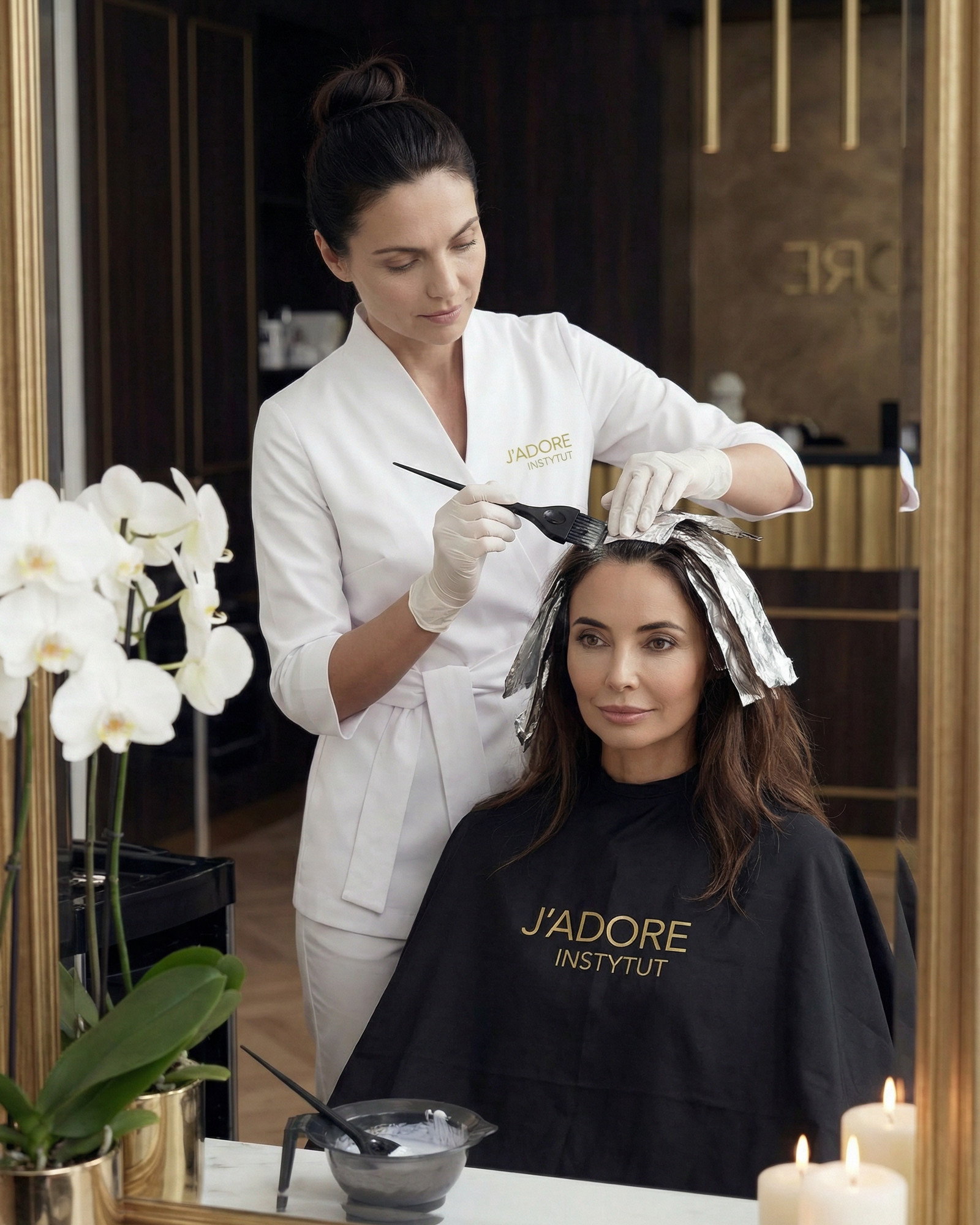
The first question is: what was on your hair before?
A reliable consultation covers salon and drugstore dyes, henna, toners, bleaching, keratin straightening, perms, metallic pigments and home experiments. The answer "nothing, just a colour shampoo" also matters, as pigment can remain in the hair. The hairdresser should ask for approximate dates, not just the date of your last visit.
A warning light should go on if the person performing the service immediately confirms a spectacular change without touching your hair or looking at the roots. The colour visible on the lengths does not tell you what is in the deeper layers. Without an interview, it is impossible to honestly predict the reaction to bleach.
A strand test should answer a question that a photo cannot resolve
For a major change, an unclear history or hair after many chemical processes, a strand test shows how quickly the pigment reveals itself and whether the fibre retains its strength. It does not guarantee an identical result on the whole head, but it limits the guesswork. Ask if a test is necessary in your case and why.
- What level of lightening is realistic during one visit?
- What will the hairdresser do if the strand starts to lose elasticity?
- Does the target colour require a transitional stage?
- What will the plan look like if the test reveals warm, uneven pigment?
A red flag is the promise of going from multi-dyed brown to a cool, very light blonde in one session without any reservations. Colouring will not reverse previous processes and will not repair the hair. It can change its colour; it cannot restore lost structure.
A portfolio should be judged by repeatability, not by one spectacular photo
Look for several works on hair similar to yours: with a similar base, density, curl and history. One photograph taken after curling and in warm light does not show colour uniformity. Look at the roots, the blending lines of the strands, the ends and how the colour looks on straight hair.
Ask if the photo was taken immediately after the service or if the salon also shows the colour after a few weeks. Fresh toning always looks more intense. A later photograph says more about the shade selection and the maintenance plan.
Cost and time should result from a technical plan
An honest quote takes into account the length and density of your hair, the amount of product, the scope of lightening, toning, correction of previous colour and the time required. The point is not to choose the most expensive service. The point is to know exactly what the booking includes and what might change the quote after the consultation.
Do not save money by shortening the diagnosis or skipping a step intended to even out the base. At the same time, not every colouring needs an extensive package. The salon should be able to explain the function of each element instead of hiding behind the name of a ritual.
A colour maintenance plan is created before the service, not at the till
Cool blonde, intense copper, red and deep brown lose their freshness at different rates. The frequency of washing, water temperature, heat styling, sun exposure and water quality all matter. Ask when toning might be needed, what the roots will look like and whether the next visit can be limited to refreshing selected parts.
- How should I wash my hair in the first few days and afterwards?
- Which products maintain the shade and which might wash it out?
- Will home-applied colouring pigment make the next visit more difficult?
- How can I protect the lengths when using a hairdryer and straightener?
When an honest hairdresser should refuse
Refusal is a sign of professionalism when the scalp is irritated, hair breaks under gentle tension, the plan requires an overly aggressive process or the client hides their chemical history. In such a situation, the right answer might be a gentler transitional stage, cutting off damaged ends or postponing the change.
Colouring will not thicken hair, stop it from falling out or rebuild damage. It can optically add depth or dimension, but a scalp problem or increased hair loss requires separate diagnostics. A salon that promises to solve everything with one dyeing is mixing up its goals.
Local choice in Krakow: check the logistics as carefully as the technique
Long colouring requires a realistic time reservation. In Krakow, J’ADORE INSTYTUT is located at Karmelicka 45/2B in the city centre; you can find current service details on the Krakow colouring page. Before your visit, confirm the estimated time, the consultation method and whether a major transformation requires a prior test.
The best criterion is not the hairdresser's confidence, but the quality of their questions. If after the consultation you know the limits of a single visit, the contingency option and the cost of maintaining the colour over time, you can make an informed decision. If you only know the promise of an effect from a photo, you know too little.
Consultation audit: details that show control over the process
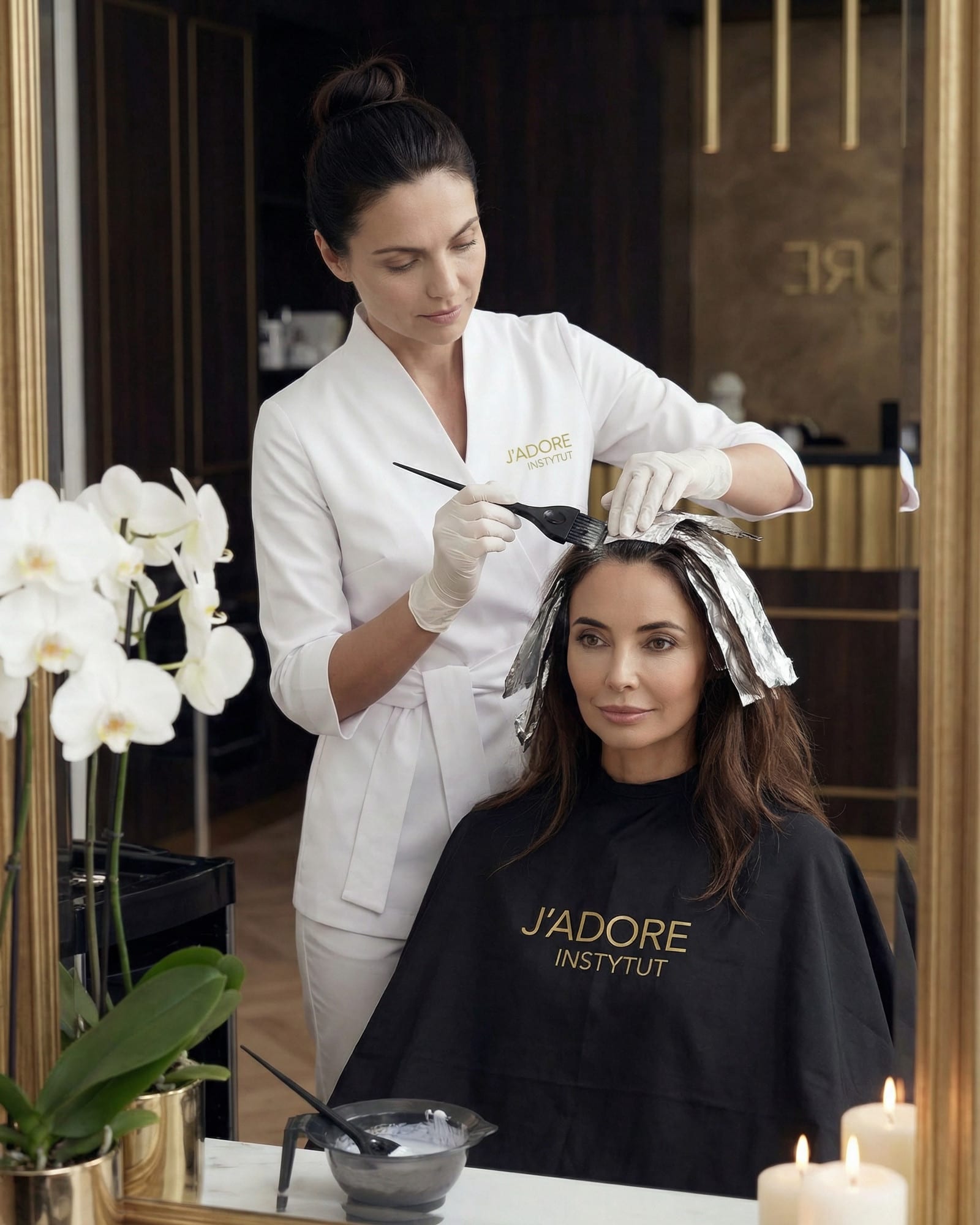
A good consultation is not an interrogation or a ten-minute lecture. It should lead to a shared, verifiable plan. The hairdresser should examine dry hair and separate it in several places, see the natural roots, assess differences between sections and check the ends. Only then does the inspiration photo become useful. You can point out the level of brightness, shade temperature, contrast, light placement and finishing style. Without this, the term "the same colour" is deceptive: a photograph is changed by white balance, filters, exposure and styling.
Ask them to name the starting point in simple words. Is the length uniform, or does it have bands from past colourings? Are the ends darker than the middle? Does the natural root have a different level than the dyed part? If the specialist sees these differences, they should also be able to say how they will affect the order of work. When correcting colour, sometimes you start with the darkest parts, sometimes you protect the most fragile ends, and sometimes you do not touch them with bleach at all. One formula applied everywhere is not always simplicity; it can be a lack of diagnosis.
Ask about process control over time. Bleach does not work like a timer set identically for everyone. The hairdresser observes the rate of pigment release and the condition of the strand. If the answer relies solely on the maximum time from the product instructions, you are not finding out how the salon reacts to differences between sections. It is also important to know who is checking the hair when one person is serving several clients. A change of staff halfway through a service does not have to be a problem, provided that roles are clear and the person responsible for the formula still oversees the process.
Talk about a realistic finish. Waves can hide strand boundaries, uneven brightness and dry ends; a straight style shows them without mercy. You do not have to give up styling, but you can ask to see the colour in several light directions and before strong curling. With a very light blonde, pay attention not only to the temperature but also to the clarity of the ends. Hair can be cool and at the same time too weakened for the result to be considered good.
Allergy, scalp and the moment when an appointment needs to be rescheduled
Colouring concerns not only the hair shaft. The preparation can come into contact with the skin, which is why previous reactions to dyes, strong itching, facial swelling, blisters or shortness of breath must be reported even before booking. The fact that a previous dyeing went well does not rule out a later allergy. The salon should explain the allergy test rules appropriate for the product used and the service date. A strand test assesses hair behaviour; an allergy test serves a different purpose. They are not interchangeable.
Fresh scratches, scabs, severe dandruff with inflammation, weeping lesions or skin burning are reasons to resolve the problem first. Dye is not a treatment for the scalp. It should not be used to cover up a symptom whose cause we do not know. If your hair has suddenly started falling out in handfuls, a change of colour might improve your mood, but it will not stop the process. In such a situation, diagnostics are more appropriate than another chemical service.
On the day of your visit, mention the current state of your skin, even if the consultation took place earlier. Between appointments, an infection, a reaction to a cosmetic or sun damage could have occurred. The pressure to use a reserved long appointment should not outweigh safety. A professional salon knows how to reschedule a service without presenting it as a client's whim.
Ten answers that sound reassuring but mean little
- "We do these transformations all the time" — ask for an example on a similar base and the history of how the effect was achieved.
- "We have the best products" — a brand name does not replace diagnosis or time control.
- "It will be exactly like in the photo" — an honest plan talks about direction and limitations, not a copy of someone else's hair.
- "This preparation does not damage" — every chemical process has conditions of use and limits of hair tolerance.
- "Olaplex will protect everything" — a supporting product does not give permission for unlimited bleaching.
- "The colour will wash out" — ask to what shade and what will require correction.
- "We will do it straight away, a test is unnecessary" — for a difficult history, a justification for this decision should be provided.
- "The price will be determined at the end" — the scope may change, but the pricing rules should be known beforehand.
- "Please trust me" — trust is built by explaining the process, not by asking you to stop asking questions.
- "We can just darken it" — re-applying pigment is not always easy to reverse during the next change.
A single sentence from this list does not disqualify a salon. What matters is whether a concrete answer appears after you ask for more details. A good specialist does not have to predict every detail, especially with a complicated correction. However, they should clearly separate what is known from what the test will show, and indicate the limit at which they will stop the process. Caution is not a lack of skill. In colouring, it is often its most valuable proof.
After your visit, evaluate not only the shade but also how your hair behaves
Your first wash at home reveals more than the salon smoothing treatment. Check if your hair is easy to detangle. See if the ends are breaking or if wet strands feel excessively rubbery. Ensure your scalp returns to its usual comfort. A slight change in sensation after a chemical process is normal. However, sudden breakage, sores or increasing burning require contact with the salon. Symptoms of an allergic reaction require appropriate medical assistance.
Observe the colour in natural light after a few washes. A fresh toner may be intentionally more saturated, as some pigment will wash out. This should be discussed beforehand. If the result differs significantly from what was agreed, document it without a filter. Contact the salon before applying home dye or purple pigment. Self-correction changes the starting point and may hinder a safe repair.
Good colouring does not end with a colour that delights for one afternoon. It should be wearable, washable and easy to refresh at a pace that suits your schedule. If the plan requires frequent visits, expensive products or giving up your favourite styling method, you must know this before the change. Choosing a salon is choosing someone who can think about your hair three months from now, not just until the photo is taken.
A brief simulation of a good consultation before a major change
Suppose you arrive with hair that has been dyed dark brown for years and you show a light beige blonde. A poor consultation ends with the sentence: "we will do it". A good one breaks the goal down into parts. The stylist determines if you care most about brightness, a cool shade, the lack of visible roots or a change of image before a specific date. Then, they show which elements can be combined and which compete with each other. A very light colour and soft roots may require different placement of strands than a uniform blonde at the scalp.
Then, a test and various options are proposed. A cautious variant might end with a caramel or honey stage. This is wearable while the hair is prepared for the next step. A more aggressive variant should have clearly stated risks. This is not about making the client feel afraid, but about providing a real choice. Consent to a service only makes sense when you know the effect after the first visit might be a stage, not the final result from the photo.
The next element is the technical limit. The stylist may say: we stop lightening when the strand loses its elasticity, even if it has not reached the planned brightness. Such a declaration is more important than a promise of a specific tone. It protects the hair when pressure from time, events or cost might encourage working one step too far. You should also know what will happen to the appearance: whether the colour will be toned warmer or if the placement of lighter parts will change.
Finally, the plan covers the first few weeks. It establishes the washing method, thermal protection, the time for the next assessment and what not to apply yourself. Purple shampoo is not a universal remedy. On very porous fragments, it may take more strongly and create unevenness. Oiling also does not replace care tailored to the condition of the hair. Specific recommendations should result from the service performed, not from a ready-made list handed to every person.
Such a conversation takes longer than choosing a strand from a sample book. However, it saves you from corrections, disappointment and months of growing out damaged lengths. If the salon can conduct this simulation before booking, you know they understand colouring as a process. If they avoid all conditions and return only to the "after" photo, you still do not have the basis for an informed decision.
Bring photographs of your hair from before your recent changes to the consultation. They may reveal old pigment or lightened parts that are not visible today under dark dye. Do not hide home colouring for fear of judgment. The stylist needs this information not to comment on your decision, but to predict the chemical reaction. If you do not remember the product, say at least whether it was a plant dye, an oxidising dye or a wash-out preparation.
Before leaving, also establish how to report a problem. Ask in what light and after how many washes to evaluate the shade. Ask what the salon considers a correction and when you must no longer experiment at home. Clear rules protect both parties. You are not left alone with doubts, and the stylist can see the original result without a layer of accidental pigment. Professionalism is also recognised by what happens after the photo is taken. Write down the recommendations, as it is easy to confuse the order of products after a long visit. If the salon suggests the next date, they should explain if it is for a check-up, toning, root work or the next stage of lightening. Each of these goals has a different justification. Booking "for colour" without specifying the task makes it difficult to assess whether the schedule serves your hair or solely regular sales.