One rule, but every jar runs on its own schedule
Most active skincare works on the same layer a treatment works on: the stratum corneum, a thin shield of dead cells held together by lipids. Retinoids and acids loosen and thin it, a grainy scrub sands it down, self-tanner stains it. A chemical peel, a laser and microneedling act on it too, only in a controlled way, calibrated to a specific depth. If your home routine has already prepped the skin its own way, the cosmetologist is working on different ground from the one they expect.
Stays on the shelf
Rebuilds the barrier and protects from light
- Ceramide cream, often in larger amounts than usual after a treatment
- Broad-spectrum sunscreen, before the treatment, throughout the series and long after
- A gentle, non-foaming cleanser
Takes a break
Thins, irritates or stains the surface
- Retinoids: retinol, retinal and prescription retinoids
- Toners and serums with AHAs and BHAs
- Grainy scrubs and exfoliating brushes
- Self-tanner
- Vitamin C as ascorbic acid, briefly before the treatment and right after it
Retinoids take a break because they speed up exactly what the treatment does
Retinol, retinal and their stronger relatives speed up skin renewal. Cells travel to the surface faster, and the outer layer becomes thinner and more permeable. Day to day, that's the point. Before a chemical peel, it's a variable you can't see: the acid penetrates faster and less evenly, and areas that were already irritated react harder than the protocol anticipated. Before a laser, a retinoid adds redness and sensitivity to skin that's about to take a dose of heat. Before microneedling, it adds irritation exactly where the needles will open the barrier anyway.
That's why a retinoid is usually paused for a few days to a week before the appointment. It comes back only once the skin has stopped flaking and stinging, whatever the calendar suggests. A prescription retinoid is a separate conversation: you don't stop it on your own, and you don't leave it out when asked about your routine. An oral retinoid course for acne matters even more, including one that ended recently. It affects how skin heals even after the last dose, so the treatment date is set with the end of that course in mind.
The acid in your toner adds up with the acid used in the clinic
Glycolic, lactic and mandelic acids (AHAs) loosen the bonds between dead skin cells. Salicylic acid (BHA) does the same, and because it dissolves in oil, it also gets into pores. At home-use strength, that's gentle daily exfoliation. But your skin can't tell toner acid from clinic acid, so the effects stack. Swipe on an acid toner in the morning, have a peel in the afternoon, and you've effectively had a stronger treatment than the one that was planned.
Acid toners and serums therefore usually take a few days off before a peel, a laser or microneedling. Before a facial cleansing the break can be shorter, since low-strength salicylic acid makes work on blackheads easier, as long as the skin isn't irritated. After the treatment, acids are among the last to return, once the skin has finished flaking.
Vitamin C stays almost to the end and returns once the skin stops stinging
A pure vitamin C serum, meaning ascorbic acid, works as an antioxidant and inhibits an enzyme the skin needs to make pigment. It doesn't exfoliate the way acids do, so before most treatments it can stay until the last few days. Its weak spot is the low pH this form of vitamin C needs to stay stable and absorb. On healthy skin, that's fine. On skin fresh from a peel, a laser or microneedling, it's an acidic product sitting on a compromised barrier: it stings, it reddens, and it speeds up nothing.
So vitamin C usually takes a short break right before the treatment and a longer one after. It returns when it stops burning on application. If pigmentation is your concern, this is an important comeback: after a peel or laser, skin darkens more easily where it has been irritated, and vitamin C together with sunscreen helps keep that tendency in check.
The grainy scrub is the first into the drawer and the last back out
A grainy scrub exfoliates mechanically and unevenly, depending on how hard you press and how sharp the particles are. Before a treatment, it leaves micro-damage you can't see but that acid, light or needles will find straight away. After a treatment, it's an even worse idea. Peeling skin after a chemical peel comes away when a new layer is ready underneath. Pulling flakes off early exposes immature skin, which is a direct route to redness and pigmentation that outlasts the peel itself.
Photorejuvenation works the same way. Pigment spots first darken, then shed as tiny crusts. That's a sign the light hit its target. Scrubbing them off speeds nothing up and damages the skin beneath.
Self-tanner hides your real skin tone, and before a laser that's a genuine problem
Self-tanner doesn't behave like a tan, but it isn't neutral either. Its colouring agent, DHA, reacts with proteins in the outer layer to produce a brown tint that sheds along with the skin. Before a laser or photorejuvenation it gets in the way twice: it masks your true skin type, which makes it harder to set the parameters, and the pigment on the surface can absorb some of the light meant to go deeper.
Before a peel, the problem is different: the treatment strips the colour unevenly, in patches. Self-tanner needs to be stopped early enough for the colour to fade completely. The outer layer renews at its own pace, so think weeks rather than days.
Ceramides and sunscreen don't take a break, they change roles
A ceramide cream replenishes the lipids that hold the outer layer together like mortar between bricks. Before a treatment, it makes sure your skin arrives in good condition rather than dry and reactive. After the treatment, it becomes the foundation, because a disrupted barrier loses water faster. For skin prone to blackheads, choose a lighter texture: a thick, occlusive cream after a cleansing facial can clog exactly what was just cleared.
Sunscreen goes from daily habit to non-negotiable. In October and November the sun sits lower, but UVA passes through clouds and windows, and skin after a peel or laser responds to it faster with pigmentation. A high, broad-spectrum sunscreen, reapplied during the day, stays for the whole series and well beyond. On freshly treated skin, mineral filters are often better tolerated. Tinted formulas with iron oxides also protect against visible light, which matters if you're prone to pigmentation.
Chemical peel: the acid has to work alone, so the pause list is the longest
In a chemical peel, the cosmetologist chooses the acid, its strength and the timing so that exfoliation reaches a planned depth. Every home exfoliant running in the background shifts that point.
- You pause: retinoids, acid toners and serums, grainy scrubs, self-tanner, and vitamin C for the last few days.
- Stays: ceramide cream, gentle cleansing, sunscreen every day.
- You add after: more barrier cream and sunscreen reapplied through the day. Flakes are never pulled off, even when they look ready to go.
- Last to return: retinoids and acids, once the skin stops flaking and stinging.
With gentler acids, as in a mandelic acid peel, flaking can be barely visible. The rule stays the same: no visible flakes doesn't mean the barrier has closed.
Laser and photorejuvenation: light looks for pigment, so nothing should fake it
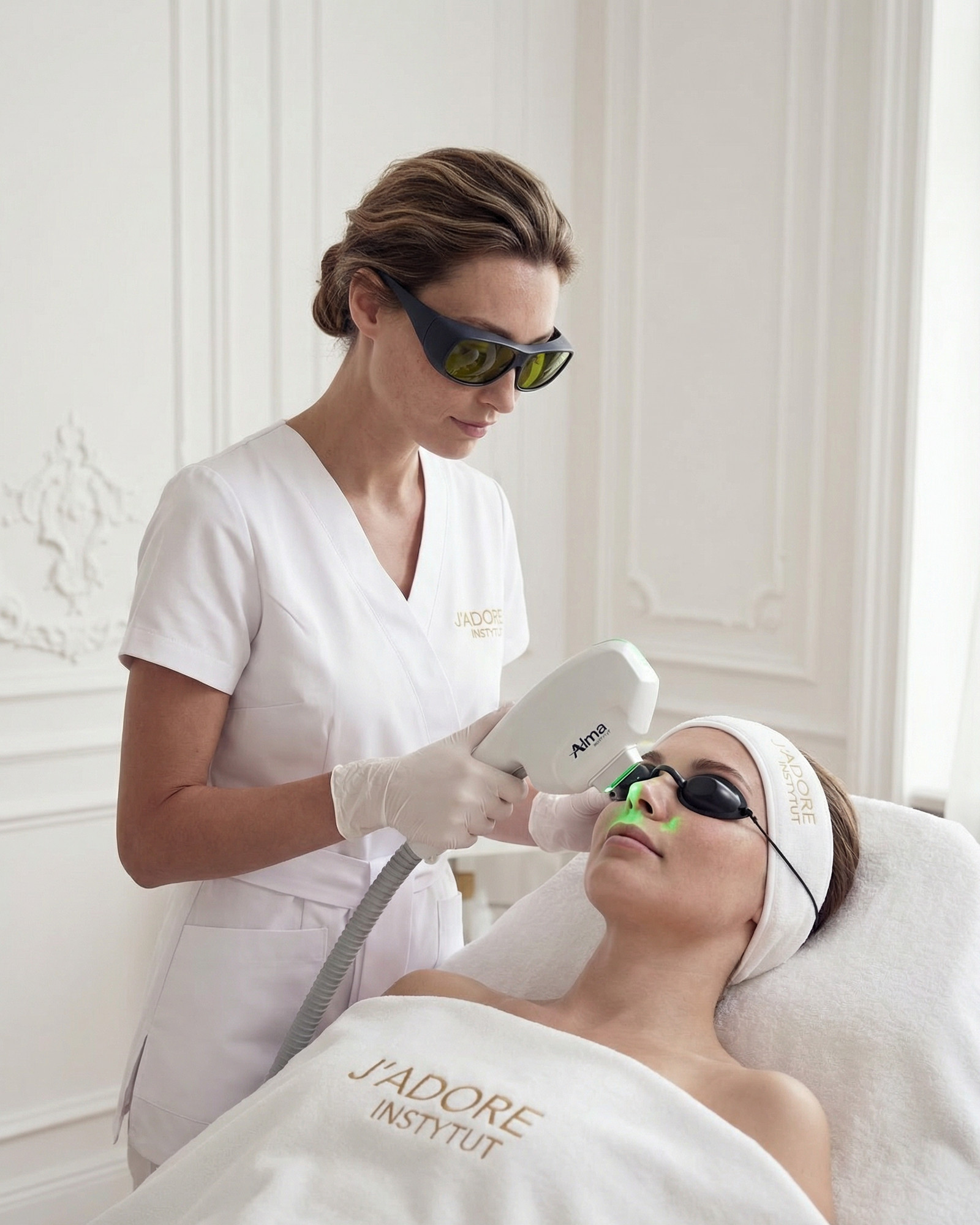
Photorejuvenation and non-ablative fractional laser aim energy at a specific target: pigment in a spot, haemoglobin in a vessel, or water in the tissue. Before it gets there, the light passes through the outer layer of skin. Anything that sensitises or stains that layer changes the path of that energy.
- You pause: retinoids and acids, because irritated skin copes worse with heat; self-tanner, because it fakes a colour that isn't there; grainy scrubs.
- Stays: ceramide cream and sunscreen, which is as important before a laser as after, because it protects against a fresh tan.
- You add after: cooling and a soothing cream in the first hours, a few days without sauna, hot baths or intense workouts, sunscreen without exception.
- Last to return: retinoids, acids and vitamin C, once the redness and the little crusts over pigment spots are gone.
Microneedling: open channels let everything in, including what you don't want
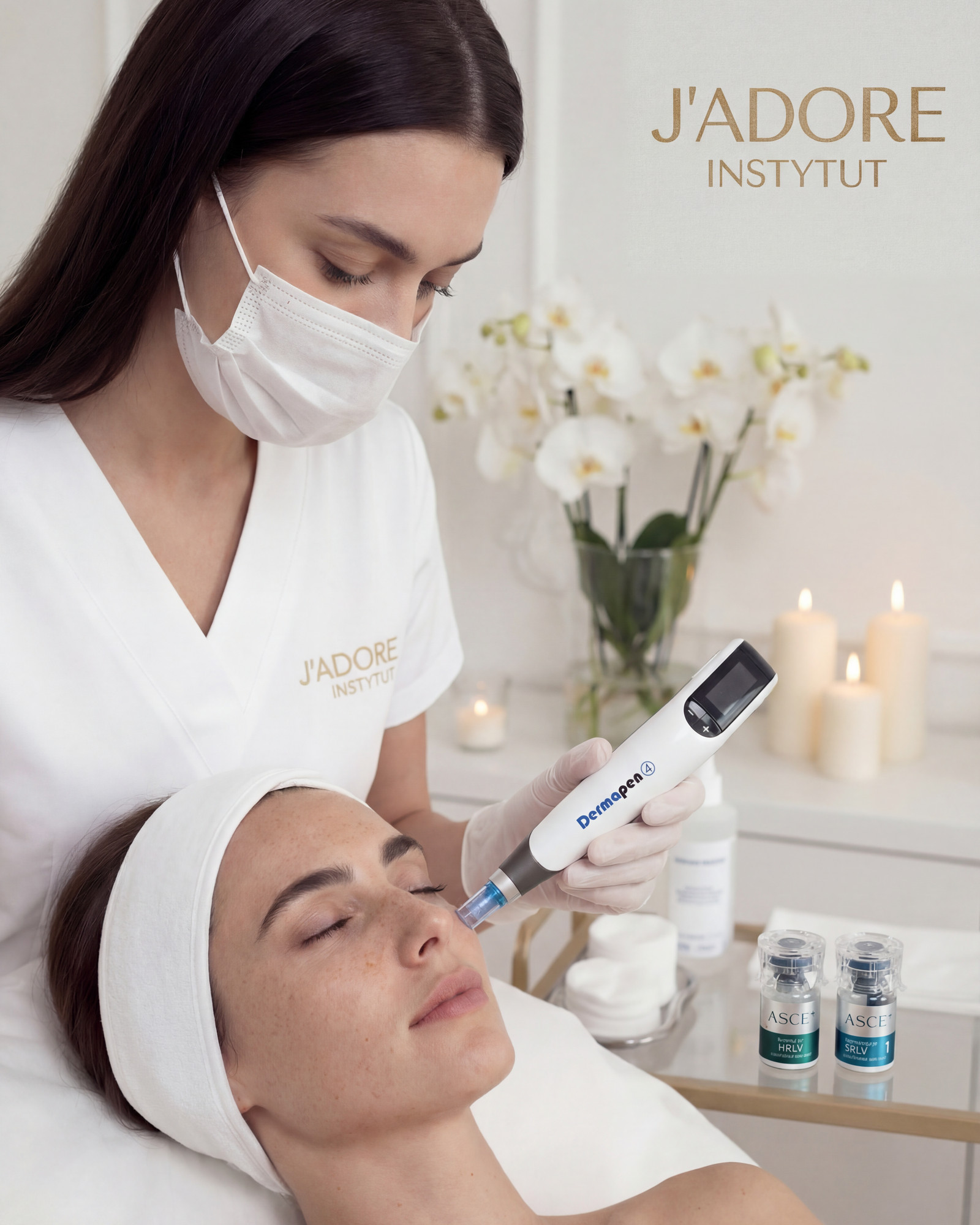
In microneedling mesotherapy, needles create a dense network of microchannels in the skin. For a while, they're a shortcut for the substance the cosmetologist applies on purpose, and for anything else too. An acid, a retinoid or a fragranced cream applied too soon goes deeper than usual and can trigger a reaction that intact skin would never have had.
- You pause: retinoids and acids, grainy scrubs, self-tanner.
- Stays: ceramide cream and sunscreen, after the treatment only once the cosmetologist says so.
- You add after: for the first day, only the product recommended in the clinic; no make-up, pool or sauna; a clean pillowcase and hands away from your face.
- Last to return: retinoids, acids and vitamin C.
Facial cleansing: a shorter list, the same logic
A manual facial cleansing means working on blackheads and pore openings, often with extraction. Skin thinned by a retinoid or freshly scrubbed tears more easily under pressure, and small abrasions take longer to heal than the blackhead itself.
- You pause: retinoids and grainy scrubs for a few days before the appointment, and usually strong AHAs too.
- Stays: gentle cleansing, a light barrier cream, sunscreen.
- You add after: a day without make-up and without touching your face, and a light texture instead of a rich cream.
- Last to return: the grainy scrub. With regular professional cleansing, you may find you no longer need it.
From a week before to the first days after: one plan that fits every treatment
- A week before
Shelf review
The grainy scrub goes into the drawer. Self-tanner should already be fading; if the colour is still visible, mention it when booking. Write down everything you use, prescription products included.
- A few days before
Pause retinoids and acids
Retinoids and acid toners take a break. Ceramide cream, gentle cleansing and sunscreen stay. No new products: this isn't the time for testing.
- Treatment day
Clean skin, no experiments
In the morning, gentle cleansing and barrier cream; no vitamin C, no acids and, if possible, no make-up. At the appointment, mention everything that has been on your face in recent days, sun exposure included.
- The first days after
Barrier and sunscreen, nothing else
Ceramide cream more often than usual, sunscreen reapplied through the day, no sauna or intense workouts. Flakes and crusts stay where they are.
- Once the skin settles
Actives return one at a time
Usually vitamin C first, then acids, with retinoids and the grainy scrub last. Each after a few days of observation, never all in one evening.
What a cosmetic won't do, and what a treatment won't do
The most common mistake of the season is expecting one to replace the other. The roles are sharply divided.
What a product on your shelf won't do
- A ceramide cream won't exfoliate to the depth chosen for a chemical peel.
- A vitamin C serum won't break up a cluster of pigment the way light aimed straight at a spot does.
- A retinol won't close a visible vessel or replace microneedling, which prompts the skin to rebuild.
What a treatment won't do
- No treatment will rebuild your barrier on the mornings that follow.
- Neither a peel nor a laser protects you from the sun between appointments.
- Even the best-matched protocol can't defend skin that gets acid toner and UVA through the window every day.
A cosmetic works daily and at the surface; a treatment works rarely and with precision. The result of a series is built in the days between appointments, and that's where it's decided whether your shelf helps or gets in the way.
Bring a photo of your shelf to the consultation, not your memory of it
The simplest prep takes a minute: a photo of every product by the sink, close enough to read the ingredients. Memory loses exactly what matters, such as the “just hydrating” toner that contains glycolic acid, or the eye cream with retinal. If you're booking a mandelic acid peel in Warsaw or hydrogen cleansing in Krakow, show that photo at the consultation. The cosmetologist will tell you what to pause and for how long, for your skin and that particular protocol. This article gives you the framework; the decision is made once your skin has been assessed in person.
Questions that come up when booking
Before the treatment
- Do I need to stop my ceramide cream before a peel?
No. Barrier cream stays before and after the treatment. On the day, a thin layer in the morning is enough, or, if the clinic asks, come with clean skin.
- I use a prescription retinoid. Should I stop it before the treatment?
Not on your own. Mention it at the consultation and ask whoever prescribed it. An oral retinoid course, including one that ended recently, always needs to be mentioned, because it affects when the treatment can be done.
- Can I use self-tanner during a laser series?
Usually not. Self-tanner masks your real skin tone and can absorb some of the light. If you need the colour for a specific event, plan the treatment date with your cosmetologist so the two don't clash.
After the treatment
- When can I go back to retinol after a peel?
Once your skin has stopped flaking, stinging and turning red when you wash it. The timing depends on the depth of the peel and how your skin reacts. Start with less frequent use, not your old routine.
- Will vitamin C right after a treatment fade pigmentation faster?
Not on fresh skin. An acidic serum on a compromised barrier stings and irritates, and irritation itself encourages darkening. Vitamin C comes back once the skin has calmed down, and then it supports the result alongside sunscreen.