Three tools, three different logics
The simplest way to remember it: laser targets precisely and deeply, IPL "sweeps" broadly and evens out tone, peels exfoliate the surface and rebuild the epidermis layer by layer. Each works on a different principle and gives different results depending on the type of hyperpigmentation involved.
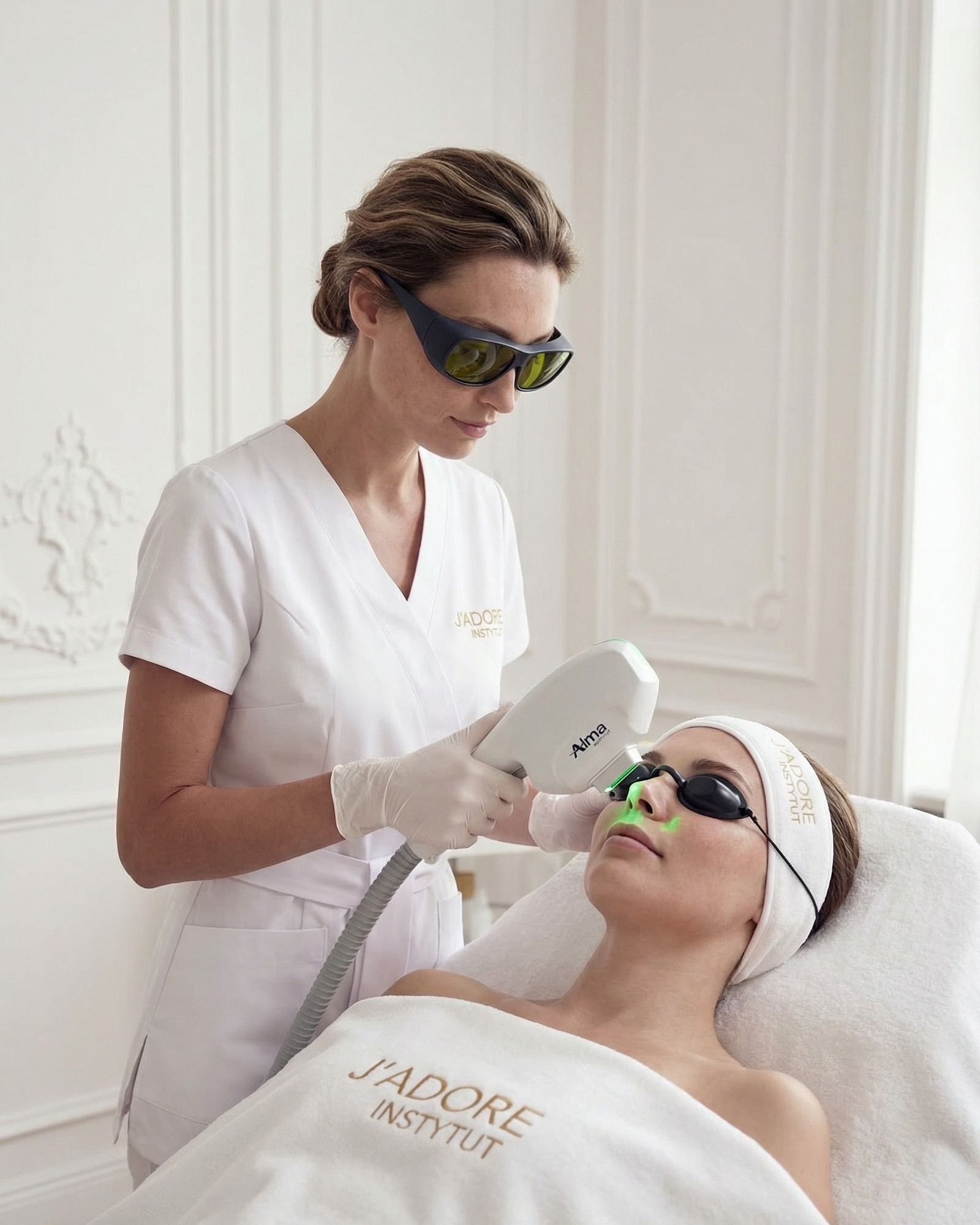
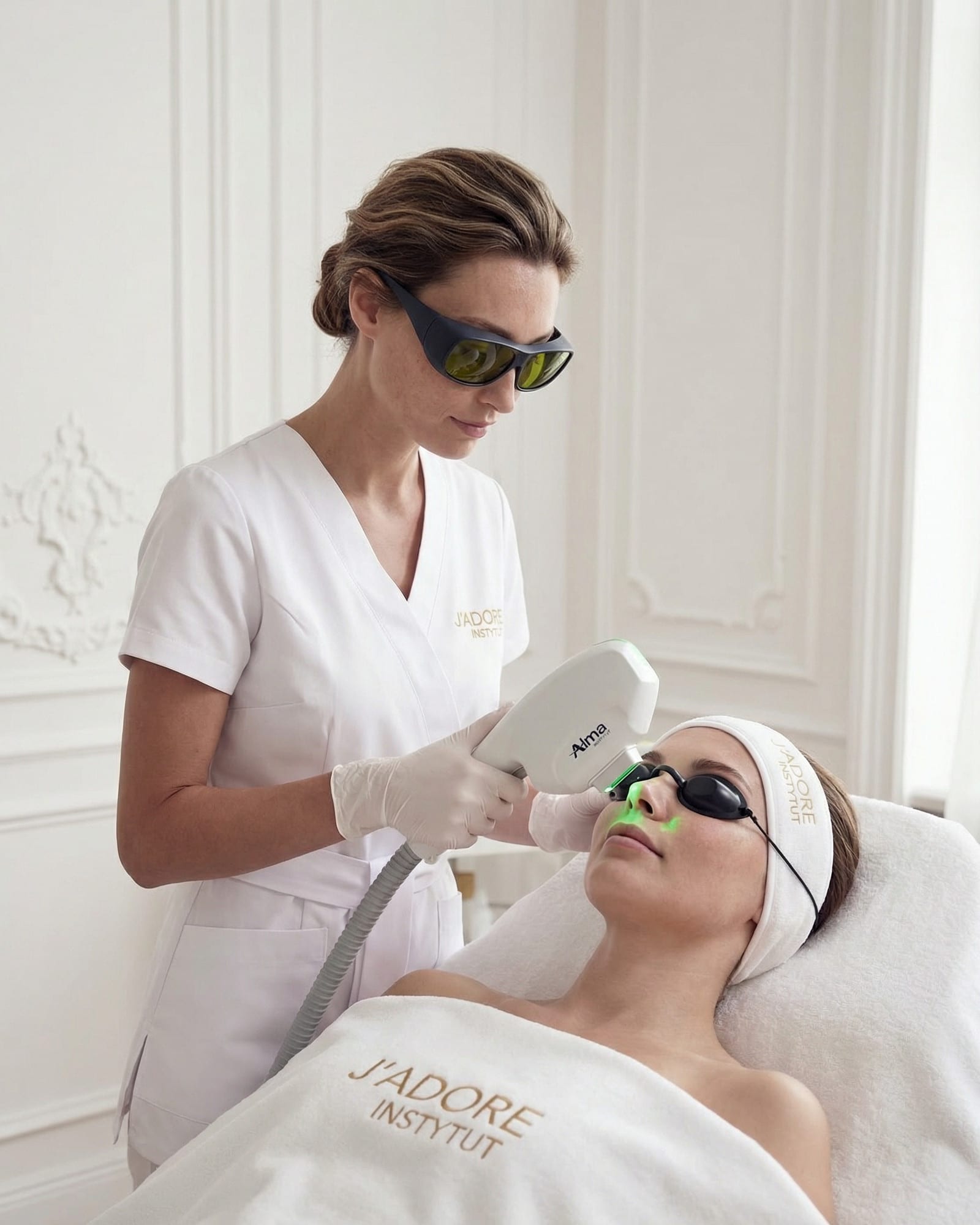
Laser (e.g. Nd:YAG, Q-switch)
targets a specific pigment focus
- localised hyperpigmentation: freckles, lentigines, tattoos
- changes seated deeper in the dermis
- works very selectively — surrounding skin can remain untouched
- usually several sessions, results appear gradually
IPL (intense pulsed light)
evens out skin tone over larger areas
- diffuse sun-induced hyperpigmentation on the face, décolletage, hands
- uneven skin tone over a larger area
- smooths and improves skin texture at the same time
- series of treatments, usually in spring or autumn (not summer)
Peel (chemical or enzymatic)
exfoliates and rebuilds the epidermis
- post-acne hyperpigmentation (PIH), superficial irritation
- general skin greyness, minor unevenness
- improves skin density and quality along the way
- possible almost all year round, in series
How to recognise what you need — a decision map
Before anyone suggests a specific treatment, it's worth considering a few things yourself. This won't replace a consultation, but it will make the conversation with a specialist more focused:
- How many patches are there, and how much space do they cover? One visible mark on the cheek is a different question from scattered spots across the whole décolletage.
- Did the hyperpigmentation appear after sun exposure, after acne, or gradually on its own? The cause often points to the direction.
- How deep is the change? Superficial patches — matte, pale brown, easily covered with concealer — often respond well to peels. Deeper, greyish patches that barely respond to cosmetics signal the need for a stronger tool.
- Have you been in the sun, or are you planning a holiday? Timing matters — especially with laser and IPL.
It's worth remembering that most hyperpigmentation has more than one layer of the problem. A deep sun-induced patch on skin with uneven tone may need both the precision of a laser and surface-level evening out — which is why results so often come not from a single treatment, but from a well-planned sequence.
When to choose what — scenarios
The scenarios below are simplifications — a consultation always takes into account skin phototype, skin history and current condition. But they help you understand the logic behind the choice:
- 01
Single sun-induced patches (face, hands)
Laser or IPL — precise targets with good access to melanin. Laser for more distinct, deeper-seated patches; IPL when there are more patches and you want to even out tone over a larger area.
- 02
Widespread sun-induced hyperpigmentation on the décolletage or hands
IPL — works over a wider area, evens out tone, and often improves texture and the visibility of broken capillaries at the same time.
- 03
Post-inflammatory hyperpigmentation (post-acne, marks left by breakouts)
Chemical or enzymatic peel — exfoliates the surface, speeds up epidermal turnover, and often smooths the skin along the way. Depending on how deep the mark sits, a series may be needed.
- 04
Grey, uneven skin with minor hyperpigmentation
Peel as a base, plus IPL later if needed. A peel improves overall skin quality and "opens it up" for further treatments.
- 05
Melasma (hormonal hyperpigmentation)
Always an individual protocol — none of these treatments on your own initiative. A combination of skincare, UV protection and a treatment chosen very carefully, if needed.
When it's best to combine treatments
The best results for hyperpigmentation are often not the outcome of a single treatment — they come from a sequence in which each tool does what it does best. A specialist always sets the logic of this sequence, but the general rule stays the same:
Peel + laser
A peel first evens out the epidermis and improves skin quality, then the laser precisely targets deeper-seated patches. Using a peel as preparation increases the effectiveness of the next step.
IPL + peel
IPL evens out tone over a large area, while a peel supports epidermal regeneration and improves texture. Both are often used at different points in a series.
Treatment + home protocol (retinol, SPF)
Any treatment for hyperpigmentation works far better alongside consistent sun protection and appropriate skincare. Without SPF, results fade quickly — regardless of the method.
Series + intervals
Hyperpigmentation rarely disappears after one session. A realistic protocol usually means several visits at set intervals — recovery time is part of the plan, not a delay.