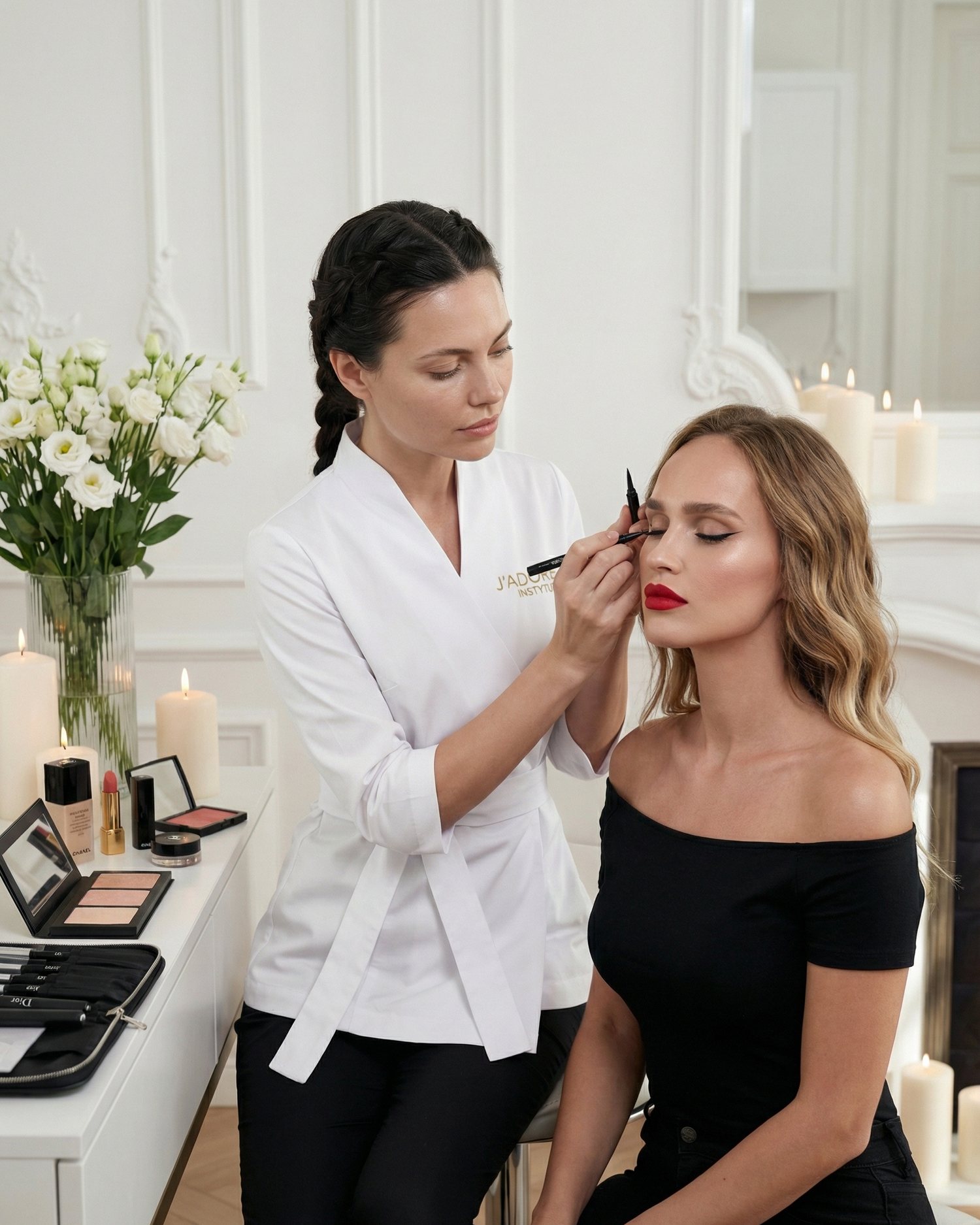
A portfolio should show different faces, lighting, and several hours of wear
A series of photos of the same model in ring light does not show the flexibility of a workshop. Look for dry, mature, oily, and textured skin, as well as different skin tones and eye shapes. Notice whether the faces remain recognisable or if every makeup look ends with the same contour and colour.
Hygiene is assessed by the procedure, not a white countertop
A clean interior is important, but it does not tell you what happens to the brush between people. Ask about washing and disinfecting tools, single-use applicators, product dispensing, and the handling of mascara, lip gloss, and cream formulas. A single-use brush loses its purpose if it returns to the shared container after use.
Hygiene process
limits cross-contamination
- clean sets of brushes
- single-use applicators
- dispensing palette
- surface disinfection
- hand washing
Red flags
transferring product between people
- the same brush in the mascara
- blowing on a brush
- a finger in a jar
- a dirty sponge
- tools without separation
A makeup artist should be able to calmly explain their standard. The answer that "nothing has ever happened" does not replace a prevention procedure.
Before booking, check if the place knows how to refuse service during an infection
An active cold sore, conjunctivitis, an oozing lesion, a purulent infection, and damaged skin may exclude work in that area or the entire service. This is not a lack of empathy for an important event. It is protection for the person with the problem, the makeup artist, and subsequent clients.
- Ask what the facility considers a reason for postponement.
- Mention the tingling that precedes a cold sore, not just a visible blister.
- Do not hide an eye infection under a contact lens or makeup.
- Do not expect a single-use applicator to make every active lesion safe.
- Establish the rules for rescheduling before making a payment.
The interview about allergies must cover ingredients and previous reactions
The sentence "I have sensitive skin" is the start of a conversation. State which products caused burning, swelling, hives, tearing, or inflammation. List allergies to latex, glues, fragrances, and specific dyes if they have been diagnosed. Do not assume that a cosmetic described as hypoallergenic guarantees no reaction.
A patch test does not rule out every late-onset allergy and is not permission to ignore a strong history of reactions. In the case of severe symptoms, a consultation with a doctor or allergist is needed.
The question about longevity should include the time of readiness and the event conditions
The promise that it "will last all night" makes no sense without data about the skin, weather, crying, dancing, touching the face, and the possibility of touch-ups. Longevity is the result of preparation, layer compatibility, product quantity, and behaviour during the event. It is not a magical feature of a single setting spray.
- Start
Time of full readiness
Makeup ends before photos, dressing, and travel.
- Exposure
Outdoor, venue, and temperature
The plan accounts for sun, humidity, heating and air conditioning.
- Wearing
Facial expressions, tears and touch
The trial shows where the product needs adjustment.
- The end
Real-time makeup removal
The makeup artist knows how many hours the makeup should remain comfortable.
A trial is necessary when the result should be a decision, not a surprise.
For a wedding, an important photoshoot, allergies, significant uncertainty or a complex style, a trial allows you to check the direction and comfort. Ask if it is a separate service, how long it lasts, what is recorded and how many changes can be tested without creating several full makeup looks on one skin.
- Arrive with skincare as similar as possible to what you plan to use.
- Bring photos of your outfit, hairstyle, jewellery and inspiration.
- Assess the makeup in daylight, under a lamp and on camera.
- Wear it for several hours and note the moment of any changes.
- Report any stinging or watering immediately, not after washing it off.
- Establish exactly what will be repeated on the day of the event.
Red flag: a lack of notes and a promise that the makeup artist will "definitely remember" the shade, glue, order and agreed adjustments on the day of the event.
Inspiration should be a starting point for conversation, not an instruction to copy someone else's face.
A model's photo shows a style, not your anatomy, skin type or outfit colours. A good makeup artist breaks the inspiration down into elements: eye intensity, skin finish, lip colour and contrast. Then they explain what they will carry over, what they will change and why.
Discussing inspiration
explains the style
- what you like
- what your features are
- what the outfit looks like
- what the lighting will be
- what the comfort level is
Copying an image
ignores the person
- the same contour
- the same colour
- no questions about the complexion
- a filter as a template
- no alternative version
A schedule for several people must be calculated by name, not divided by optimism.
In a group, each person has different skin, requirements and preparation speed. Ask how many makeup artists are working, how much time is allocated per person, who starts first and what happens if someone is late. Time for cleaning the station and changing tools must not disappear when the schedule shifts.
An offer to perform a large number of full makeup looks by one person in a short window should prompt a simple calculation of how many minutes remain for hygiene, consultation and application.
A booking agreement should explain the deadline, trial, lateness and cancellation.
Before paying, read what the service includes, where it takes place, who performs it and how much time is reserved. Establish rules for changing the location, illness, infection, lateness and resignation. For a wedding, ask if the trial is included in the price and if the booking is for a specific makeup artist.
- Do not base arrangements solely on disappearing messages.
- Confirm the full address and readiness time.
- Check the rules for deposits and rescheduling in case of infection.
- Establish fees for travel, early hours and an additional person.
- Ask for confirmation of significant schedule changes in writing.
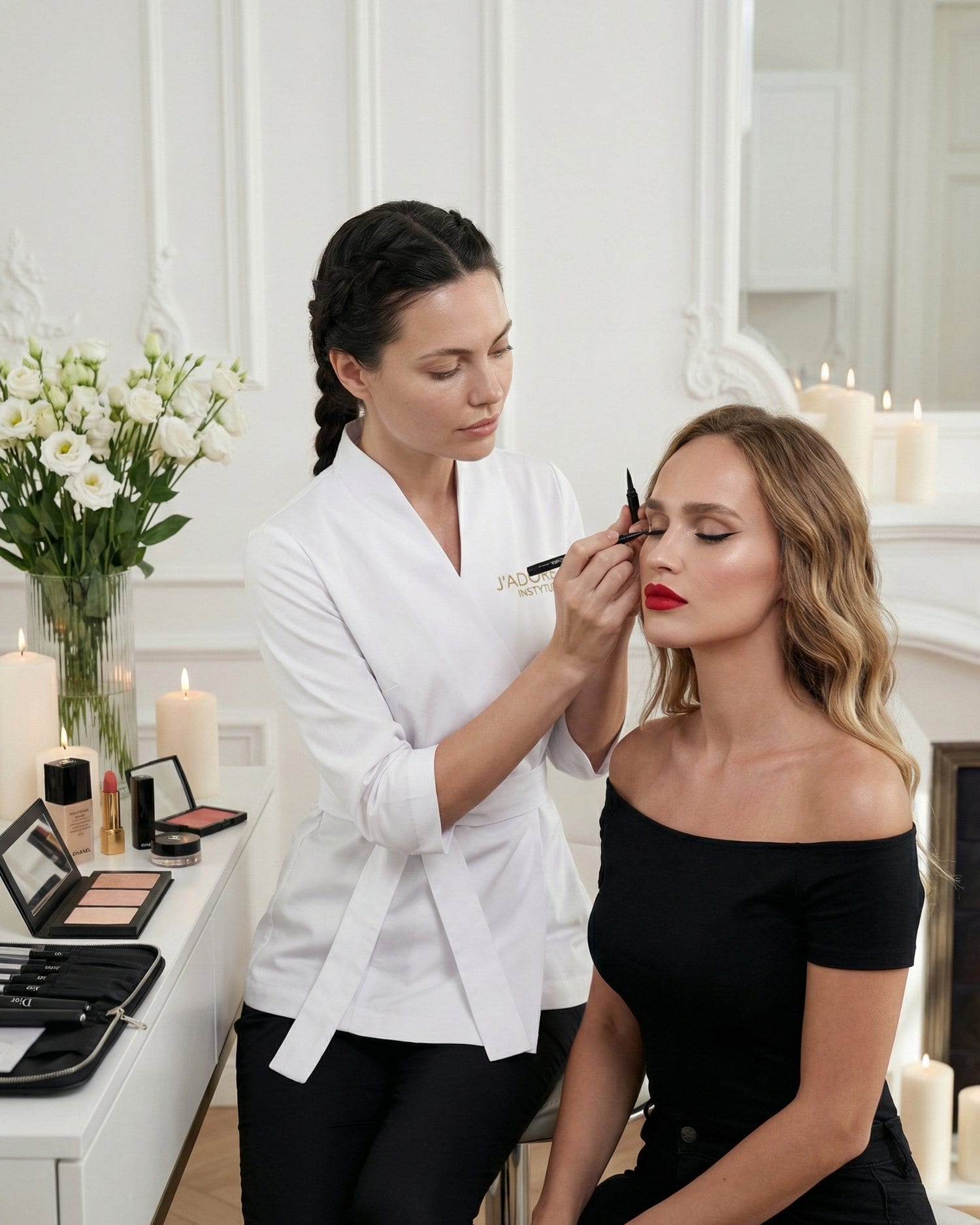
Your own cosmetic may help with allergies, but it must fit the entire layer system.
A person with a well-tolerated foundation, mascara or glue may want to bring it to the appointment. This is a reasonable topic to discuss, but the product itself does not work in a vacuum. Its behaviour depends on the cream, filter, base, powder and application method. The makeup artist should know in advance that they are to incorporate an external formula into the process.
- Bring the product in its original packaging with the ingredients list and expiry date.
- Do not bring an opened cosmetic with a changed smell, colour or consistency.
- Test the combination during the trial, not on the day of the event.
- Establish who applies the product and how to maintain packaging hygiene.
- Do not assume that tolerance of one cosmetic excludes a reaction to the remaining layers.
Mature, acne-prone and flaky skin each require different compromises in coverage.
Applying more foundation does not remove texture. On mature skin, it can highlight fine lines. On active breakouts, it can create a heavy layer. On dry skin, it can cling to flakes. In a portfolio, look for someone with a similar age, skin concern and desired finish. Ask your makeup artist which areas they will intentionally leave less covered for your comfort.
A realistic conversation
establishes priorities
- colour or texture
- comfort or maximum coverage
- matte or natural movement
- spot retouching
- a plan for touch-ups
Unrealistic promises
ignore the skin's surface
- zero pores
- the absence of all lines
- full coverage without a heavy layer
- an identical result for every skin type
- no questions about medical treatment
If you have an active skin condition, a dermatological consultation and limiting makeup use may be the priority. A makeup artist should not diagnose skin conditions or advise you to stop medical treatment to improve the product's finish.
Makeup removal is the final test of a salon's quality.
Long-lasting makeup must be removed in the evening without aggressive rubbing. Ask how to remove eyelash glue, waterproof products and setting layers, especially if you wear contact lenses or have reactive skin. A place that builds durability should be able to explain how to remove it safely.
The worst answers sound confident because they ignore the conditions.
A professional response allows for conditions, alternatives and refusal. It may sound less impressive: "I will check the ingredients", "we need a trial", "I will not perform this area today". These exact sentences show that the process is more important than closing a booking.
When choosing makeup in Warsaw, also consider the location and the continuity of arrangements.
J'ADORE INSTYTUT operates at ul. Żelazna 59, 00-848 Warsaw from Monday to Saturday between 8:00 and 21:00, and on Sundays between 11:00 and 19:00, as well as at ul. Mińska 29A/46, 03-808 Warsaw from Monday to Saturday between 9:00 and 21:00. You can find the range of services on our website: Occasional makeup in Warsaw.
Confirm which location will host the trial and the actual service, who has access to your notes and what the access is like for your event venue. If a different person performs the trial, ask how products, shades and corrections are communicated. Sharing the same brand name does not replace continuity.
Choose a place that can promise a process and define the limits of the effect.
A portfolio should show technical skill, a trial — decisions, hygiene — standards, and a schedule — feasibility. None of these elements is sufficient on its own. The best salon does not guarantee an identical look after rain, tears and a whole night; it explains how it will prepare the makeup and touch-ups for these conditions.
Before making a payment, ask questions about tools, infections, allergies, trials and time. If the answers are specific, you can assess the risk. If you only hear "it will be perfect", return to the portfolio without filters and the work procedure. Your face deserves more than the promise of a well-positioned lamp.