Two weeks before: stop unapproved experiments with active ingredients
Let’s start with the basics — to understand the difference in action, it is worth understanding what lies behind the abbreviations. AHA stands for alpha-hydroxy acids, and BHA stands for beta-hydroxy acids. The difference in the name reflects the difference in chemical structure — and it is this structure that determines how each of them behaves in contact with the skin.
There is one key, fundamental difference: BHA is fat-soluble, while AHA is water-soluble. This statement, which looks like a chemical detail, translates in practice into everything: where the acid goes, what skin type it works on, and what problems it can solve. BHA deals with oil — so it enters where oil collects. AHA works on the surface — so it deals with what is happening on the very top of the skin.
- AHA (alpha-hydroxy acids): glycolic, mandelic, lactic, citric, malic. They work on the skin surface — they loosen the connections between dead cells, facilitating their exfoliation. They act primarily in the stratum corneum of the epidermis.
- BHA (beta-hydroxy acids): practically one player — salicylic acid. It dissolves in fats, so it penetrates the sebum layer and enters deep into the pore opening. It is the only substance among popular skincare acids that reaches the places where blackheads collect and bacteria multiply.
Salicylic acid is chosen because of sebum and follicle openings
If you have oily skin with a tendency to clogged pores, blackheads, or breakouts, BHA is likely the acid you are looking for. The logic is simple: the pore is filled with sebum, and salicylic acid likes fat — so it physically reaches where the problem has its source.
Inside the pore, BHA loosens accumulated keratinocytes (dead skin cells mixed with sebum) and facilitates their evacuation to the outside. This is why, after some time of regular use, pores may appear smaller — not because they have "closed" (pores do not have muscles), but because they are simply less filled. Additionally, salicylic acid has anti-inflammatory properties, which makes it the only exfoliating acid that simultaneously calms redness around breakouts.
A week before: do not tan, do not damage, and observe active changes
For all the difference in chemistry, in practice, the choice between BHA and AHA comes down to one question: what is your skin's main problem? Clogged pores and oiliness — BHA. Dullness, dryness, uneven texture — AHA. And what if it is both?
BHA — salicylic acid
lipophilic exfoliation (likes fat)
- Enters deep into the pore opening
- Dissolves the sebum-keratin plug
- Acts on blackheads and breakouts
- Anti-inflammatory properties
- For oily, combination, and acne-prone skin
AHA — glycolic, mandelic, lactic
hydrophilic exfoliation (likes water)
- Works on the surface of the epidermis
- Loosens connections between dead cells
- Improves texture, colour, and radiance
- At higher concentrations, it stimulates collagen
- For dry, mature skin and skin with hyperpigmentation
Combination skin is a case where the answer can be complex. The central part of the face (forehead, nose, chin) may require BHA — because it has pores prone to clogging. The cheeks may need AHA — because they are drier, more matte, and perhaps have hyperpigmentation. A good practice is then using both — but in different zones or in different routines — instead of forcing a choice of one.
Two days before: no hair removal, squeezing, or mechanical peels
Yes — and it often makes sense. But "simultaneously" requires clarification, as it is easy to cause excessive irritation here.
- 01
One acid at a time — to start
If you are just starting with acids, let your skin get used to one. Introduce it slowly — 2-3 times a week, in the evening. Observe the reaction for at least 3-4 weeks.
- 02
Combining — different days or different products
Once the skin is accustomed, you can use BHA and AHA alternately — one evening BHA, the next AHA. Or use a product with both acids in a proven, ready-made combination.
- 03
The same evening — only with caution
Applying both acids one after another on the same evening only makes sense at lower concentrations and when the skin is ready for it. It does not compensate for the effects — the sum of exfoliation is not always the sum of benefits.
- 04
SPF filter in the morning — always
Acids increase the skin's sensitivity to UV radiation. After a night with an acid, a filter in the morning is not an option, it is a necessary condition — without it, some of the results of the work are quickly reversed.
On the day of your visit: clean skin and a full list of medications are more important than makeup
Acids — both BHA and AHA — are very effective skincare tools. With regular use and proper selection for your skin, they can significantly improve texture, reduce the visibility of pores, brighten hyperpigmentation, and even out skin tone for many people. These are real results, not marketing promises.
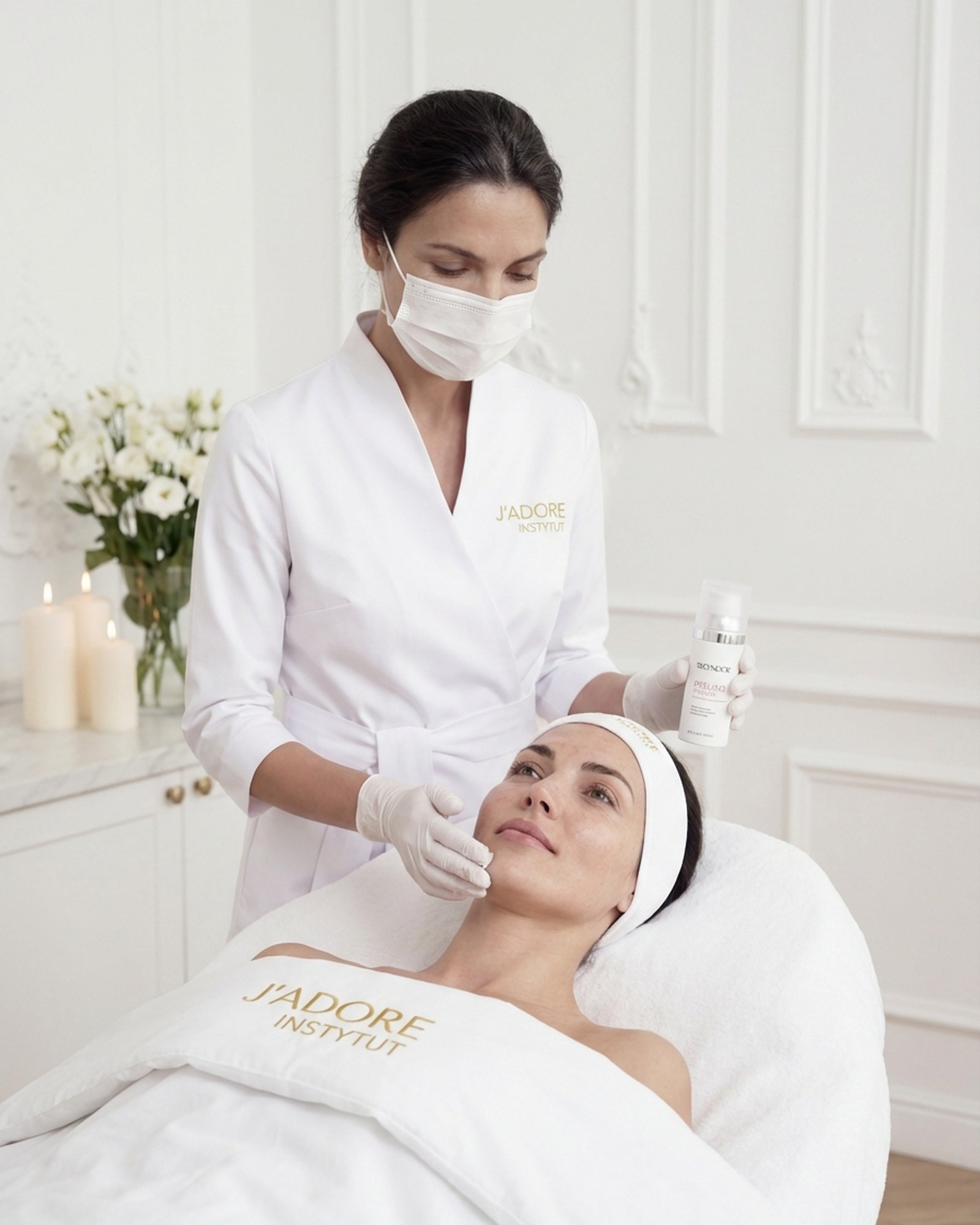
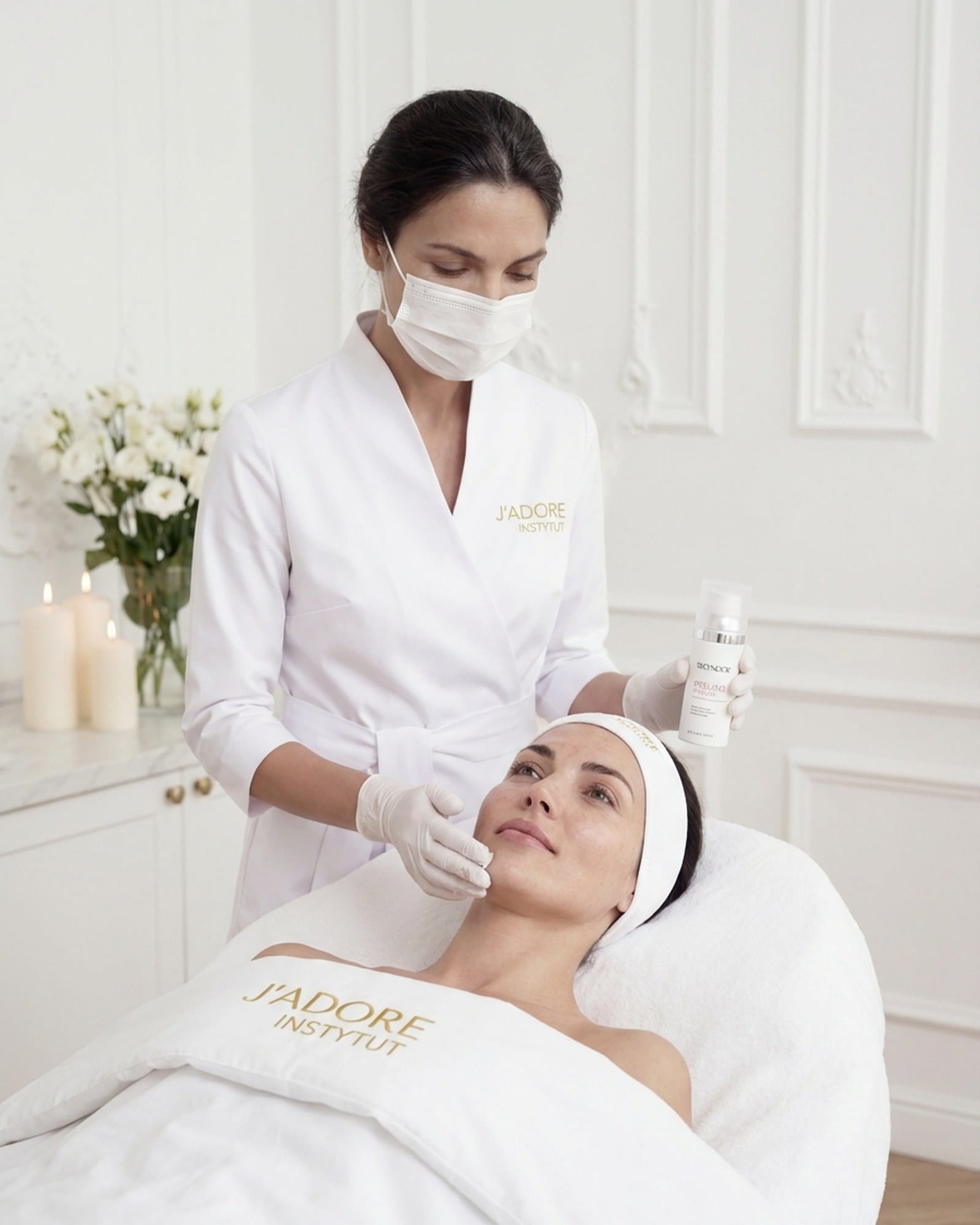
But there is a limit that home care does not cross — and it is worth knowing it. Acids in cosmetics work in concentrations and at a pH adjusted for safe daily use. Professional peels work under completely different conditions: higher concentrations, controlled pH, precise exposure time, and the ability to combine substances in protocols impossible to replicate at home. This is why the effect of one professional treatment is often described by many as equivalent to weeks of a home routine — not because "home products don't work", but because the salon does the same thing, just more intensely and precisely.
Chemical peel
Professional AHA and BHA concentrations in a controlled protocol — a result of deeper exfoliation, even skin tone and acne management in a single session.
Needle mesotherapy
After a series of peels — replenishing hydration and supporting the skin barrier from within, especially for skin weakened by intensive exfoliation.
Ultrasonic cleansing
Combining mechanical impurity removal with the effect of acids — they reinforce each other and deepen the effect of clear pores.
AHA and BHA work in different skin environments
Let us start by demystifying a word that sounds intimidating. "Acid" is associated with something corrosive, but in skincare, it refers to something much milder: substances that gently loosen the bonds between dead epidermal cells. This allows older, "worn-out" layers to shed more easily and evenly. Skin exfoliates naturally throughout your life — acids simply organise and accelerate this process when it begins to falter due to age or skin problems.
The result everyone wants is skin that is smoother to the touch, more radiant and more even in colour, with less congested pores. Acids can also facilitate the absorption of subsequent skincare products and support acne-prone skin. These are real benefits — provided we do not confuse "regularly and wisely" with "a lot and all at once".
Combining acids before your visit may overload the barrier
Before you buy anything, one question: what problem do you want to solve? Acids are not a skincare "must-have" that everyone needs on their shelf. They are a targeted tool — and your choice depends on what is happening with your skin. The three main families work differently and suit different needs.
AHA (fruit acids)
Radiance and smoothing
- Water-soluble — they work mainly on the skin surface
- Mandelic and lactic — the mildest, good for starters
- Glycolic — a smaller molecule, penetrates deeper, stronger
- For: dull complexion, uneven skin tone, minor hyperpigmentation, dryness
BHA (salicylic acid)
Pores and blemishes
- Oil-soluble — it penetrates pores and "unblocks" them
- Works on blackheads, seborrhoea and oily skin
- Can be soothing for skin prone to redness
- For: combination, oily skin, with blackheads and breakouts
PHA (new generation)
For sensitive skin and beginners
- Large molecule — penetrates more slowly, works most gently
- Often better tolerated by reactive skin
- Additionally support hydration
- For: sensitive skin, vascular skin, "first time with acids"
The simplest tip to start: if your problem is blackheads, oiliness and clogged pores — look towards BHA. If it is about radiance, skin tone and smoothness — look towards mild AHA. And if your skin quickly becomes red and stings — start with the gentlest forms (mandelic, lactic, PHA) instead of reaching for strong glycolics immediately.
At-home preparation should not mimic a salon procedure
This is the heart of the entire text. Most irritation comes not from the acid itself, but from the pace of its introduction. Follow these steps in order — from the safest to the more advanced. Hasting at the start usually ends with a week of hiding from the mirror.
- 01
Step 1 — Basics first, acids later
An acid is an addition, not a foundation. If your skin is dehydrated, scrubbed raw or chafed by strong cosmetics, calm it down first: gentle cleansing, hydration and — this is key — a sunscreen during the day. On a damaged barrier, an acid will act like it is on an open wound.
- 02
Step 2 — Choose ONE mild product
Instead of buying three acids at once, choose one with a low concentration — preferably a form recognised as mild (mandelic, lactic, PHA) or a gentle BHA if you are fighting pores. One product = easy to tell how your skin reacts. A mix of five at once = guessing what went wrong.
- 03
Step 3 — Introduce slowly and observe
Start by using it infrequently — every few days, in the evening — and observe. A slight, temporary "tingle" can be normal; stinging redness that does not go away is a sign of "too much, too soon". Only when your skin tolerates it calmly should you gradually increase the frequency. This is not a race.
- 04
Step 4 — Sunscreen is not an option
After using acids, your skin is more sensitive to the sun, and without protection, it is easy to get hyperpigmentation — exactly what many people want to fight with acids. A high-filter cream every day is a condition, not an accessory. Without it, all your effort can have the opposite effect.
- 05
Step 5 — Give your skin time and evaluate in weeks
The first "radiance effect" can be quick, but real improvement in skin tone or smoothness is a matter of weeks of regularity, not a single application. Do not change the product every few days in pursuit of a miracle. Consistency does more here than strength.
Pay attention to the order. The skin barrier and sunscreen are the foundation — acid is just the next floor. The strongest peel will not compensate for dehydrated, irritated skin or a lack of sun protection. That is why we build from the bottom, not from the roof.