Is it really a concern? When PDO threads come into consideration
Before answering the question, “how does it work?”, it is worth considering an earlier one: when is it worth thinking about at all? Not every loss of skin firmness requires treatment. And not every treatment is suitable at every stage.
PDO threads are not the first step in skincare — this treatment is for people who understand that they are dealing with a biological process of tissue ageing, not simply a lack of moisture. If your skin is dehydrated, irritated or has lacked basic care, it is worth addressing this first. Threads work better in well-cared-for tissue.
Why skin loses firmness — a mechanism worth understanding
Before you understand how PDO threads work, it is worth knowing why they are needed in the first place. This is not about poor skincare — it is physiology.
Young skin (up to approximately age 30)
Balance between production and breakdown
- Fibroblasts actively produce collagen and elastin
- Dense fibre network — skin is firm and resistant to gravity
- Quick regeneration after damage from sun, stress or deficiencies
Mature skin (after approximately age 35)
Breakdown is faster than production
- Fibroblasts work more slowly — less new collagen
- The fibre network becomes thinner — skin loses suppleness and density
- Subcutaneous fat shifts downwards under the influence of gravity
The role of external factors
They accelerate what happens naturally
- UV radiation: damages collagen and slows its production
- Smoking: impairs blood supply, so fibroblasts work less effectively
- Chronic stress and lack of sleep: disrupt night-time regeneration
PDO threads address this deficit through a mechanism known in aesthetic medicine as neostimulation — stimulating fibroblasts to increase collagen production. The thread acts as a stimulus. The tissue responds to a foreign body with a controlled inflammatory response, which activates repair processes. When the thread is absorbed, usually within a few months, new connective tissue remains — denser and better hydrated.
Smooth PDO threads step by step — what the treatment involves
This is the heart of this article. Knowing exactly what happens before, during and after the treatment removes much of the anxiety. It also helps you assess realistically what to expect. Let us go through the full process.
- 01
Step 1 — Consultation and qualification
The treatment starts at the desk, not in the treatment chair. A doctor or certified specialist assesses your skin quality and thickness, the degree of density loss, facial contour and general health. This is the stage for discussing expectations, possible contraindications, such as active infections, blood clotting disorders and pregnancy, as well as the treatment plan. A well-conducted consultation takes as long as needed — it is not a formality before completing a form.
- 02
Step 2 — Mapping and marking the points
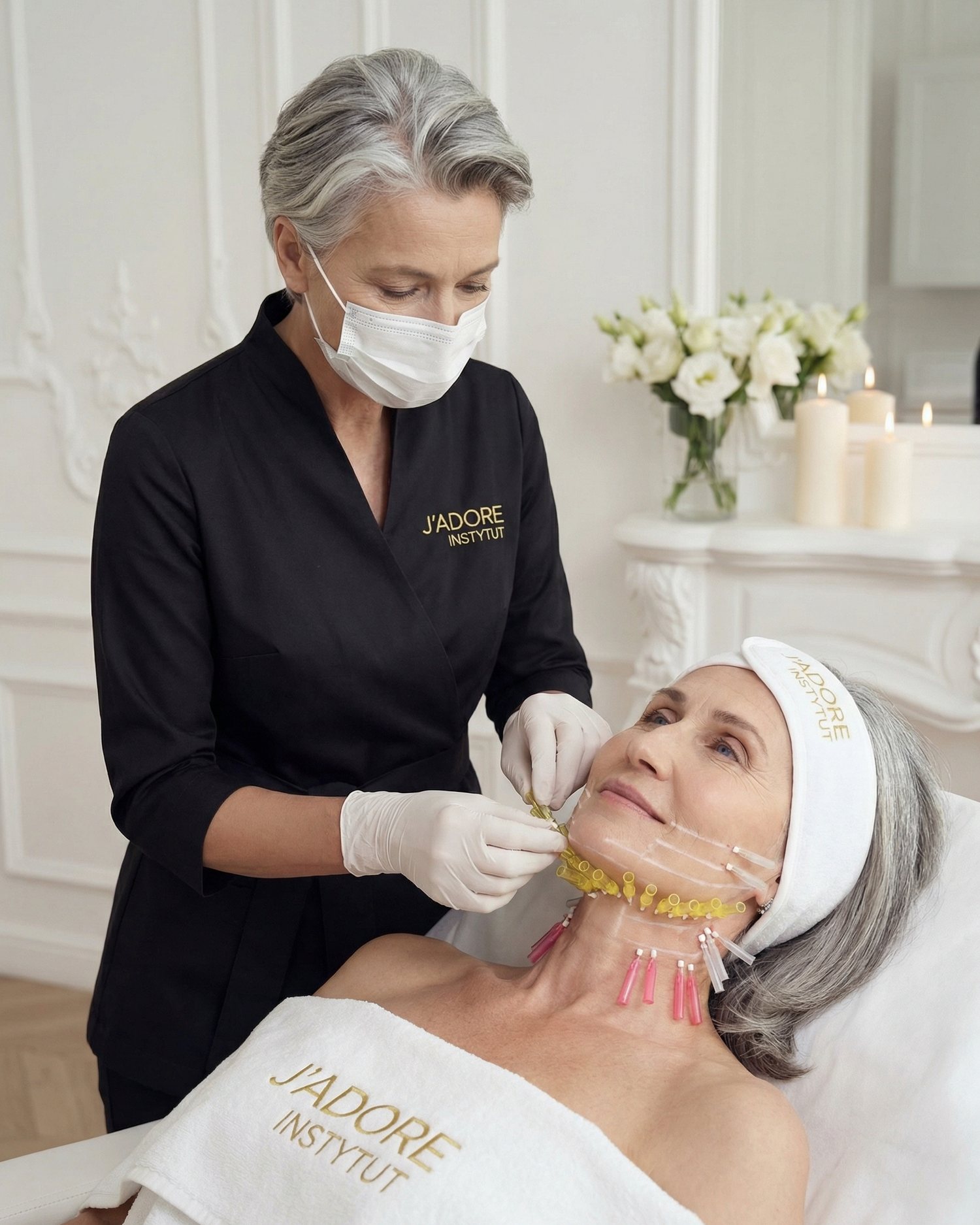
Before anaesthesia, the specialist marks the insertion points and lines on the face, or another area, where the thread mesh will be placed. This is a stage of precision — thread placement determines the final result. Good mapping takes anatomy into account: the course of blood vessels and nerves, and tissue thickness in individual areas.
- 03
Step 3 — Local anaesthesia
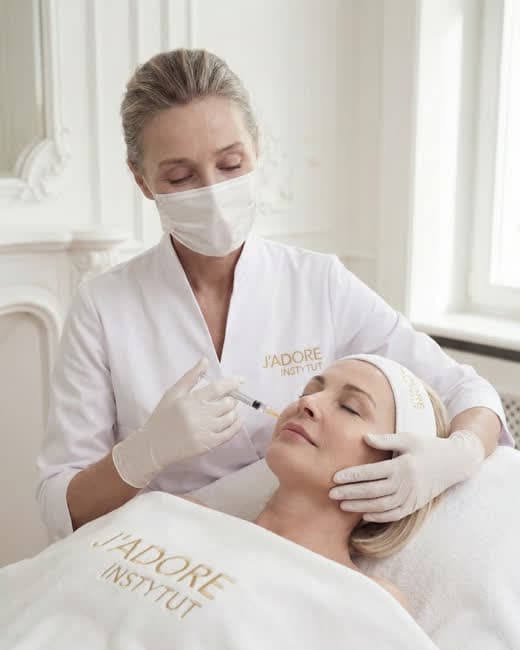
Numbing cream is applied to the marked areas. Just before the treatment, lignocaine is injected into the insertion points. Most people describe the treatment itself as minimally uncomfortable rather than painful. Local anaesthesia is standard — there is no reason to feel pain.
- 04
Step 4 — Thread insertion
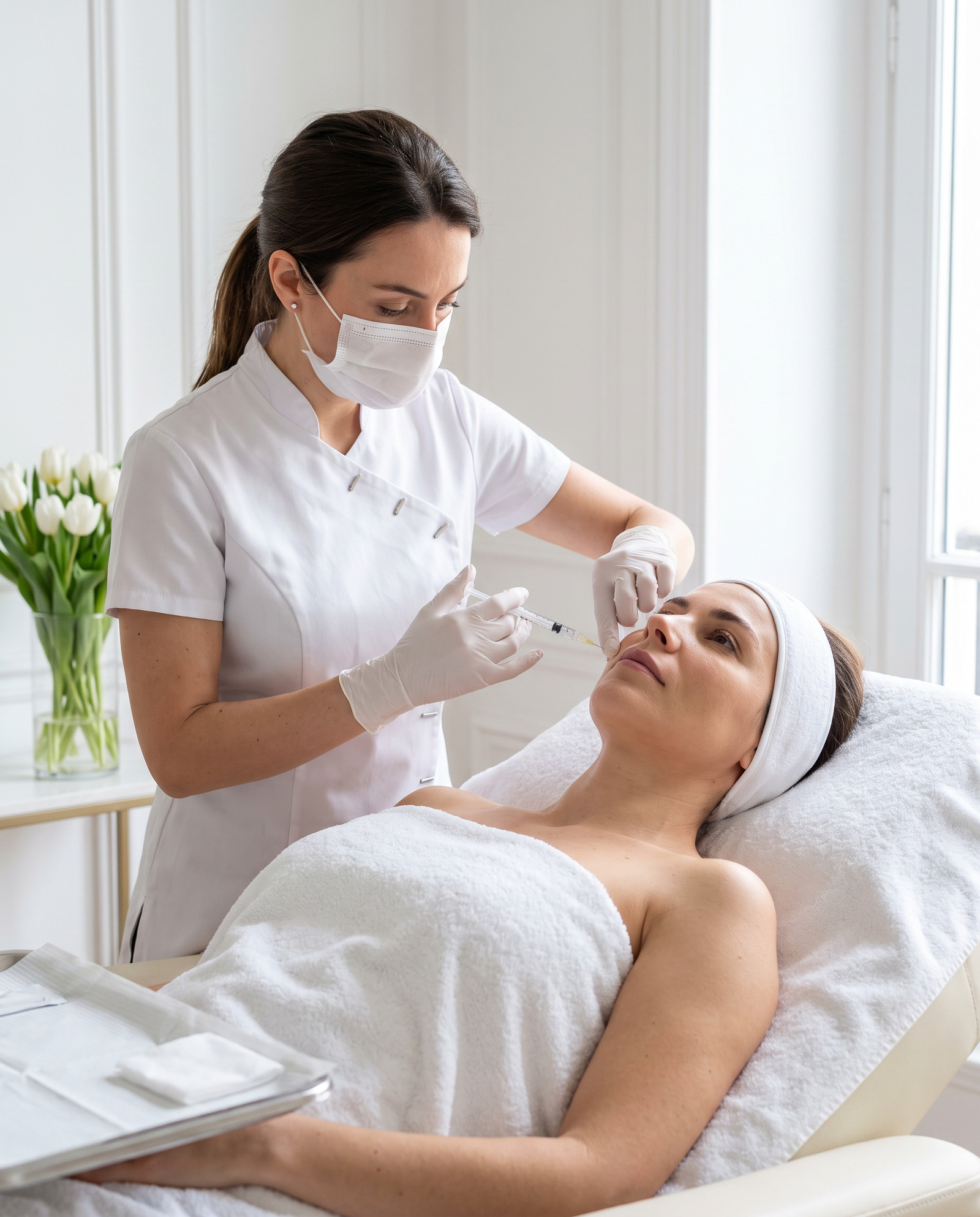
Cannulas, or blunt needles, or sharp needles are inserted through microscopic punctures, depending on the area and the specialist’s preference. The thread is placed in the appropriate tissue layer, usually within or just below the dermis. The procedure is systematic. A facial treatment may involve from several to several dozen threads, arranged in a mesh, lines or crosses — depending on the area and indication.
- 05
Step 5 — Contouring and assessment of the result
Once the threads are in place, the specialist gently contours the tissue. They check symmetry, assess placement and correct any unevenness. This is the point where experience and aesthetic judgement are crucial: a thread placed unevenly produces a different result from the intended one.
- 06
Step 6 — Aftercare and recovery
Swelling and redness appear immediately after the treatment — this is a physiological tissue response, not a complication. The specialist discusses aftercare: avoiding make-up for the first few days, avoiding massage and saunas for several weeks, and sun protection. The stimulating results develop over several months — because building a new collagen mesh takes this long.
What NOT to do — common recovery mistakes
PDO thread treatment is only half the success. The other half is how you behave in the first weeks afterwards. Most complications and disappointment with the result come not from technical errors, but from failing to follow recovery guidelines. Read this list before booking your visit.
One principle brings this whole list together: during the first weeks, less is more. The tissue needs calm to build what you expect from it. Recovery after PDO threads is not dramatic — but neglecting it can have dramatically costly consequences.
When to see a specialist — checklist
PDO threads are a medical treatment, not a cosmetic one — and this is an important distinction to respect. Below is a simple list of situations when it is worth booking a consultation rather than looking for answers on forums.
- You notice a clear loss of firmness in the skin of your face, neck or décolletage — and topical skincare has not produced noticeable results for at least several months.
- You want stimulation of your own collagen, rather than simply restoring volume — this is exactly how PDO threads work.
- You want to combine PDO threads with other treatments, such as hyaluronic acid, PRP or laser treatment — a good specialist will create a plan in which the treatments reinforce one another.
- You have already had treatments with acid or biostimulators and feel that you want “something more” — more structural work with the tissue.
- After a previous thread treatment with another specialist, you have doubts about the result or experience worrying symptoms, such as asymmetry or palpable lumps lasting longer than 4–6 weeks.
A good consultation is not a commitment to treatment — it is an opportunity to assess whether you are a suitable candidate, what you can realistically achieve and how this fits into a broader skin plan. It is worth knowing what is possible before making a decision. At J'adore, we begin with a detailed conversation, without pressure or ready-made packages.