Where the summer peel ban came from — and whether it was justified
The origin of the ban is simple. Deeper acid peels — particularly phenol and high-percentage TCA peels, used for decades — leave the skin in a state of intense regeneration for several days, sometimes longer. Freshly renewed skin, stripped of its epidermal protection, exposed to the sun is a direct route to hyperpigmentation and irritation, which can be difficult to reverse. That's the truth on which the entire "peels only in winter" narrative was built.
The trouble started when this rule began being applied to every peel — including superficial ones, which in their modern form have entirely different safety profiles. Cosmetology has moved on: today there are acids, concentrations and formulations designed for year-round use. A ban that was valid for one category of treatments became a myth covering an entire field.
Six myths — one by one
Myth 1: "No peels at all in summer — that's an absolute rule." The most widespread myth, and the most damaging one. Modern superficial peels — enzymatic peels, mandelic acid, low-percentage AHA, lactobionic acid peels — can be used safely all year round, provided you use proper photoprotection and have your skin individually assessed. The summer restriction mainly applies to deeper treatments that need a long recovery period. Not to all peels.
Myth 2: "After a chemical peel, you can't go out in the sun for a month." This applies to specific, deeper protocols — not to the whole category. Superficial peels done in the salon may only require a few days of extra caution and solid SPF. How long you need to protect your skin after a treatment depends on how deep it works and how your skin reacts individually — and your specialist sets this based on the treatment, not a blanket rule.
Myth 3: "A summer peel means guaranteed hyperpigmentation." Hyperpigmentation after a peel is a possible complication, not a rule — and the risk can be significantly reduced. The key factors are: the type and depth of the peel, your skin phototype, the photoprotection you use, and how your skin is prepared beforehand. For people with darker skin (phototypes III–IV), the risk of post-inflammatory hyperpigmentation is higher regardless of the season — and calls for a different approach to the protocol. For someone with fair skin using SPF50+, the risk from a superficial summer peel can be comparable to the risk in winter.
Myth 4: "You have to stop home acids in summer — AHA serums, retinol, exfoliating peels." This myth does particular harm to people dealing with acne and hyperpigmentation — precisely when their skin needs consistency. Low-concentration acids used regularly all year round, combined with solid daily SPF, don't need to be stopped in summer. The exception is retinol during very intense sun exposure — and even then, the advice tends to be "use it in the evening and wear SPF" rather than "stop until September". If your skin tolerates it well the rest of the year, there's no reason to stop in summer.
Myth 5: "Tanned skin is ready for a peel — it's already exfoliated on its own." The opposite is true. A tan is evidence that your skin actively defended itself against radiation — it produced melanin, may have lost moisture, and its hydrolipidic barrier can be weakened. Skin like this tolerates acids less well, not more. A fresh tan is one of the typical contraindications for a deeper peel — and one reason a pre-treatment consultation matters, even if you've had a peel before.
Myth 6: "Summer peels are only shallow acids — anything deeper is pointless." In summer, we do work differently — choosing acids with a lower pigmentation risk (mandelic, lactic, lactobionic acid) and often preferring formulas with a higher pH and shorter contact time. But that doesn't mean the results are weak. A well-chosen series of treatments over summer can even out skin tone, improve hydration, control oiliness, and prepare the skin for more active autumn treatments. Deeper doesn't necessarily mean better — consistency and the right acid choice often achieve more.
When a summer peel REALLY makes sense — and what to choose
If you're considering a peel in summer, a few questions help establish whether it's the right moment. First of all: what's your phototype, and how has your skin reacted to previous treatments? Someone with fair skin, no tendency towards pigmentation, and consistent SPF use has a completely different risk profile from someone with phototype IV and a history of PIH from inflamed acne.
Fine in summer — with good SPF
Low-risk treatments in summer
- Enzymatic peels (papain, bromelain)
- Mandelic acid — low concentrations
- Lactic acid — hydrating and exfoliating
- Lactobionic acid — gentle, antioxidant
- Low-percentage AHA/PHA in creams and serums
In summer — better to wait
Treatments requiring a longer protection period
- Deeper TCA peels (higher concentrations)
- Combined peels with retinol and AHA
- Treatments requiring several days of recovery
- Treatments for people with phototype III–IV and a history of PIH
SPF after a peel — why "I use a cream with SPF" isn't enough
Sun protection after a peel is a topic where mistakes are most common. "I have a cream with SPF" isn't enough — what matters is exactly what's in that cream, how much you apply, and how often you reapply it.
- SPF50+ with a mineral or broad-spectrum filter (UVA+UVB) — not SPF15 in a foundation or BB cream
- Amount: a teaspoon for the face and neck — most people apply about a quarter of that, which gives an actual SPF far lower than what's stated
- Reapply every 2 hours if you're active outdoors — a filter doesn't work all day without reapplication
- Avoiding peak UV hours (roughly 10am–3pm) right after your treatment — even with sunscreen on
- Hats and clothing as a supplement, not a substitute
Summer as a time to prepare your skin for autumn
There's another perspective that few people mention. Instead of treating summer as "a season without treatments", you can treat it as a time to actively prepare your skin for more intensive treatments in September and October. Well-chosen superficial peels in summer — strengthening the barrier, evening out skin tone, regulating sebum — mean your skin will respond better to deeper protocols in autumn. A regular series of gentle treatments often gives better results than one intensive session "after the season".
What to establish before a summer peel
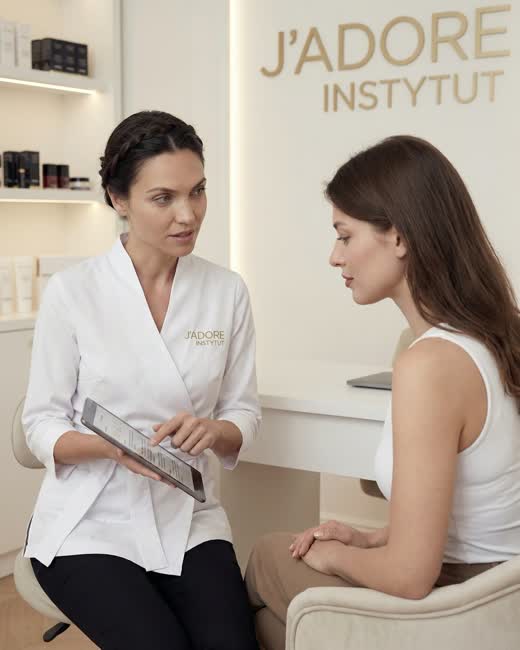
A good consultation before a summer peel should cover a few specific questions. What's your phototype? — that's the first and most important piece of information. What does your July look like? — a week sailing in Mazury carries different risk from an office job with a daily bus commute. What are you using on your skin? — acids, retinol, dermatological medication all change the safety profile. And finally: what do you want to achieve? — because the answer determines whether a summer peel is the right tool for the job, or whether a different treatment would work better.
- 01
Consultation
Assessment of your phototype, skin history, products you use, and planned sun exposure. The protocol is chosen to suit the season.
- 02
Skin preparation
An optional preparation phase using low-concentration acid creams or depigmenting agents — a few days before a deeper treatment.
- 03
Treatment
A peel chosen to suit the summer profile: an acid with low pigmentation risk, the right pH, contact time calibrated to your skin.
- 04
Aftercare
Specific instructions: what to apply, which SPF, when you can wear makeup, when to come back for your next visit. Not a general rule, but a plan for you.
Summer isn't the enemy of chemical peels. It's the enemy of chemical peels without a plan — without a skin assessment, the right acid, and proper photoprotection. With these three elements in place, many people use salon treatments all year round without complications. And that's the point: it's not "can I or can't I", it's "how and when".