Where hyperpigmentation comes from — and why SPF isn't just an "extra"
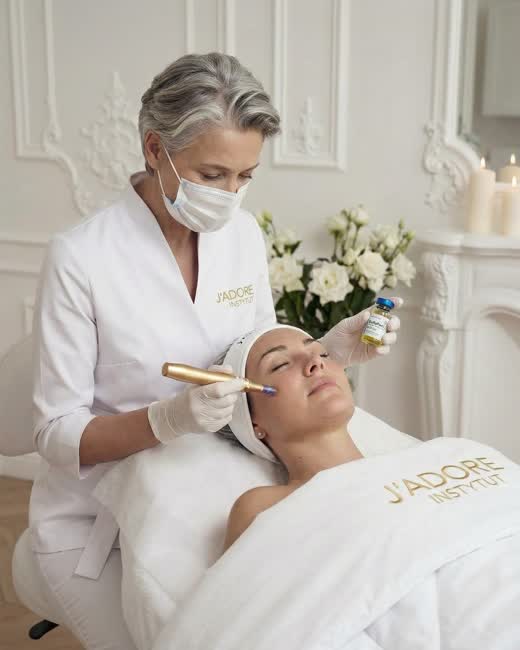
Melanin is a pigment your skin produces as a defence response — to UV radiation, to inflammation, to micro-injury. More triggers mean more melanin, and a darker mark. A depigmentation treatment — whether a chemical peel, laser, needle mesotherapy with melanin inhibitors, or a complex salon protocol — works on several levels: it exfoliates overpigmented cells, inhibits the tyrosinase enzyme responsible for melanin synthesis, and slows the transport of pigment to the skin's surface.
The result is visible — skin lightens, the mark fades, tone evens out. But after treatment your skin is in an especially vulnerable state: the stratum corneum is partially removed or thinned, protective barriers are weakened, and melanocytes will spring straight back into action under any UV exposure. SPF here isn't a "care tip" — it's the mechanism that protects your result. Without it, you can complete the treatment, but you can't keep the effect.
Six myths that undo depigmentation results
Myth 1: "SPF is only needed in summer, at the beach." UVA radiation — the type responsible for hyperpigmentation and photoageing — passes through clouds and through glass. It's active all year round, including in December, during a short walk through town, and even in the car. The difference between summer and winter concerns UVB intensity (the type responsible for sunburn), but UVA stays constant and invisible all year. After a depigmentation treatment, there's no "safe season" for skipping SPF.
Myth 2: "I have darker skin — this doesn't apply to me." This is one of the most dangerous myths. People with darker skin tones (Fitzpatrick phototypes III–V) have more active melanocytes, which react faster and more intensely. Melasma and post-inflammatory hyperpigmentation affect darker skin far more often than lighter skin. After depigmentation, weakened skin with high pigmentation potential creates ideal conditions for recurrence — often stronger than the original mark.
Myth 3: "Everyday powder with SPF is enough." Powder with SPF, foundation with SPF, even BB cream with a filter — all these products contain UV filters, but the layer applied as makeup can't be compared to a dedicated SPF cream. For powder to deliver the protection it claims, you'd need to apply far more than you would in everyday use. In practice, foundation with SPF 30 applied each morning protects at a level closer to SPF single digits or low teens. After a depigmentation treatment, that's nowhere near enough.
Myth 4: "Skin gets used to it — the more sun, the less sensitive it becomes." The opposite is true. Skin after depigmentation is more reactive, not less. Chemical peels, lasers, mechanical exfoliation — each of these treatments removes the protective layer, which takes several weeks to rebuild. During this time, every UV exposure reaches deeper, into freshly exposed cells. There's no such thing as "toughening up skin after treatment" — only growing risk of recurring hyperpigmentation and inflammation.
Myth 5: "One good filter is enough — a daily moisturiser with SPF." A moisturiser with SPF is a good product for everyday care — but after a depigmentation treatment, your UV protection needs are different. A moisturiser with SPF is designed primarily to hydrate; the filter is a supporting ingredient, not the main one. Its formula and proportions differ from dedicated photoprotective products. After treatment, you need something designed with UV protection as its primary function — not a product that protects "as well".
Myth 6: "After two weeks the result settles and I can go back into the sun normally." Epidermal healing after treatment takes 7–14 days — but melanocyte sensitivity lasts far longer. For many people prone to hyperpigmentation (melasma, post-inflammatory hyperpigmentation), the state of heightened reactivity lasts several months after each treatment. Specialists recommend strict photoprotection for at least 4–8 weeks, and for those with melasma — all year round, regardless of season. Two weeks is the absolute minimum, not the end of the regimen.
What protection after depigmentation should really look like — without the myths
Instead of a product list — a few rules that genuinely affect how long results last. First: apply SPF as the last step of your morning routine — don't mix it with serum, and don't apply it before your makeup base. A filter works as a layer on the skin; mixing or diluting it reduces its properties. Second: reapply your SPF. Even the best mineral filter wears off within a few hours. On longer days out, refresh protection every 2–3 hours. That's not overkill after treatment — it's the standard.
- 01
First 48–72 hours
Avoid sun entirely — skin is irritated and its protective barriers are damaged right after treatment. Don't leave the house without SPF 50+; a hat is essential for any longer outing.
- 02
1–2 weeks after treatment
Apply a dedicated SPF 50+ broad-spectrum filter (UVA + UVB) every day. Avoid intense sun exposure even when it's cloudy. Powder with SPF is a supplement, not a substitute.
- 03
3–8 weeks after treatment
Daily photoprotection, no exceptions — at home by the window, in the car, on short walks. This matters especially if you're prone to melasma or have a darker skin phototype.
- 04
Long term
Make SPF a permanent habit, not just something for after treatments. For skin with a history of melasma or post-inflammatory hyperpigmentation — strict protection all year round, with no "summer break".
Heat and infrared — the less obvious melasma triggers
There's another factor that gets far less attention than UV — heat. People with melasma increasingly hear about so-called heat-induced hyperpigmentation from specialists — a phenomenon where high temperature (sauna, hot baths, intense exercise in the heat, infrared from warming devices) can trigger melanin production independently of UV radiation. This explains why some people see their hyperpigmentation worsen in summer even with strict SPF use.
In practice, this means that in the first weeks after a depigmentation treatment, it's worth limiting not only sun exposure, but also saunas, hot showers on the face and intense outdoor training in full sun. This isn't excessive caution — it's a clinical observation worth bearing in mind, especially for skin with a history of melasma.
Two different experiences — women and men after depigmentation
In Poland, the stereotypical image of "someone having depigmentation" is still a woman — but hyperpigmentation is a problem that increasingly brings men into the salon too. In women, depigmentation most often addresses melasma (linked to hormones, pregnancy, contraception) and sun-induced hyperpigmentation. Skin tends to be thinner, often more reactive, and while home care can be intensive, it doesn't always include dedicated photoprotection. This is exactly where the "makeup with SPF is enough" myth lives on.
In men, the story is different: hyperpigmentation often results from chronic sun exposure (outdoor sport, working outdoors), post-acne marks, or micro-injuries from shaving. Men use fewer products, so SPF — when it appears at all — is often the only step in their routine. The good news: that makes it easier to build as a habit. The bad news: myths in this group tend to run deeper — "SPF is for women", "I'll sort myself out in summer" are lines heard regularly in the salon. And after a depigmentation treatment in men, the recurrence mechanism works exactly the same way as in women — UV makes no distinction.
Before you leave the salon after depigmentation — what to ask
Every depigmentation treatment leaves skin in a different state — it depends on the type of treatment, its depth of action, your phototype and your history of hyperpigmentation. So instead of one protocol for everyone, it's worth leaving the salon with clear answers to a few questions. How long should I follow a strict photoprotection regimen? For some, four weeks is enough; for others — with melasma — the standard is all year round. Are there active ingredients I should avoid? Retinoids, acids, vitamin C at certain concentrations — some can irritate skin right after treatment. What type of filter does your specialist recommend? Mineral or chemical, SPF 30 or 50+, in what formula — this is a question worth asking rather than guessing.