Why men's skin has a tougher problem than they think
Men's skin is thicker than women's and produces more sebum — which slows visible ageing on one hand, but on the other means pores clog faster. The moustache and beard area is a constant inflammatory zone if you shave regularly. Pressing a blade against your skin every day causes micro-injuries. Without proper recovery, these show up as roughness, redness and ingrown hairs. Add dust, exhaust fumes and time spent in air-conditioned spaces, and skin turns grey and loses its radiance.
Most men respond with a harsher cleanser — or don't respond at all. Neither strategy works long-term. A chemical peel works differently: instead of scrubbing, it loosens the bonds between dead cells and lets them shed naturally, opening the skin up to regeneration. The result isn't "airbrushed photo" smoothness — it's simply skin in better condition.
What the mandelic peel does — the mechanism, without the marketing jargon
Mandelic acid belongs to the AHA family (alpha-hydroxy acids). It's one of the gentler members of that family — mainly because its larger molecule penetrates the skin more slowly and evenly. That means it works effectively without the sharp reactions that can occur with harsher peels. For skin regularly exposed to shaving and daily irritation, that's a real advantage.
- Removes dead epidermal cells — not by scrubbing, but by loosening the bonds between them: skin feels smoother and more even straight away.
- Unclogs pores — excess sebum and impurities are released from pores, which often reduces visible blackheads and T-zone dullness.
- Evens out skin tone — it stimulates cell renewal; for many people, grey, tired skin gains radiance after a single session.
- Smooths post-shave irregularities — AHA peels have a beneficial effect on skin prone to ingrown hairs and minor razor-related redness.
- Has antibacterial properties — mandelic acid has properties that may help limit the bacteria responsible for acne and inflammation.
Hibiscus in the formula isn't just decoration. Hibiscus extract contains natural fruit acids and powerful antioxidants that support hydration and protect skin from oxidative stress. Combined with mandelic acid, it delivers exfoliation and regeneration in a single step — without the dryness that can result from chemical peels used incorrectly.
Salon peel vs home peel — where the difference lies
Salon peel
professional treatment
- Concentration tailored to your skin — assessed by a cosmetologist
- Full control over exposure time and neutralisation
- Can be combined with other steps (mask, serum, mesotherapy)
- Visible immediately, no adjustment period
Home peel (OTC)
daily care
- Low concentrations, safe for self-application
- Good maintenance routine between visits
- Available over the counter at pharmacies and drugstores
In the salon, your cosmetologist assesses your skin before the treatment: type, thickness, current condition, tendency to irritation. Based on this, they select the acid concentration and exposure time — different for oily skin with enlarged pores than for dehydrated skin prone to dryness. Self-applied "peeling" at home is a different tool. It's useful as a routine, but it doesn't offer comparable depth or precision.
What the treatment involves — zero surprises
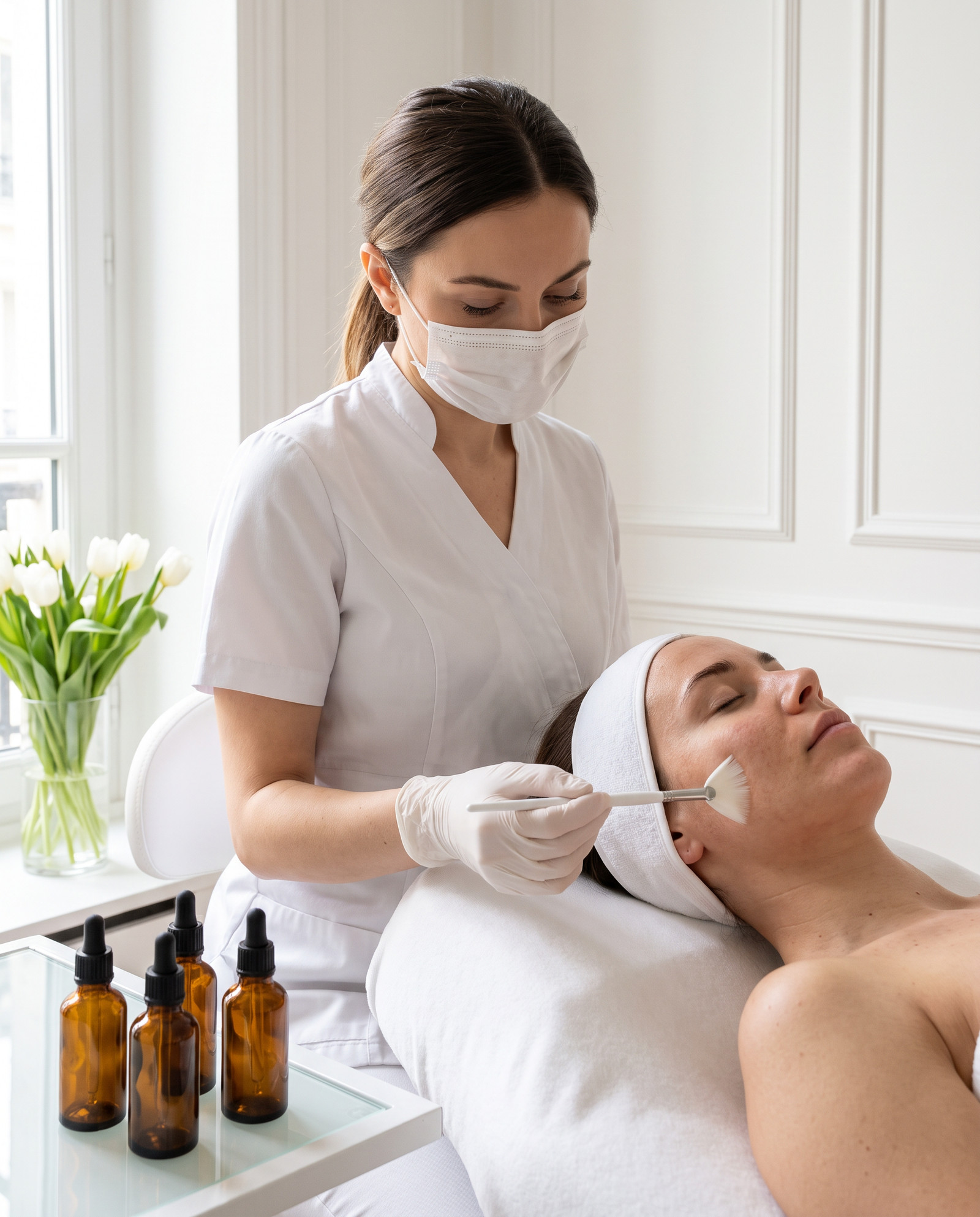
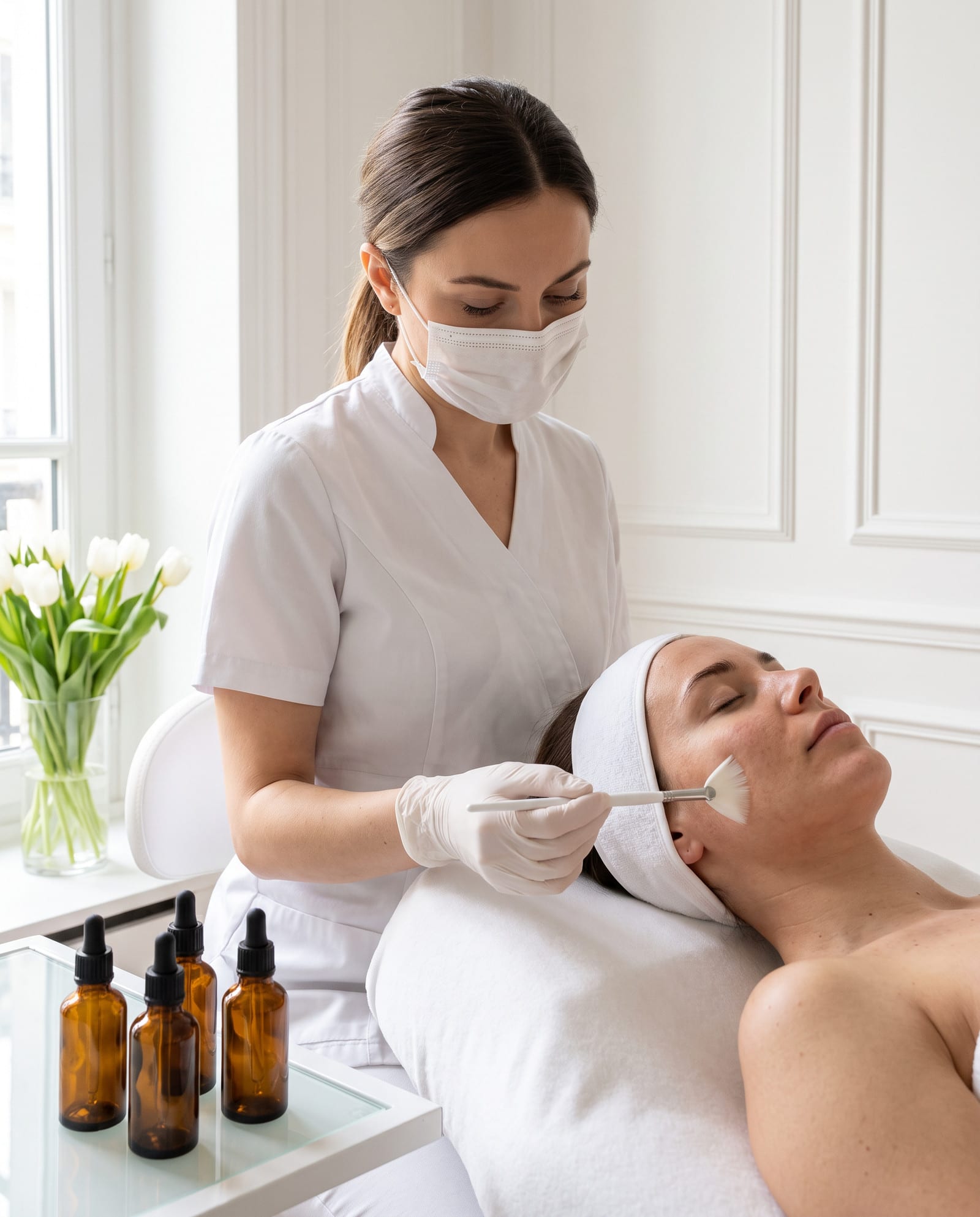
No drama, no pain, no visible change to how you look walking out of the salon — and that's exactly the point. The cosmetologist cleanses your skin, applies the mandelic acid and hibiscus formula, leaves it on for a set time, neutralises it, and finishes with a hydrating mask or serum. The whole thing takes a matter of minutes. You may feel a slight tingling during application — a normal reaction to the acid — which passes quickly after neutralisation.
- 01
Cleansing
Your cosmetologist removes sebum and impurities so the acid can work evenly — not through a layer of dust.
- 02
Acid application
The formula is applied to the face; exposure time is chosen based on your skin's condition.
- 03
Neutralisation
The acid is neutralised — skin returns to its proper pH, ending the exfoliation process in a controlled way.
- 04
Nourishment and soothing
A mask or serum with hydrating and soothing ingredients closes the treatment and reduces any redness.
After the treatment, skin may be slightly red for an hour or two — that's normal. Visible physical peeling (i.e. flaking skin) isn't standard with a mandelic peel; if it appears at all, it's subtle and passes quickly. Most people go straight back to their day after leaving the salon.
When it's worth it — and when it isn't
The mandelic peel works well in specific situations, but it isn't the answer to everything. Consider it when:
- Your skin is grey, dull and lacking radiance — especially after winter or a period of intense stress
- You shave regularly and struggle with roughness, ingrown hairs or minor razor-related redness
- Your skin is oily or combination, with visible pores and a tendency towards blackheads
- You want a fresher look but are concerned about prolonged peeling — for example before an important meeting or event
- You want to refresh your look without any treatment that leaves visible traces
When it's better to wait or skip it: active inflammatory breakouts (your cosmetologist may suggest a different protocol in this case), recent sunburn, a compromised skin barrier from overly aggressive home skincare. Each of these can be assessed during a short consultation — and that's exactly the moment to ask, not guess.
Combine with — options for those who want more
The mandelic peel pairs well with other treatments — either as a preparatory step or as part of a series. If you want to address a specific concern more thoroughly, a combination is worth considering.
Ultrasonic cleansing
Combining the peel with ultrasonic cleansing (sonophoresis or spatula) deepens the effect: the acid loosens, and the ultrasound mechanically clears sebum residue from pores. Good for oily skin with visible blackheads.
Needle-free mesotherapy
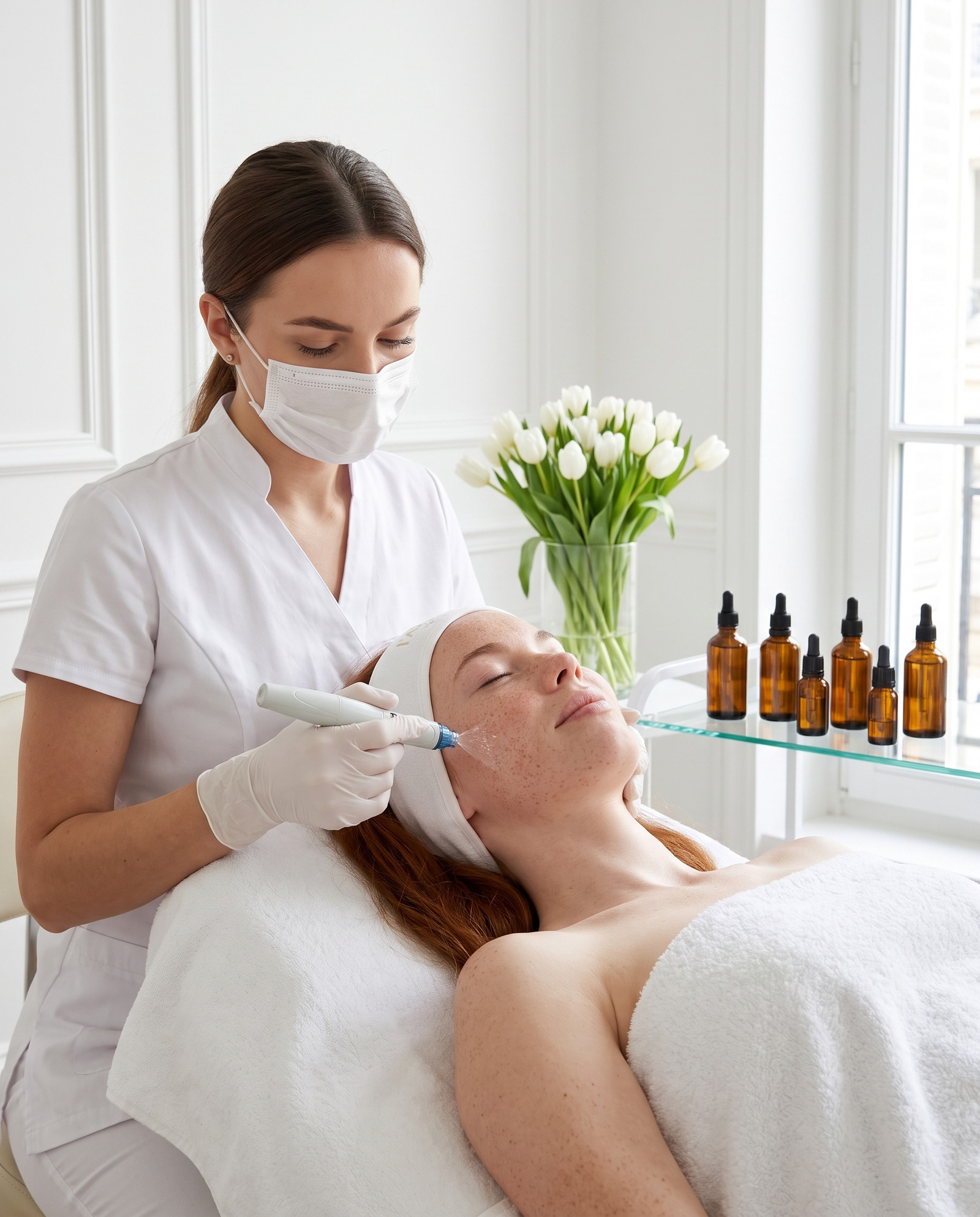
After the peel, the skin barrier is more permeable — a good moment to deliver hydrating or brightening active ingredients. The hydration effect is then deeper.
Hibiscus enzyme mask
As a finishing step — it soothes any redness and provides intensive hydration. A good option for dehydrated skin, or after an intense autumn-winter season.
Series of 3–4 sessions
A single peel gives a result — a series gives a change. For grey, tired skin or skin prone to clogged pores, a series spaced a few weeks apart often brings a lasting evening-out and refreshing effect that persists well after the series ends.
One summary sentence — no sugar-coating
The mandelic peel with hibiscus isn't a dramatic "anti-ageing" treatment. It's a reset — clearing away what's built up and opening the door to regeneration. It works on skin the way a good night's sleep works on how you feel: it doesn't change the fundamentals, but it noticeably improves what you see.