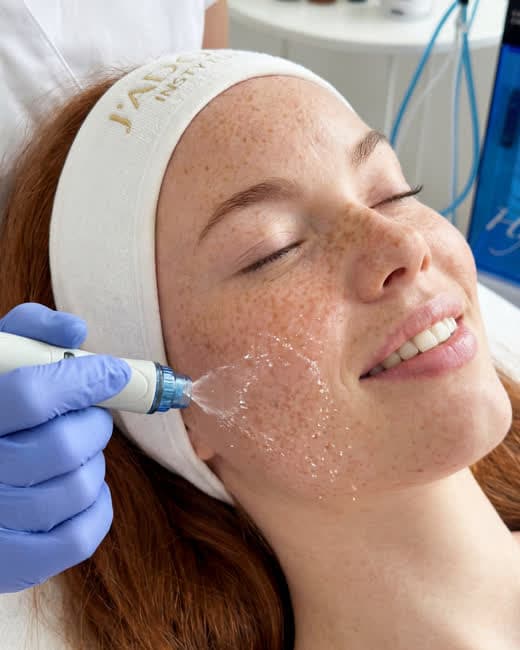
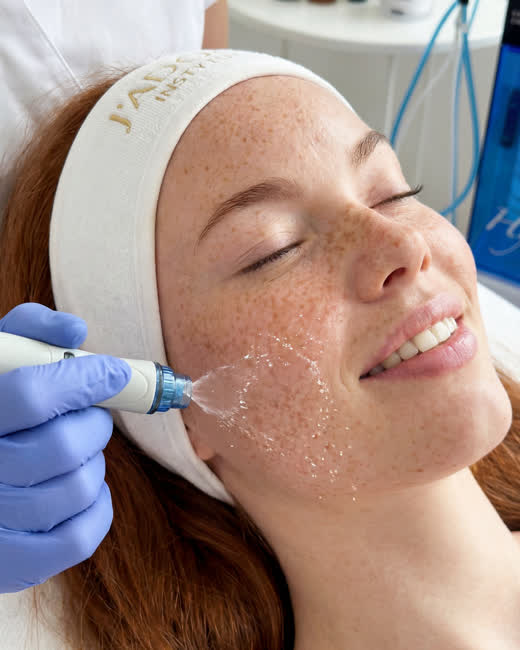
What a peel does — and where its reach ends
A peel works through controlled exfoliation. Its main job is to remove dead cells from the skin's surface — the epidermis — and speed up the natural cell renewal cycle, which slows down noticeably with age. Young skin replaces epidermal cells efficiently and regularly. Older or tired skin does this more slowly, leading to a dull tone, uneven texture and a feeling of "thick" skin.
Depending on the substance used and its concentration, a peel can work purely on the surface — gently smoothing texture and brightening tone — or reach deeper, into the layers of the dermis. Deeper peels often address hyperpigmentation, shallow acne scars or early signs of ageing. But even the deepest-acting acid has a limit: it works on the existing structure of the skin. It doesn't stimulate the skin to build a new one.
This is where an important observation comes from: after a peel, skin often looks noticeably better — smoother, brighter, more even. But that's the effect of revealing fresh cells, not building new structure. When the problem sits deeper than the epidermis — in firm scars, deeper pigmentation, loosened collagen — a peel alone hits a wall. That's where microneedling takes over.
How microneedling works — the mechanism from within
Microneedling operates on a completely different logic to a peel. Instead of exfoliating from the outside, it creates very fine micro-injuries in the skin — hundreds of small, controlled punctures that the skin needs to heal. The whole mechanism lies in that healing process. The body reads these micro-injuries as a damage signal and launches a repair cascade: cell migration, and production of collagen, elastin and other structural proteins.
In other words: microneedling doesn't repair the skin directly — it forces the skin to repair itself. That's a fundamental difference. Instead of supplying ready-made building material from outside, it sends a signal: "there's damage here, rebuilding is needed." The body's response is natural — and that's exactly why the results can be lasting, not temporary.
- 01
Micro-injuries
Needles create tiny channels in the skin — a signal the body reads as damage that needs repair.
- 02
Repair cascade
The body activates healing mechanisms: an influx of repair cells, the release of growth factors, and increased fibroblast activity.
- 03
Collagen production
Fibroblasts produce new collagen and elastin — over the weeks and months following the treatment, not immediately after.
- 04
Structural remodelling
Skin becomes denser, firmer and better hydrated from within. The effect builds gradually and can keep developing for several months.
Microneedling works particularly well where the problem is the quality and density of the tissue itself: acne scars, stretch marks, lax or thin skin, and the early stage of losing firmness. For these conditions, exfoliation alone changes nothing, because the problem doesn't lie in the dead cells on the surface — it lies deeper in the structure.
Why combining both methods can be stronger than either alone
Since a peel works from the outside and microneedling from within, a logical question follows: can you combine them? Yes — and in many cases, combining them genuinely strengthens the results of both methods. But the key is understanding why — and for whom.
Peel alone
exfoliation from the outside
- Removes dead epidermal cells
- Evens out surface tone and texture
- Works quickly — the result is visible once exfoliation happens
- Good for: dull skin, uneven tone, prevention
Peel + microneedling
combining two logics
- A refined surface plus stimulated regeneration from within
- The channels created by the needles make it easier for active ingredients to penetrate
- A dual-track approach: surface tone and texture plus tissue quality at depth
- Good for: scars, hyperpigmentation combined with loss of density, ageing skin
One of the main benefits of combining both is the "open door" effect: microneedling creates channels in the skin that allow active ingredients to penetrate deeper than surface application alone. Serum with vitamin C, hyaluronic acid or growth factors, applied right after microneedling, has a much shorter path to the layers where it really works. This means not only the treatment itself, but also the products used during it, can work more effectively.
When it's worth adding the needle — and when the acid alone is enough
Not every skin type needs microneedling. And not every problem justifies a deeper intervention when a peel can solve it efficiently and simply. It's worth understanding when to reach for the extra tool — and when the simpler option is enough.
- Acne scars (atrophic) — one of the classic cases where a peel alone rarely suffices. An atrophic scar is a loss of tissue deep in the skin, not a surface problem. Microneedling stimulates collagen rebuilding — a peel can't replace that.
- Lax or thin skin — when the skin has lost density and firmness, and the problem isn't just on the surface. Exfoliated skin alone will still be lax. Microneedling stimulates the skin to become denser from within.
- Deeper, stubborn hyperpigmentation — a good peel can address shallow epidermal pigmentation. But when pigmentation sits deeper, or keeps returning after exfoliation alone, combining it with microneedling can help brightening ingredients penetrate to where the pigment has actually settled.
- Early signs of ageing with loss of firmness — when tone is still good, but the skin has "lost its bounce." Here a peel maintains surface quality, while microneedling works on the scaffolding underneath.
- Prevention and general skin quality — for people without a specific problem to solve, but who want to invest in long-term skin condition, combining both methods can deliver results that exfoliation alone won't provide.
There's one more important aspect: the condition of the skin at the time of the treatment. Active atopic skin, active inflammation, certain dermatoses or medications you're taking may rule out one or both treatments — or require a different protocol. That's why a conversation with a specialist before the treatment isn't a formality. It's a real step that protects you from unnecessary irritation.

What to feel — and what to expect after the treatment
With a peel-only exfoliation, results appear faster: skin looks smoother and brighter almost immediately after the treatment, and over the following days as exfoliation continues. When microneedling is combined with the peel, the deeper, visible results take longer to appear — a few weeks — and the full effect of collagen remodelling can arrive after several months. Patience here isn't optional; it's built into the mechanism of the treatment.
Treatments worth considering
Depending on what matters most to you — surface exfoliation, deeper stimulation, or a combination of both — the salon offers various protocols. Below are treatments that fit both logics described in this article.
Peel + collagen stimulation
For smoothing texture and improving skin density at the same time — a protocol combining both mechanisms in one session.
Series of stimulating treatments
For scars, laxity or maintaining results over time — a series, rather than a single session, delivers lasting changes in skin structure.
Preparatory peel
If the skin needs its texture evened out before deeper stimulation — a peel as the first step before microneedling.