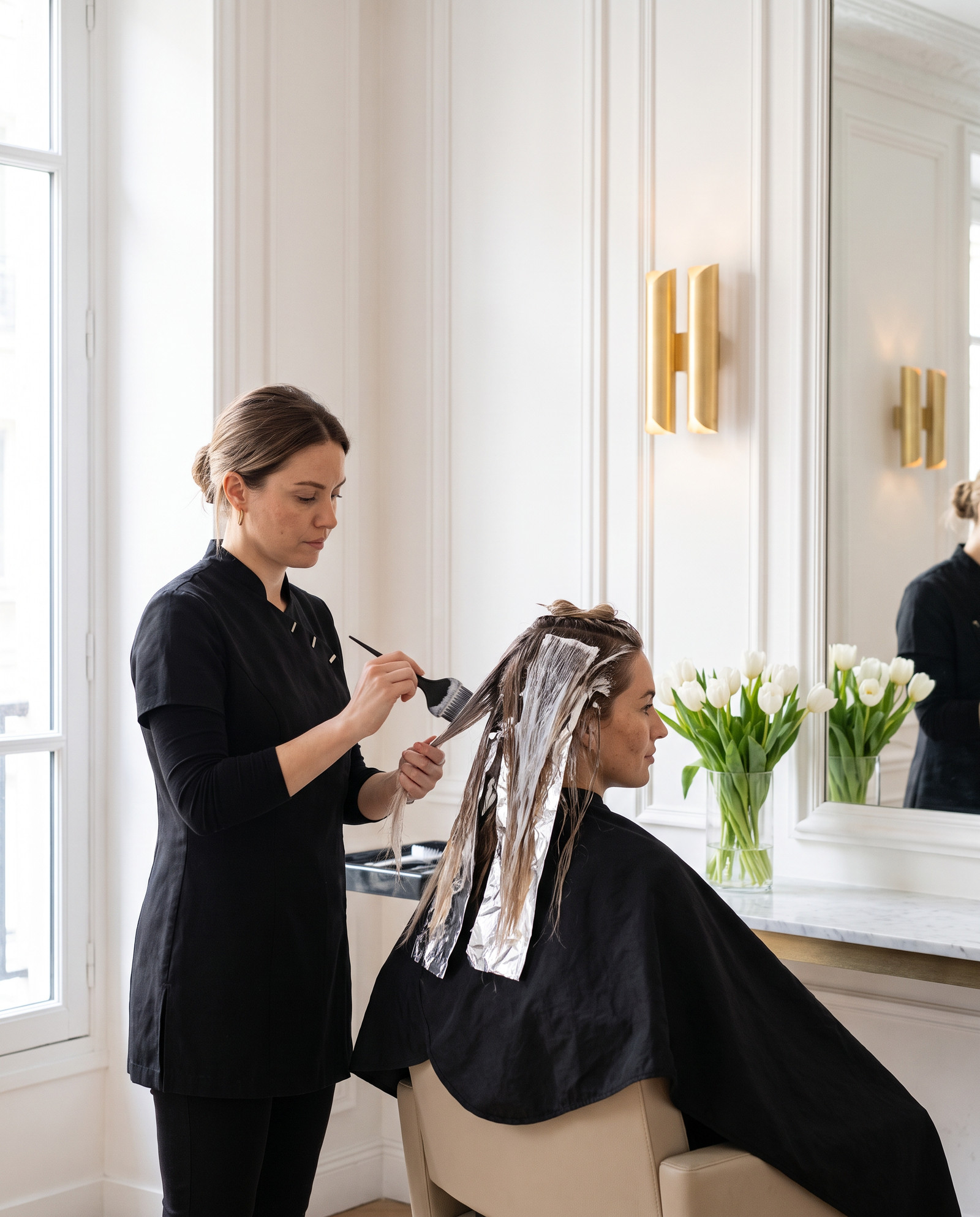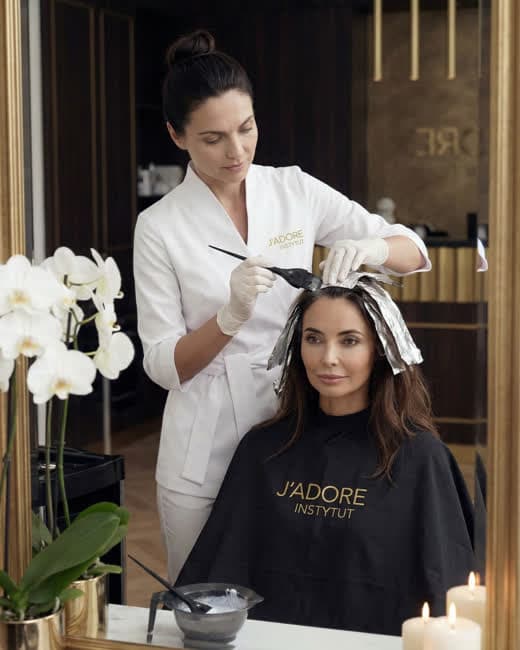
The stylist should determine if the problem really concerns damaged bonds
Hair can look similar for different reasons. Dullness can be the result of a raised cuticle, hard water deposits, product overload or chemical weakening of the cortex. Frizz can result from a natural curl, not damage. If every answer is "OLAPLEX", the salon is skipping the stage that determines the point of the service.
During the consultation, the history of lightening, perms, chemical straightening, the frequency of high-temperature styling and the behaviour of a wet strand are what matter. Excessive elasticity without returning to shape, crumbling and differences between the roots and the length help to determine the type of damage. The assessment should cover several zones, as the ends may require cutting while the middle part is still suitable for strengthening.
The condition of the scalp can also change the visit, although OLAPLEX works on the hair fibre. Weeping lesions, fresh abrasions, increased itching or a reaction to dye require caution and sometimes a dermatological consultation. A hairdressing treatment should not mask a skin problem or delay a diagnosis.
Ask whether you are booking a standalone treatment or an add-on to colouring
The official professional system includes concentrated salon products used in stages. The first can be part of a standalone treatment or used during a chemical process, and the next completes the professional scheme. These are different services in terms of purpose, time and material consumption. The phrase "OLAPLEX for dye" should not be presented as a full regeneration performed separately.
Standalone treatment
a separate visit for weakened lengths
- diagnosis of condition without parallel colour change
- professional stages performed according to the brand's scheme
- possibility to assess the reaction without the influence of a lightener
- a plan for further care and potential trimming
Add-on to a chemical service
protection and support during colouring
- the product works in the context of dye or lightening
- the procedure depends on the entire colouring recipe
- the result includes colour, condition and styling
- it is not automatically the same number of stages
Before booking, ask for a clear name of the variant. This way, you will not compare a short add-on with an extensive service as two identical items. The salon should also tell you if washing, drying and styling are part of the visit or separate elements.
Also ask if the service includes only professional products or if the stylist plans to finish it with a home-use cosmetic from the brand. A home-use stage is not a flaw if it plays a conditioning role and is named as such. The problem starts when a retail product is presented as an equivalent to a concentrated salon treatment.
The original product must remain recognisable even at the station
- Manufacturer's warnings. OLAPLEX expressly warns against using products from unreliable sources, counterfeits, diluted preparations, and those sold in unlabelled containers.
- Reliable sources. The brand recommends purchasing products from trusted sources rather than from random offers.
- Transparency principle. For the client, this means a simple rule: the professional formula used during the treatment must be fully identifiable.
Do not expect the stylist to open a new full bottle for one person. Salon products are dispensed from professional packaging. However, you have the right to see a clear name, product number and the condition of the packaging. A hand-signed bottle without the possibility of indicating the source does not provide the same transparency.
Check the product's origin before the expiry date, not when the product is already on the hair. Ask the salon where it sources its professional line, and request an invoice or batch number. A retail receipt from a random marketplace does not give the same certainty of origin.
A strand test is more important than the promise of an immediate glass-like finish
- Verification of hair behaviour. With very weakened strands, the test allows you to check the reaction to wetting, application of the preparation, gentle detangling and drying.
- Risk limitation. Although this is not a laboratory proof, this method protects against handling the whole head too aggressively during the treatment.
- Analysis of boundaries. The contact points between the repeatedly lightened length and the less damaged roots require special attention.
The visual effect immediately after styling is the weakest criterion. Even a severely damaged strand can look smooth after being stretched on a brush and having a silicone serum applied. Better questions are: does the wet hair return to its shape, does it break less during brushing and how does it behave after the first wash at home?
After home lightening, the strand at the temple stretches when wet and does not return to its original shape immediately, while the hair at the back of the head remains resilient. A uniform protocol for the entire length would ignore this difference. The stylist separates the zones, refrains from further lightening on the weakest fragment and explains which ends require trimming despite the bonding treatment. This is what a diagnosis at the station looks like: it leads to a change in the scope of work, not just to an impressive photo of a wet strand.
The trial should not consist of pulling out a hair or repeatedly stretching it until it breaks. A sparing assessment of a selected fragment and observation in the context of the planned service is sufficient. If the salon uses the test mainly as a spectacle, ask for an explanation of what decision depends on it.
The way of washing and detangling reveals the standard of work
Wet, lightened hair is susceptible to stretching and mechanical damage. Tugging with a brush can add breakage regardless of the quality of the preparation. Observe whether the stylist separates the strands, starts detangling from the ends and controls the resistance instead of pulling tangles from the roots.
Even saturation also matters. The product should not land symbolically on the surface or drip from the hair without control. Dividing into sections helps to reach different parts of the length. For very thick or long hair, the amount of material and working time increase, which is why the salon should know the length before confirming the booking.
A good consultation separates reconstruction from hydration and smoothing
A bond builder, emollient mask, protein treatment and smoothing treatment are not interchangeable names for the same care. OLAPLEX focuses its communication on bonds inside the hair. This does not exclude the use of a conditioner or serum, but their surface effects should not be attributed solely to bond reconstruction.
- Rough but resilient hair may primarily need an improvement in surface conditioning.
- A gummy strand after lightening provides a stronger argument for a bonding treatment and limiting chemicals.
- A split end or a white spot at the point of breakage requires trimming, because the missing part cannot be glued back on.
- Natural frizz of a curl is not a bond failure and should not be promised as a problem to be removed.
- Mineral deposits may require proper cleansing before the actual porosity is assessed.
A salon earns trust when it can suggest a different service or refrain from one. Selling OLAPLEX as a mask for every type of dryness blurs the mechanism and makes it difficult to assess the result.
A colouring plan must account for what the hair can no longer withstand.
Adding a bond builder to lightener does not make any colour change safe. The product may limit some damage and support the fibre, but it does not negate the importance of chemical history, processing time, developer strength or applying lightener to previously lightened sections.
If your goal is a very bright blonde from a dark, repeatedly dyed base, a good stylist will discuss the stages and an acceptable compromise. They may suggest test strands, a smaller change, several visits or even decline the service. The statement "you can lighten anything with OLAPLEX" is a red flag, as it shifts responsibility from technique to product.
Agreement on changing the scope is also important. If it turns out during the process that only part of the hair can be safely lightened, the stylist should stop and present a new result, timeframe and cost. A bond builder does not authorise continuing a process that you did not agree to after the conditions changed.
Home care recommendations should not turn your visit into a mandatory shopping basket.
A professional treatment can be supported by home care, but you should know which products are necessary for hygiene and protection, and which remain optional. The salon may recommend gentle washing, a conditioner matched to your porosity, thermal protection and limiting temperature without forcing an entire line from one brand.
Changing the habit that constantly damages your hair is more important than the number of bottles. If your ends touch a very hot plate every day, and lightening is repeated on the same sections, a home product alone will not maintain the result. The stylist should point out temperature and technique as areas for adjustment without moralising.
Ask them to write down the order and frequency, especially if you already have protein and deep-cleansing products. Adding them all at once can increase stiffness or dryness and make assessment difficult. A good recommendation also states what not to use for a while and what signal should prompt a change in the plan.
Red flags are visible before the first drop of the preparation.
- No questions about lightening, dyeing, perms or daily temperature.
- A promise to glue split ends together without the need for cutting.
- Unlabelled packaging and a refusal to provide a professional product variant.
- A claim that OLAPLEX straightens hair or permanently seals the cuticle.
- The same procedure for healthy regrowth and gummy, lightened lengths.
- Intensive tugging of a wet strand to shorten detangling time.
- A promise of a safe transition to any blonde thanks to one additive.
- A package of many treatments sold before checking the hair's first response.
One organisational imperfection does not have to disqualify a salon, but signals regarding authenticity, diagnosis and handling fragile hair go to the heart of the service. If you feel pressure, you can end the consultation before the application.
Another red flag is publishing a transformation without consent or pressure to reveal your face in exchange for a promotion. A portfolio can be built anonymously and after obtaining clear approval. You should know where the photo will go, whether it will be sponsored and whether you can choose the service without your image being used.
Evaluate portfolio photos by looking at the hair before styling.
The most useful materials show similar light, the same frame and the condition after simple drying, not just after styling. Ask whether the photograph represents an independent OLAPLEX treatment, an additive to colouring, a haircut, a toner or styling. Several actions can produce a beautiful finish, but you must not attribute it to just one.
Look for cases similar in chemical history, not just colour. A natural, thick brown after one colouring is not the right reference point for a thin blonde that has been lightened for years. Even a real photo will not predict the result if the starting material is different.
Ask for a photo before styling even when the salon documents your case. It will make it easier to compare the next visit and separate the fibre's behaviour from the brush work. A photograph after natural drying may look less spectacular, but it better shows frizz, ends and irregularities resulting from chemical history.
In Krakow, choose a salon based on the answers to eleven questions.
You can find a description of the local service on the OLAPLEX regeneration in Krakow page. Before your appointment, send a current photo of your hair length in daylight and describe your recent chemical processes. This makes booking the right amount of time easier, but it does not replace an on-site assessment of the strands.
For your consultation, come to Karmelicka 45/2B, 31-128 Krakow. The salon is open Mon–Sat 8–20; for a major colour change, also book a relaxed journey home, without squashing freshly styled hair under a hat or planning another service in a hurry.
- Does my hair indicate a problem that a bond builder is intended for?
- Does the booking include an independent treatment or a product added to colouring?
- What professional stages will be performed during this variant?
- Can I see the original packaging used at the station?
- How will you assess the differences between the regrowth, mid-lengths and ends?
- Will you perform a test on a limited strand for fragile parts?
- What can OLAPLEX improve, and what can it no longer reverse in my hair?
- Is it necessary to trim the ends before further lightening?
- How will you distinguish the effect of the treatment from styling and finishing serum?
- Which home recommendations are crucial, and which remain optional?
- What will you change if the hair does not react according to the plan after the first visit?
The answers do not have to be long. However, they should create a coherent story from diagnosis through product to verification at home. The best salon will not promise to save the entire length; it will indicate which part can be strengthened, which must be protected from further chemistry, and which should be honestly trimmed.
After the consultation, give yourself a moment to decide, especially when OLAPLEX is to accompany a major colour change. You do not have to accept lightening in the same minute you learn about the fragility of your strands. You can choose just the treatment, a test, a haircut or postpone the chemistry entirely. A salon that respects this pause treats consent as a process, not a formality.
Keep your recommendation card and take your own photo without styling after the first wash. At the next assessment, it will be clear whether the hair breaks less or if the drying method has simply changed. Verification based on the same light, routine and brushing technique protects you from buying your next visit solely for temporary shine.