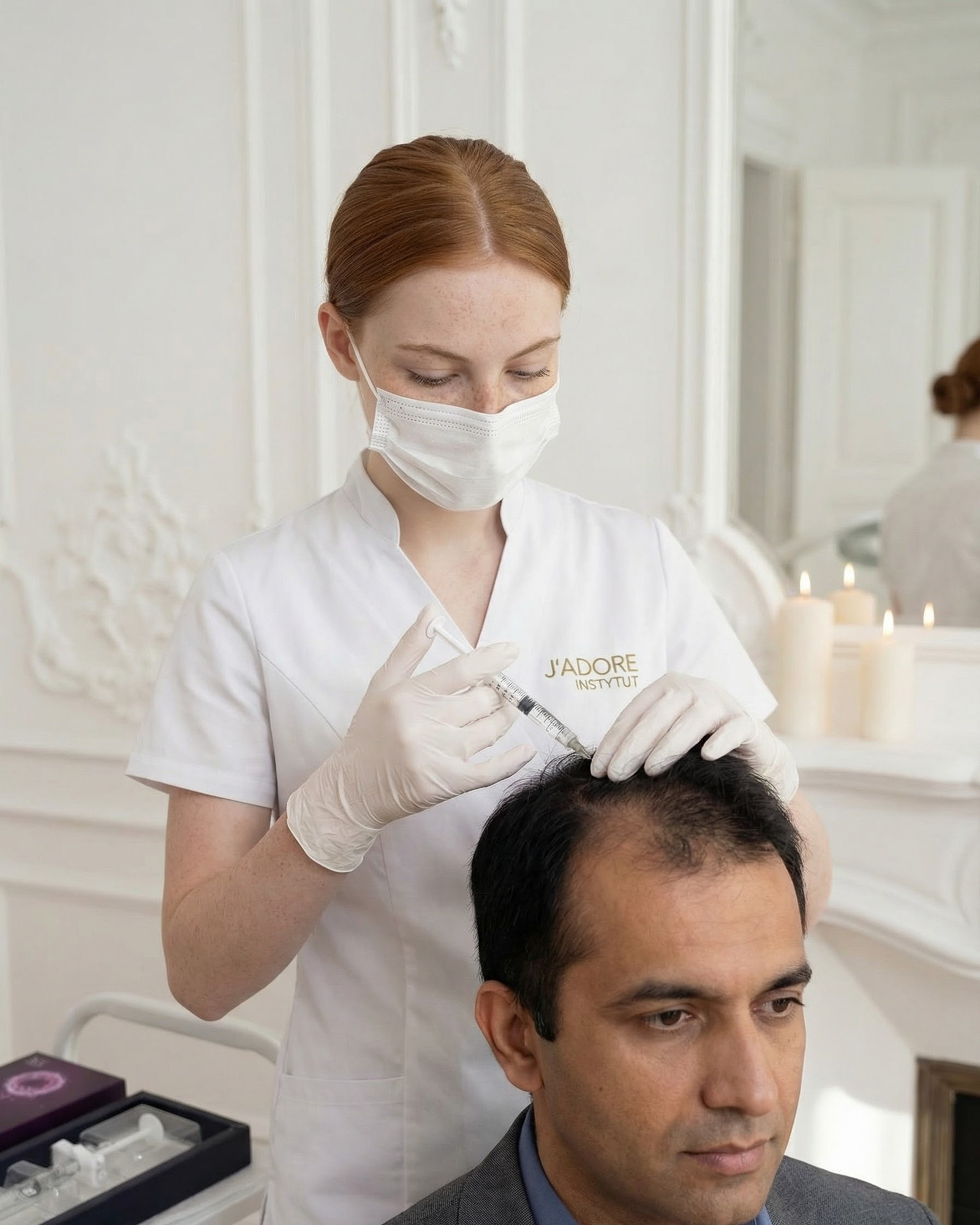

Hair from within — the structure few people consider when washing their hair
Before we go further, it is worth pausing on one fact that changes the whole picture: hair is dead. What grew from the hair follicle and eventually reached a length of several or several dozen centimetres is not alive. It cannot regenerate or repair damage on its own. Only the hair follicle is alive — hidden beneath the skin and beyond the reach of any conditioner or treatment applied to the hair shaft.
The hair shaft itself is made up of layers — rather like a tree cross-section. The outer layer is the cuticle — made up of overlapping scales, like roof tiles. When they lie flat and tightly together, hair looks smooth and reflects light — creating the shine we know. Beneath the cuticle lies the cortex, the main body of the hair. Its protein bonds provide shape, colour and strength. Deeper still, thicker hairs may contain a medulla — often hollow and contributing little to the shaft’s mechanical properties.
- Cuticle — the outer protection. When damaged, hair tangles easily, becomes dull and loses moisture.
- Cortex — provides hair with strength and elasticity. This is where damage from bleaching, perms and overheating occurs.
- Medulla — found mainly in thick hair; it does not determine its condition in everyday wear.
Why hair becomes damaged — and where the problem really lies
Hair is damaged in several ways at once — and rarely for one reason alone. Bleaching or colouring is the most common factor, but it is only part of the story. Daily heat styling, aggressive brushing of wet hair, hard water, UV radiation, nutritional deficiencies and hormonal fluctuations — each of these factors acts at a different level and leaves a different mark.
Cuticle damage
visible on the surface
- Dullness and roughness to the touch
- Easy tangling and frizz
- No shine even after washing
- Rapid moisture loss
Cortex damage
deeper, less visible
- Hair that alternates between feeling “gummy” and brittle
- It stretches too much or breaks when pulled
- Colour “does not hold” or fades quickly
- It is difficult to maintain the shape of the hairstyle
The key observation is this: different types of damage require different tools. A smoothing treatment can work very well on the cuticle, but it will not rebuild the protein structure of the cortex. A moisturising mask will replenish moisture, but it will not “seal” broken keratin disulphide bonds. Each method has its own reach — and that reach is limited. This is why an action plan rarely ends with one session.
What one treatment can really do — and what it cannot
Let us say it directly, without downplaying it: one good treatment has real value. It can smooth the cuticle, temporarily fill keratin losses, improve hydration and make hair easier to manage. The result is visible, tangible and worthwhile. The problem begins when we expect it to last — or to change the deeper structure.
In other words, one treatment is an excellent start or a valuable part of the process — but it is rarely a process in itself. Understanding this difference saves frustration and money. It is not that further visits are solely for the salon’s profit. Hair, as a structure, follows the rules of accumulation rather than quick repairs.
Why lasting change requires a series — the logic of accumulation
One mechanism explains almost everything: hair does not regenerate, it grows. This is a fundamental difference. Skin can regenerate in the same area after a treatment. Hair cannot — a damaged shaft remains damaged until new hair grows in. Treatments work on the existing material while creating better conditions for the hair that is yet to grow.
- 01
Assessment and reset
The first series — an assessment of porosity, cuticle condition and cortex damage. Initial replenishment of losses, evening out porosity and restoring smoothness as a starting point.
- 02
Structural reconstruction
Further visits focus on the cortex — protein reconstruction treatments and work on the hair shaft’s elasticity and strength. This is where the main “repair” of what already exists takes place.
- 03
Hydration and sealing
Once the structure is stable, we protect it with hydration and by closing the cuticle. Hair stops losing water so quickly and maintains the result between visits.
- 04
Maintenance and new growth
Regular “maintenance” of the existing length, combined with creating optimal conditions for healthy regrowth. Visits are less frequent at this stage, but consistency still matters.
This logic is similar to rehabilitating a muscle after an injury — one physiotherapy session will not restore full function. Biological change requires time, repetition and a method tailored to the current condition. This does not mean being dependent on the salon forever. It means that structural change has its own natural timeframe, which cannot be reduced to one visit.
The role of the hair follicle — the work you cannot see
There is one hero in this story that often remains in the background: the hair follicle. It is the only living part of the whole system — and it determines what hair will grow. Shaft thickness, growth rate, density and tendency to shed are all managed by the follicle and its environment: scalp microcirculation, hormonal balance, nutrient availability and tissue inflammation.
This is why some hair concerns — especially weakening, thinning or slow growth — cannot be resolved at the hair shaft level, because the problem lies deeper. Treatments applied to the hair work with material that already exists. Treatments focused on the scalp and follicle work on what is yet to come. Both are important, but they concern different things and are not interchangeable.

How to approach a treatment plan — where to start
If one sentence from this text stays with you, let it be this: different hair concerns require different solutions at different levels — and a good treatment plan recognises this instead of giving every hair type the same set of treatments.
Before planning a series of visits, it is worth answering a few diagnostic questions. Not to prescribe a treatment for yourself. Instead, it helps you arrive at your first consultation with a clear picture of the situation, rather than describing the concern simply as “damaged”.
- When did the problem begin? — a sudden increase in hair loss after severe stress and long-term weakening have different causes.
- What do you do to your hair every day? — styling heat, washing frequency, water hardness and chemical treatments such as colouring, bleaching or perming.
- How does your hair behave after washing? — does it quickly become dull, frizzy or dry despite conditioning? This indicates the condition of the cuticle and its porosity.
- How does it react to water? — does it become wet immediately or repel water for a long time? This is an indicator of porosity.
- Has your general health context changed? — diet, medication, hormones, thyroid function or stress. Hair is often the first sign that something is changing internally.
Combining treatments — why they can do more together
Some people achieve a good result after a treatment, only to quickly return to their previous condition. They may benefit from combinations — treatments that work at several levels at once: the cuticle, cortex and scalp. This is not the right approach for every situation or every hair type. However, for specific concerns, such as hair that is weakened, porous and shedding at the same time, it may shorten the time to a noticeable change.
Keratin filling + scalp treatment
This combines work on the hair shaft — smoothing and restoring the cuticle — with follicle care. It is particularly suitable for hair loss intensified by stress or incorrect scalp hydration.
Protein conditioner + hydration in a series
Protein rebuilds the strength of the cortex, while hydration maintains elasticity — together, they deliver results without brittleness. Used alternately or in appropriate proportions.
Trichological treatment + home plan
A follicle treatment supports the growth environment. Without tailored care between visits, however, the result is much weaker. A home ritual is a “maintenance dose” between sessions.