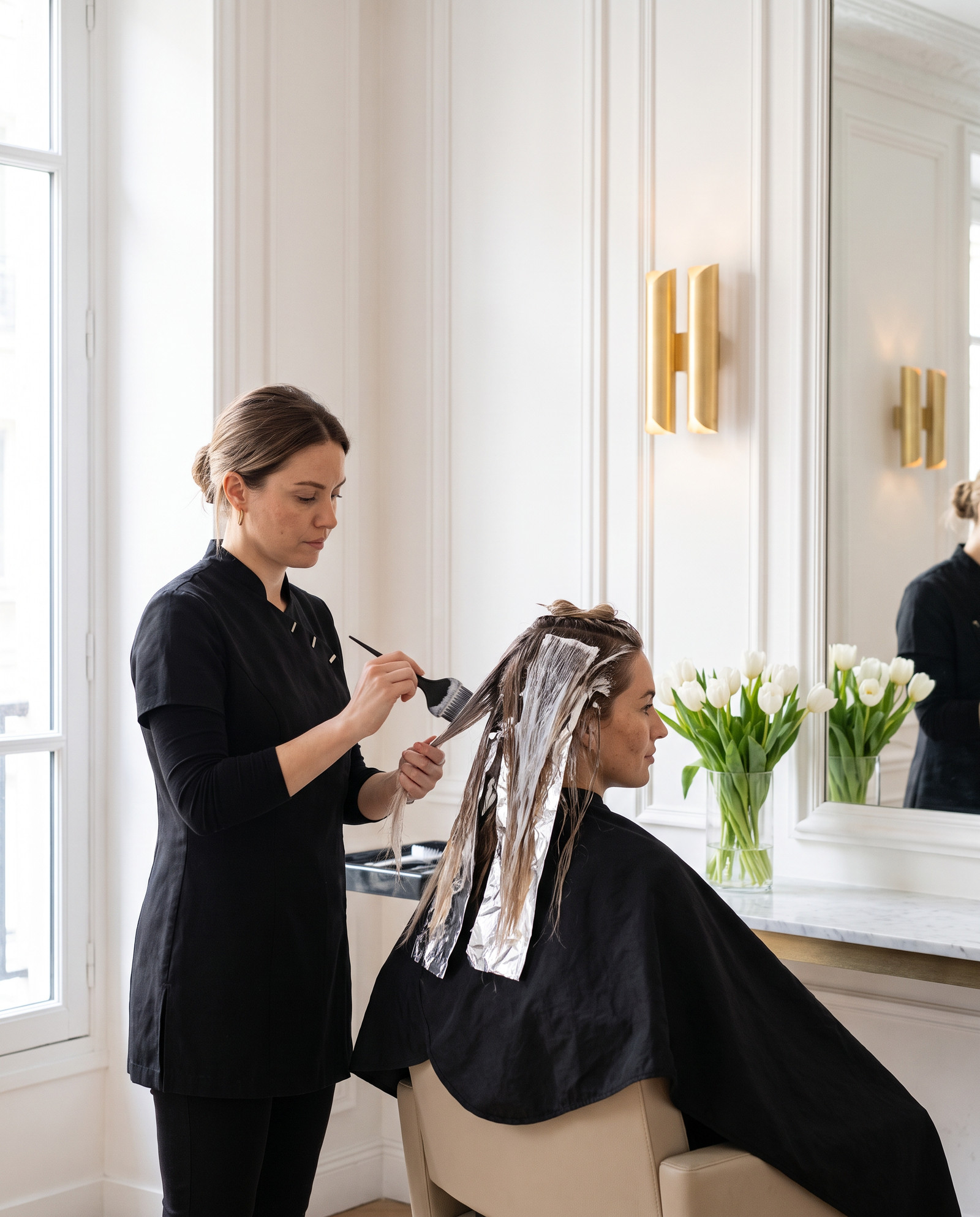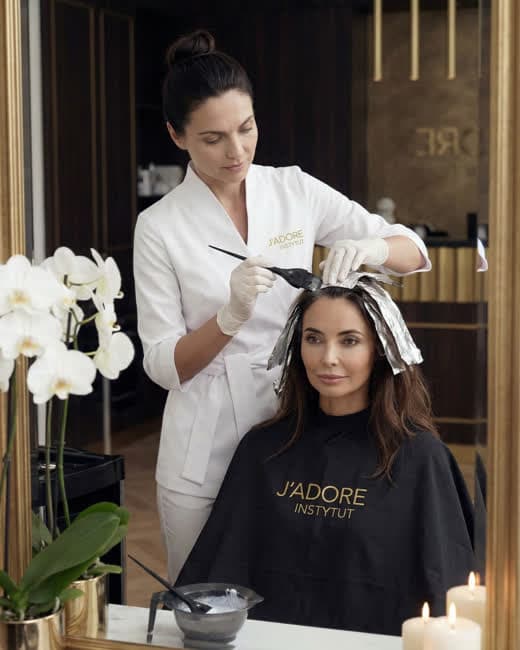
The first difference in pricing stems from what the salon calls OLAPLEX.
A professional salon system can function as a standalone treatment or as support for a chemical service. There are also home-care products and shorter treatments using a selected stage. Each option has different consumption, time, and purpose. A shared brand does not create a single standard item.
Ask the salon to break down the booking in simple language: what will be used before washing, during the chemical process, and after it; whether the application includes the professional two-part system; whether the service is standalone; what happens after rinsing. Without this, you might confuse a protective add-on with a full regeneration visit.
Narrower variant
part of a larger service
- product included in the colouring process
- shorter time dedicated exclusively to a specific stage
- cost calculated alongside dye, toner, and styling
- result assessed together with the entire chemical process
Extended variant
separate plan for the condition of the lengths
- analysis of several zones and damage history
- full sequence of the professional treatment
- washing, careful detangling, and assessment after drying
- recommendations regarding subsequent chemical services
Also, check if the visit includes a consultation before washing. When a booking is automatically treated as an approved treatment, the salon has no space to change the decision after assessing the hair. The time dedicated to diagnosis is not empty waiting; it can prevent you from spending money on a treatment your strands do not need.
Promotional names, such as "molecular reconstruction with OLAPLEX", may combine several brands or stages. Ask to separate the brand ingredients from the salon's proprietary add-ons. This lets you see if you are paying for the professional brand system, an additional mask, an ampoule, or primarily for the ritual and styling.
Length is not enough to calculate the product quantity.
- Ponytail circumference and density. Shoulder-length hair can be thin and sparse or very dense, which directly affects the amount of preparation used.
- Structure and porosity. Curly and porous hair requires a different amount of work during sectioning than straight strands.
- Hair condition. It is not just the length that counts, but also the degree of tangling and the differences in the state of individual hair sections, which determine the treatment time.
An honest salon may ask for photos of the hair from the back, side, and after separating the strands. An initial quote may still be adjusted after seeing them in person. However, a change should not appear at the checkout without your consent. The stylist should explain before application why the density or the condition of the lengths requires a different variant.
Some salons use length thresholds, others provide a price after consultation, and some combine both methods. No model is inherently dishonest. Transparency means you know the calculation method before application and can refuse if the final scope differs from what was assumed.
Chemical history affects the difficulty of the service more than the colour visible today.
- Hidden hair history. Uniform brown often masks past lightening, the use of box dyes, toners, and subsequent darkening of the strands.
- Differentiated structure. Despite a consistent external appearance, hair along its entire length has zones of varying chemical strength.
- Importance of diagnosis. Conducting a thorough diagnosis and a strand test is time-consuming, but it allows you to limit the risk of an incorrect assessment of the hair condition and further damage.
If OLAPLEX is part of a new colouring, the cost of the entire visit depends primarily on the target colour, the amount of lightener, the number of techniques, toning, and time. Do not attribute the difference to the bond builder alone. Ask for a separate indication of what is a colouring service and what is an element of structure protection.
If you do not remember the product names, provide approximate dates and show photos after subsequent changes. Hiding home dye for fear of judgement can lead to a bad calculation of the process. A professional conversation is not for shaming; the stylist needs information so as not to apply more chemicals blindly.
Originality and proper storage are the boundary where it does not pay to save.
The manufacturer warns that products from unreliable sources may be counterfeit, old, damaged or diluted. It also points out that professional formulas are not sold as anonymous samples with a handwritten label. A lower cost obtained through an unreliable source is not an equivalent offer.
At the salon, ask to see the packaging from which the product is dispensed. You do not have to receive a new bottle or a purchase invoice number, but the brand and the professional stage should remain legible. The team also has a duty to ensure closure, date, and storage conditions in accordance with the instructions.
- A bonding mixture of another brand sold under the name OLAPLEX is incomparable.
- Dilution that increases the number of clients changes the way the product is used.
- Decanting into a nameless bottle removes the possibility of verification.
- A very low rate combined with avoiding questions about the source requires caution.
- Authenticity does not guarantee good technique, but it is a condition for assessing the service.
The price of professional material also includes technological losses. A portion prepared for a bowl cannot return to the packaging, even if part was unused. Safe dosing and hygiene generate a cost that is not visible on the finished hairstyle.
You are also paying for work that prevents new damage.
The treatment is not performed by the molecule alone. The stylist divides the hair into sections, ensures even saturation, controls delicate areas, detangles wet lengths, and chooses the drying method. Each of these steps can protect a strand or weaken it. Brushing with force and very hot air can take away part of the point of regeneration.
Experience should be visible in decisions, not in a prestigious title. The person performing recognises the moment when the ends require cutting, refuses further lightening, and does not confuse natural curl with damage. If a higher price does not include diagnosis or time for careful work, the reputation alone does not fill the difference.
The remuneration of the person performing also includes responsibility for refusal. An experienced stylist may end the plan at the consultation stage when hair is breaking or the scalp has active lesions. An offer based solely on product consumption would reward execution at any cost; a professional service also pays for a protective decision.
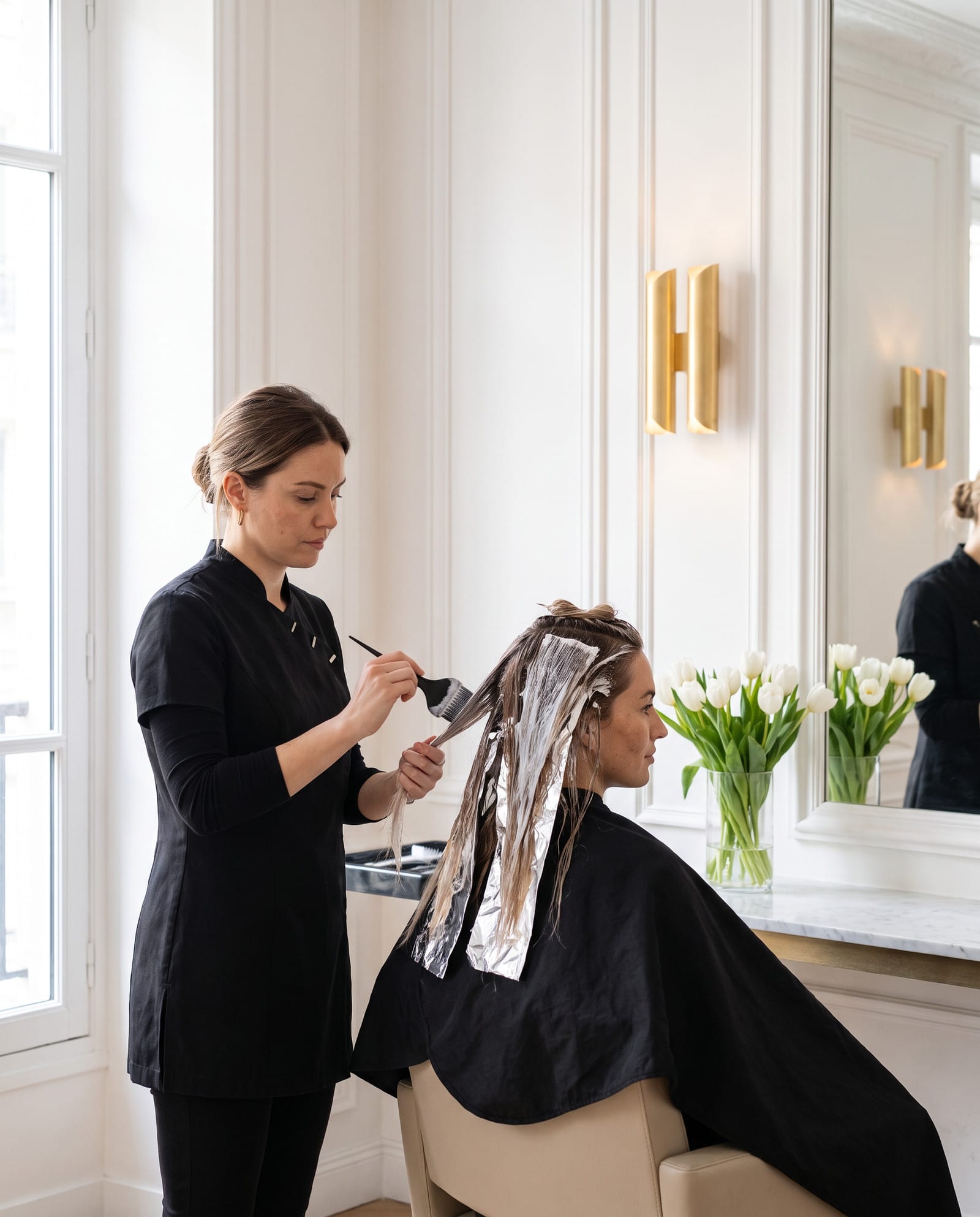
Styling, cutting, and home products can be included or separate.
- Technical drying. After the treatment, the hair must be dried to assess its behaviour, but full styling with a brush is not always included in the basic variant.
- Additional services. Trimming split ends, a toner, or a conditioning ampoule can be separate items in the price list.
- Scope verification. Ask for a breakdown of services before starting, as the package name does not always specify which elements are mandatory.
You send the same photo of your hair to two salons. The first response includes a treatment, a significant trim, a blow-dry, and a home-care set. The second describes washing, a professional bonding variant, basic drying, and recommendations. You cannot immediately assume the difference in the final bill is a difference in OLAPLEX quality. First, remove the extras you do not need. Then, compare the amount of product, the treatment steps, and the work performed on wet hair. Only such a common scope shows whether one offer is truly more expensive.
Home-care products are sometimes suggested for maintenance, but they do not have to be included in the bill. Ask if you can use your own gentle shampoo, conditioner, and heat protection. The recommendation should suit your hair, not assume you need to replace your entire bathroom cabinet.
A series package only makes sense after assessing how your hair responds the first time.
Highly bleached lengths may need more than one visit, but it is impossible to honestly determine the entire cycle based solely on a photo. After the first treatment, we check elasticity, brittleness, susceptibility to tangling, and behaviour after home washing. Only then do we know whether to repeat the same variant, change the interval, or focus on protection against further chemicals.
Before paying for a series, read the rules on validity, rescheduling, and the possibility of switching to a different service. Your hair may be trimmed, the colour plan may change, and the stylist may decide that another session will not provide benefits. A discount should not force you to attend unnecessary appointments.
A series should not be treated like a subscription with a fixed frequency. Hair is dead fibre and does not regenerate biologically like skin; we assess its behaviour, new damage, and chemical treatments. A repeat session results from the needs of the length, not from the fact that a predetermined month has passed.
Compare Warsaw offers by content, not by a single figure.
The Warsaw service variant is described on the OLAPLEX regeneration in Warsaw page. Before your visit, determine whether it is a standalone treatment, an add-on to colouring, or a post-bleaching plan. Confirm the length, density, washing, drying, any potential trimming, and home-care products.
Check the correct location in your booking confirmation. Żelazna 59, 00-848 Warsaw is open Mon–Sat 8–21 · Sun 11–19; Mińska 29A/46, 03-808 Warsaw is open Mon–Sat 9–21. This allows you to compare quotes from two conversations without confusing the locations.
- Which professional step and variant does the given quote include?
- Will the product be dosed according to length and density?
- What will change the bill after assessing the hair on-site?
- Are styling, toner, or trimming separate items?
- Will the salon show an invoice or the product batch number?
- Can I opt out of optional retail care?
- What criterion will show that the next treatment is needed?
- What will happen to the booking if a strand test rules out the chemical plan?
The cheapest offer loses when it relies on an anonymous preparation or an insufficient amount. The most expensive one does not win if you are paying mainly for styling you do not need. A good price is transparent: you know which variant you will receive, how much hair it covers, and what stylist decisions it includes.
Save the arrangements in a message, especially for a visit combined with extensive colouring. A short list limits misunderstandings: colour goal, test condition, bonding variant, scope of trimming, and the maximum level of extensions requiring re-approval. This is more practical than trying to reconstruct the conversation at the final bill.
Do not choose a date just because a promotion ends in the evening. First, send your history and get an answer as to whether the offer covers your density and chemical plan. Time pressure encourages booking the wrong category, and a later surcharge can be higher than the apparent saving. A transparent salon allows you to check conditions without starting a countdown.
After finishing, ask for the name of the variant performed on your visit confirmation. When you change salons or your colouring plan in a few months, this information will allow you to compare services without relying on memory. Documentation also limits the risk of paying again for a package presented under a different marketing name.
Take one rule from this comparison: an identical name does not mean an identical scope. A quote only becomes useful when you can place a specific variant, amount of hair, stylist work, and a list of extras next to it.