Two different problems, two different answers
To understand why microneedling and Olaplex aren't an either-or choice, we need to step back to the structure of hair itself. Because hair — although it looks uniform — is actually two completely different structures, and each can fail independently of the other.
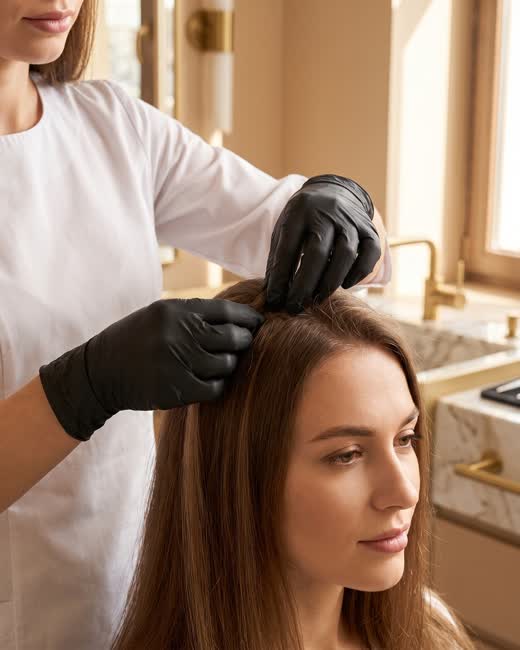
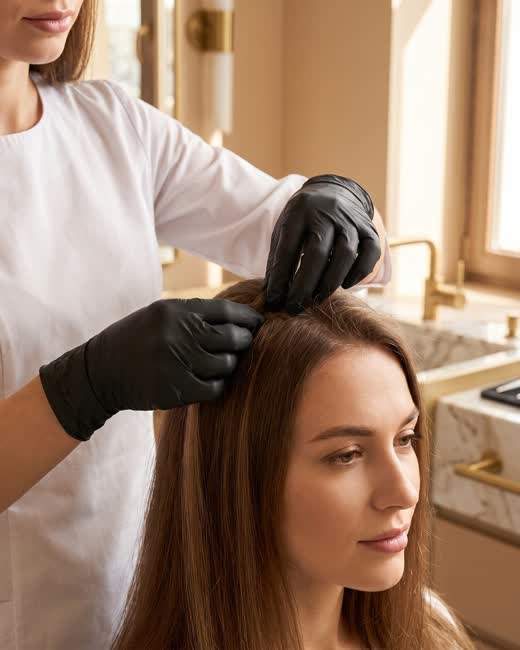
- The scalp — the foundation. This is where the hair follicle lives: living, active tissue that produces the hair, nourishes it, and decides whether it grows at all. The scalp has blood vessels, sebaceous glands, nerve endings. If something fails at this level — poor circulation, inflammation, a disrupted skin environment, hair loss — the problem is in the soil, not the plant.
- The hair shaft — the structure itself. This is the part you see and feel: from the root upwards. The shaft is built from keratin and internal chemical bonds that determine whether hair is springy, smooth and strong, or brittle, dry and dull. If something fails at this level — damage from colouring, bleaching, heat, or simple wear over time — the problem lies in the material the hair is made of.
This is exactly why it isn't a choice between one or the other. Microneedling addresses the soil — the condition and activity of the scalp. Olaplex addresses the plant — the structure and condition of the hair itself. Whichever problem you have, that's the tool that makes sense. Often both problems exist at once — and then neither is fully enough without the other.
How scalp microneedling works
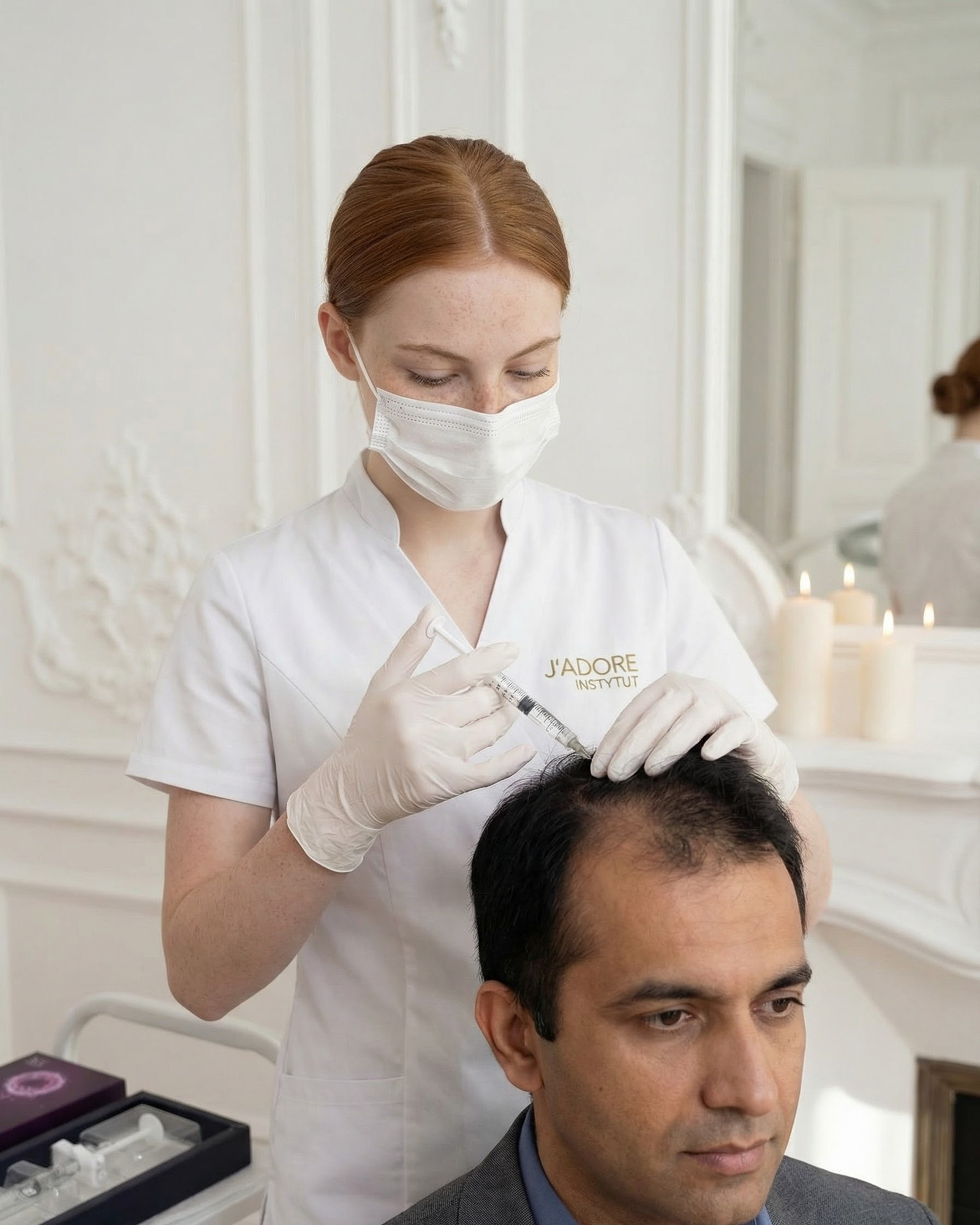
Microneedling — also known as scalp microneedling — uses a device with fine needles to create hundreds of microscopic channels in the scalp. It sounds literal — because it is. And that literalness is exactly its strength.
These micro-injuries trigger a natural repair response in the skin: increased fibroblast activity, greater local blood flow, and production of growth factors and collagen. In other words, the scalp "thinks" something has happened and mobilises resources to repair it. A side effect of this mobilisation is a better-nourished, better-perfused environment for the hair follicles.
- 01
Mechanical micro-injury
The needles create fine channels in the epidermis and dermis, triggering a repair cascade.
- 02
Inflammatory response (short-lived)
The skin mobilises platelets and growth factors — a desired, controlled biological reaction.
- 03
Increased local blood flow
Stimulated blood vessels nourish the hair follicles more effectively. For many people, this may support follicle activity.
- 04
Better absorption of active ingredients
The open channels significantly increase absorption of applied actives — ampoules, scalp serum — for a short window after the treatment.
- 05
Results over time
For many people, regular sessions translate into improved scalp condition and healthier new hair growth — not within a week, but after several weeks of consistent work.
Who is it for? Above all, for people whose problem lies in the scalp itself: excessive hair loss, balding (including male pattern baldness), poor growth, thin hair "from the root", or an oily or inflamed scalp. Microneedling won't repair the structure of existing hair — but it can influence what the next hair to grow looks like.
How Olaplex works — and where it really operates
Olaplex is the name of a specific technology (and product line) built on one key piece of chemistry: rebuilding disulphide bonds in hair keratin. To understand this, you need to know where the strength — and the weakness — of hair structure comes from.
Hair is made mainly of keratin, and keratin holds its shape thanks to a network of chemical bonds between protein chains. Among them are disulphide bonds — relatively strong links that determine the elasticity and resilience of hair. Colouring, bleaching, perming, and even intense heat all break these bonds, gradually degrading the hair's structure. Hair becomes porous, brittle, dry, dull. This isn't a "feeling" — it's a literal chemical change.
For many people, the effect of Olaplex is springier, less brittle, smoother hair — because structures that were damaged have been (at least partially) rebuilt. One important note: Olaplex works on the keratin of existing hair. It doesn't affect the scalp, doesn't stimulate the follicle, and doesn't stop hair loss. It works only on material that has already grown.
Comparison — which level, which problem
Once you know where each of these tools works, the comparison is almost obvious — but it's worth seeing them side by side, because it's often this visual overlap that makes people treat them as interchangeable.
Scalp microneedling
works beneath the skin — in the follicle and growth environment
- Stimulates blood flow and nourishment to the hair follicle
- Activates growth factors in the scalp
- May help reduce hair loss for many people
- Improves absorption of actives applied to the scalp
- Works on the "soil" — the environment hair grows from
Olaplex
works on the shaft — the structure of hair that has already grown
- Rebuilds disulphide bonds in keratin
- Reduces brittleness and porosity after colouring
- Improves elasticity and shine
- Works during and after chemical treatments
- Works on the "plant" — the structure of what has already grown
This comparison frees you from one of the most common mistakes in hair care: looking for a single solution. If someone has hair damaged by colouring and is also starting to lose hair — both issues are real, and each needs its own approach. Doing only Olaplex won't stop hair loss. Doing only microneedling won't repair a damaged shaft.
When it makes sense to combine both approaches
Combining both approaches makes sense wherever the problem sits on both levels at once — which is surprisingly common. Hair after repeated colouring combined with hair loss, thin and brittle hair with a weakened scalp, hair after chemotherapy or hormonal treatment. In such cases, microneedling can improve the environment for new hair growth while Olaplex looks after the condition of the hair already growing.
Microneedling + copper peptide serum
The channels opened by microneedling significantly increase absorption — actives applied to the scalp right after the treatment (such as copper peptides, caffeine, biotin) penetrate deeper and may work more effectively.
Microneedling + Olaplex / keratin treatments
When hair loss and poor structural quality exist together — microneedling addresses the soil, Olaplex or keratin treatments address the condition of the shaft. Both can be planned within the same period, though not necessarily on the same day.
Microneedling + scalp mesotherapy
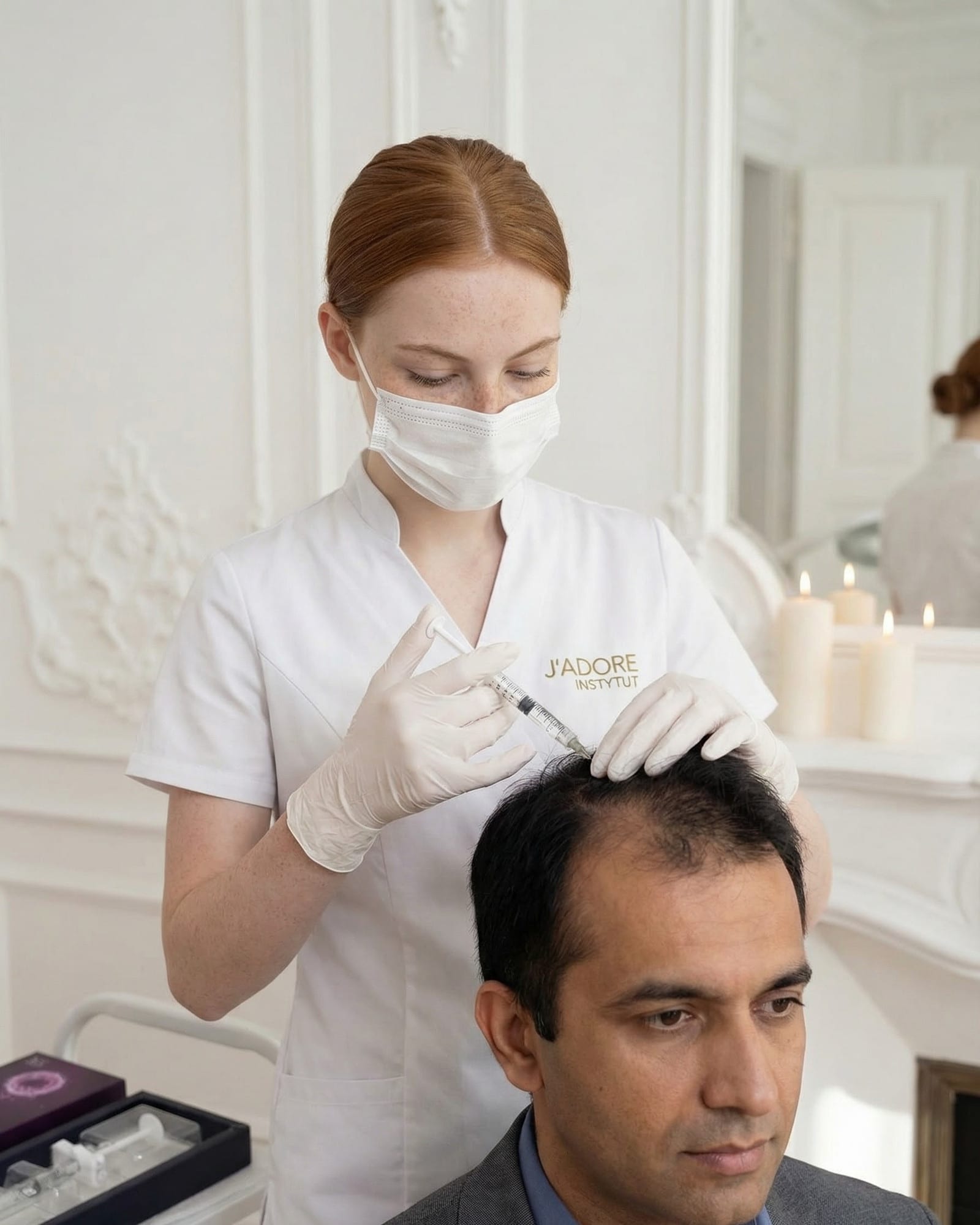
For advanced hair loss or male pattern baldness, microneedling can be used as preparation or as part of a cycle alongside mesotherapy, boosting absorption and the tissue response.
What it looks like from the inside — a guide through the questions
Instead of a "what to choose" list, here's a set of questions — because the answers point the way better than any fixed scheme. Hair is a system that reacts to specific context. And here, the questions matter more than ready-made prescriptions.
- Is your hair falling out more than usual? → If so, the problem may lie in the follicle — and scalp microneedling, mesotherapy or a trichology consultation make sense.
- Is your hair brittle, dull, porous or hard to comb — especially after colouring? → This may be damage to the shaft's structure — that's where Olaplex and similar reconstruction technologies work.
- Do both problems apply to you at once? → Both issues need their own answer — not "one treatment for everything".
- Have you ever done anything for your scalp — not just for the shaft itself? → If not, there's a good chance this part of the work hasn't been tackled yet — even with a good home routine.
- Are you using Olaplex and still losing hair? → That's not a failure of Olaplex — it was never going to stop hair loss. It's a signal that the problem lies elsewhere.
The answers to these questions aren't always simple — sometimes the symptoms come from something neither microneedling nor Olaplex addresses: nutritional deficiencies, an underactive thyroid, androgenisation, stress. In such cases, even the best-matched treatments may give weak results until the root cause is addressed. So when in doubt — consult, don't experiment blindly.