Hair loss: a subject most men ignore for too long
Hair loss in men is common — but that doesn't mean it's inevitable. The problem is that most men react too late: once the bald patch is visible to the naked eye, not when the first signs appear. Yet the earlier you act, the more you can hold onto. Follicles that stop working actively fade over time — and once that happens, no method can rebuild what was lost.
The early signs worth taking seriously: more hair on the pillow and in the drain, visible thinning at the temples and crown, weaker hair structure — strands feel thinner to the touch before they get shorter. If you notice this, you still have a window where prevention and better follicle nourishment genuinely make a difference.
What non-needle mesotherapy does — and why it isn't just "scalp hydration"
Non-needle mesotherapy works by enhancing the delivery of active ingredients through the skin — without puncturing it. Your cosmetologist uses a specialist device that helps active substances penetrate the outer layers of the epidermis. As a result, active ingredients reach the area close to the hair follicle, where they can support its nourishment and local microcirculation.
The cocktails used in this method typically contain ingredients that support scalp condition: substances that boost microcirculation, amino acids that build hair structure, peptides and B-group vitamins. This isn't a product for home use — the concentrations are higher, and the application method makes them more effective than simply applying them to the skin. But this is about nourishing the follicle's environment, not blocking DHT the way pharmacological hair loss treatment does — an important distinction we'll come back to below.
Non-needle vs needle — two methods, two different goals
This question always comes up: "which one is better?" The answer: it depends on the stage and the goal. Both methods have their place, and they often work well together — in sequence, not as alternatives.
Non-needle mesotherapy
a good introduction and prevention
- no punctures, zero marks after the treatment
- zero downtime — you walk out and carry on as normal
- nourishes the scalp and follicles
- good for early hair loss and prevention
- performed by a cosmetologist
Needle mesotherapy
precise delivery of ingredients
- ingredients reach the dermis directly
- stronger effect for advanced hair loss
- allows the use of stronger cocktails
- performed by a doctor or a qualified cosmetologist
A schedule that works well in practice: start with non-needle — see how your scalp responds, get used to the routine, assess the first results. If hair loss is advanced, or you want a stronger effect, the next step is needle mesotherapy or a combined protocol. A good specialist will suggest a path suited to your stage — not a single treatment, but a plan.
What the visit involves — in practice
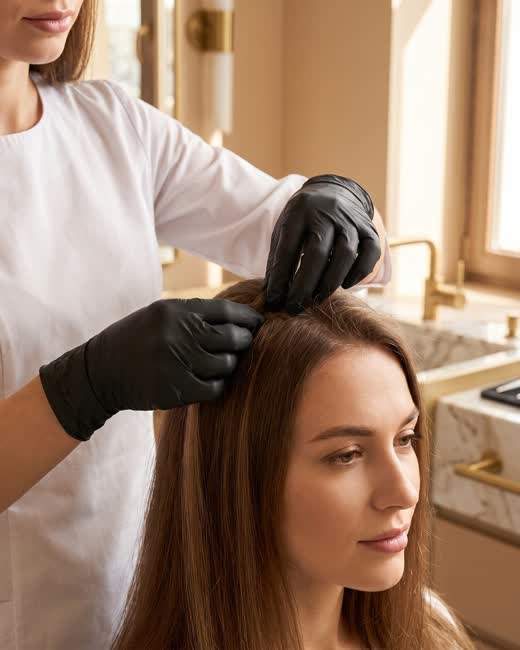
The non-needle scalp mesotherapy treatment requires no special preparation. You come in with a clean scalp. Your cosmetologist assesses your scalp and hair condition and selects a cocktail. The treatment itself involves working evenly over the whole area — the device is passed over the scalp, and gentle vibration combined with microgalvanic current help the substances penetrate. It doesn't hurt, and there are no punctures.
- 01
Consultation
Assessment of your scalp, the stage of hair loss and any deficiencies — to choose the right cocktail and protocol.
- 02
Skin preparation
A quick cleanse of the treatment area. Your scalp needs to be clean and free of styling products.
- 03
Non-needle application
The device is passed over the whole scalp in systematic movements. It feels like a light, warm massage.
- 04
Finish and aftercare
You can leave straight away. The usual recommendation: don't wash your hair for a few hours, so the substances can absorb without being rinsed away.
What non-needle mesotherapy won't replace
Honesty matters here: non-needle mesotherapy is not a cure for male pattern baldness. If the hair loss is driven by a genetically determined effect of DHT on the follicle, nourishing the scalp alone won't stop the mechanism — it may slow it down and improve the follicle's environment, but it won't remove the underlying cause.
- Advanced male pattern baldness (AGA) — here, the standard approach is pharmacological treatment (finasteride/minoxidil) or a hair transplant. Mesotherapy can be a complement, not the foundation.
- Systemic deficiencies (iron, ferritin, zinc, vitamins) — hair loss caused by deficiencies needs to be addressed from within. Topical care alone isn't enough.
- Alopecia areata — this is an autoimmune condition and requires dermatological diagnosis and treatment.
A good reason to start now, not in a year
A hair follicle that stays inactive for several years fades away. The earlier you start caring for your scalp — through nourishment, microcirculation and proper care — the more you can hold onto. Non-needle mesotherapy isn't a miracle fix. It's a sensible, low-commitment introduction to a more serious approach to the issue.
And one more thing: no one will ask where you've been after you leave the salon. Your scalp doesn't look "post-treatment" the way your face might after certain procedures. You walk out normally and go back to work. For many men, that's the deciding factor.
What to combine with non-needle scalp mesotherapy
Non-needle mesotherapy rarely works best on its own. If you have a diagnosis, build a protocol — salon treatments, complemented by a daily routine and, where relevant, treatment of the underlying cause. Below are treatments that often feature in such a plan.
Needle scalp mesotherapy
A natural extension of the non-needle series — deeper penetration of ingredients, stronger nourishing effect. The typical path: start without needles, assess, move to needle mesotherapy for greater needs.
Platelet-rich plasma (PRP)
A method using your own blood — centrifuged plasma contains growth factors and is delivered directly into the scalp. Used for more advanced hair loss, either as a complement or as a standalone protocol.
Scalp carboxytherapy
Subcutaneous delivery of CO₂ improves microcirculation and oxygenation around the follicle. Often combined with mesotherapy as a supporting protocol.