The first criterion is the movement of the body during the session
Imagine two extreme needs. In the first, you want to lie down and limit changes in position because you rest best in a predictable rhythm. In the second, you want someone to guide your legs, hips and torso through gentle stretching settings. The first description is closer to Shiatsu; the second directs attention towards Thai massage. Both methods may use pressure, but they organise the body differently.
Classic massage adds a third variant: the work takes place on a table, and the therapist’s movement usually shifts the skin and tissues using a product. Acupressure alone does not yet say whether you will lie still, sit, or receive it as part of another technique. Before you compare intensity, establish how much active positioning the specific service includes.
Shiatsu organises the session with a rhythm of pressure through clothing
Shiatsu is not about sliding hands over the skin. The therapist works with their thumbs, palms or forearms, pausing the pressure in successive places and arranging it into a calm sequence. Clothing remains on the body, and oil is not needed. For someone who dislikes damp skin after a massage, this is a practical difference, not a minor aesthetic detail.
The session may include gentle mobilisations or stretching, but its character should not automatically turn into a dynamic series of positions. If you want to limit movement, mention this before starting. The name Shiatsu does not exempt the practitioner from agreeing on sensitive areas, injury history or pressure strength.
Thai massage adds levers, positions and passive stretching
- Session conditions. Thai massage often takes place without the use of oil, in loose clothing and on a mat, similar to Shiatsu.
- The therapist’s role. The specialist actively positions your limbs and torso, changing joint angles and guiding stretches that you do not perform yourself.
- Intensity rules. Correct work does not require reaching the maximum range of motion, but allows for calm breathing and the possibility of stopping immediately.
Someone who enjoys the feeling of movement may perceive this form as more engaging than Shiatsu. For someone with a fear of sudden changes in position or a recent restriction in mobility, the same element will be a drawback. The choice does not stem from courage. It stems from whether the guided settings suit your body at the time and whether the practitioner can reduce the range without pressure to "endure it".
Classic massage works on the skin, so it changes the preparation and sensations
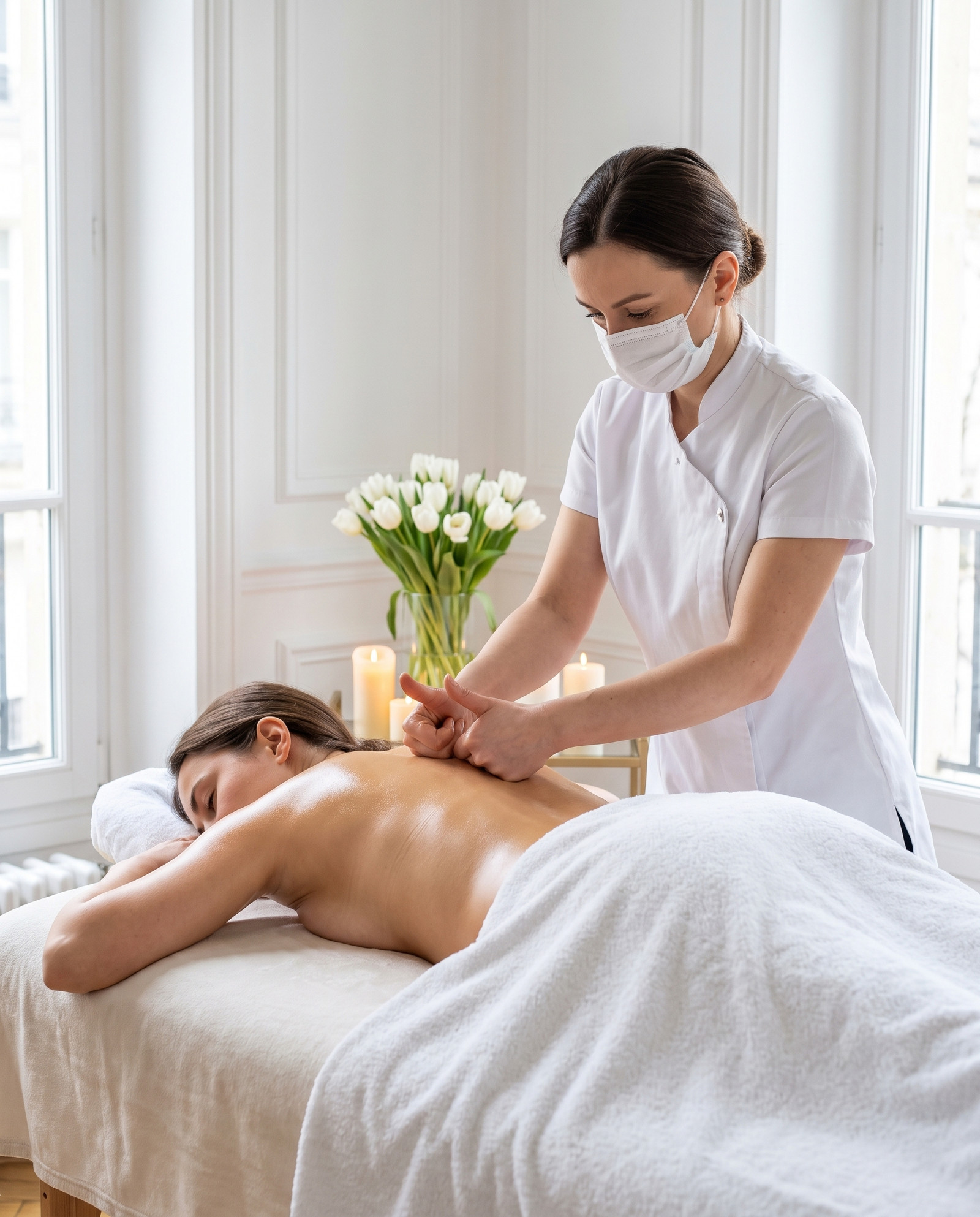
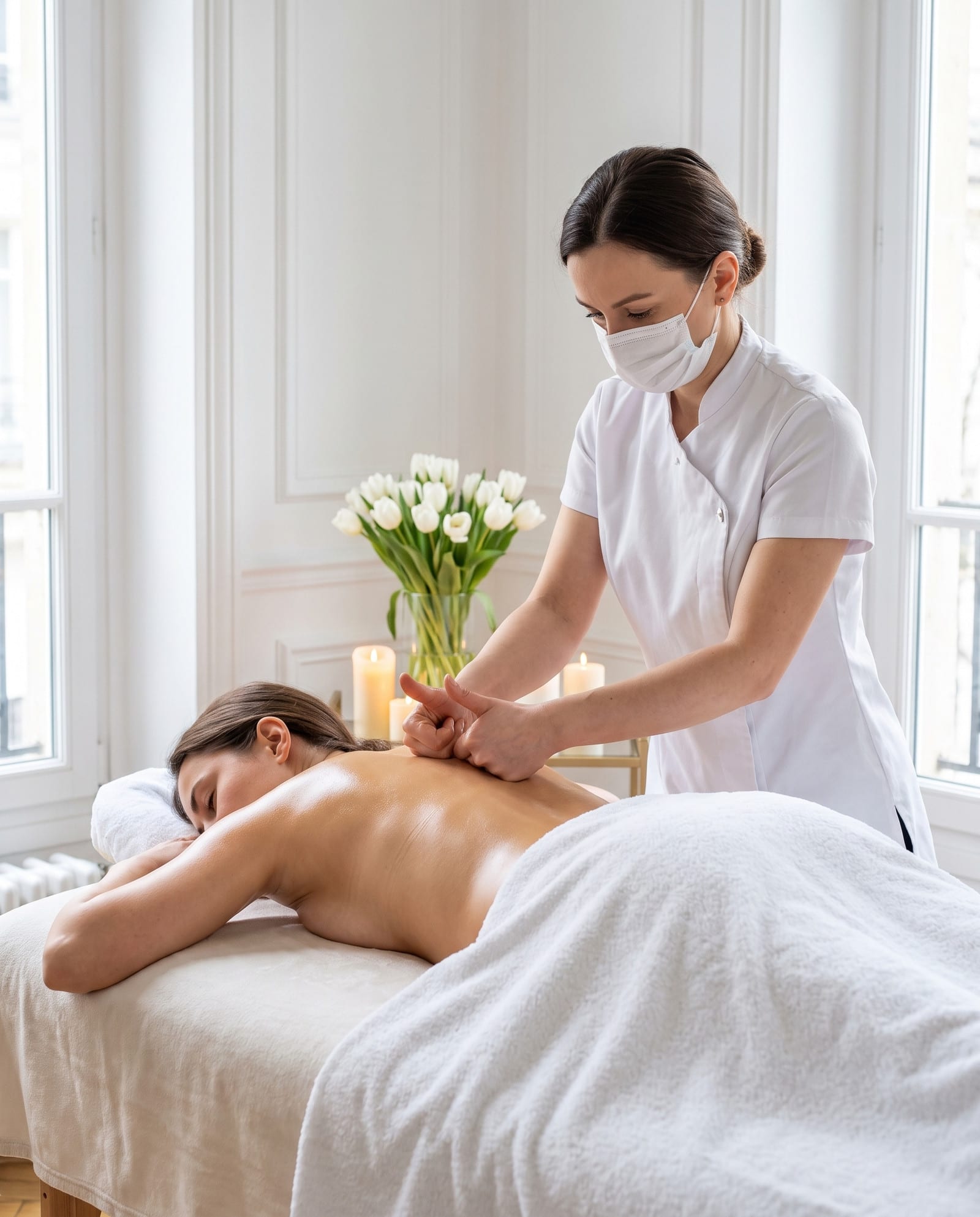
In a classic massage, selected areas are usually uncovered one by one, leaving the rest of the body under a cover. A product facilitates the use of effleurage, friction and kneading. For some people, this continuous contact and work on a specific muscle group are the most clear. Others prefer to keep their clothes on or do not want the scent of a cosmetic — in which case Shiatsu gains a practical advantage.
Classic massage is not automatically more delicate or stronger. Pressure can be light, medium or deeper, depending on the wellness goal, tissue condition and communication. Likewise, Shiatsu does not become intense just because it uses a point. Compare the way force is transmitted: sliding over tissue, sustained pressure or guiding a limb.
Acupressure describes a tool, but often does not describe the entire visit
The word "acupressure" speaks of pressing selected points, but does not determine the duration, surface or scope of the body. It can be a short fragment of Shiatsu, an element of Thai massage or a separately named service. Two offers using this label may therefore look different. Without an additional description, it is difficult to predict whether the session will be point-based, full-body, calm or combined with movement.
Clothing and oil can decide the choice immediately
Shiatsu
contact through an elastic layer
- loose clothing remains on the body
- no need for oil
- pressure is easy to follow point by point
Thai
clothing must allow for guiding joints
- loose material without hard fastenings
- usually no product on the skin
- more changes of position and stretching
Classic
glide is created on the uncovered area
- successive parts are uncovered under a cover
- cosmetic remains on the skin temporarily
- easier to focus on one area
This comparison concerns the typical format, not an immutable law. The clinic should be able to describe its own way of working. If a service called Shiatsu requires undressing and a large amount of oil, ask for an explanation of exactly what will be performed. The more the offer deviates from recognisable features, the more important the conversation before the appointment becomes.
The surface changes both comfort and the possible range of movement
A mat gives the therapist space to work with their own body weight and to guide larger settings. A table facilitates access to tissues in a familiar, classic format. No surface is by definition more professional. It must be clean, stable, suited to the technique and safe when getting on and off.
If kneeling, turning or getting up from a low position is difficult for you, mention this when booking, not at the clinic. The ability to lie on a mat may determine whether Thai or a specific variant of Shiatsu will be comfortable. Someone after a recent procedure, with dizziness or a joint restriction needs an individual assessment, and sometimes a completely different service.
Strength is not a common scale for the four methods
The assessment "strong massage" can mean deep pressure in a classic massage, a long-held point in Shiatsu or a large range of stretching in Thai. These stimuli are not interchangeable. You may tolerate hand pressure well and react poorly to a lever on the hip. You may also dislike skin sliding, even though point contact through clothing is comfortable for you.
Sharp, stinging, electrifying pain, increasing numbness or a feeling of losing control are not the price of effectiveness. Communication should lead to stopping, changing the angle or abandoning an element. A good choice of method does not consist of finding a technique where you can endure the most. It consists of choosing a stimulus that can be safely dosed.
The goal "I want to rest" must be clarified in one sentence
If rest means for you a reduction in stimuli, remaining in clothing and predictability, Shiatsu may fit better than dynamic Thai. If you want to feel that your body has been guided through movement, Thai becomes a more logical candidate. When you value classic contact with oil and work on a specific area, there is no reason to choose a more exotic name.
Consider acupressure only after learning its scope in a given offer. The word itself does not say whether you will receive a full session. Instead of using a general goal, say: I want to remain dressed, I do not want stretching, I care about calm pressure or I prefer work on the back with oil. Such a sentence enables a real match.
Three everyday scenarios show the differences more clearly than definitions
Sensitivity to stimuli is a valid criterion for selection
Some people struggle not with the pressure itself, but with the unexpected nature of the touch. Changing positions without warning, moving quickly from one side of the body to the other, or intense scents can make it impossible to relax, even during a technically gentle session. In such a case, the calm rhythm of Shiatsu may be easier to predict, but only if the therapist informs you about changing areas and respects your request to skip mobilisation. The name alone does not guarantee this.
Classical massage may suit someone who finds continuous gliding soothing, but the aroma of the product or the exposure of skin might be an obstacle. Thai massage may be comfortable due to the clothing, yet too rich in position changes. In acupressure, the problem may be the long duration of holding one point. Before your visit, mention which stimuli are difficult: scent, silence without warning, point pressure, limb movement, contact with a specific area, or the temperature of the hands. You can base a specific modification on this list.
During your first visit, choose predictability, not an ambitious range
- Choosing a method. Decide whether you prefer a massage using oil, whether you accept guided stretching, and whether you feel comfortable on a mat.
- Setting parameters. Ask for moderate treatment intensity and the possibility of requesting adjustments at any point during the session.
- Purpose of the visit. Remember that the first meeting is for learning your body's reactions, not for achieving the maximum range of work.
Do not buy a long series before checking the technique. After the visit, assess your comfort during the session, tenderness in the evening, and how you feel the next day. If the format did not suit you, changing the method may be more sensible than increasing the force. Sometimes, a different person performing the same technique is enough, as tempo and communication are part of the experience.
Record specifics, not just an assessment. Instead of "Thai was too strong," note that you did not like the hip guidance in flexion. Instead of "Shiatsu was weak," check if you expected work with oil on one area. An experience described this way allows you to improve the next session or consciously choose a different one. A general impression easily turns into a ranking of methods, even if the problem concerned only one element.
A good test is comparing the first and a later visit without assuming the next one must be stronger. During the first Shiatsu, a client stiffens every time the thumb stops near the shoulder blade, even if the pressure itself is not high. She therefore asks for shorter pauses and a warning before moving to the neck area. By the fifth session, she already knows the sequence, but on that day, she reports pain after a long drive. The therapist does not mechanically use the previous setting: they avoid the sensitive point, work with a broader hand, and do not add mobilisation. In Thai massage, an analogous change may mean giving up one lever, and in classical, limiting kneading in favour of calmer hand movements. The difference between a good first and a good fifth visit lies in the quality of information, not in pushing the pain threshold. If the salon records the reaction to a point, position, or cosmetic, the next session starts with a specific detail. If they only hear "please do the same, but stronger," they lose the most important lesson from the previous meeting.
Contraindications do not disappear after changing the name of the massage
Fever, active infection, recent injury, unexplained swelling, painful skin lesions, and acute deterioration of well-being are reasons to postpone manual work. If you suspect thrombosis, loss of strength, shortness of breath, or a sudden symptom, you need medical help. Switching from Thai to "gentle acupressure" does not solve the qualification problem.
If you are pregnant, post-surgery, have osteoporosis, chronic diseases, or take medication affecting blood clotting, provide this information before the session. The response may mean a modification, a doctor's approval, or cancellation of the treatment. Thai massage with levers and ranges especially requires careful assessment, but Shiatsu and classical are also not neutral in every condition.
Six questions reveal the true format of the service
- Do I remain in my clothes throughout the visit?
- Does the session take place on a mat, a table, or both settings?
- What part involves passive stretching or mobilisation?
- Is oil or another skin preparation used?
- How do I report excessive pressure, and can an element be omitted entirely?
- Is acupressure a full service or a fragment of a chosen technique?
The answers should be simple and concrete. When the reception uses only sentences about harmony, flow, or unblocking energy, return to the physical process: what you wear, where you lie, and what the therapist does with your limb. This does not take away from the traditions of the methods. It protects you from choosing based on words that every salon understands differently.
In Krakow, verify the name of the service before choosing a date
You can check the scope on the Krakow Shiatsu card. The J'adore Instytut salon in Krakow is located at Karmelicka 45/2B, 31-128 Krakow; opening hours are Mon–Sat 8–20. When booking, say if you want to limit position changes, avoid oil, and have a calm rhythm of pressure.
The final choice comes down to four observable decisions
Choose Shiatsu when you are comfortable with clothing, no preparation, rhythmic pressure, and a small number of position changes. Consider Thai massage when you accept a mat and guided positions. Classical suits people who prefer a table, gliding, and work on areas exposed one by one. Evaluate acupressure by how the salon fills this name with a concrete procedure.
No method wins a general ranking. Compatibility between your need and the actual way of working wins. If you can indicate the attire, movement, surface, and pressure limit before booking, the choice stops being a guess. And when your health status raises doubts, the first step is not comparing massages, but a proper consultation.