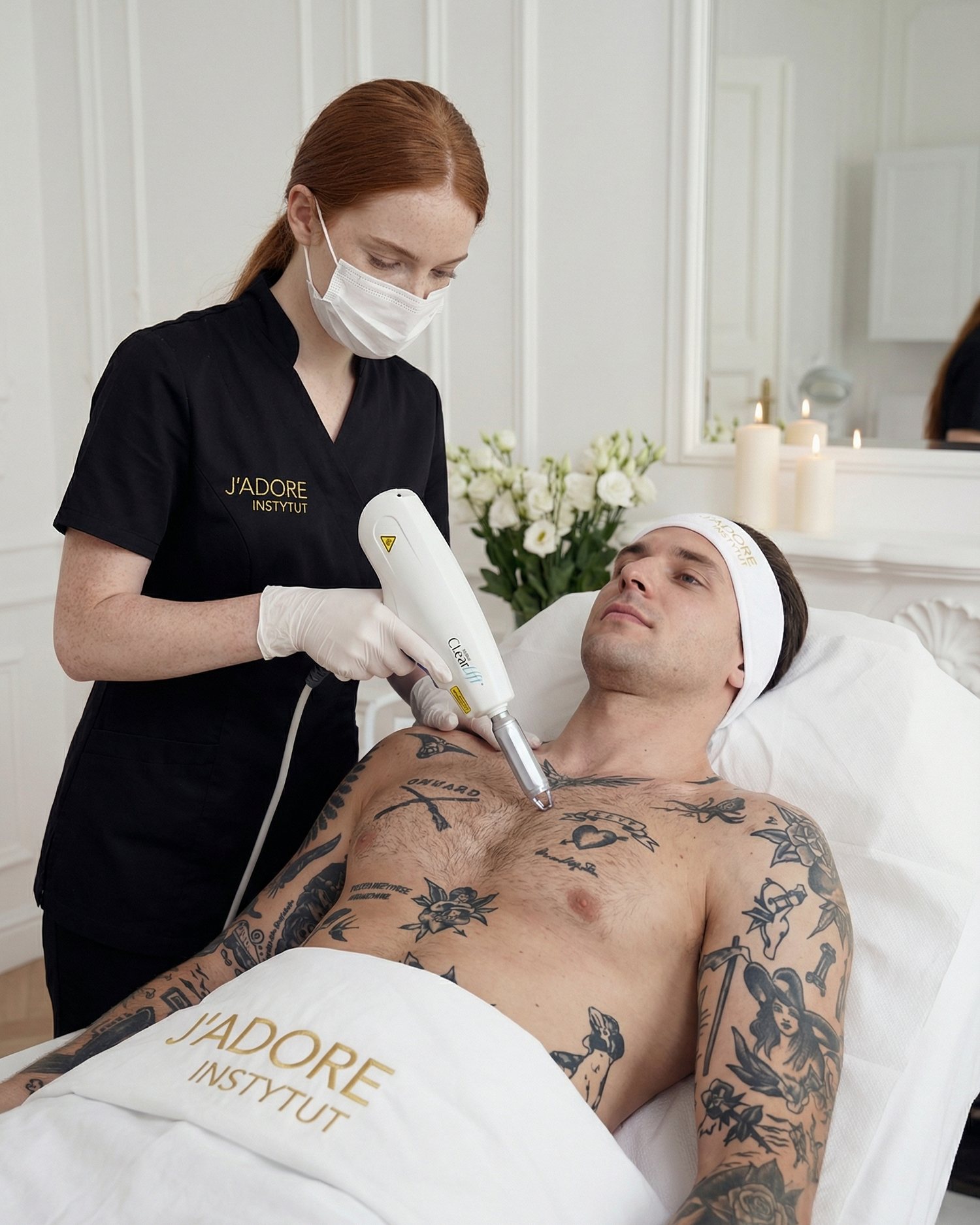
The result begins after the reaction disappears, not at the moment of the laser flash
A whitish coating, known as frosting, may appear immediately after the pulse. It is caused by a rapid reaction in the tissue and does not mean the ink has vanished. In the following hours, redness, swelling, tenderness and later scabs are possible. Only after healing can you honestly see how the pigment has changed.
The laser does not pull the ink out through the surface like an eraser. It breaks it into smaller fragments that the body gradually removes. For this reason, repeating the treatment too soon does not automatically speed up the end of the series. The skin needs regeneration, and the pigment elimination process needs time.
Black ink usually gives the laser a clearer target than a light mixture
The 1064 nm wavelength is used primarily for dark pigments, and 532 nm for some warmer colours, including red. This does not mean that two wavelengths solve every colour. Green, blue, turquoise, yellow and mixed pigments may react more slowly or require different technology.
Black absorbs energy in a way that is usually more predictable. A multi-coloured tattoo is a collection of several separate tasks. A red flower may fade at a different rate than a black outline, and light details may remain longer. An honest plan does not promise a single number of sessions for the entire composition without a trial and observation of the reaction.
More predictable
the laser has a clear target
- black and dark pigment
- older, partially faded design
- shallower fragments
- goal: lightening for a cover-up
Less predictable
the result requires careful assessment
- many colours
- light and mixed pigments
- dense professional outline
- unknown composition of permanent makeup
Ink density and depth explain why the outline remains after shading
A professional tattoo may have an even, heavily saturated outline and several layers of pigment. Shading is often lighter and shallower, which is why it often fades earlier. In an amateur design, the ink is uneven: some points lie shallow, others deep. The effect after the session may look patchy, though it is precisely revealing the differences that were under the skin from the beginning.
Corrections applied over an old design create further layers. Black ink may cover an earlier colour, which will only become visible after the top layer is weakened. This does not have to mean a change in pigment caused by the treatment; sometimes the laser reveals the history of the tattoo. That is why questions about corrections, the age of the design and the studio have practical significance.
The location on the body affects the pace, but does not provide a simple ranking
The body removes the fragmented pigment through processes related to, among others, the immune and lymphatic systems. Location, blood supply, design size, skin condition, smoking, illnesses and regeneration can all influence the pace. However, you cannot honestly predict the result solely from a body map.
A tattoo on the ankle may behave differently than a design on the arm, but the depth and composition of the pigment can reverse the expected order. This is why a specialist assesses the reaction after every session. A fixed schedule without looking at the healed skin ignores the most important data: the actual response of the specific design.
- The age of the tattoo does not tell you by itself how many sessions remain.
- A small design is not always easy if it has a very dense outline.
- A large tattoo may be divided into zones for practical reasons.
- The fading pace after the first session helps with planning, but does not guarantee a linear result.
The interval between sessions is part of the result, not an empty break
The treatment card at J'adore Instytut usually provides for intervals of six to eight weeks, depending on healing and the specialist's assessment. During this time, the skin regenerates and the body works on the fragmented pigment. A subsequent session performed too soon adds trauma to an unhealed area and may increase the risk of complications.
Fading does not have to stop after the second week. The change may increase later, although it is not accompanied by spectacular peeling. A "every month no matter what" plan is not a sign of determination. A good date results from full healing, location, reaction and the goal.
- 01
The first hours
Frosting, redness and swelling show the reaction, not the final pigment loss.
- 02
The first days
The skin may be tender, form scabs and require protection against friction and infection.
- 03
The following weeks
The body gradually removes fragmented particles; comparison makes sense in constant light after healing.
- 04
Qualification for the next session
The specialist assesses the skin and the remaining pigment, not just a date on the calendar.
Complete removal, lightening and cover-up are three different definitions of success
A person planning a cover-up does not always need clean skin. The tattoo artist can indicate the level of lightening sufficient for the new project. This is often a shorter path than striving for an invisible trace at all costs. The plan should be coordinated: first the laser and full healing, only then the new ink.
With complete removal, the result is also assessed in terms of the skin. Further increasing the energy makes no sense if the remaining pigment reacts poorly and the risk of discolouration or scarring increases. Sometimes an honest end to the series is significant lightening, not absolute invisibility.
Permanent makeup may first darken or change tone
PMU pigments are not the same as classic black ink. They contain mixtures that can change colour when exposed to energy, including temporarily darkening. Brown brows may reveal a grey or rusty undertone, or another component of the blend. For this reason, a patch test is particularly important.
A promise to remove brows in one setting without a test should give you pause. You must discuss the possibility of colour change, the plan for further sessions, and the time required before any potential new permanent make-up. The skin must be completely healed. Applying new pigment to a freshly treated area distorts assessment and increases risk.
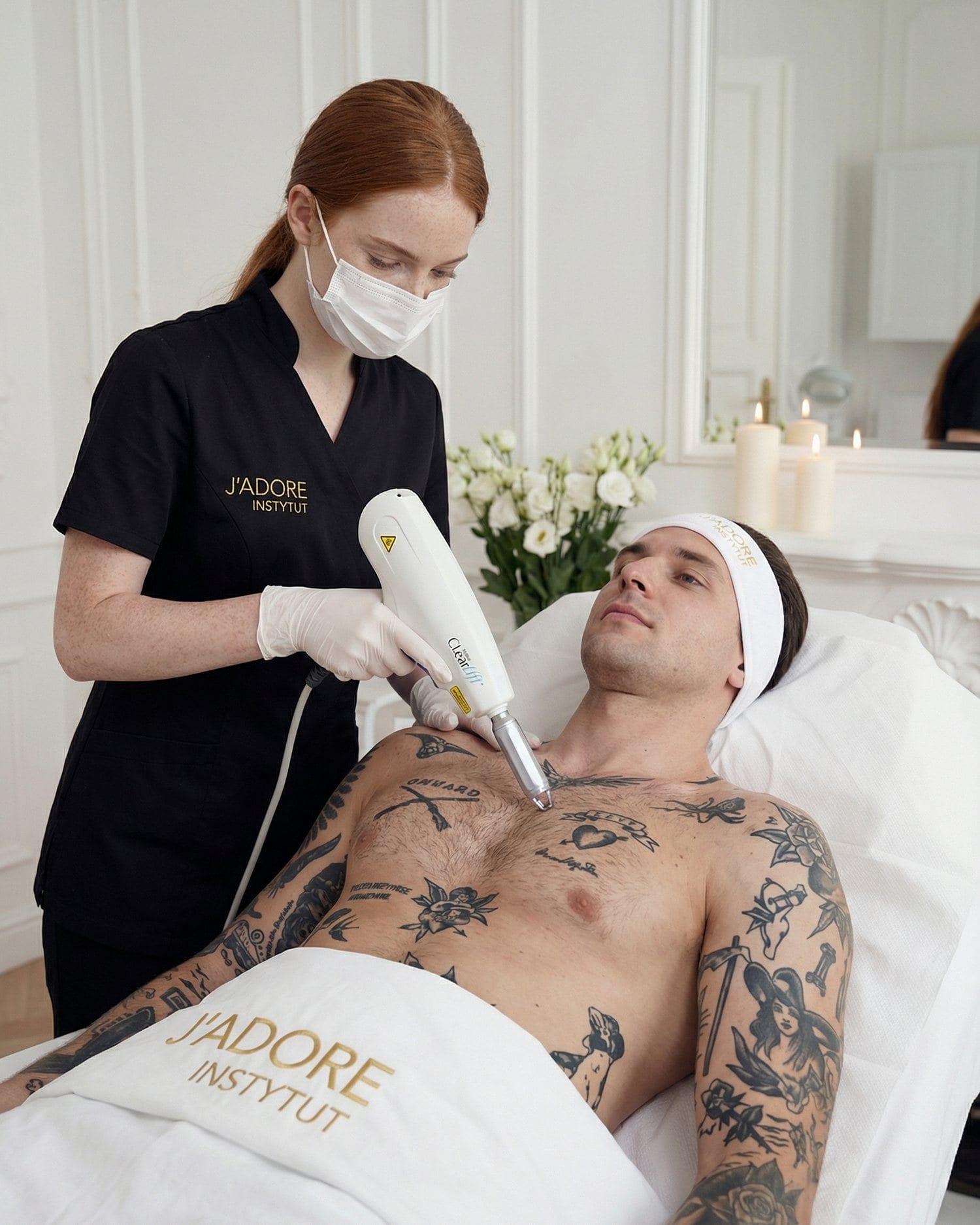
A comparison photo is only reliable under identical conditions.
A tattoo looks lighter under bright light, on oiled skin, or after adjusting the white balance. The camera angle can hide the texture or shadow of the contour. Reliable documentation uses similar distance, positioning, lighting, and skin condition. A photo after healing should not be compared with a pre-treatment photo taken in a dark room.
Check whether the "after" image shows redness or fresh frosting. If so, the photo shows the moment immediately after the session. Ask about the date of the photograph relative to the treatment and the number of sessions performed. Without this information, a spectacular comparison does not reveal how much time, healing, and intervention lies between the frames.
- The same light and camera distance.
- The same position of the limb or skin.
- A photo after full healing, not after the pulse.
- The stated number of sessions and the interval since the last one.
- No filter, wet skin, or selective editing.
The skin may reveal a mark that was created during tattooing, not during removal.
A dense contour, multiple touch-ups, and working too deep with the needle can leave fibrosis or a minor scar during the tattooing process. As long as the area is black, the unevenness may be barely visible. When the pigment fades, light begins to reveal the change in texture. It is then easy to assume the laser caused the scar, even though it existed beforehand.
Before the first session, it is good to view the pattern under light and take side-view photos. The specialist should note raised lines, depressions, hyperpigmentation, and scars. The laser removes pigment; it does not automatically reconstruct texture. If unevenness remains after the series, its further care is a separate plan undertaken only after full healing.
A lack of spectacular change after one session does not determine effectiveness.
The first session also serves as information. It shows how the skin heals, which pigment reacts, and whether the assumed scope is reasonable. With a dense tattoo, the change may be subtle, especially in a photo taken in different light. Assessment only after a full healing cycle allows you to separate a real lack of response from impatience.
On the other hand, rapid lightening of a fragment does not allow you to multiply the result by the number of subsequent sessions. As the more reactive ink is removed, particles that are more difficult, deeper, or of a different composition remain. The end of the series may progress more slowly than the beginning. An honest conversation updates the forecast instead of defending the number given before the first pulse.
Healing protects the result from scarring, hyperpigmentation, and delays in the series.
After the treatment, the area must be protected from friction, dirt, overheating, and the sun according to the aftercare instructions. Scabs must not be scratched. Swimming pools, saunas, intense training, and tight clothing may increase irritation in the initial period. A fresh tan is a reason to postpone the next session.
The sun not only changes the appearance of the comparison. Melanin competes for energy and increases the risk of hyperpigmentation and hypopigmentation. Protection with a high SPF on the exposed area and avoiding sunbeds are mandatory for the duration of the plan established with the specialist. If increasing pain, purulent discharge, extensive blisters, or fever occur, contact the salon for an appropriate consultation.
Krakow: the reference point is established before the first pulse.
In Krakow, J'ADORE INSTYTUT is located at Karmelicka 45/2B. You will find the treatment description and the local booking path on the tattoo removal in Krakow page. For the consultation, prepare information about the age of the pattern, touch-ups, colours, previous removal attempts, diseases, medications, and sun exposure plans. If the goal is a cover-up, also bring the tattoo artist's recommendation regarding the expected lightening.
The most honest effect does not fit into a single photo. It is a sequence: healed skin before the treatment, a controlled session, calm healing, weeks of fading, and re-assessment. A tattoo may disappear unevenly because it was an uneven layer of different pigments from the start. Make the decision about further work based on healed skin, not on the white mark left by the laser.