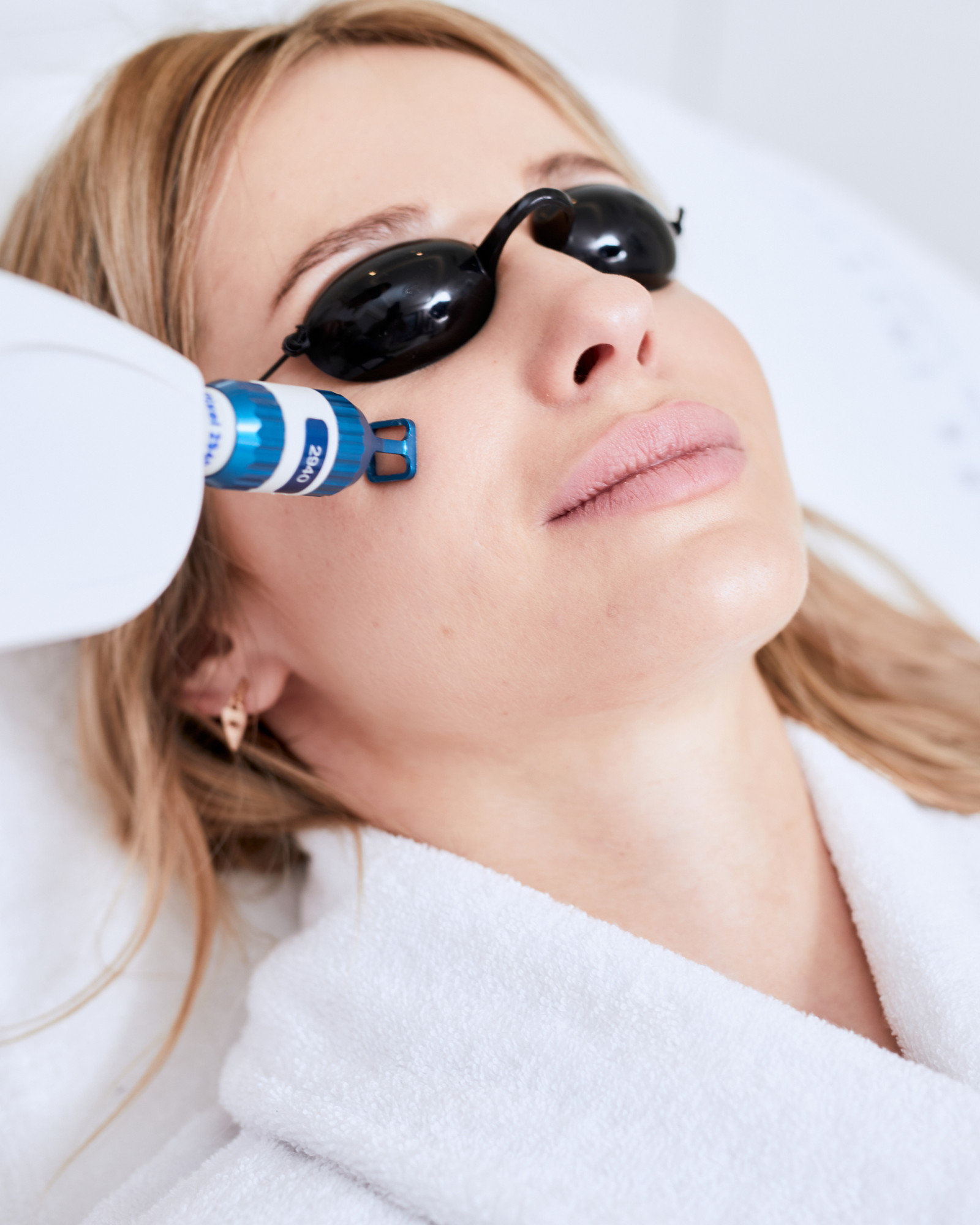
Why one laser can do so much
Before we look at each handpiece, it helps to understand one fundamental rule of laser physics: different tissues absorb different wavelengths. Melanin (the pigment behind hyperpigmentation and hair colour) absorbs different wavelengths than haemoglobin (the pigment in blood vessels), and both differ from water inside skin cells. This means that by changing the wavelength or emission mode, a laser can target completely different "goals" — without disturbing everything around them.
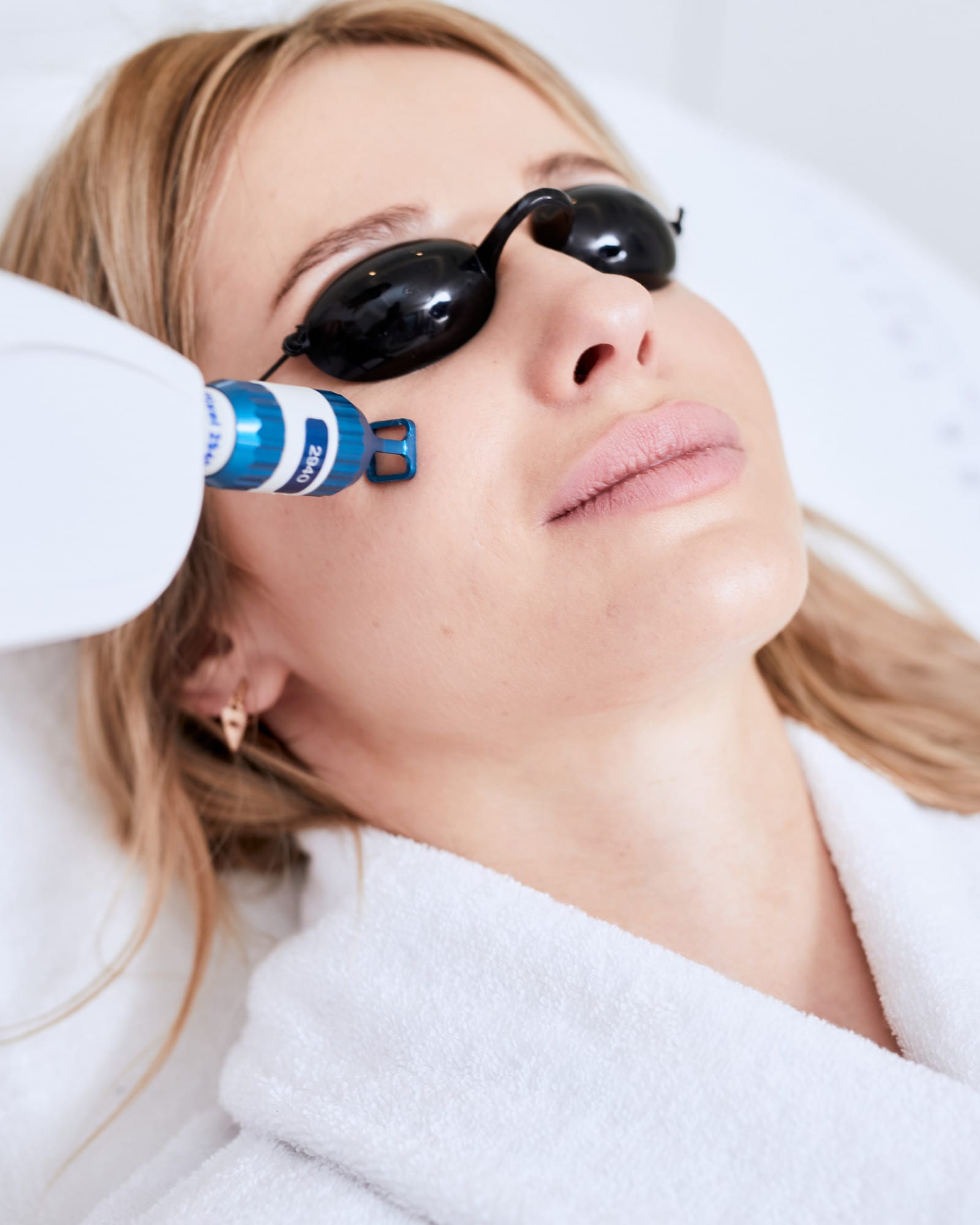
A multi-handpiece platform is the answer to this biological diversity. Instead of swapping the entire device, your specialist simply changes the handpiece — and the laser suddenly "sees" differently. Think of it like a camera with interchangeable lenses: the body stays the same, but each lens produces a completely different photograph. ZYE YAG works the same way. It has four such "lenses", each designed for a different skin concern.
Handpiece one: Q-switched laser — a fast strike on hyperpigmentation
The first handpiece works in Q-switched mode — pulsed, with a very short duration for each pulse. This matters: the shorter the pulse, the less time the energy has to spread sideways, and the more precisely it strikes its target. In practice, this means the laser can break up a cluster of melanin — a pigmented spot — into tiny fragments. Your immune system then gradually clears them away, while the surrounding skin stays largely undisturbed.
This mechanism even has its own name: photoacoustic. The pulse is so short that the energy converts not so much into heat, but into a microscopic shockwave that mechanically shatters the pigment particles. Think of it as cracking a brick with a quick, precise blow — rather than melting it whole. For many people, after a series of sessions, hyperpigmentation visibly fades or becomes less noticeable. Results are always individual, though, and depend on the depth and type of pigmentation.
- Sun-induced hyperpigmentation — sunspots, freckles, age spots
- Post-acne marks (post-inflammatory hyperpigmentation)
- Tattoos — particularly dark shades (results require a series)
- Melasma — requires a cautious approach, often in toning mode
Handpiece two: Nd:YAG long pulse — vessels and deep warming
Where the Q-switched handpiece fires short and sharp, the long pulse Nd:YAG handpiece works the opposite way — a longer pulse lets the energy warm its target in a controlled way. This acts differently at tissue level: instead of breaking things apart mechanically, the laser coagulates, meaning it seals shut. That's why this handpiece works well anywhere you want to "seal" something — blood vessels, hair, or even areas of skin that benefit from thermal stimulation in the deeper layers.
For blood vessels, the mechanism works like this: the laser heats the haemoglobin inside the vessel until the vessel wall coagulates and closes. The vessel is no longer visible, and the surrounding tissue — if the treatment is performed correctly — remains undamaged. For many people, after a few sessions, red spider veins, vascular redness or telangiectasia on the legs become noticeably less visible. Results are individual, though.
- Spider veins and telangiectasia — face and legs
- Vascular redness and enlarged cheek capillaries
- Laser hair removal — particularly on dark hair
- Thermal skin stimulation — as a side effect of the deeper action
Handpiece three: Er:YAG — an ablative laser, layer by layer
The third handpiece is Er:YAG — erbium-doped yttrium aluminium garnet, a completely different laser crystal from the neodymium-based Nd:YAG. The difference in application is fundamental: Er:YAG has a strong affinity for water inside skin cells. When laser energy hits a water-rich cell, the water instantly vaporises — the cell is removed almost mechanically, before it has time to heat up. The result? Precise, controlled removal of successive skin layers.
In practice, the Er:YAG laser works differently from classic chemical peels — it doesn't dissolve tissue, it ablates it, removing layers one at a time with tight control over depth. That's why it can be used for surface smoothing, treating shallow scars and improving texture irregularities. Skin needs time to recover afterwards — for a few days it stays pink and sensitive. That's the trade-off for genuine surface remodelling.
- 01
Ablation
The laser removes a thin layer of water-rich cells — with almost no thermal effect deeper down. Skin is physically "resurfaced" with precision.
- 02
Repair inflammation
The body responds to the tissue loss like a controlled wound — triggering a repair cascade that produces new collagen and elastin.
- 03
Regeneration
Over days to weeks, new cells replace the ones removed. Skin surface may become smoother and more even. Speed depends on individual regenerative capacity.
- 04
Remodelling
For several weeks after the treatment, skin continues a "quiet" rebuild — new collagen matures and tightens the structure. Results can keep building over time.
Handpiece four: fractional laser — a dense grid of micro-columns
The fourth handpiece introduces an entirely different working philosophy: fractional treatment. A classic ablative laser removes a continuous surface — effective, but it requires a longer healing period. A fractional laser does something smarter: instead of removing the whole surface, it creates a dense grid of micro-columns — each a tiny "well" reaching into the skin, with untouched strips of healthy tissue left between them.
Why does this matter? Because the undisturbed tissue around each micro-column acts as scaffolding — it supplies stem cells, speeds up healing and reduces the risk of complications. Skin responds to hundreds of micro-injuries at once, triggering intensive new collagen production — but heals faster than after classic full-surface ablation. For many people, the result after a few sessions is a marked improvement in texture, firmness and the appearance of scars.
Fractional laser
grid of micro-columns
- Acts in patches — untouched strips remain between columns
- Faster healing than full ablation
- Intensive collagen stimulation
- A good choice for scars, texture, firmness
Ablative laser (Er:YAG)
continuous surface
- Removes the entire layer evenly
- Greater control over depth
- Even surface smoothing
- Effective for surface-level irregularities
Four handpieces, one logic for choosing between them
Since each handpiece does something different, the question is: how do we know which one to use? The answer is simpler than it sounds: the therapeutic goal decides the tool, not the other way round. That's why a consultation before laser treatment matters. Your specialist assesses the type of concern, the depth of the issue, your skin type and any previous treatments before the choice of handpiece is even made.
In practice, many people come in with several concerns at once — hyperpigmentation and acne scars, visible vessels and uneven texture. This is where the real strength of a multi-handpiece platform shows itself: a single treatment series can combine different modules, addressing each goal in turn. There's no need to visit several salons with different lasers — the platform brings them together in one place.
What to know before your first laser session
A laser — whatever the handpiece — is a precise tool, but it needs the right preparation and context. A few things worth knowing before your first visit:
- A tan is a contraindication. Freshly tanned skin has more melanin in the epidermis — the laser may react with that instead of its intended target. Handpiece laser treatments aren't performed on tanned skin, and the summer months call for extra caution.
- Consultation always comes first. There's no single protocol "for hyperpigmentation" or "for vessels" — the choice of handpiece, intensity and number of sessions always depends on your specific skin and concern.
- Results often build up. One session rarely tells the full story — for many people, the best results appear after a series of sessions, and some effects (especially collagen-related ones) continue to build for weeks after the series ends.
- Skin may feel more sensitive for a few days. Especially after ablative modes — light pinkness, mild flaking and increased sun sensitivity are normal reactions, not complications.
- Sun protection after a laser treatment is a requirement, not a suggestion. Skin is more vulnerable to photodamage after treatment. Skipping SPF can undo your results.
Mesotherapy / biostimulators
After a laser series, skin is "primed" for regeneration — a biostimulator or mesotherapy session can reinforce and extend collagen rebuilding, working in synergy on the same scaffold.
Chemical peels
A peel can be used as a complement between laser sessions — it addresses the surface of the skin (the epidermis), while the laser works deeper. Your specialist plans the sequence and intervals.
Oxygen infusion / oxybrasion
Gentle stimulation once a laser series is complete — it helps maintain skin quality and condition after an intensive cycle.