 A treatment room at J'adore
MASSAGE & SPA (~30)
Pregnancy is a unique time — and also a real challenge for the body. A growing bump shifts your centre of gravity.
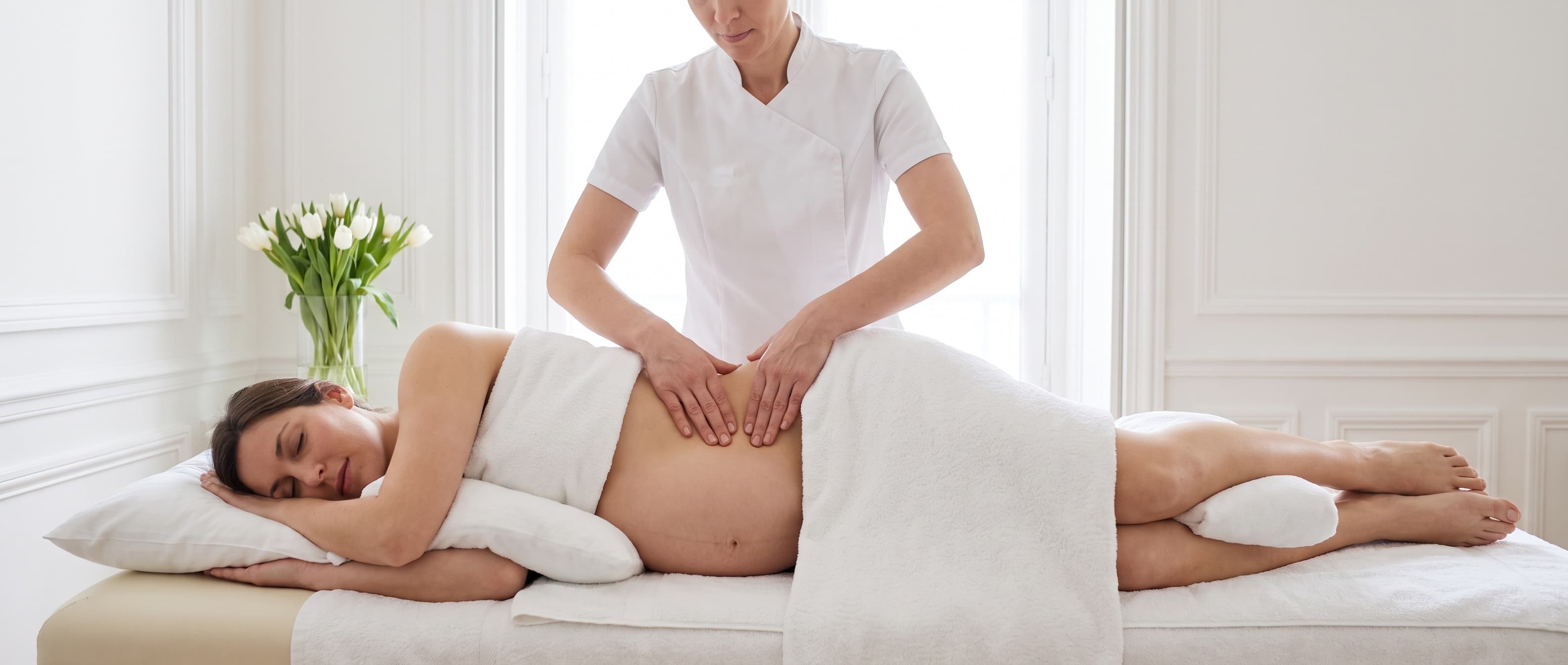
Your back and lower back work overtime. Your legs swell by evening, and sleep can become shallow and restless. Prenatal massage doesn't treat or "fix" anything — it's a gentle massage, fully adapted to pregnancy, that eases tension and gives you a moment of rest. We work in a side-lying position, supported by special pillows, using gentle movements. We focus on the back, lower back and swollen legs — and always avoid the abdomen. Less back pain, lighter legs, calmer sleep, and an hour just for you. At J'adore Instytut, the treatment is performed by a massage therapist / therapist trained in working with pregnant women. Below you'll find everything worth knowing before your visit.
single visit or regular sessions — from the second trimester, at a pace matched to your pregnancy
How it works
Prenatal massage involves manual work with gentle, flowing movements and light pressure, fully adapted to your changing body during pregnancy. You lie on your side, supported by special pillows that take the weight off your abdomen, spine and hips — the safest and most comfortable position for an expectant mother. A calm, steady rhythm eases tension in the back and lower back, while gentle work on the legs helps with the heaviness and swelling that so often develop in the second half of the day.
The goal is simple and important: relief, relaxation and a moment of rest — without straining the body, without deep kneading, always avoiding the abdomen. This isn't "an ordinary massage performed more carefully" — it's a separate, deliberately guided treatment, adapted to your trimester and how you feel on the day.
Did you know: calm, rhythmic touch lowers tension not only for the mother-to-be. When a mother relaxes, she breathes more deeply and steadily — a state in which the whole body, including the baby, simply "slows down". An hour to yourself during pregnancy isn't a luxury — it's a real part of self-care.
Ideal for
We perform prenatal massage from the second trimester (usually after weeks 12–14). We do not recommend massage during the first trimester and won't perform it without clear medical indication — this is a period when we remain especially cautious. We also always ask for confirmation from your doctor that there are no contraindications. This isn't bureaucracy — it's real safety for you and your baby.
A space for women
Prenatal massage for women is a treatment designed entirely around the expectant mother — her body, her wellbeing and her need for rest. It's a space for women in its purest form: a safe side-lying position, gentle touch, work exactly where pregnancy places the greatest strain, and full respect for your comfort and privacy. The intensity is always gentle, matched to the day and the trimester.
What we work with
This treatment is designed for pregnant women, so there is no separate men's area here — but there is an important role for the partner. A prenatal massage is one of the most beautiful gestures of care you can give an expectant mother: a voucher for a visit says "take care of yourself and rest" better than words.
What we work with
A tip for partners: the best gift for an expectant mother is often the one she wouldn't ask for herself. A voucher for prenatal massage takes away the decision of "is it okay to take care of myself" — because the decision is already made. We'll sort out the rest (date, approach) together on the day, with her wellbeing in mind.
Safety
In pregnancy massage, safety matters more than any "effect". That's why we follow a few fixed, non-negotiable rules — and we ask that you know them before your visit:
We usually perform prenatal massage after weeks 12–14 of pregnancy. We do not recommend massage during the first trimester.
We ask for confirmation that your gynaecologist or midwife sees no contraindications — especially with a high-risk pregnancy, spotting, high blood pressure or other complications.
We don't lay you face-down or flat on your back for extended periods; a safe side-lying position takes the weight off the spine and doesn't press on major blood vessels.
We never massage the abdomen or the area around it — we work on the back, lower back, legs, neck and shoulders.
Light pressure, no deep muscle "breaking down", no hot compresses and no strong essential oils, which can be unsuitable during pregnancy.
Red flag: when to see a doctor first (or skip the massage) · We don't perform the massage (or only with written approval from your doctor) if there is: a high-risk pregnancy or complications, spotting or bleeding, suspected premature contractions, high blood pressure or pre-eclampsia, uncontrolled gestational diabetes, thrombosis or suspected thrombosis (pain, swelling or redness in the calf is an absolute warning sign), as well as fever, infection or acute inflammation. We don't recommend massage during the first trimester. If you have any doubts at all, speak to your gynaecologist or midwife first — we always postpone a visit when your safety or your baby's is at stake.
What to expect
The question I hear most often at the start is: "am I really allowed to do this?". The answer is always the same: if you're past the first trimester and your doctor sees no contraindications, we can begin — calmly and gently. And if anything feels uncomfortable during the session, even the position of a pillow, just say so and we'll change it. Your comfort always comes first here.
Portfolio
A record of the work in our salons — the place where we publish treatment frames and, after photo sessions, results.
A record of results — in preparation. We publish photographs of our clients only with their consent.
After the massage and for the rest of the day, drink water calmly, in small sips. Good hydration supports circulation and helps reduce swelling — especially important during pregnancy.
If you can, don't dive straight back into things. A calm moment, legs slightly raised, no rushing — this is when the relaxation and relief in your legs work best.
In the evening, prop your legs up slightly (for example, on a pillow) — a simple way to support lymphatic drainage and reduce the feeling of heaviness after a long day.
The evening after a massage is a good time for sleep — your body is relaxed. During pregnancy, sleeping on your left side, with a pillow between your knees, is the most comfortable and safest position.
Very hot baths, saunas and hammams aren't advisable during pregnancy — overheating the body isn't good for you or your baby. A lukewarm shower or a warm (not hot) bath is absolutely fine.
Skip intense exercise after the massage. A gentle walk is great, but straining the body right after a session undoes the calm we've just worked to build.
Prenatal massage (pregnancy)
During pregnancy, only prenatal massage is appropriate and safe — other forms of massage are either postponed during this time or resumed after childbirth. A short cheat sheet so you don't get confused:
safe massage for the expectant mother
not a deep, strong therapeutic massage or one focused on the abdomen
classic relaxation (outside pregnancy)
we don't perform this during the first trimester or without a doctor's approval during pregnancy — choose prenatal massage instead
working on muscle tension
firm pressure and lying face-down aren't advisable during pregnancy — this isn't the right time for it
Combine with
During pregnancy, we combine treatments carefully, choosing only those safe for expectant mothers. The most common, gentle combinations are below — you'll find details of each on their own pages, and we decide together, taking your doctor's advice into account, what's right for you:
We always decide together what's safe for you and when — taking into account your trimester, how you feel, and your doctor's recommendations. During pregnancy, "less, but considered" is always better than "a lot, just in case".
A simple rule: you are past the first trimester of pregnancy and your doctor sees no contraindications → prenatal massage, the only option intended for you. Dreaming of a classic relaxation or a more intensive approach to tension → come back to them after giving birth, once your body has rested. You will find the details of both on the pages for relaxation massage and classic massage.
After the massage
Prenatal massage doesn't require recovery time — you go back to your day calmly. A few small things, though, help the relief in your back and legs, and the feeling of relaxation, last longer:
A gentle massage oil without strong essential oils, which can be unsuitable during pregnancy — good slip, with a mild or no scent.
Dla kogoThe foundation for work on the back, lower back and legs; a good choice when scents are bothersome during pregnancy.
A nourishing balm supporting the elasticity of the skin on the abdomen, hips and chest, for everyday home care.
Dla kogoA home ritual between visits — we don't apply it to the abdomen during the massage itself.
A light, cooling gel or balm that brings relief to tired, swollen legs — especially in the evening and in hot weather.
Dla kogoHeaviness and swelling of the ankles and calves in the second half of pregnancy.
A neutral, unscented oil for anyone with the heightened sense of smell typical of pregnancy.
Dla kogoFor when even a light scent is bothersome — a safe, neutral setting for the session.
Fact: We deliberately mention types of products here rather than specific brands: during pregnancy, what matters most is that a product is safe, gentle and free from strong essential oils. Have a favourite product approved by your doctor? Bring it along — we're happy to use it.
Price list
Checking free hours…
Gift voucher
Buy a voucher for this treatment in the J'ADORE online boutique — an elegant gift, redeemable at the salon of your choice.
Voucher pricePLN 299
Buy the voucher (opens in a new tab)Purchase and payment take place in the J'ADORE online store. The voucher is valid for 12 months from purchase and covers the selected treatment variant.
From the magazine
Editorial pieces on how this treatment works in practice — what happens during the session, how to prepare, where the limits are and what the first days after look like.
See also
The result lastsrelief from the first visit; better sleep and less swelling build up over a seriesJ’adore Instytut
Information. Prenatal massage is a wellness/relaxation service adapted to pregnancy; it does not replace diagnosis or medical treatment. We perform it from the second trimester, only after your doctor (gynaecologist / midwife) confirms there are no contraindications; we work in a side-lying position and never apply pressure to the abdomen. If you have a high-risk pregnancy, complications, spotting, high blood pressure, or any doubts, consult your doctor first. The information above is provided for guidance only. The details and choice of approach (area, position, intensity) are determined by a specialist during your visit.