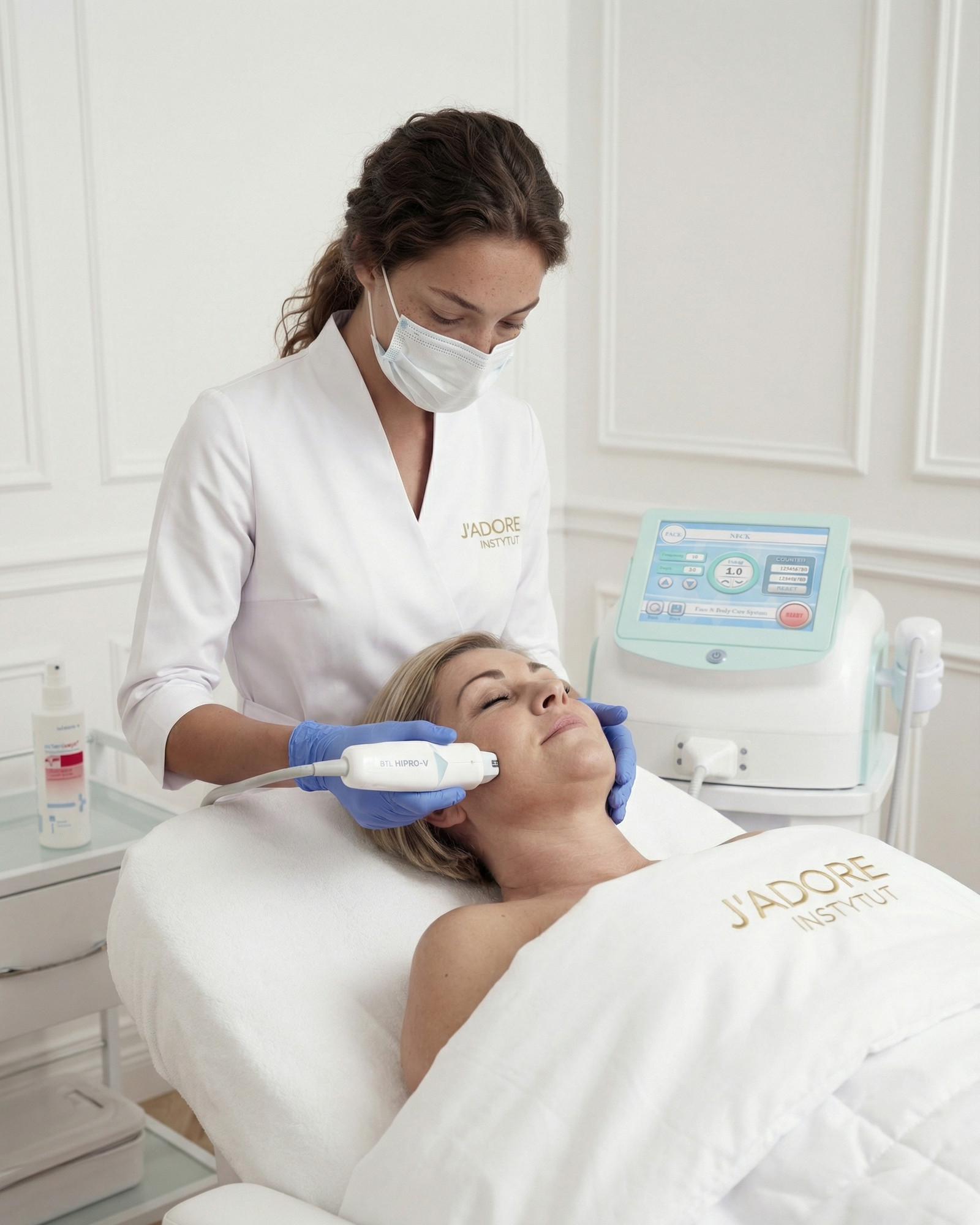
You feel the HIFU pulse deeper than a superficial burn.
HIFU focuses ultrasound energy at a selected depth, creating a focal thermal stimulus without removing the epidermis. This is why the surface can remain relatively calm, while the sensation occurs beneath it. Some describe a series of tiny pricks, others a warm pinch, a spasm or a short "jump" along the jawline.
Topical anaesthesia can reduce sensations from the skin, but it does not fully switch off the stimulus generated deeper down. Therefore, the promise of a completely pain-free experience after cream is not very credible. The goal is a tolerable, controlled treatment, not proving that you feel nothing.
Bony areas and thin tissue layers usually hurt more.
Near the bone, energy and vibration are perceived differently than in a fuller cheek. The jawline, chin, temple area or places with thin subcutaneous tissue can give a sharper signal. The proximity of nerves and the anatomy of your specific face also matter, which is why the treatment map should not be copied from a template.
Softer cheek.
more often dull and deep discomfort.
- more tissue over the bone.
- less vibration transmission to the teeth.
- heat perceived as focal.
- change of sensation with depth.
- still possible high sensitivity.
Jawline and bony areas.
more often sharp or electrical signal.
- less soft coverage.
- vibration transmitted through the bone.
- possible radiation to the teeth.
- greater importance of handpiece precision.
- need for immediate feedback.
Cartridge depth changes the layer, and with it, the pain profile.
HIFU devices use cartridges that focus energy at different depths. A deeper line may cause dull, focal pain, while a shallower one may cause sharper stinging closer to the surface. However, you cannot predict the sensation solely from the cartridge number, as the thickness of the skin and subcutaneous tissue changes between areas.
- The same cartridge can be felt differently on the cheek and under the jaw.
- Higher energy is not the only factor; the number and density of lines also count.
- A pace that is too fast can make it difficult to report the nature of the previous pulse.
- Overlapping many passes in one area can accumulate discomfort.
- The depth plan should result from anatomy and the goal, not from one protocol for everyone.
A review of facial and neck HIFU studies estimated the average pain score as moderate. A newer meta-analysis of micro-focused ultrasound also indicates moderate pain and large variation between studies. However, the average does not tell you what you will feel at a specific bone and with a specific setting.
A pain scale only helps if the practitioner asks about the nature of the sensation.
A number from zero to ten is useful for tracking an increase, but "seven" can mean a short sting or a radiating electrical pulse. These two sensations require a different reaction. Before the first line, establish the words: heat, prick, vibration, radiation, spasm, numbness.
- First pulses.
Calibration instead of surprise.
The practitioner starts as a check, asks about the location and nature of the signal, and verifies handpiece contact.
- Subsequent lines.
Monitoring the increase.
You report a change in the type of pain; do not wait until the entire area becomes intolerable.
- Bony area.
Re-evaluation of the setting.
In case of radiation or electrical pain, the treatment is stopped and the position is checked.
- End of the area.
Checking sensation and comfort.
We do not automatically move on without asking about persistent pain, numbness or muscle weakness.
Anaesthetic cream does not reach all layers that perceive HIFU.
Topical anaesthesia can reduce epidermal stinging, but it does not block all sensation in deeper tissues or vibration conducted through the bone. Its application, type and timing should result from a medical assessment and the clinic's instructions. Do not apply cream yourself before arrival.
A stronger painkiller should not be used to mask incorrect settings. If the pain suddenly changes character, we first check the cause. Good comfort does not mean a lack of communication; it means that every reaction has a response from the operator.
Sharp electric pain, numbness, or muscle weakness require stopping.
A short, deep prick may be a predictable sensation. An impulse running along the jawline, persistent numbness, clear asymmetry of movement, or pain that does not disappear after stopping the line has a different character. Such signals should not be covered up by saying that "HIFU must hurt".
The operator should stop energy delivery, assess the area, and decide if the treatment can be safely continued. After leaving, persistent severe pain, sensory disturbance, muscle weakness, or skin changes require urgent contact with the clinic and a medical assessment.
Pain does not confirm that the energy has reached exactly where it should.
It is easy to confuse the intensity of the sensation with the intensity of the result. Meanwhile, pain also depends on innervation, bone, transducer contact, and sensitivity. A person who feels less does not necessarily have a weaker treatment; a person suffering significantly does not automatically receive better remodelling.
Proof of a good plan:
it can be verified
- qualification for the indication
- a map of areas and depths
- documentation of the device and cartridges
- parameters recorded in the chart
- follow-up at the scheduled time
False proof:
is based on suffering
- "the more it hurts, the better"
- no reaction to radiating pain
- counting endured lines as a success
- increasing energy for the impression of power
- assessing the effect immediately after swelling
Mental preparation helps, but it does not replace technique.
Tension can increase alertness to every impulse. It helps to know how long a line lasts, which areas are more difficult, and how to report a change in sensation. Breathing, short breaks, and a predictable pace can improve tolerance, but they are not a tool to convince the client that they should endure unusual pain.
- Eat a normal meal and ensure hydration, unless the clinic advises otherwise.
- Tell us about anxiety, fainting, migraines, and exceptional tooth sensitivity.
- Do not take additional painkillers on your own without consultation.
- Establish a stop signal before the first impulse.
- Do not book a treatment on a day when time pressure prevents a calm pace.
If stress remains very high, you can postpone the decision or choose another method with a different profile of sensations and effects. Pain tolerance is not a moral criterion. An aesthetic treatment makes sense only if you accept its real course after receiving reliable information.
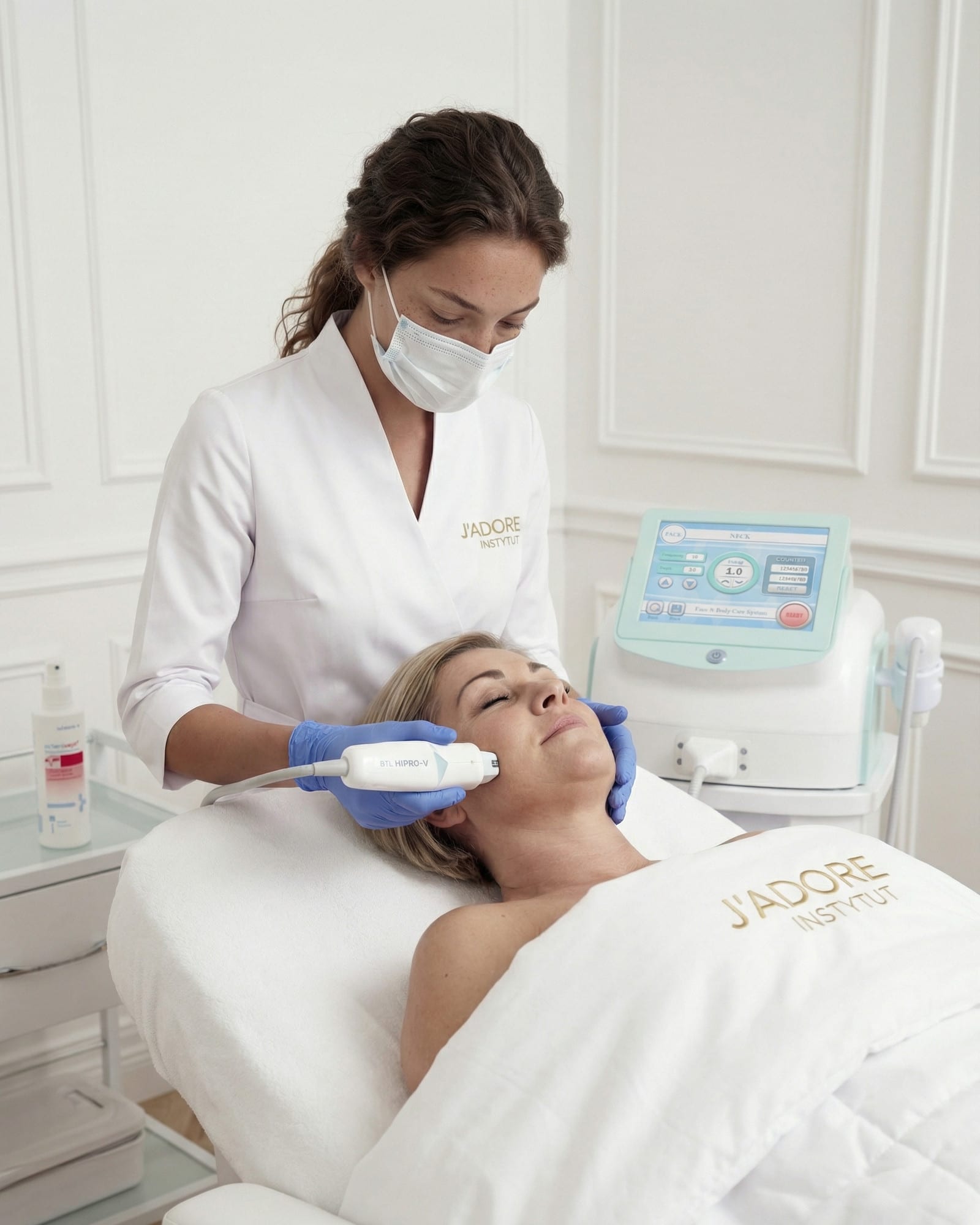
What is most tiring is not a single impulse, but accumulation in one area.
The first line may be surprising but tolerated. It is often more difficult when a dozen or so subsequent impulses hit adjacent points, the tissue remains tender, and the client starts clenching their jaw and holding their breath. Pace, the order of areas, and short breaks are then more important than heroically gritting your teeth.
- Report that the pain is increasing with each line before it reaches a level that makes it impossible to distinguish sensations.
- Ask to move to another area if the protocol and anatomy allow it.
- Relax your jaw; clenching can increase the sensation of radiation to the teeth.
- Do not speed up the end of the treatment just because you want it over with.
- After a break, describe whether the pain has disappeared completely or if tenderness or numbness remains.
A long treatment requires a comfort plan from the beginning. If the operator uses all the easier places and leaves the most sensitive jaw for the moment of greatest fatigue, tolerance may be worse. However, the order must not disrupt the logic of the mapping; it is determined consciously, not randomly.
An alternative is better when you do not accept the pain required for a meaningful protocol.
Parameters can be adjusted, but there is a limit beyond which the treatment ceases to address the original goal. If the only way to complete HIFU would be to drop to settings without a justified stimulus, it is better to stop and discuss another method. Paying for a session does not create an obligation to perform all lines.
Adjustment makes sense when:
the plan still addresses the goal
- the pace is changed
- breaks are used
- transducer contact is corrected
- a dangerous point is avoided
- the changed parameters are documented
It is better to choose an alternative when:
comfort destroys the purpose of the procedure
- every impulse is intolerable
- nerve radiation appears
- Anxiety prevents you from staying still and communicating effectively.
- The plan is significantly weakened.
- You are expecting results beyond the scope of HIFU.
Radiofrequency, surface treatments, injections or surgery have different goals, sensations and limitations. They are not simple substitutes, but they may better suit your anatomy and tolerance. The choice of an alternative should result from a re-diagnosis, not solely from seeking a method without any discomfort.
After HIFU, tenderness may last longer than visible redness.
Your skin may look normal but remain tender to the touch, washing or facial expressions. Temporary swelling, redness, stinging or sensory disturbances are also possible. The extent and duration depend on the area and the parameters used. The clinic should describe the expected course and the follow-up point.
HIFU in Warsaw — the conversation about pain begins before choosing the transducer.
In Warsaw, J'ADORE INSTYTUT operates at ul. Żelazna 59, 00-848 Warsaw and at ul. Mińska 29A/46, 03-808 Warsaw. The Żelazna location is open from Monday to Saturday between 08:00–21:00 and on Sundays from 11:00–19:00, and the Mińska location from Monday to Saturday between 09:00–21:00.
You can find the scope of the service on the HIFU in Warsaw page. During your consultation, ask about the device, cartridges, mapping, ways to reduce discomfort and the procedure for radiating pain. Mention any implants, treatments in the area, medications, sensory disturbances and previous reactions to energy-based treatments.
Good HIFU does not require heroism, only precise communication.
Expect short, deep pulses that are stronger near the bone and may radiate towards the teeth. Topical anaesthesia may help partially, but the greatest difference is made by mapping, proper contact, pace and the operator's reaction.
Report any change in the nature of the pain immediately. Moderate discomfort is within the data from studies, but the average is not an obligation for a specific person. The goal is not to finish every planned line. The goal is to perform only those lines that can be delivered safely, precisely and sensibly for the identified problem and the anatomy of that specific facial area.