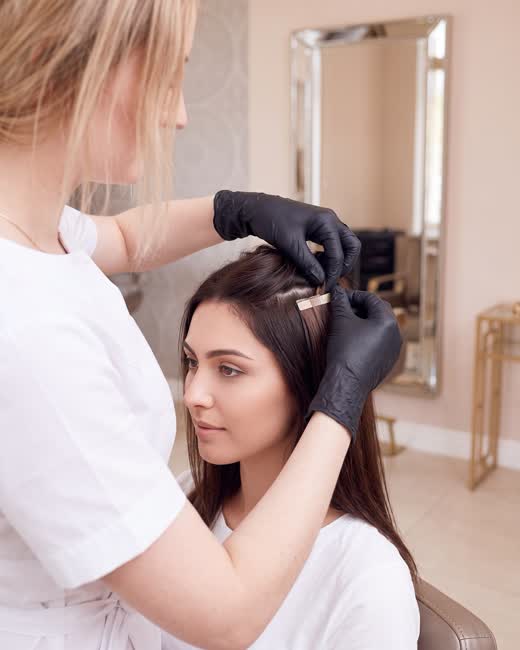
Hair from the inside — three layers, three roles
Before we can understand why the order of treatments makes a difference, we need to look at what we're actually colouring and what we're repairing. Hair that looks like a simple strand is, in fact, a three-layer structure — and each layer has a different function, a different resilience, and a different response to chemical treatments.
- Cuticle — the outer layer. These are overlapping scale-like plates arranged like roof tiles around the hair shaft. When the cuticle lies flat and tight, hair is smooth, glossy and impermeable — nothing unwanted gets in, and moisture and pigment stay where they should. When the cuticle is lifted or damaged (as after excessive bleaching, dryness or aggressive treatments), hair becomes porous and loses its ability to hold onto anything.
- Cortex — the middle layer, the core of the hair. This is where natural and artificial pigments live, and where the structure responsible for strength and elasticity runs. During colouring, dye needs to reach the cortex — and this is where it's decided whether colour will be even and long-lasting. In healthy hair, the cortex is dense and well saturated. In damaged hair, it's riddled with gaps, irregular, and absorbs pigment unevenly — hence patches, cold undertones and fast fading.
- Medulla — the centre. The deepest, partly hollow layer. Its role isn't fully understood — finer hair often doesn't have one at all. It isn't the main player in colouring and repair, but it does affect the strand's overall mechanical strength.
What colouring does to hair — the mechanism, without embellishment
For colour to change the natural shade of hair — lightening it or covering it with a different tone — it has to reach inside the cortex. This isn't a figure of speech: pigment physically penetrates the hair structure. To get there, it first has to open the cuticle. This is where the unavoidable cost of colouring begins.
The agents used to open the cuticle are alkalis — alkaline compounds found in every hair dye. They work effectively: the cuticle lifts, pigment enters the cortex, and a chemical reaction deposits the new colour. The visual result can be excellent — but after this process, hair is left in a state that needs attention. The cuticle has been forced open, the cortex has gone through a chemical reaction, and moisture and lipid levels are reduced. The more intensive the colouring (especially lightening), the more pronounced these effects are.
And here's the key principle: hair that goes into colouring in poor condition comes out in even worse condition. Porous cuticles, a weakened cortex, dry and brittle structure — all of this deepens further under the influence of chemistry, even mild chemistry. So the question of repair "before or after" isn't a matter of aesthetics. It's a question of the starting point colouring has to work from.
What repair actually is — and what it actually fixes
The word "repair" gets used very broadly in hairdressing — and doesn't always mean the same thing. It's worth understanding what different treatments actually do to hair structure, so the logic behind their order relative to colouring makes sense.
- 01
Hydration
Replenishing the water level within the hair structure. Dehydrated hair is dull, brittle and loses elasticity. Hydration is the quickest and easiest improvement, but also the shortest-lasting — without sealed cuticles, water escapes quickly.
- 02
Cortex regeneration
Replenishing the internal structure of the hair — proteins, amino acids, keratin. This works deeper than hydration: it's about rebuilding what has been chemically damaged or washed out. The effect lasts longer and has a real impact on hair strength.
- 03
Cuticle sealing
Restoring the cuticle's tight, flat arrangement — by lowering pH or using specific compounds. Sealed cuticles hold both moisture and pigment inside. This is the stage that determines how long colour lasts.
- 04
Lipid sealing
External protection for the hair surface — replenishing the lipid layer responsible for smoothness, shine and resistance to outside factors. This is the cuticle's last line of defence.
A good repair treatment carries out this whole process in the right order. But — and this is key to understanding the whole logic — sealed cuticles and a sealed cortex make it harder for pigment to penetrate. If hair is perfectly "sealed" and impermeable, colouring will struggle to deposit pigment evenly. That's why full repair after colouring works differently to repair before it.
Why order makes a difference — two scenarios compared
The theory is easiest to show with a concrete example. Picture hair after a year of intensive colouring, several lightening sessions and daily exposure to straightener heat. The cuticle is lifted and irregular, the cortex has gaps, porosity is high. This hair arrives at the salon for another colouring session.
Scenario A: colouring without repair
Hair goes into the chemistry in poor condition
- Pigment absorbs unevenly through irregular cuticles
- Pigment settles more heavily in damaged areas of the cortex — hence patches and dark tones
- Chemical action on an already weakened structure
- A "flat" or cold result, because the colour doesn't reflect the intended tone
Scenario B: repair, then colouring
Hair goes into the chemistry evened out
- Cuticles pre-evened — pigment absorbs uniformly
- Cortex replenished with proteins — there's somewhere for pigment to settle
- Colouring works on a more stable base
- A cleaner, deeper result, true to the intended tone
The difference isn't always dramatic — on healthy hair with minor damage, both scenarios can give a similar result. But on heavily porous hair, after intensive treatments or with a history of inconsistent care, repair before colouring can shift the result by several tone levels and several weeks of colour longevity. That's a real difference, visible after every wash.
When repair after colouring matters — and why it's not the same thing
Repair after colouring is an absolute necessity — but it plays a different role to repair before the treatment. Its job is to lock in colour and repair the structure after the chemical process. Sealed cuticles, a replenished cortex and a sealed surface determine how long colour looks fresh — and whether hair, weeks later, is elastic and glossy or dry and dull.
- Sealing the cuticle after the alkaline process — pigment stays inside the cortex
- Replenishing lipids washed out by chemical agents
- Restoring elasticity and hydration lost during colouring
- Protecting colour from hard water, UV and heat
In short: repair before colouring prepares the ground, repair after protects it. Either one works on its own — but both together, in the right order, give a result that lasts significantly longer than any single piece of this puzzle.
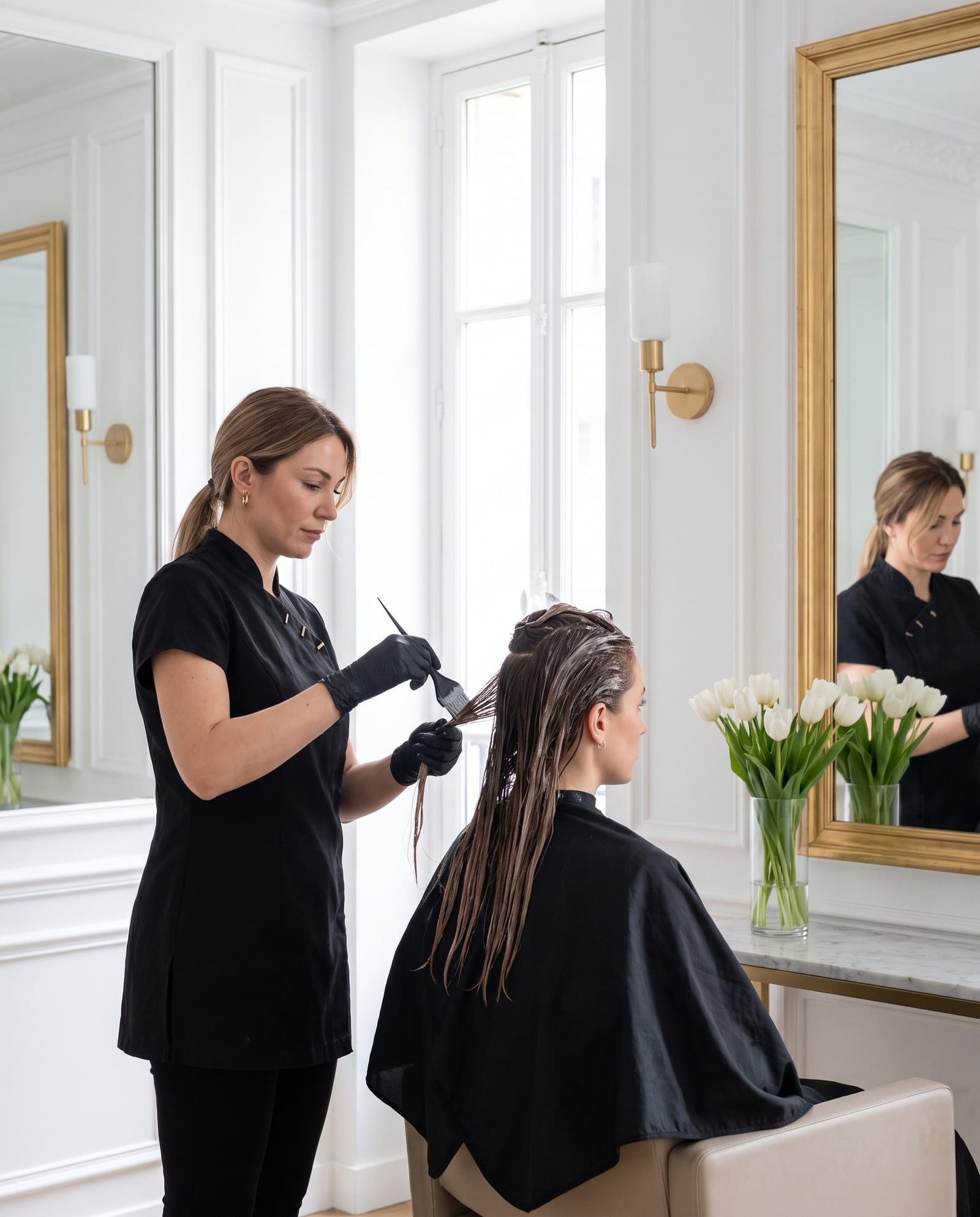
When repair is absolutely necessary — the signs
Not every head of hair needs an intensive repair protocol before every colouring session. But there are a few clear signals that hair isn't ready for another chemical treatment — and that skipping the repair stage will produce a result far from what you'd hoped for.
- Dry, rough ends — often the first place high porosity and cortex damage show up
- Colour fades very quickly — a few washes, and an intense shade is left as a shadow of itself. A sign that the cuticle isn't holding onto pigment
- Hair goes rubbery when wet — porous, damaged structure loses elasticity when wet; this rubbery feel is a critical warning sign
- Uneven results from previous colouring — patches, cold tones, a shade different from the swatch. High odds this will happen again without repair
- A history of multiple lightening sessions in a short time — bleaching is the most aggressive process for hair structure; it almost always calls for a repair protocol before the next treatment
- Heavy heat styling — daily straightening or curling at extreme settings speeds up cuticle damage
Home care as the third piece of the puzzle
The salon and home are two different levels of the same care for hair. Salon treatments can build a solid foundation — evening out porosity, rebuilding the cortex, sealing the cuticle. But what happens between visits decides how long that foundation holds.
After colouring, hair is in a state of heightened sensitivity — and the weeks following the treatment are when home care has the greatest impact on the final result. The cuticle needs support to stay sealed. The cortex needs regular replenishment of what water and heat draw out. Colour loses intensity more slowly when it has somewhere to "sit".
Colouring + repair treatment in the salon
The classic pairing: repair before the process evens out porosity and prepares the cortex, repair after seals the cuticle and protects the colour. The colour result is cleaner, and it lasts noticeably longer.
Keratin straightening + colouring
Two intensive chemical processes — the order and the gap between them matter enormously for hair structure. Combining them is possible, but it requires assessing hair condition, and often a repair stage in between.
Bleaching + toning + reconstruction protocol
For intensive lightening, the repair protocol may be split into several stages — some before the process, some after. Toning on repaired hair gives a noticeably cleaner, longer-lasting result.