Hair loss in men: what's normal and what's a warning sign
Everyone loses hair — every day, with every wash, every time you run a hand through your hair. That's physiology, not a problem. The hair growth cycle lasts several years, and shedding is simply its natural end. The problem starts when the balance shifts: shedding speeds up, and new hair either doesn't grow back at the same rate or comes in thinner. That's when it becomes visible.
In men, the most common cause is male pattern baldness — genetically determined, progressing in a characteristic pattern (a receding hairline, thinning at the crown). But hair loss isn't always down to androgens. Increasingly, the cause is stress, deficiencies (iron, zinc, B vitamins, D3), overload on the body, poor sleep, or simply months of working at peak tension.
The distinction matters, because different causes of hair loss need different approaches. A strengthening treatment won't reverse male pattern baldness — but it can slow the process, improve the quality of remaining hair, and restore follicles weakened by stress or deficiencies. Knowing what you're treating is the first step.
Why an off-the-shelf shampoo isn't enough
The market for "hair loss" products is enormous. Most rely on good marketing and ingredient concentrations that look impressive on the label, but their real effect on the scalp is marginal. That's not because manufacturers are lying — an active substance simply has a long way to travel to reach the follicle, and only a small number of molecules cross the skin barrier in the right concentration.
Off-the-shelf product
what it does and doesn't do
- cleanses the scalp
- may improve hair shaft hydration
- visual effect (gloss, volume)
In-salon treatment
what actually changes
- active substances delivered directly (mesotherapy, ampoules)
- stimulation of scalp microcirculation
- rebuilding the hair growth environment
That doesn't mean daily care is pointless — it isn't, especially when it complements an in-salon programme. But a strengthening treatment isn't a series of expensive shampoos. It's a planned sequence of treatments that work deeper than the cosmetic layer.
What a strengthening programme includes
A good hair treatment programme for men combines several elements that support each other. There's no single treatment that "fixes" everything — but there is a sequence that can stop the process and improve the condition of the hair you have.
- 01
Scalp diagnostics
Before any treatment — an assessment of follicle condition, scalp health and shedding phase. A trichoscope shows what's invisible to the naked eye: follicle condition, micro-inflammation, hair density per cm². Without it, you risk treating the wrong thing.
- 02
Scalp mesotherapy
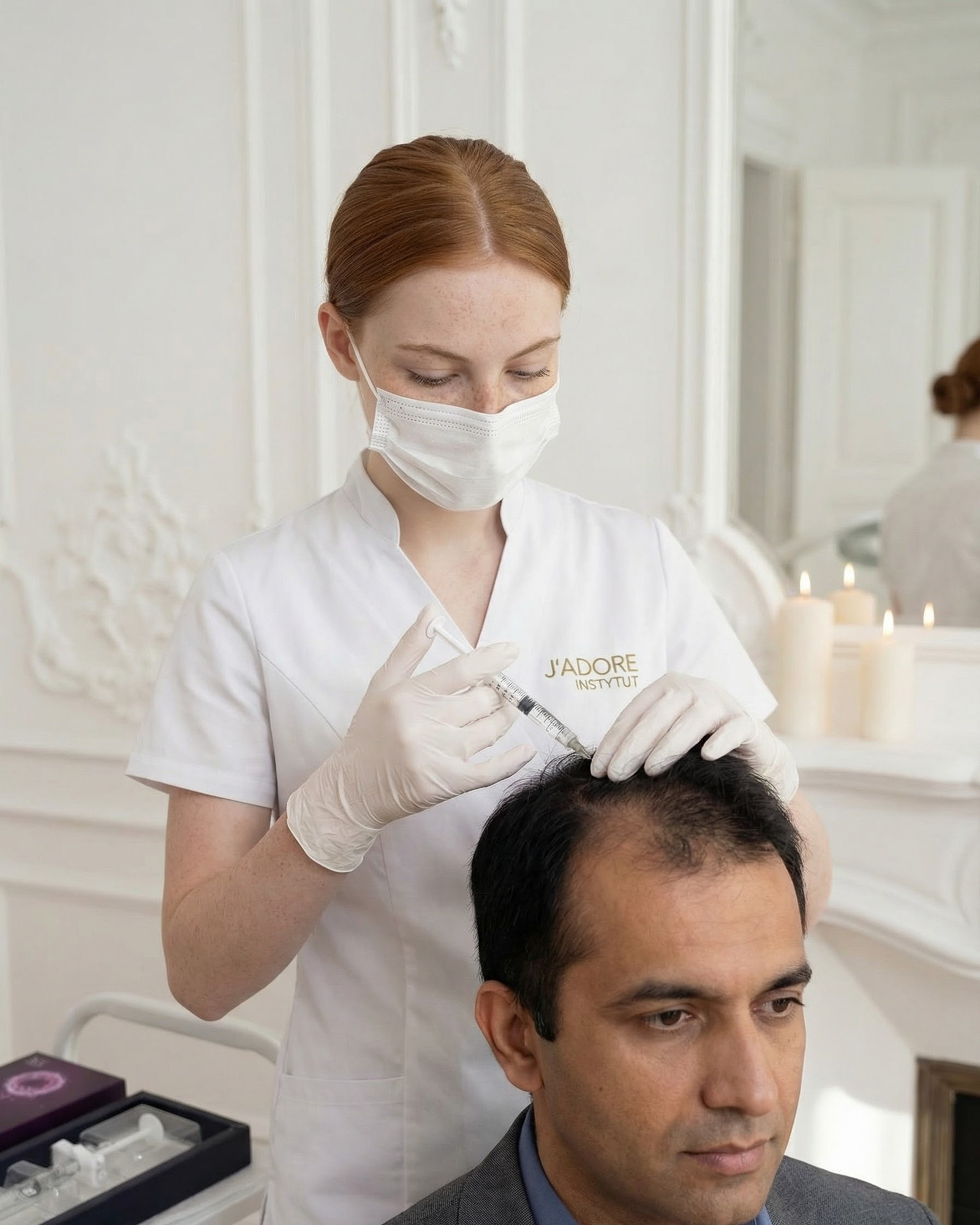
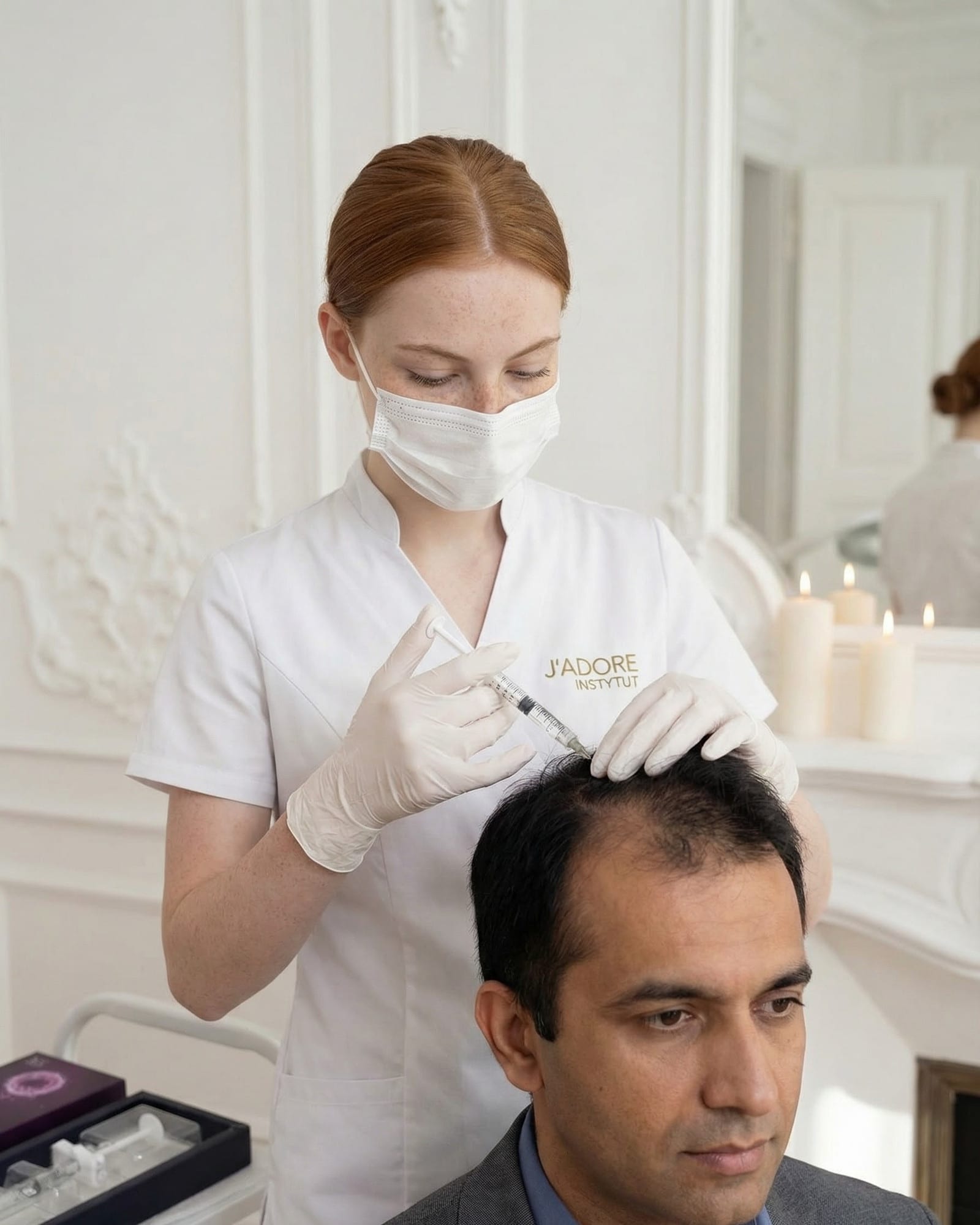
Active substances (peptides, vitamins, trace elements) delivered directly into the scalp — bypassing the skin barrier. For many people, this can improve blood flow to the follicle and slow shedding. It requires a series, and results are gradual.
- 03
Microcirculation-stimulating treatments
A scalp with poor circulation is an environment where the follicle simply works less well. Treatments that boost blood flow improve nutrient delivery to the hair root.
- 04
Supporting regenerative treatments
Depending on scalp condition — hydrating treatments, anti-inflammatory care, sebum regulation. A healthy growth environment is the foundation of the whole programme's effectiveness.
- 05
Review and adjustment of the plan
After a few weeks — a follow-up trichoscope assessment. Data, not impressions, show whether the programme is working and what might need adjusting. Without a review, there's no way to know whether to continue in the same direction.
When to start — and why timing matters
The popular "I'll wait, maybe it'll pass" approach works for reactive hair loss (after severe stress, illness, deficiencies) — but only if you also remove the cause. If stress is chronic, deficiencies persist and shedding keeps increasing, time works against you: hair follicles can gradually lose their growth potential.
The good news: for many people, reactive hair loss responds well to a strengthening programme, especially when started at the right time. Androgenic hair loss isn't reversible, but its progress can be clearly slowed, and the quality of the remaining hair can be improved.
What you can do yourself, and what needs a salon
A good programme combines what you can control yourself with what a salon does. Neither replaces the other — but together they make sense.
- Blood tests — before anything else. A full blood count, ferritin, TSH, zinc, vitamin D3 — this isn't "advanced diagnostics", it's the absolute basics. You can address deficiencies yourself (guided by your results), and this often removes an important cause.
- Targeted supplementation, not "just in case". Biotin works, but only if you're deficient in it. The same goes for zinc, iron and D3. Buying everything at once without tests isn't prevention — it's wasted money.
- Scalp massage. A few minutes daily, with your fingertips or a dedicated brush. It stimulates microcirculation — simple, free, and with real evidence behind it.
- Regular washing. A scalp with built-up sebum and impurities is a worse environment for the follicle. Scalp cleanliness isn't optional — it's a basic requirement.
- Avoiding heat overload. A hairdryer on maximum heat, every day, doesn't help. If you dry your hair, keep the temperature moderate.
A salon steps in where self-care hits physical limits — when active substances need to reach deeper than the skin allows, when imaging diagnostics are needed, or when shedding is intense enough to require more advanced intervention.
Scalp mesotherapy + trichoscopy
Diagnostics before and after the series — the only way to genuinely assess progress without guesswork.
Strengthening treatment + home ampoules
In-salon treatments work more effectively when combined with well-chosen daily care. Your specialist can suggest a home protocol that fits your treatments.
Programme + internal medicine consultation
If test results point to deficiencies or hormonal imbalances, in-salon treatment should go hand in hand with treating the cause, not just the symptom.
What to expect — honestly
A strengthening treatment isn't a hair transplant, and it doesn't work like a shampoo advert. Results are gradual, measured in months, not weeks. Many people see a clear reduction in shedding, thicker and denser hair, and a healthier scalp. For some, the process stops and the condition stabilises.
Mindset matters here: this isn't a one-off "fix it and forget it" treatment, but a programme that requires consistency. A series of sessions, plus review, plus adjustment where needed. Exactly like any other health protocol — the gym, a diet, physiotherapy. Results are proportional to consistency.