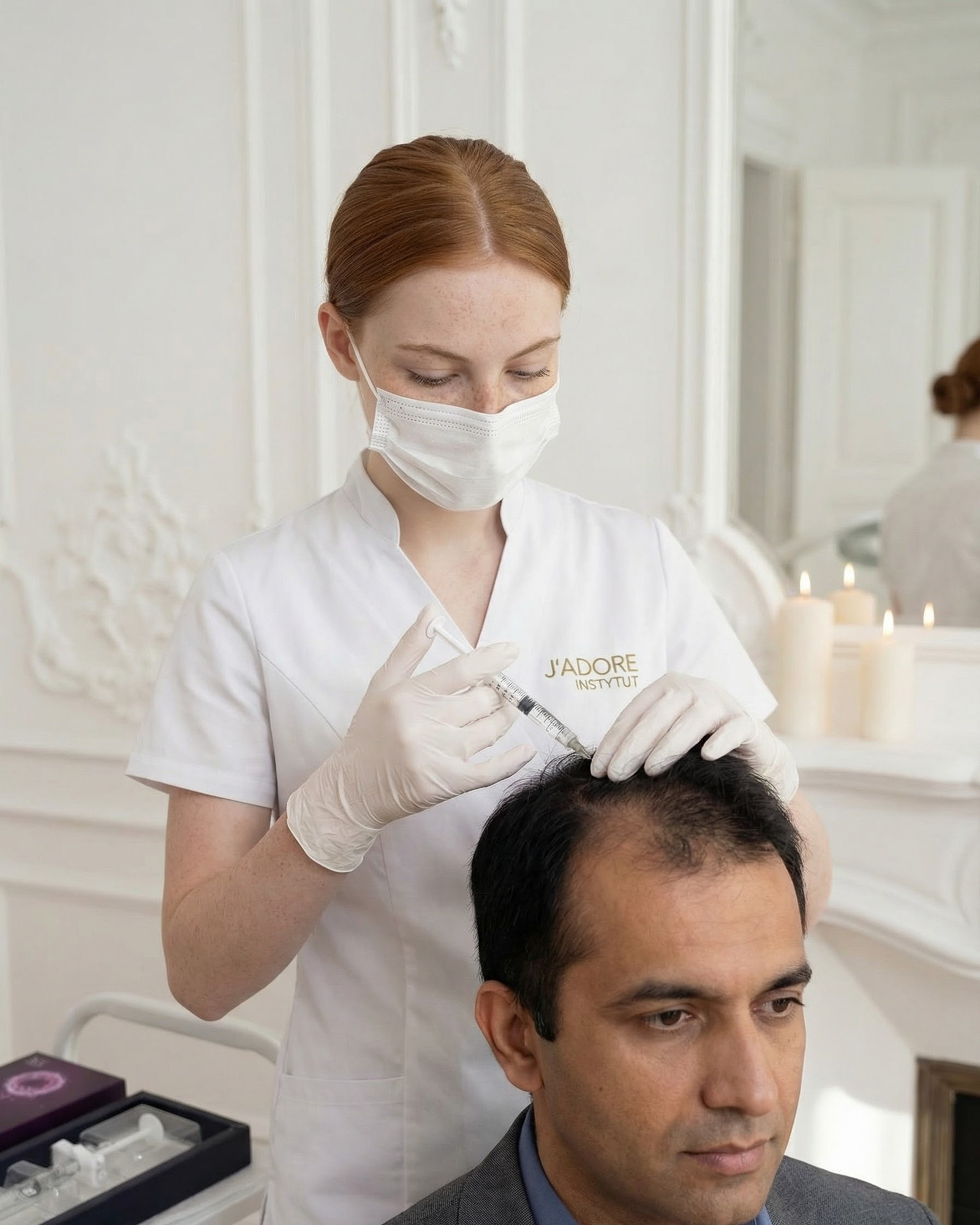

What is actually happening to your hair
The mechanism is simpler than it seems. It is worth understanding, because it explains why half of the “miracle methods” cannot work. In short, some of your hair follicles — especially those at the temples and crown — are genetically sensitive to DHT (dihydrotestosterone), a testosterone derivative. DHT gradually affects sensitive follicles: each new growth cycle is shorter, while the hair that grows becomes thinner, shorter and lighter. This process is called miniaturisation.
This is why AGA does not look like sudden patchy hair loss — it is gradual thinning. First come the receding temples, then thinning at the crown. The back and sides of the head usually remain unaffected, as follicles there are resistant to DHT. This is also why they are suitable for transplantation. It is not about having “too little testosterone”. On the contrary, the myth that “bald means full of testosterone” comes from the fact that the issue is follicular sensitivity to the hormone, not its level.
The key conclusion is this: a follicle miniaturises gradually, but eventually disappears for good. While it is alive, it can still be treated. Once it dies, no hair will grow from it again. A transplant is then the only option for that area. The whole process is therefore about time — acting while there is still something to save.
Diagnosis first, not guesswork
Before spending a single zloty, it is worth knowing what you are dealing with. It sounds obvious, but most men treat “their hair” blindly. They buy what an advert or a friend recommended, then wonder why it does not work. Not every type of hair loss is AGA. Thinning can result from iron or vitamin D deficiency, thyroid problems, stress, medication or diet. These causes require completely different treatment — and can often be reversed.
The starting point is a trichology consultation with trichoscopy — a scalp examination using a high-magnification camera. A trichologist can see what you cannot: whether follicles are genuinely miniaturising, what percentage of hairs are thin, and whether there is inflammation, excess sebum or dandruff. This shows whether it is androgenetic alopecia, what stage it is at, and whether other factors are involved.
- Trichoscopy — an assessment of density, hair shaft thickness and how many follicles have already miniaturised. It is your “baseline photo” for comparing progress.
- Medical history — when it started, how your father and grandfathers lost their hair, what medication you take, and what your diet and sleep are like.
- Blood tests when needed — iron/ferritin, vitamin D and thyroid tests — to rule out reversible causes that can easily be mistaken for AGA.
What really works — and what is marketing
This is the key point. The hair-growth market offers hundreds of products, but only a handful have a genuine basis. Let us break it down — what makes sense for AGA, and what you can skip.
Has a genuine basis
works on the AGA mechanism
- treatment targeting DHT and follicle stimulation (a doctor’s/trichologist’s decision)
- scalp mesotherapy — nutrients delivered directly to the follicle
- PRP / platelet-rich plasma — a regenerative stimulus from your own blood
- exosomes and regenerative scalp therapies
- consistency measured in months, not weeks
Marketing and myths
a waste of time and money
- a “miracle hair growth shampoo” as the only treatment
- head massage or standing on your head “to improve circulation”
- oils and homemade masks “for receding temples”
- waiting for it to “go away on its own” or “grow back with age”
- changing five products every month because “it does not work after two weeks”
Note one thing: serious methods do not exclude each other — they work together. A sensible plan usually combines action on the mechanism itself, by limiting the effect of DHT, with external follicle stimulation. The latter is what is genuinely done in the salon. Shampoo can support scalp condition, but treating it as “treatment” is exactly the trap most people fall into.
What is actually done in the salon
Specifically, without vague promises — these are the options that make sense for male pattern baldness and can be combined into a plan tailored to its stage. None is a “magic solution”. They work by delivering what the follicle needs or giving it a stimulus to function. All require a course of sessions and time — this is an investment measured in months.
- Scalp needle mesotherapy — nourishing and regenerative cocktails delivered directly into the scalp, where the follicles function. The aim is to improve their condition and nourishment, and support hair that is still growing. A classic part of a plan for thinning hair.
- PRP / platelet-rich plasma — a platelet- and growth factor-rich fraction is separated from your blood, then delivered into the scalp as a regenerative stimulus. It may sound like science fiction, but it is standard practice in the salon.
- Scalp exosomes — a newer generation of regenerative therapies that carry signals stimulating the follicles. They are often combined with microneedling for better absorption.
- Microneedling / regeneration with microneedling — controlled micro-stimulation that creates a pathway for active ingredients and stimulates the scalp itself.
A separate situation arises when part of the area is already “burnt out” — the follicles have died and nothing will grow from them. Then a realistic aesthetic solution may be scalp micropigmentation (SMP): precise pigment microdots that imitate the effect of beard stubble and create the appearance of greater density. This is not treatment — it is highly effective camouflage. It works particularly well with a short cut and for “burnt-out” receding temples.
Timing — why “later” is the worst strategy
If you remember one sentence from this text, let it be this: with male pattern baldness, the person who starts early wins. The whole mechanism comes down to a race against miniaturisation. The earlier you act, the more living follicles there are to save and the better the potential result. The later you start, the more areas remain where only camouflage or a transplant is possible.
- 01
You notice the first signs
More hair on the towel and pillow, the hairline at the temples seems to be receding, and the crown shows through in sunlight. This is the moment most people dismiss — and it is exactly when there is most to gain.
- 02
Diagnosis instead of guesswork
A trichology consultation with trichoscopy: is it AGA, what stage is it at, and is there a reversible cause involved? Without this, everything else is a shot in the dark.
- 03
A plan tailored to the stage
Usually, we combine targeting the underlying mechanism with in-clinic follicle stimulation (mesotherapy, PRP, exosomes). This is agreed with a trichologist/doctor, not on an online forum.
- 04
Sessions and patience
Hair condition results are assessed over months, not weeks. A course of sessions is performed, monitored with trichoscopy and compared with a “baseline photograph”.
- 05
Maintaining the result
AGA is a chronic process — maintaining the result requires consistency. It is not “one treatment and done”, but a routine you build into your life.
Pay attention to the final point, as it can be disappointing: there is no finish line. Androgenetic hair loss is chronic and progressive by nature — it can be slowed and inhibited, but DHT pressure on the follicles does not disappear. That is why we talk about maintenance, not a “permanent cure”. It is an honest trade-off for a real result — and still far better than passively watching the process take its course.