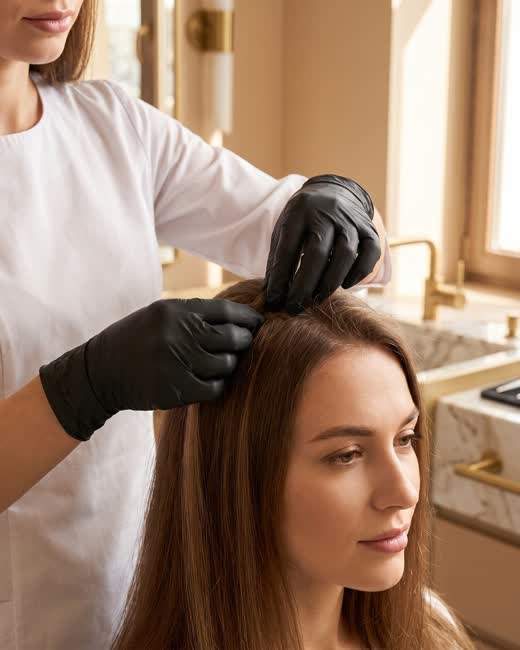
What androgenetic alopecia actually is
Androgenetic alopecia (AGA) results from hair follicles' sensitivity to dihydrotestosterone (DHT) — a derivative of testosterone that, in genetically predisposed people, causes gradual follicle miniaturisation. Hair becomes progressively thinner, shorter and lighter, until the follicle stops producing visible hair. In men, this usually shows up as a receding hairline and thinning at the crown. In women, it shows up as diffuse thinning around the frontal area and parting, without a receding hairline. In both cases the mechanism is the same, though the pace and pattern differ clearly.
Diagnosing AGA isn't purely visual — it requires ruling out other causes of hair loss: alopecia areata, telogen effluvium (e.g. after stress, pregnancy, illness), and deficiencies (iron, ferritin, vitamin D, zinc, thyroid hormones). A treatment without this diagnosis is a shot in the dark — and the first myth worth putting to rest.
Seven myths that sabotage therapy
Myth 1: "A series of treatments and the problem is solved." This is the most common mistake — treating mesotherapy, PRP or carboxytherapy like a one-off course of antibiotics. Treatments for androgenetic alopecia work as support — they boost microcirculation, deliver nutrients to the follicles, and can slow miniaturisation and stimulate regrowth. But they don't remove the cause: the follicles' sensitivity to DHT remains. Without continuation — regular maintenance sessions and consistent home care — the effect gradually fades.
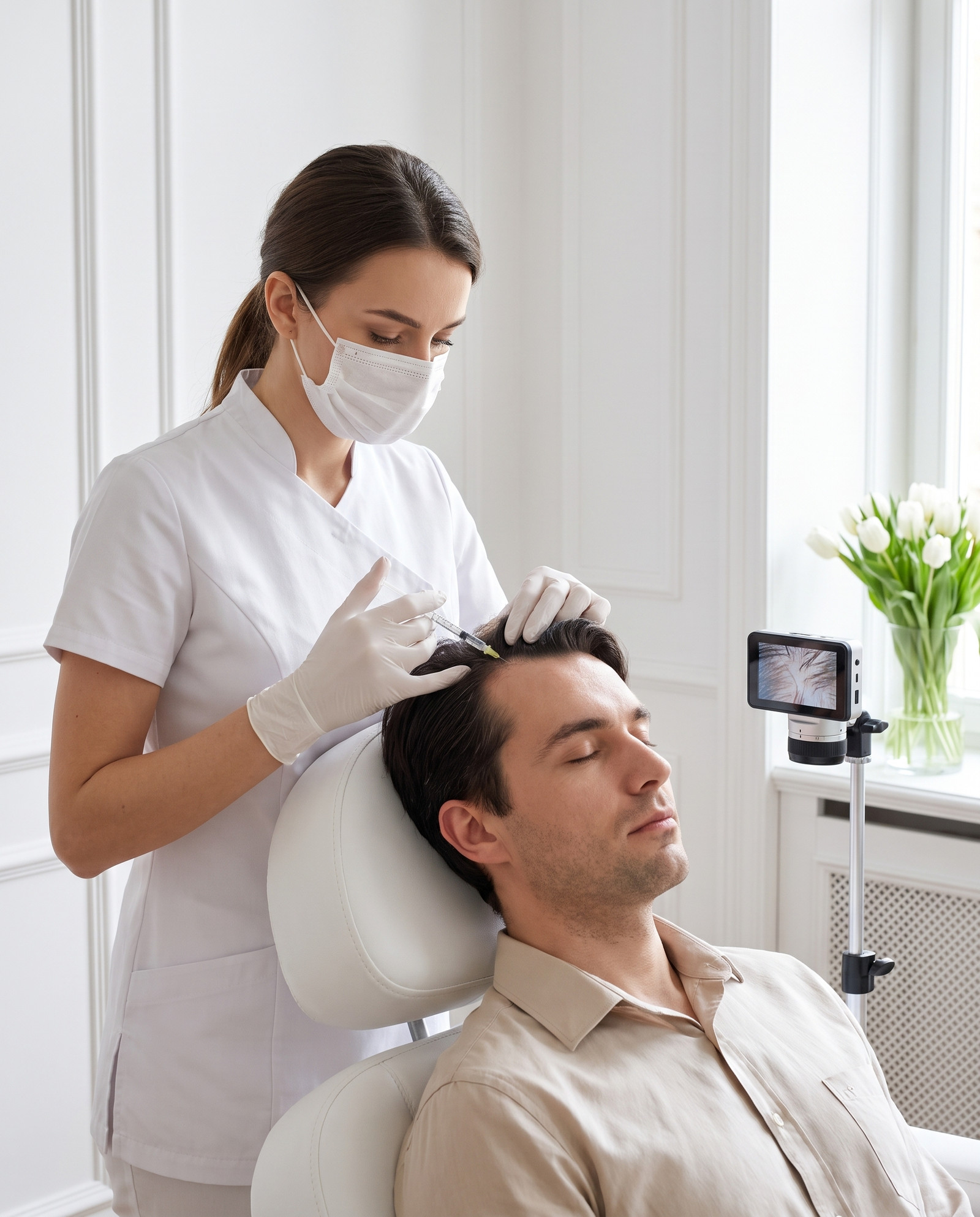
Myth 2: "The treatment will work without a diagnosis." Before a trichologist or dermatologist prescribes the first treatment, they should establish a specific diagnosis. Hair loss has more than a dozen possible causes, and some of them look similar to AGA but require completely different management. Telogen effluvium — triggered by, for example, anaemia, hormonal stressors or a restrictive diet — often resolves on its own once the cause is removed. Treated as AGA and put through a series of sessions, it just wastes budget and time. Trichoscopy, blood count, ferritin, TSH, hormone panel — these are the minimum before starting therapy.
Myth 3: "Home-care products don't matter if I'm having treatments." The hair follicle works around the clock — seven days a week, not just on the day of your salon visit. Daily scalp care — the right shampoo (sulphate-free for sensitive scalps, with zinc or piroctone olamine for accompanying dandruff), serum or ampoules with peptides, caffeine, minoxidil or phytosterols — isn't a cosmetic luxury. It's daily support for microcirculation and the follicle environment. Treatments work faster and last longer when the home routine doesn't work against them.
Myth 4: "Results show up after a month — and if they don't, the treatment isn't working." The hair growth cycle takes several months. A follicle stimulated by a treatment enters the anagen (growth) phase with some delay — and only after a while do fine regrowths become visible on the scalp. Full assessment of a treatment series is usually only possible three to six months after finishing the course, not a week after the last session. Giving up too early is one of the most common mistakes.
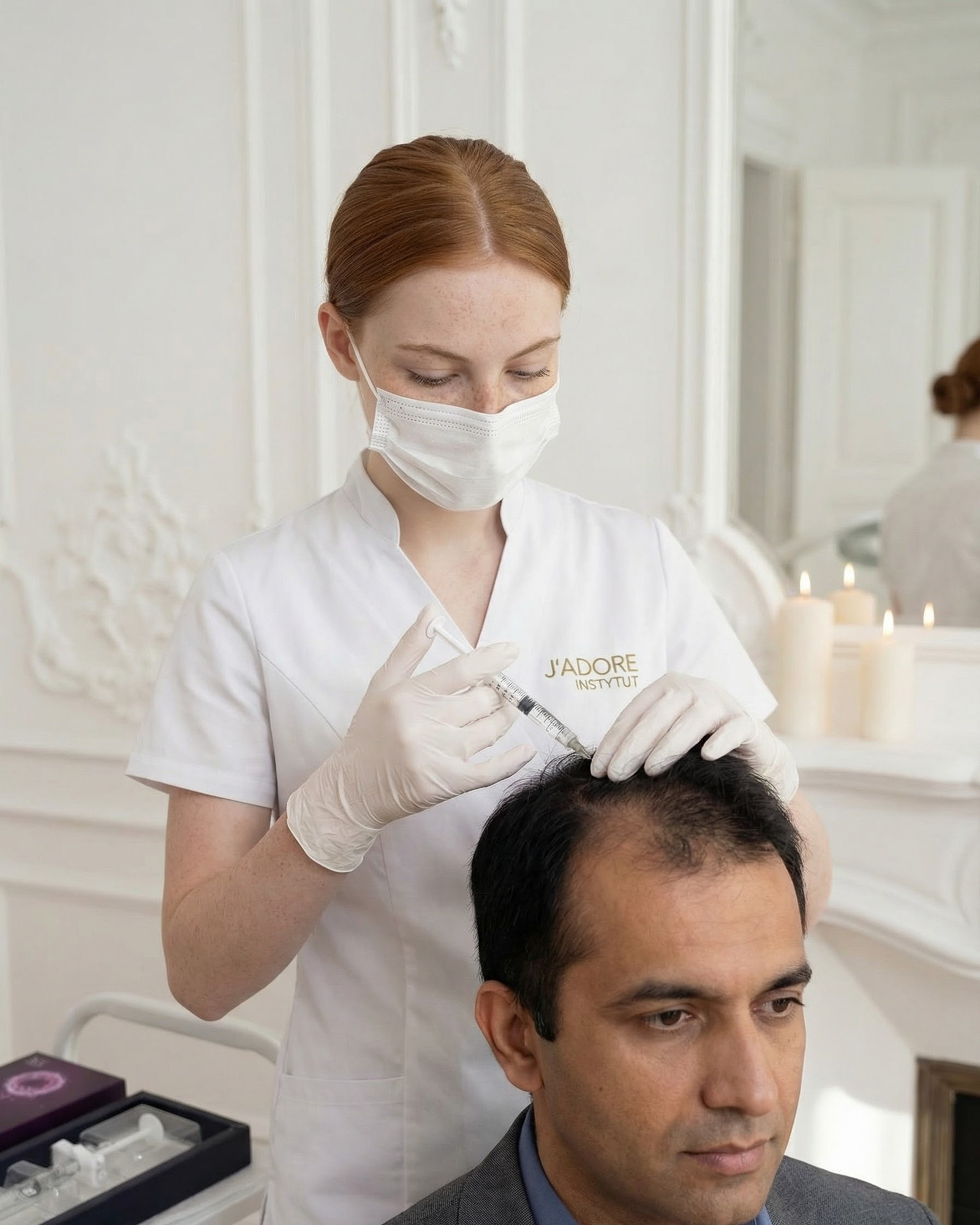
Myth 5: "PRP is the only effective method." PRP (platelet-rich plasma) is very popular — rightly so, since it delivers concentrated growth factors to the follicles. But effective AGA therapy is usually a combination of methods, not a single "gold standard." Needle mesotherapy, carboxytherapy, treatments with fibroblasts, laser support, and — in men — sometimes oral drugs that inhibit 5-alpha-reductase under a doctor's supervision, can all be part of a plan, depending on the stage and how the body responds. The question isn't "what's the best treatment?" but "what's best for you, at this stage, with your results?"
Myth 6: "Baldness is only a men's problem." Androgenetic alopecia in women is far more common than people think — estimates suggest it affects up to 40% of women by age 50, though it often presents differently and is less often recognised. In women, thinning concentrates around the parting and frontal area, without a receding hairline — and for years it's often dismissed as "normal shedding." There's also a hormonal difference: in women, AGA can be linked to PCOS, insulin resistance, falling oestrogen during menopause, or hyperandrogenism. This means a woman's AGA treatment plan should always include a hormone panel, and often collaboration with a gynaecologist or endocrinologist.
Myth 7: "Once hair starts growing back, everything can be stopped." Regrowth after therapy is an intermediate goal, not the end of treatment. AGA is a chronic process — follicle sensitivity to DHT doesn't disappear. Once a satisfying result is achieved, we recommend switching to maintenance mode: less frequent sessions, consistent home care and regular trichology check-ups. Stopping everything usually means a gradual return to the pre-treatment state — just a few months later, which is often misread as "the treatment stopped working."
What a plan that actually works looks like
Effective androgenetic alopecia therapy rests on four pillars that need to work together — not one after another. Treatments without a diagnosis, diagnostics without home care, or home care without maintenance — each leaves the puzzle incomplete. The framework that delivers lasting results looks roughly like this:
- 01
Diagnosis
Trichoscopy, a panel of tests (ferritin, blood count, hormones, TSH) — establishing the cause of hair loss before starting therapy.
- 02
Series of treatments
Usually several sessions every 2–4 weeks — mesotherapy, PRP, carboxytherapy, or a combination, chosen based on the stage and test results.
- 03
Daily care
Shampoo, serum and trichology ampoules as a permanent part of your routine — not a one-off add-on to a treatment series.
- 04
Maintenance phase
After the series is complete — follow-ups every 2–3 months and regular trichology reviews, to assess progress and adjust the plan if needed.
Each of these pillars requires patience — results don't appear week by week. But clients who stick to the plan for a year often achieve results that would have seemed impossible a year earlier: noticeably thicker hair, a less visible parting, and thinning brought to a halt.
Women and men — same condition, different approach
Women with AGA
Hormonal differentiation is essential
- Diffuse thinning at the crown and parting — hairline preserved
- Frequent overlap with PCOS, insulin resistance or deficiencies (ferritin, vitamin D)
- Hormone panel required before therapy
- Special attention during perimenopause and menopause
- Trichology treatments + possible gynaecological or endocrinology consultation
Men with AGA
Visible earlier, diagnosed earlier
- Receding hairline and/or crown thinning — Norwood pattern
- DHT as the main driver — faster progression than in women
- Earlier age of onset (often before age 30)
- Medications that reduce DHT are available — require a doctor's consultation
- Trichology treatments + possible dermatology or andrology consultation
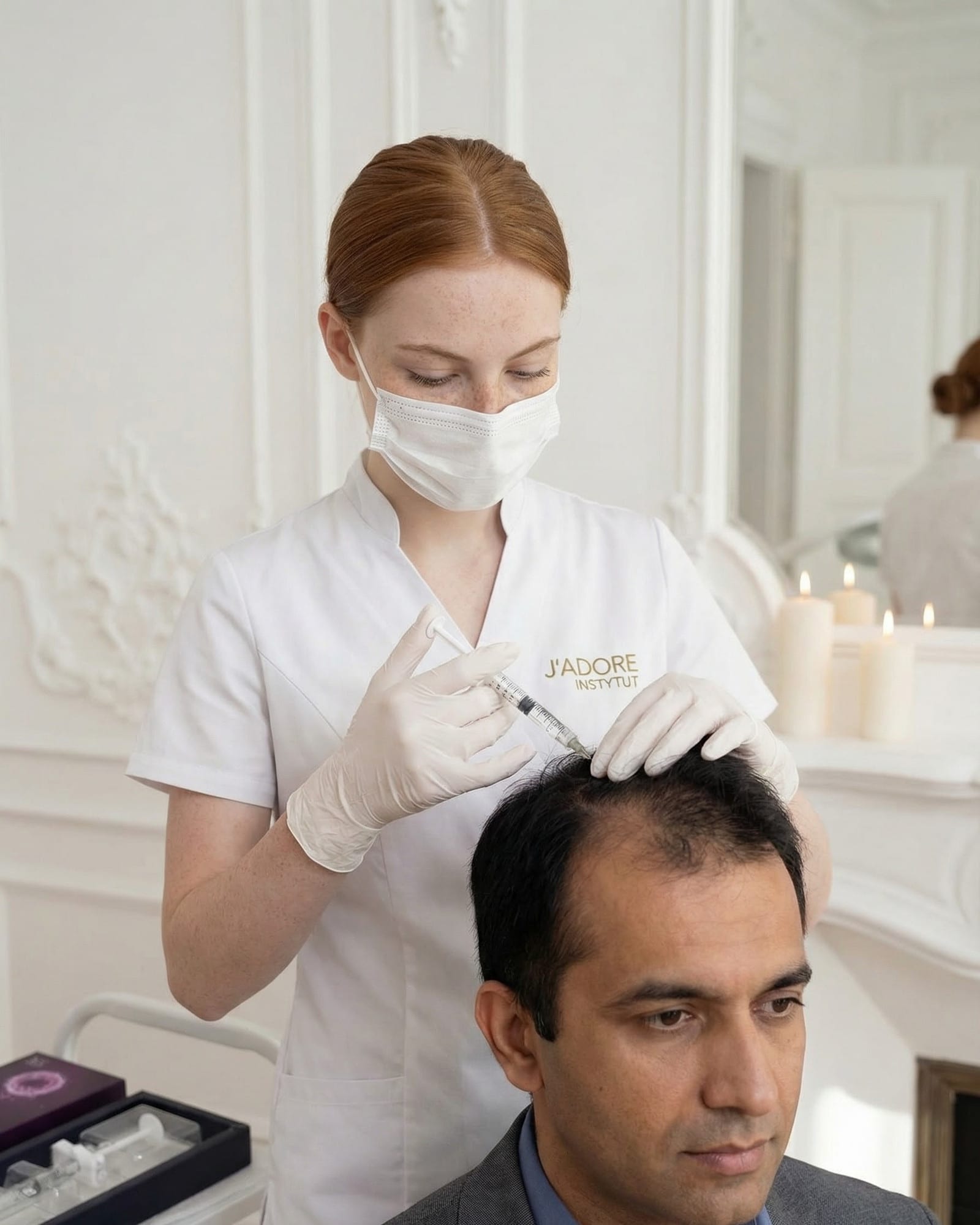
Treatments worth knowing — and how to combine them
Trichology treatments available in salons work through different mechanisms — which is exactly why combining them tends to be more effective than a single approach. Not every treatment suits every stage, and not every method works the same way for a woman with iron deficiency as for a man with early Norwood II. A few methods that most often form part of a comprehensive plan:
Needle mesotherapy of the scalp
Delivers vitamins, minerals and active substances directly into the scalp — improving microcirculation and the follicle environment. A good base for a series, often combined with PRP or carboxytherapy.
PRP (platelet-rich plasma)
Growth factors from your own blood — can stimulate follicle regeneration and extend the hair growth phase. Particularly valued for moderate AGA.
Scalp carboxytherapy
Subcutaneous CO₂ delivery improves blood flow and tissue oxygenation, and may help activate "dormant" follicles. Well tolerated, and often used alongside mesotherapy.
Laser therapy (LLLT)
Photobiomodulation stimulation — may support follicle cell metabolism. Available both in salons and as at-home devices.
Fibroblasts and biostimulators
Treatments that regenerate the scalp environment from the ground up — particularly valuable when the scalp is dry, has disrupted microbiota, or accompanying excess oil.
The order and combination depend on the individual plan agreed with a trichologist or dermatologist — there's no single formula that fits everyone. A good specialist tailors the protocol to your test results, stage and response to previous treatment.
Before you start — worth knowing
Androgenetic alopecia is a process that can be slowed, halted and, in many cases, partly reversed — but this takes patience, consistency and a multi-pronged approach. A treatment is a tool, not a solution. If a salon tells you "ten sessions and the problem is gone for good" — that's a warning sign. An honest trichologist will say: this plan can bring clear improvement, but it needs continuation and your commitment between visits.
The most important thing you can do today is book a trichology consultation with trichoscopy, and bring your basic test results. The rest — choosing the method, session frequency, home-care plan — is the specialist's job. Your part: consistency and realistic expectations about timing.