Mango enzymes do more than just remove dead cells.
Many people sitting in the salon chair for the first time expect intense burning or even pain, associating peels with aggressive skin irritation. When an experienced cosmetologist applies a mango preparation to the face, surprise often follows. Instead of discomfort, the client feels only a delicate, pleasant warmth. This is the moment when myths about the need to "burn" the skin to achieve a radiant effect lose their meaning.
However, the enzymes contained in mango are not everything. The peel formula combines them with gentle acids, which allows for a dual-action effect. While the enzymes dissolve dead cells, the acids support the exfoliation process and stimulate the deeper layers of the skin to regenerate. This makes the treatment not only cleanse but also nourish and hydrate, using the richness of antioxidants present in the fruit.
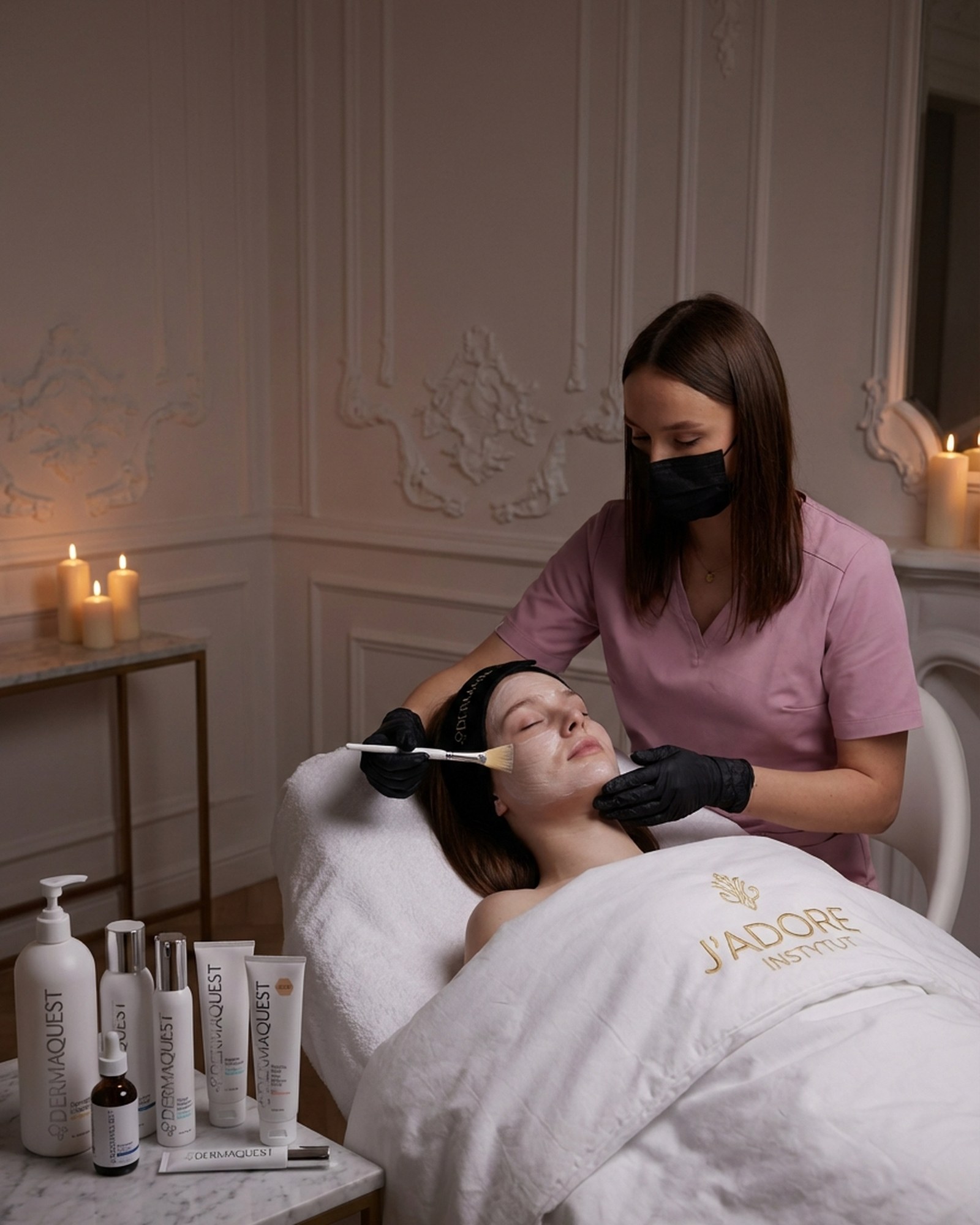
Thanks to this approach, the skin after the treatment is not "tired" from aggressive intervention but refreshed. This is crucial for those who are looking for an improvement in skin tone and to fight dullness, but cannot afford a long recovery. Illustrative photo, showing an example of the treatment process, during which the cosmetologist carefully observes the skin's reaction, ensuring that the process is gentle and predictable.
Your skin does not have to peel to look better.
I often hear the same question in the salon when a client looks in the mirror just after getting up from the chair: "Did it really work if I don't see any skin sheets?". In our skincare culture, there is a conviction that an effective peel must be visible to the naked eye in the form of intense peeling. In the case of Mango Peel, it is quite the opposite.
The lack of visible epidermal sheets does not mean the treatment was ineffective. On the contrary — with superficial peels like this one, the lack of a violent reaction is a sign of proper regeneration. Mango enzymes work in a subtle way, dissolving the bonds between dead cells in a controlled manner. The skin renews itself at a pace that does not disrupt its protective barrier, which allows you to avoid irritation and discomfort.
- Subtle exfoliation is almost invisible to others.
- The lack of skin sheets means the hydrolipid barrier remains intact.
- The radiance effect results from smoothing the surface, not from aggressively removing layers of the epidermis.
- If my skin doesn't peel, does it mean the treatment was too weak?
No. Mango Peel is a superficial peel designed to brighten and refresh the complexion without taking you away from your daily activities. The lack of visible peeling is proof that the treatment was well-matched to your sensitivity.
- How long can this subtle exfoliation last?
It is usually a process lasting up to a few days. It may manifest only as a slight feeling of tightness or dryness, which is easily calmed with appropriate home care.
We aim for the skin to look rested and radiant after the visit, not irritated. If your goal is radiance rather than a week of recovery, this type of work with the epidermis brings the most predictable results.
A home peel from a drugstore is not the same as a professional series.
Many people wonder if a home peel from a drugstore can replace a salon visit. Although both products are designed to smooth the epidermis, they differ primarily in their mechanism of action and the concentration of active substances. Professional preparations, such as those used in Mango Peel, are designed to work in controlled conditions where the cosmetologist monitors the skin's reaction on an ongoing basis.
Salon peel
- Precisely selected acid concentration
- Controlled pH of the preparation
- Deeper but safe action
- Professional skin condition assessment
Home peel
- Low, averaged concentrations
- Risk of improper use
- Only superficial action
- No specialist supervision
A common mistake is trying to perform intense exfoliation on your own just before an important event. It happens that clients, wanting to get a quick radiance effect, reach for drugstore products that are too strong or use them too often. The result is often the opposite of what was intended: instead of radiance, redness, burning, and irritation appear, which are difficult to hide under makeup.
- Home cosmetics do not provide the same control over the epidermal renewal process as a series of treatments.
- An improperly selected product can disrupt the hydrolipid barrier, leading to dryness.
- A professional treatment is not just exfoliation, but also appropriate soothing and hydration of the skin after applying acids.
In the salon, an experienced cosmetologist selects the preparation so that the skin receives exactly the dose of stimulation it needs, without the risk of aggressive irritation. It is this difference in precision that makes a professional series of treatments bring lasting improvement in skin tone and texture, while home experiments often end only in temporary discomfort.
A series of treatments builds an effect that cannot be achieved in one session.
A common mistake is expecting that one treatment will completely change the structure of the epidermis. In the case of Mango Peel, it is regularity that determines whether we get only a temporary radiance effect or a lasting improvement in skin tone. A series of treatments allows for gradual, controlled exfoliation that does not disrupt the skin's protective barrier while effectively stimulating renewal processes.
- 01
First meeting
The skin gains an immediate glow and a feeling of smoothness, which is an ideal introduction to further work.
- 02
Building the effect
During subsequent visits, thanks to 1–2 week intervals, the skin tone is evened out and roughness is reduced.
- 03
Final stage of the series
After 4–6 treatments, the complexion becomes noticeably firmer, and fine discolourations become less visible.
During a salon visit, I often hear the question about why all repetitions cannot be performed in a shorter time. An experienced cosmetologist always emphasises that the skin needs time to regenerate between sessions. 1–2 week intervals are crucial for safety — they allow for safe use of acids without the risk of irritation. It is this time that allows for building an effect that cannot be achieved in one session.
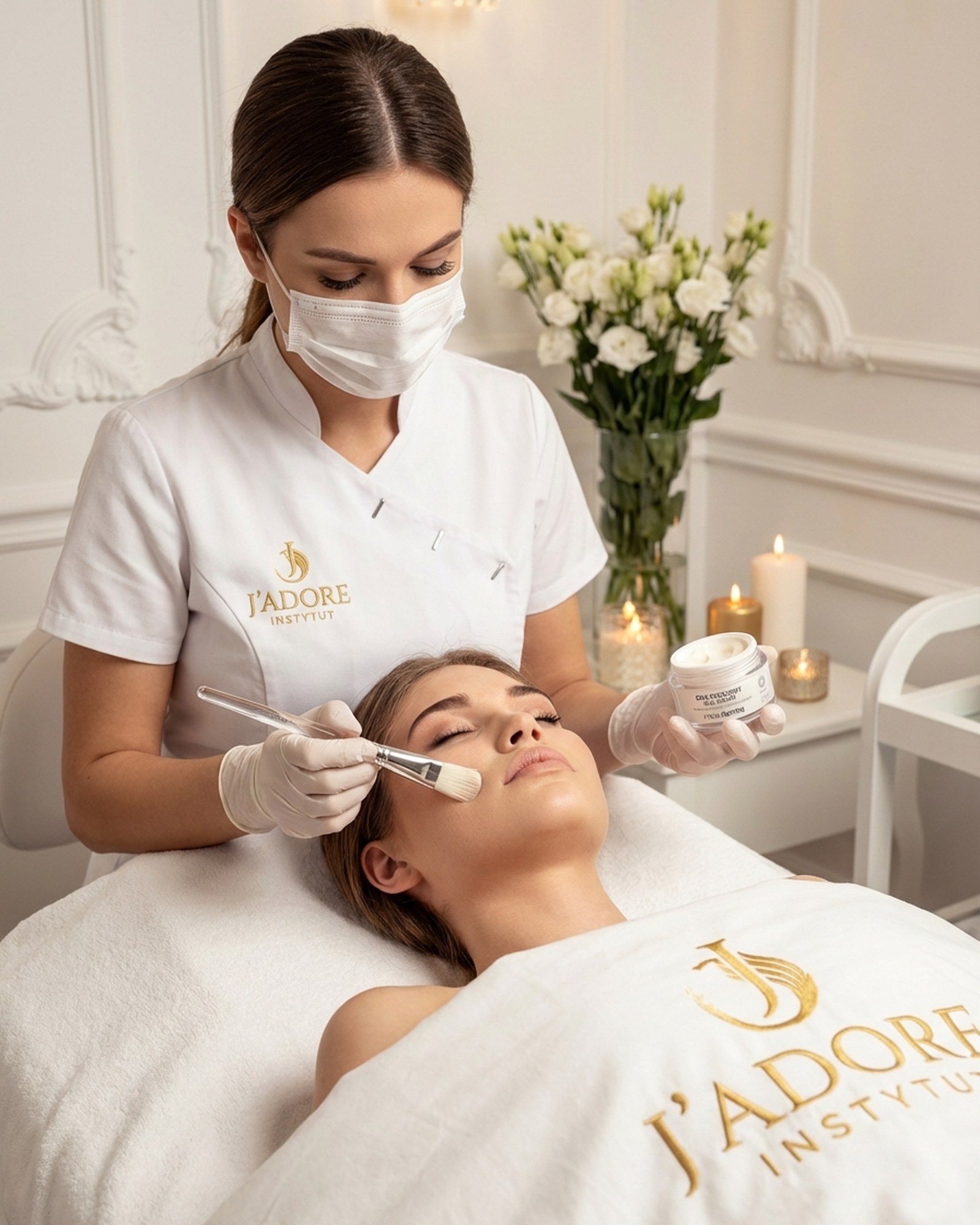
In the salon, we observe how the complexion of our clients changes. After the third treatment, the skin looks completely different than after the first — it becomes more uniform, and its texture is smoothed. This is proof that patience in planning visits brings results that no single, even the most intense, treatment can replace. Illustrative photo, showing an example of the treatment process, shows how calmly and without unnecessary stress for the epidermis this process takes place.
Preparing the skin for the treatment starts in your bathroom.
Preparation for a salon visit starts a few days before the scheduled date. Your main goal is to keep the hydrolipid barrier intact so that the skin can accept the peel in a controlled and safe manner. Before you appear at J'adore Instytut, it is worth stopping the use of products that could unnecessarily sensitise the epidermis.
- Retinoids and strong acid preparations used in home care – stop using them about 3–5 days before the treatment.
- Mechanical peels with particles and face cleansing brushes – give them up so as not to disrupt the continuity of the epidermis.
- Products with denatured alcohol or high concentrations of fragrances that may cause allergic reactions.
Remember that the skin after the treatment needs support, not additional stimulation. If on the third day after the visit you feel slight itching or notice subtle peeling, do not give in to the temptation to reach for a mechanical peel or a rough washcloth. This is a natural stage of epidermal renewal that requires only gentleness.
Men are increasingly choosing mango as their first treatment.
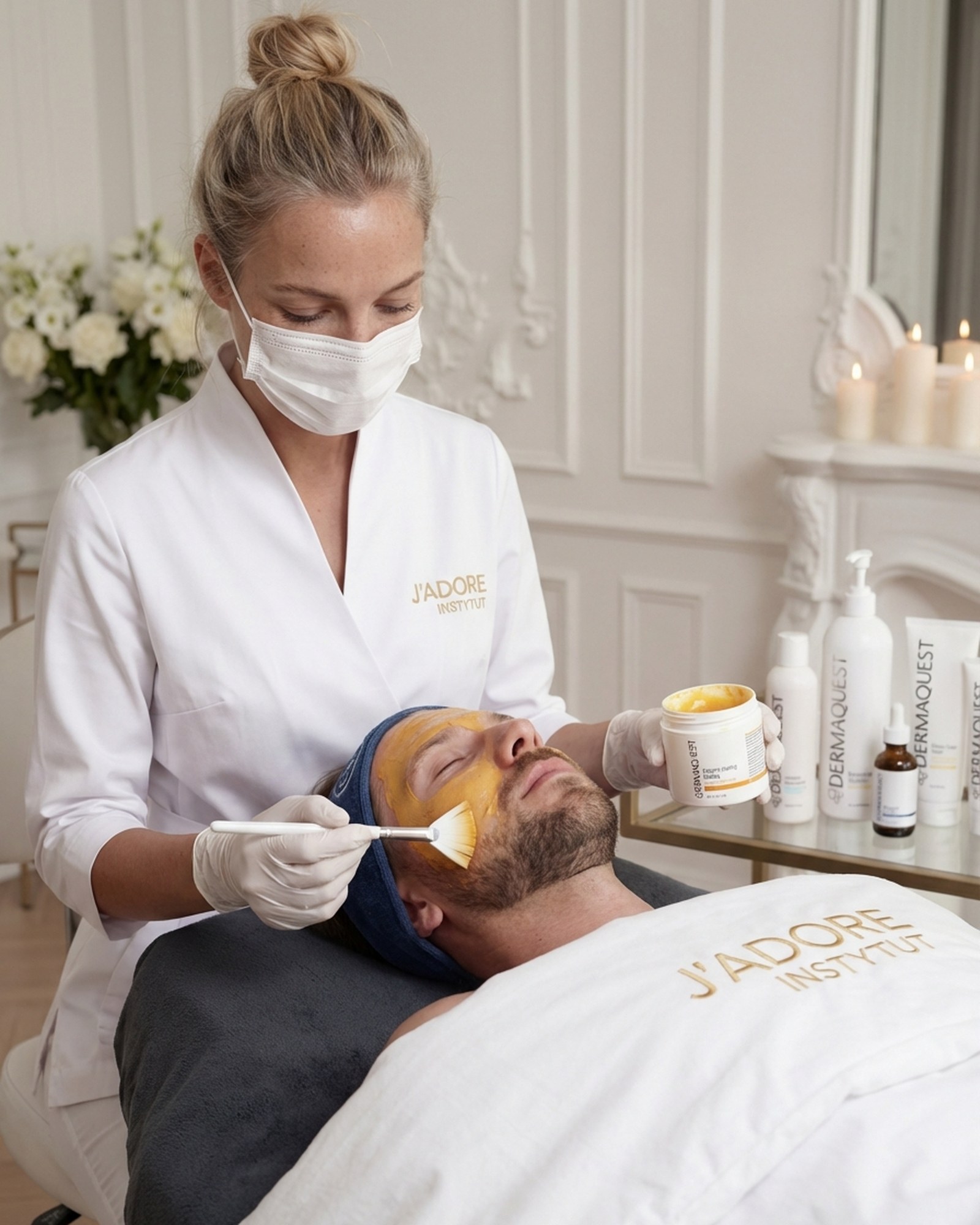
In our salons, we increasingly meet men for whom Mango Peel becomes the first conscious step towards professional care. They often come to us on the recommendation of their partners or looking for a way to quickly "reset" a tired complexion, without wanting to enter into complicated procedures that they associate with a long recovery period. Mango Peel turns out to be an ideal solution because it is discreet and predictable.
A key difference in the treatment process and subsequent care is the presence of facial hair. For men with a beard, the cosmetologist pays special attention to ensuring that the preparation is applied evenly to the facial skin, avoiding the product entering the thick hair, which could make its removal difficult. After the treatment, the skin under the beard requires equally careful protection as the rest of the face.
- People with facial hair should remember to thoroughly pat vitamin C serum and ceramide cream into the skin under the hair to avoid a feeling of dryness.
- Daily application of SPF 50+ is essential on the entire face, also in areas where the skin meets the beard line, to prevent uneven skin tone.
- In the case of shaving, it is worth keeping a few days' interval from the treatment so as not to mechanically irritate the epidermis, which is in the renewal phase.
For men who have previously limited themselves to basic face washing, Mango Peel is a safe start. The lack of aggressive acid action means the skin's protective barrier remains intact, and the effect of a rested complexion is visible almost immediately. It is this simplicity and the lack of need to "hide" at home that make many of them decide to continue the series, treating it as a permanent element of taking care of their appearance.
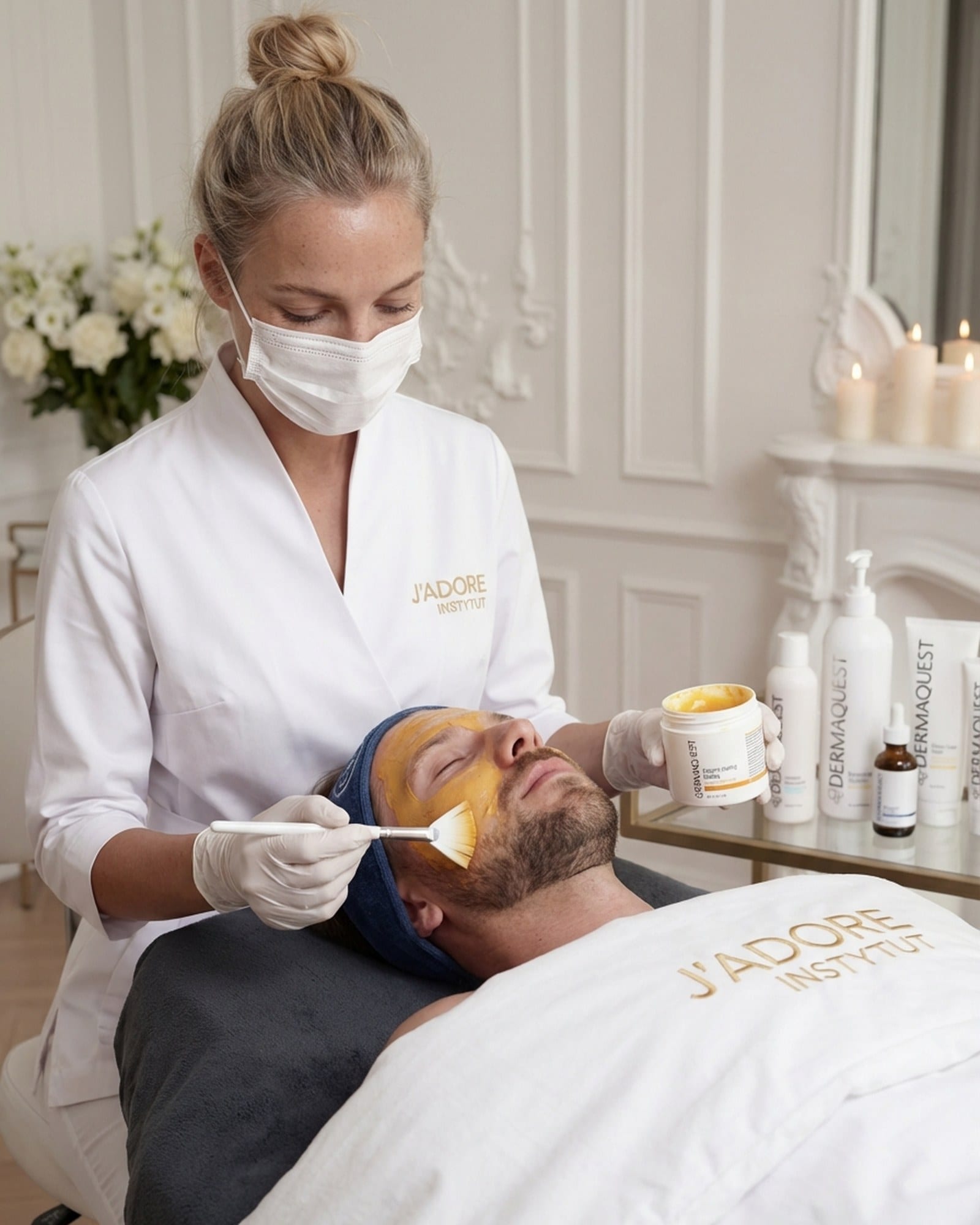
Combining treatments allows for faster results while maintaining safety.
Combining Mango Peel with other procedures is a way to maximise the skin's potential during a single visit. Instead of treating the peel as a separate stage, the cosmetologist can weave it into a broader care plan, which allows for more noticeable results without the need to increase the aggressiveness of the exfoliation itself. The key here is the appropriate sequence and selection of techniques that complement each other rather than exclude each other.
An excellent example is pairing the peel with needle-free mesotherapy. The mango peel itself effectively removes dead epidermal cells, which naturally clears the way for active ingredients. When we introduce needle-free mesotherapy after such preparation of the skin surface, moisturising and nourishing substances penetrate much more effectively than during independent application of cosmetics at home. The result is a complexion that not only regains radiance thanks to exfoliation but becomes noticeably firmer and deeply hydrated.
Mango Peel + Needle-free mesotherapy
The peel prepares the way, and mesotherapy provides the skin with essential nutrients, which gives a deep hydration effect.
Mango Peel + LED light therapy
A combination that allows for soothing the skin immediately after the treatment, minimising potential redness before leaving the salon.
An important element is also caring for comfort after the treatment. Often, after applying the mango preparation, the cosmetologist selects LED light therapy. This solution allows for quick soothing of the skin, which is especially important for people who plan to return to daily duties after the visit. LED light acts soothingly, reducing the feeling of warmth and making the skin look rested the moment you leave the salon.
- Increased absorption of active ingredients thanks to prior epidermal cleansing.
- Possibility of personalising the treatment by selecting the appropriate LED light wavelength.
- Faster regeneration and soothing of the skin immediately after the procedure.
- A synergy effect where each method supports the action of the other, leading to a more lasting improvement in skin tone.
Such an approach allows for safely building the condition of the complexion. Instead of looking for one very strong solution, we focus on a thoughtful combination that respects the epidermal protective barrier while providing it with exactly what it needs at a given moment.
Not every dull complexion needs the same type of peel.
A dull complexion is a signal that the skin needs support, but the causes of this state can be extremely different. Mango Peel deals great with earthiness resulting from the accumulation of dead epidermal cells or slight dryness. If, however, the dullness is the effect of deeper pigmentary disorders, such as melasma, a gentle enzymatic-acid peel may prove insufficient. In such situations, the cosmetologist looks for solutions targeted at a specific problem, reaching for more advanced procedures, such as Cosmelan or Dermamelan.
Selecting the appropriate method is not only a matter of effectiveness but, above all, safety. There are situations in which a specialist must refuse to perform a treatment, even if your only goal is quick facial radiance. It is crucial to exclude contraindications that could lead to undesirable reactions.
- Why does the cosmetologist refuse the treatment in case of an active cold sore?
A chemical peel is a recognised factor that can reactivate the Herpes virus. A treatment during an active outbreak could lead to its spread to a larger area of the face, which is why we always postpone the visit until full healing.
- Does a fresh tan exclude Mango Peel?
Yes. Skin after exposure to the sun is irritated and in a state of slight inflammation. Performing a peel on such skin drastically increases the risk of permanent discolouration, which is why we wait with the treatment until the complexion returns to its natural state.
A special event requires appropriate advance planning.
Planning a salon visit with a specific event in mind, such as a wedding, a photo shoot, or an important outing, requires a change in perspective. There is often a temptation to perform the treatment just before the date, counting on maximum radiance on the day of the event. In the case of Mango Peel, the strategy should be slightly different. Although this treatment does not involve a long period of downtime, the skin needs time to fully regain balance and calm down after contact with acids and enzymes.
- Schedule the last treatment of the series about 4–7 days before the planned event.
- Let the skin go through the process of gentle exfoliation in the comfort of your home, without rushing.
- Take care of intense hydration in the days preceding the big outing to strengthen the radiance effect.
Why is this time margin so important? Even if the exfoliation is subtle and almost invisible, the epidermis undergoes a renewal process. Performing a peel too close to the event date can make the skin still be in a transitional phase, which will make applying makeup difficult. Instead of a perfectly smooth surface, you may notice fine, dry flakes that will become more visible under foundation. An appropriate interval allows the complexion to be fully calmed, hydrated, and ready to accept cosmetic products.
Remember that the radiance you are looking for is the effect of healthy, well-hydrated skin, not a freshly performed exfoliation. If you take care of appropriate advance planning in your schedule, your complexion will reward you with a natural, radiant look that will be an excellent base for any makeup. Illustrative photo, showing an example of the treatment process in salon conditions, where calm and time are just as important as the preparations themselves.