
Skin lives in a cycle — and the cycle governs the results
The surface of your skin — the part you touch and see in the mirror — isn't static. It's constantly being renewed. Cells are born deep in the basal layer of the epidermis, then slowly rise towards the surface, mature, die off and eventually shed. Depending on age, condition and various other factors, this cycle takes anywhere from a few days to several weeks. Young, healthy skin does this smoothly and regularly. Older, dehydrated or hypersensitive skin does it more slowly, less regularly, often with "bottlenecks" halfway through.
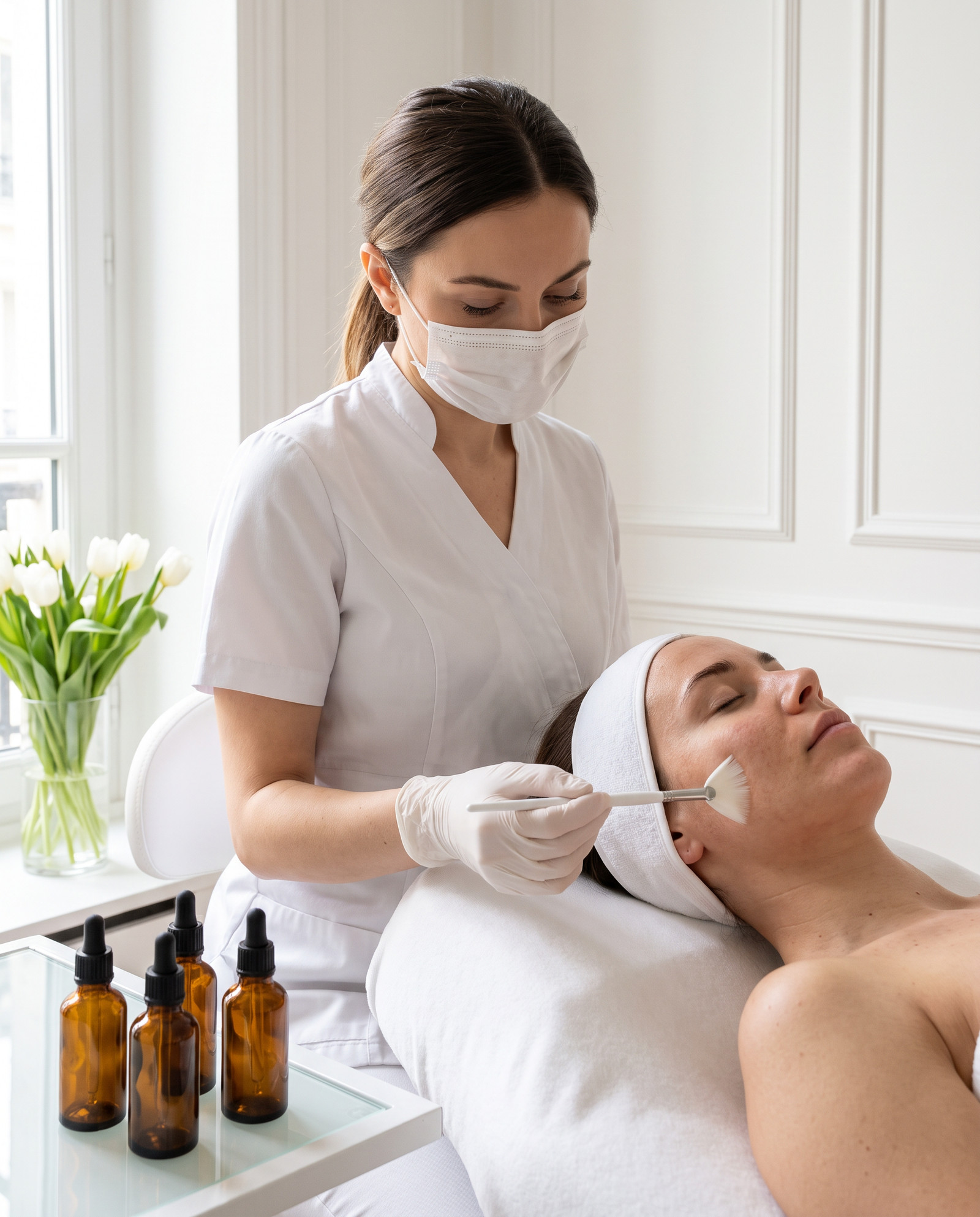
A peel intervenes directly in this mechanism. It speeds up the shedding of dead cells from the surface, clears the way for younger cells, and prompts deeper layers to work harder. This is genuine — and it's why results are visible right after the treatment. The catch is that skin has its own biological inertia: a single stimulus changes what's on the surface and just beneath it. But deeper habits — the pace of renewal, collagen production quality, hydration patterns — change more slowly. They need repetition to settle into a new rhythm.
That's why the interval between sessions in a series isn't arbitrary. A well-designed series is synchronised with your skin's biological cycle — the next session comes once your skin has finished responding to the previous one and is ready for another stimulus. Too short a gap means working on skin that hasn't had time to renew. Too long a gap means losing momentum and slipping back into old habits.
What a peel really does — and what it can't do in one go
It's worth separating two levels at which peels work, because this explains why a series is a necessity, not a marketing add-on. The first level — surface level — is the one you notice straight away: removal of dead cells, more even skin tone, a temporary reduction in visible pore size, an instant freshness. Here, one session genuinely delivers a clear result.
The second level — deeper — happens after the treatment and continues for longer, even when nothing more is visible on the surface. Mechanical or chemical exfoliation is, for your skin, a controlled micro-injury — a signal to produce new cells, a stimulus for fibroblasts, an activation of repair processes. This process doesn't finish within a few hours. It continues for days, sometimes longer. And this is the heart of the matter: these deeper processes accumulate across a series — they don't level off after the first session, they build up with each one that follows.
After one session
immediate result
- Removal of the dead cell layer from the surface
- Smoother texture, fresher skin tone
- Better absorption of skincare products for a few days
- Stimulation of repair processes (but only once)
After a series of sessions
cumulative result
- A lasting increase in the pace of epidermal renewal
- Gradual evening-out of pigmentation and rough patches
- Clearer improvement in skin firmness and density
- Long-term stimulation of collagen production
A column, not a point — how to think about a series
A helpful way to picture the logic of a series is a column, not a point. One treatment is a point — something changed, a mark was made. But a point isn't stable; there's nothing to return to. A series builds a column — layer upon layer — and that structure is exactly why results don't "fade" after a month. They stay, because they're rooted more deeply.
- 01
Session 1 — The starting signal
Skin receives its first impulse: dead surface cells shed, repair processes activated. Results are visible straight away — freshness, smoother texture. But biologically, this is only the start.
- 02
Session 2 — Confirming the direction
This session meets skin already "primed" by the previous one. Repair processes activate again, this time faster and on a deeper foundation. Improvement is clearer and longer-lasting than after the first session.
- 03
Session 3 — A new rhythm
The renewal cycle starts to shift — skin works faster, more clearly and more evenly. Pigmentation gradually fades, texture evens out more lastingly. Results begin to live between sessions, not just right after them.
- 04
Session 4+ — Consolidation
Changes have accumulated, your skin's response has matured. This is where something hard to achieve in one go appears: a lasting change in skin quality, not a one-off "refresh".
Why skin "forgets" without regularity
If the gap between sessions is too long, your skin returns to its previous habits — a slower shedding rhythm, less repair activity, old collagen production patterns. This isn't failure, and it isn't a reversal of results. It's simply biology: the body keeps processes active for as long as it keeps receiving a stimulus. Once the stimulus stops, activity returns to its previous level.
So regularity in a series isn't only about aesthetic results — it's a condition for biological change. Each session at the right interval reinforces the signal before the previous one has had time to fade. Skin doesn't need a one-off shock — it needs a rhythm that, over time, becomes its own.
Different peels, the same principle
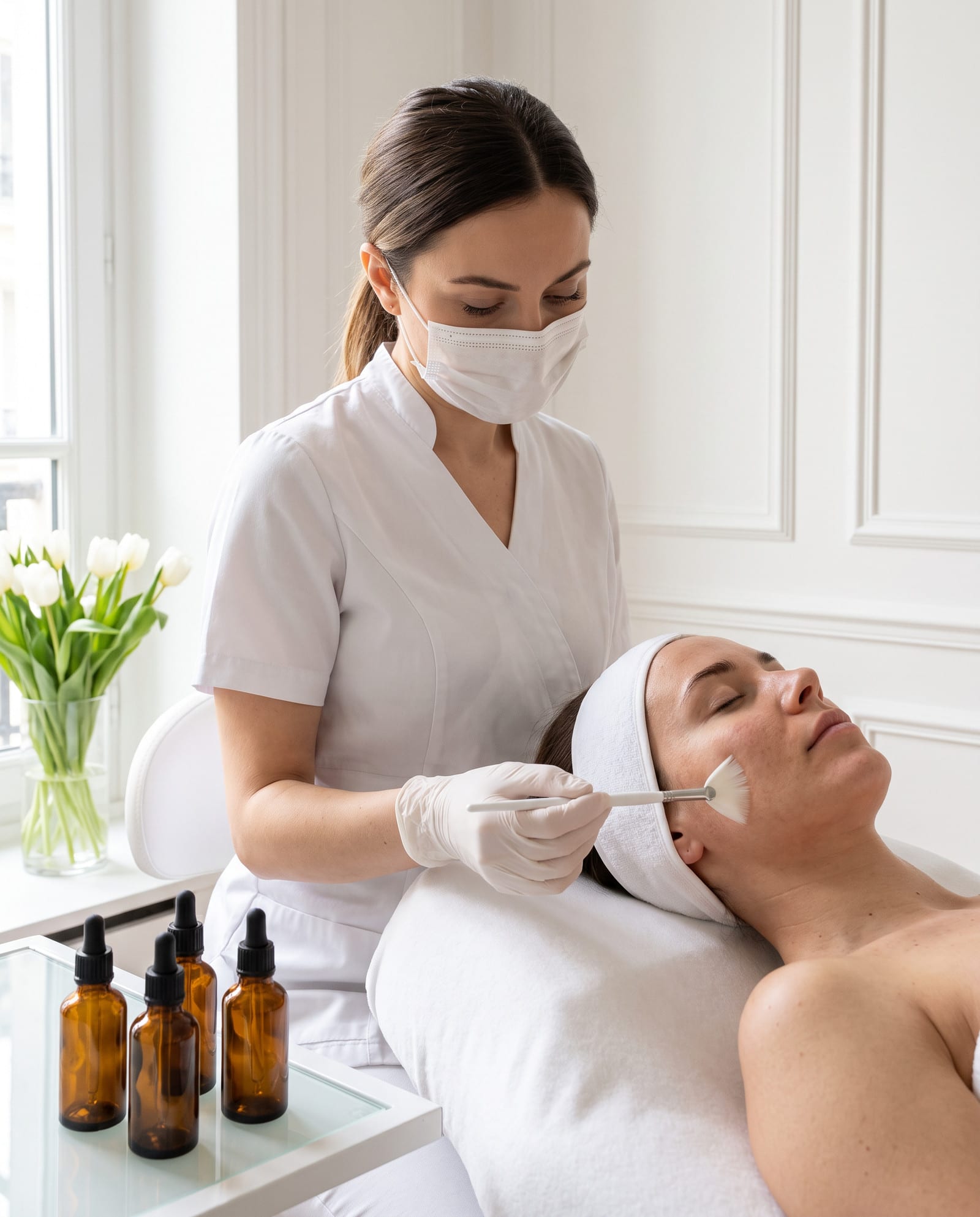
There isn't just one type of peel — and that's a good thing, because different skin types need different tools. Mechanical peels work by physically removing cells. Chemical peels (acids) work by enzymatically or chemically "dissolving" the bonds between cells. Enzymatic peels are gentler and slower. Each of these groups has its own indications, rhythm and depth of action.
What unites them is the same principle of a series: whatever you're peeling with, one session opens the subject — the following ones write it. Only the optimal frequency and number of sessions in the cycle differ. A gentler peel can be repeated more often; a deeper peel needs longer gaps, but also delivers a faster jump in quality after a single series. This is exactly what we determine at the consultation before a series — matching the method to the goal, not applying one standard to everyone.
Gentler peels
smaller stimulus, higher frequency
- Enzymatic, low-concentration acid peels
- Suitable for sensitive and vascular skin
- Shorter recovery time after treatment
- Series usually longer, but easier to fit into a rhythm
More intensive peels
stronger stimulus, longer-lasting effect after the series
- Higher-concentration acids, combination peels, medical-grade peels
- Faster improvement visible after the series
- Stronger stimulation of deeper processes
- Better response for pigmentation and scarring
Series versus maintenance — what happens after the cycle ends
Finishing a series doesn't mean everything resets to zero — this isn't a treadmill you have to keep running on forever just to avoid slipping back. After a well-run series, your skin sits at a new baseline: better texture, more even tone, a stronger barrier. This is a lasting change in quality, not a result you have to maintain at all costs.
Once a series ends, the natural next step is moving to a maintenance rhythm — less frequent sessions, aimed not at improvement but at preserving and consolidating what you've gained. How often, and with what, depends on your skin and on what the series achieved. For one person, a single session every few weeks is enough; for another, a short series once a season.
Peel + deep hydration
After a series of peels, skin is ready to absorb hydration more deeply than usual. Combining this with an intensive hydrating treatment in the final phase of the cycle locks in results and strengthens the protective barrier.
Peel series + biostimulation
Peels open up skin and speed up its rhythm — a biostimulator introduced during or after a series meets ground that's better prepared to respond. Together, they deliver a clearer improvement in quality and density than either method alone.
Peel + sun protection
Not a treatment, but a necessity: peeled skin is more sensitive to the sun. Without SPF, the risk of post-inflammatory hyperpigmentation rises — protection is an integral part of every series, not an optional extra.