Where the myths about prenatal massage come from
Distrust of massage in pregnancy has a few sources. The first is caution carried over from surgery — for years the rule "don't touch a pregnant woman" came from a general fear of any intervention that might lead to the question "why did this go wrong". The second is vague advice passed down through generations: "don't massage the feet, you'll trigger contractions." The third — and perhaps the most damaging — is online algorithms, which amplify cases of incompetent massage and equate a therapist's lack of knowledge with the procedure itself.
The myths — one by one
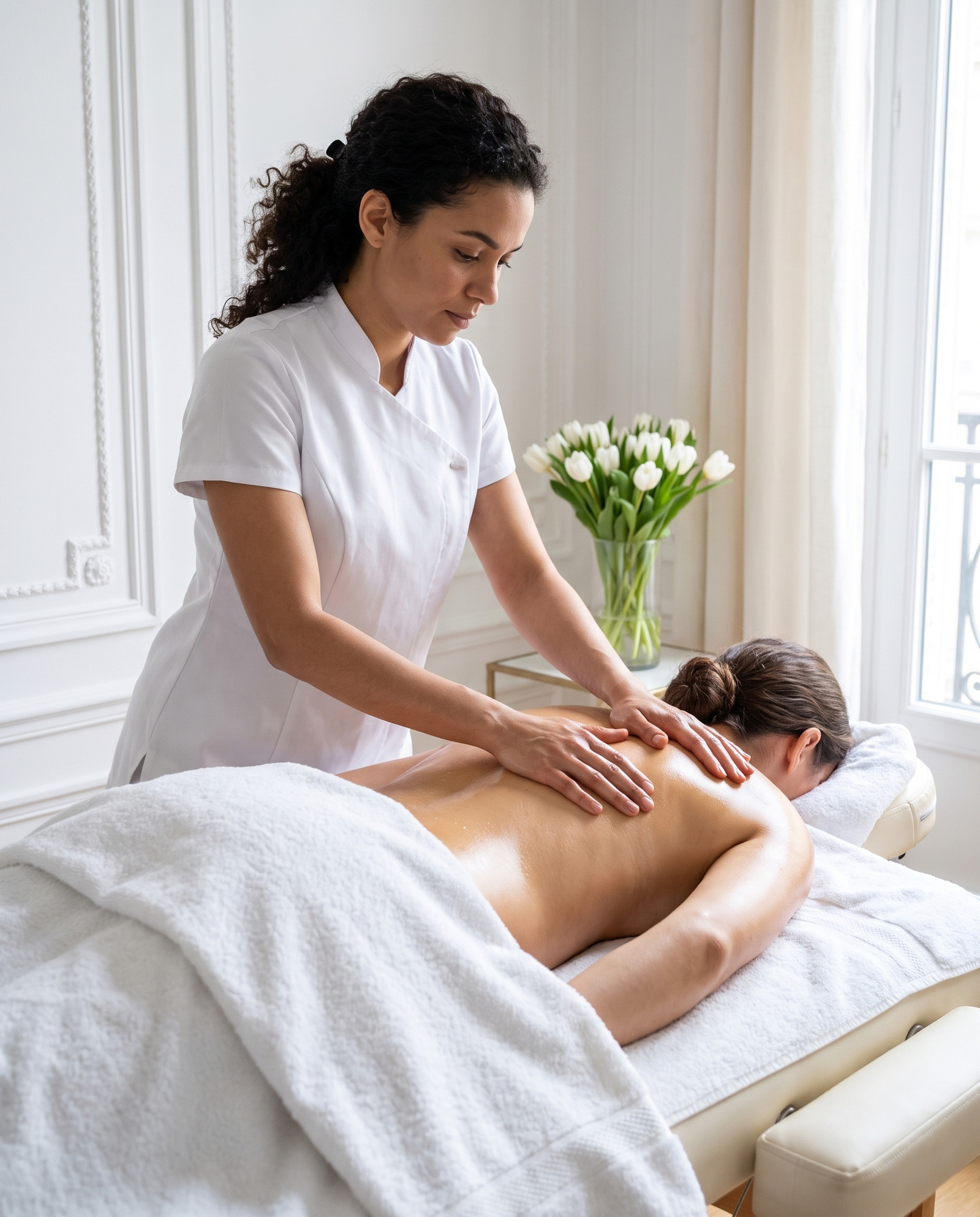
Myth 1: "Massage is banned during pregnancy." There's no medical consensus banning prenatal massage outright. There are specific contraindications — and these are often wrongly stretched to cover the whole of pregnancy. A healthy pregnancy without complications isn't an illness that requires you to stay still. Physiotherapists and prenatal massage therapists work with pregnant clients regularly, and a well-performed massage can be one of the few ways to ease pain that pharmacology has limited options for during pregnancy.
Myth 2: "Massage triggers premature labour." This belief has a specific source: reflexology and foot acupressure, where certain points are traditionally avoided during pregnancy (for example, the area around the medial ankle, point SP6). A classic relaxation massage of the back, neck, arms or legs, however, doesn't stimulate uterine contractions. The mistake is that guidance about specific techniques and points turned, in popular belief, into a blanket ban on everything. As usual, a detail grew into an absolute rule.
Myth 3: "You can't lie on your back, so massage is impossible." Not "impossible" — it needs a different position. Prenatal massage is performed lying on your side (on the left, with a pillow between your knees) or on specially shaped supports. Lying on your back is indeed discouraged from around the second trimester — but a good therapist never works with a pregnant client in that position. Position is a matter of preparing the treatment room, not a reason to skip the treatment.
Myth 4: "Massage in the first trimester is especially dangerous." The first trimester calls for the most caution — but caution isn't a ban. Most salons apply the rule of avoiding prenatal massage until after week 12 as an internal safety measure, because the risk of spontaneous miscarriage is statistically higher in this window (and has nothing to do with massage — but any coincidental timing would be distressing and hard to explain). It's a precaution, not a medical prohibition. Women with a normally progressing pregnancy, after consulting their doctor, can safely use very gentle relaxation techniques — but this point is always worth discussing with your gynaecologist, because every pregnancy is different.
Myth 5: "Massage is for the body, and in pregnancy only mental health matters." This is a false distinction. Muscle tension and stress are connected. Pregnant women report some of the most bothersome symptoms as: lower back pain, hip pain (joints loosened by relaxin), swelling in the legs, neck stiffness and insomnia. Prenatal massage can be one of the few ways to address these issues without turning to medication. The pregnant body isn't a topic to put off until after birth.
Myth 6: "Any massage therapist can perform a prenatal massage." This is the one myth with real clinical significance. Prenatal massage is a specialisation — it requires knowledge of a pregnant woman's changing anatomy, awareness of contraindications, the skill to work in a side-lying position, and the ability to recognise warning signs (such as sudden swelling, headache, dizziness, or circulatory irregularities). A therapist without this training could — unknowingly — apply intense pressure where they shouldn't, or miss a client signalling discomfort. Ask about qualifications. It isn't a marketing point — it's a safety one.
From when — practical guidance
The question "from when" has a simple answer and one important nuance. The simple answer: most therapists work with pregnant clients from the second trimester, meaning after week 12–14. In this window, the risk of spontaneous miscarriage drops sharply, the body is more stable, and many women are past the intense nausea and fatigue of the first trimester. The nuance: it isn't about counting weeks like a dose of medicine — it's about discussing it with your gynaecologist at a check-up. Your doctor knows your pregnancy and its specifics. If it's progressing normally, they're unlikely to find a reason to advise against it.
- 01
First trimester (weeks 1–12)
Usually avoided or limited to very gentle relaxation techniques. This is precautionary, not an absolute ban — the decision depends on how the pregnancy is progressing and your gynaecologist's guidance.
- 02
Second trimester (weeks 13–26)
The optimal time for prenatal massage. The body has stabilised, aches and pains start to build (back, hips), and medication options are limited. Massage can become a regular part of self-care.
- 03
Third trimester (weeks 27–40)
Massage is possible and often much needed — particularly for lower back pain, swollen legs and sleep problems. It requires the most precision from the therapist: positioning, pressure, and avoiding acupressure points on the legs.
- 04
After birth (postnatal massage)
A separate category — perineal massage, recovery-focused massage, often supporting the body's return to form. This requires assessing whether the birth was natural or by caesarean section, and allowing an appropriate healing period before returning to treatments.
What a therapist genuinely needs to avoid
Myths about prenatal massage often confuse two things: a ban on certain techniques and points with a general ban on massage. That's a fundamental difference. Here's what genuinely calls for caution — not because "that's what people say", but because there's a real reason for it:
- The area around the medial ankle and inner calf — this is where acupressure points (SP6, KD3) traditionally avoided in pregnancy are located, and the lower leg is also an area of potential clot risk — pressure here should be minimal or avoided altogether.
- The abdomen — especially in the third trimester: direct, firm pressure is out of the question; light, surface stroking (if the client wants it) is a separate matter.
- Intense deep tissue massage — deep pressure techniques and trigger point work across the body need significant adaptation, or scaling back, to suit the pregnant state.
- Heated stones and warm compresses on the abdomen and legs — there's a risk of overheating and of affecting blood flow to the placenta.
- Scents and essential oils — some (rosemary, sage, eucalyptus, basil, juniper) are traditionally advised against in pregnancy; neutral, mild carrier oils are a safe alternative.

What prenatal massage can offer — honestly
Rather than a list of guaranteed results, here are a few things that come up regularly for many pregnant women after prenatal massage. None of these is a certainty — bodies differ, pregnancies differ, and techniques differ. But this is what we hear most often:
- A noticeable reduction in lower back and hip pain — often after just the first session.
- Milder swelling in the legs, particularly around the ankles and calves.
- Better sleep quality — one of the most frequently mentioned results among women in the third trimester.
- Reduced tension in the neck and shoulders, particularly for women who work at a computer during pregnancy.
- An overall sense of calm and self-care — at a time when so much is changing.
Postnatal massage — a separate topic, worth knowing about
Postnatal massage is a separate specialisation and a separate topic — but it's worth mentioning, because questions about prenatal massage often lead here. After a natural birth, the body may be ready for gentle massage relatively soon — though the exact timing depends on individual healing and any tears or incisions. After a caesarean section, the scar and abdominal recovery need considerably more time and care.
Postnatal massage can support the body's return to its pre-pregnancy shape, help release overworked muscles (particularly the shoulders and neck from breastfeeding) and — something that's often overlooked — give a new mother space to care for herself at a time when everyone's attention is on the baby. This isn't a luxury. It's part of mental and physical health during the postpartum period.