
What actually damages men's skin
Contrary to what's sometimes said, men's skin isn't more resilient. It's thicker — which only means changes can build up longer before becoming visible. By the time they show, the damage is usually deeper than on a woman's face of the same age.
- UV radiation — even without sunbathing. Everyday sun exposure — driving, walking to the office, weekends out — accumulates over years. UV degrades collagen and elastin fibres long before any visible change appears.
- Chronic stress — chronically elevated cortisol weakens the skin barrier and slows cellular regeneration. The effect builds slowly and is hard to pin to any single event — one day, skin simply looks "older than it should".
- Shaving — an underestimated mechanical stress. Regular shaving strips the outer layer of the epidermis, irritates the hydrolipidic barrier and creates micro-damage that, without adequate regenerative reserves, accumulates into irritation and accelerated ageing.
- Structural dehydration — not to be confused with dehydration that water alone fixes. This is the skin's declining ability to bind moisture in its deeper layers — common with an intense lifestyle, alcohol, caffeine and irregular sleep.
Nucleofill — what it is, and why it isn't "hyaluronic acid reinvented"
The most common mistake is lumping Nucleofill together with fillers, or even with mesotherapy. It's a different tool with a different mechanism:
Fillers (HA)
what Nucleofill isn't
- physically add volume
- result visible immediately
- metabolised over time — they disappear
Nucleofill (PDRN)
how it actually works
- biostimulator — activates cellular receptors
- skin produces its own collagen and elastin
- results build over weeks, not instantly
Nucleofill contains polynucleotides (PDRN) — DNA fragments that, once delivered into the skin, bind to cellular receptors (A2A) and trigger a repair cascade: fibroblasts start producing more collagen and elastin, microcirculation improves, and skin regains its capacity for deep hydration. This is biostimulation — not filling in what's missing, but reactivating what skin naturally did in its early twenties.
Who Nucleofill makes the most sense for
Nucleofill isn't a "quick fix" treatment — if you're after visible results within a day, this isn't the right direction. But it makes exceptional sense in specific situations:
- Tired, grey skin — no obvious wrinkles, but no "glow" either. You're losing tone and firmness, and looking older than you actually are.
- Skin after an intense outdoor season — holidays, sport, mountains, sailing. UV takes its toll, even with sunscreen (usually applied too lightly by men, in any case).
- Skin irritated by years of shaving — particularly around the neck and jawline: over-dried, thin, prone to irritation and ingrown hairs.
- Prevention after 35 — before deeper wrinkles and volume loss set in. Nucleofill works best while tissue still has regenerative potential — waiting until something has "really progressed" reduces the effect.
- Preparation for an important period — before a major project, a new job, a photo shoot. Skin in better condition simply looks better, in photos and in person.
What the course of treatment looks like in practice
The treatment starts with a consultation — the doctor assesses skin condition and decides whether Nucleofill makes sense on its own or combined with something else, such as plasma or another type of biostimulator. There's no single protocol that fits everyone.
- 01
step
Medical consultation — assessment of skin condition, discussion of expectations and lifestyle. A decision on what to do, and in what order.
- 02
step
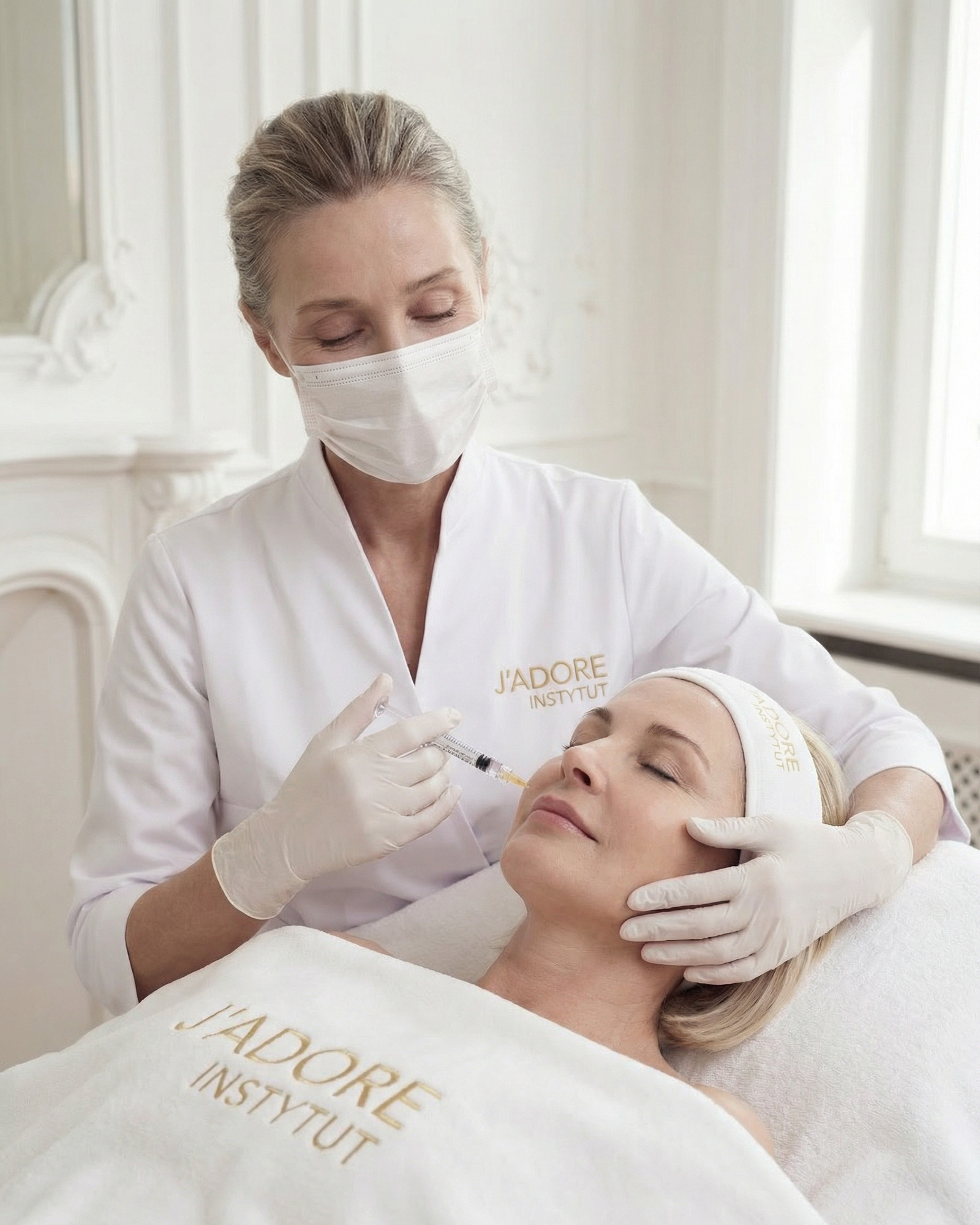
Application — a series of intradermal injections on the face (usually forehead, cheeks, neck). Fine needles, short session. Most men describe the discomfort as moderate; mild redness may follow the treatment.
- 03
step
A few days after the treatment — skin may be slightly swollen or red. This usually passes within 24–48 hours. You can return to work the same day.
- 04
step
Weeks 2–6 — the effect builds. Skin becomes better hydrated, more even in tone, and gains firmness and a glow that men often describe as "you look better, I don't know why".
- 05
step
Follow-up and decision on the next session — the treatment is usually repeated several times within a series, then once or twice a year for maintenance.
For a few days after the treatment, it's worth avoiding intense gym sessions, sauna and alcohol — standard advice for any injectable treatment, to limit the risk of bruising and unwanted spread of the product. Zero downtime from work — this isn't a treatment that keeps you away from a meeting.
What Nucleofill won't do
It's worth being precise about expectations — because Nucleofill is an excellent tool, but it isn't the answer to everything:
What Nucleofill can improve
real results after the course
- skin hydration and firmness
- tone and glow (reducing greyness)
- skin condition after shaving and UV exposure
- the pace of the tissue's own regeneration
What it won't replace
other tools for other purposes
- deep wrinkles — Botox or filler works better here
- lost facial volume — a biostimulator does less than HA here
- hyperpigmentation — laser pigmentation removal or peels
- acne scars — different protocols