

 A treatment room at J'adore
SCALP & HAIR
After repeated lightening, strong colouring or years of straightening, hair can start behaving unpredictably: split ends, that rubbery feel when wet, mid-length breakage and tangles you simply can't comb through. Molecular hair reconstruction is a deep repair of the hair structure from within — a complex of proteins, keratin and amino acids penetrates the weakened shaft, "sealing" micro-damage and rebuilding the internal network of bonds.
The result is restored elasticity, less breakage, and hair that finally cooperates with a comb. This isn't a surface-level conditioner, and it isn't straightening — it's repair of what styling and colour have weakened from inside. That's why we often perform it just before colouring (colour sits more evenly and causes less additional damage) or as a maintenance treatment between visits. At J'adore Instytut, it's carried out by an experienced hair stylist. Below you'll find everything worth knowing before your visit.
1 refreshing visit, or a series for heavily damaged hair; often repeated as a maintenance treatment
How it works
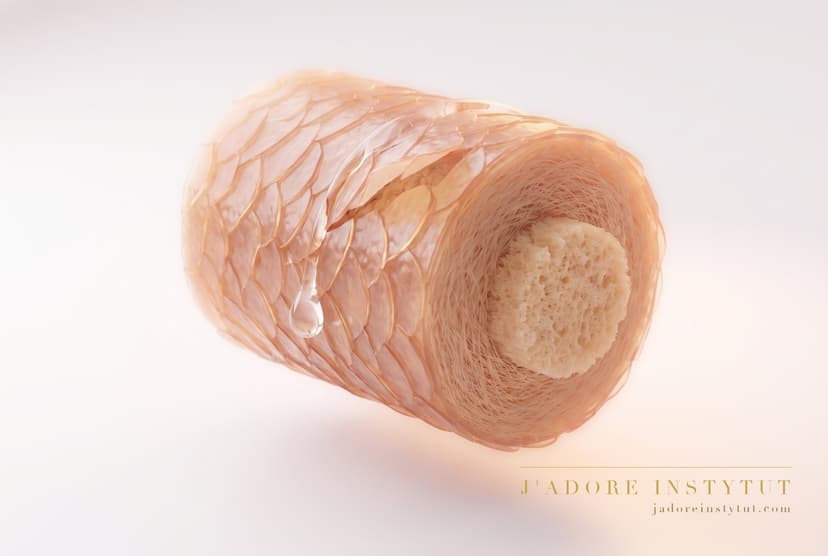
Hair isn't a dead strand — it's a layered structure with an inner "core" held together by a network of protein bonds. Colouring, lightening, straightening and blow-drying gradually loosen this network: micro-damage and gaps form, through which hair loses elasticity, breaks and becomes dull. Molecular reconstruction delivers missing building blocks deep into the shaft — a complex of proteins, keratin and amino acids fills the gaps and rebuilds the internal connections.
The key difference from an ordinary mask: a mask coats the hair from outside and smooths the cuticle, while molecular reconstruction works inside — it replaces what the hair has actually started to lack. That's why it delivers a result a conditioner alone cannot: genuinely stronger, more elastic hair, not just a temporary slip.
Ideal for
Who it's for
This is the most common version of the treatment. Molecular hair reconstruction for women is usually a rescue after bleach, balayage and years of colouring — where the priority is keeping length, elasticity and glossy colour without straw-like ends.
What we work with
Men think about "hair treatments" less often, but they often need them too: molecular hair reconstruction for men is a simple solution for hair dried out by sun, hats, frequent washing or lightening. No salon fuss — just results.
What we work with
Did you know: healthy hair can stretch to roughly a third of its length and spring back — that's the elasticity you feel when it "bounces" after combing. Excess protein damage and lightening break down this elasticity, and hair starts snapping instead of springing back. Good reconstruction works precisely to restore this "shape memory" — not just shine.
The visit
The whole visit is a relaxed session lasting around an hour (longer for long, thick hair). No downtime and no "recovery" afterwards — you go straight back to your day, and the shine is visible immediately.
Consultation
your stylist assesses the degree of damage, porosity and colour history — and chooses a variant and formula that fits your colour plan
Cleansing
a preparatory wash that opens the hair to absorb the product
Layered application
reconstructing product applied along the length and ends, with time to penetrate deeply
Sealing and styling
sealing the structure, blow-dry styling — you leave with a finished, glossy hairstyle
Portfolio
A record of the work in our salons — the place where we publish treatment frames and, after photo sessions, results.
A record of results — in preparation. We publish photographs of our clients only with their consent.
What to expect
You'll see the shine and softness right away — that's the most satisfying part. But real structural repair is a process: you feel the biggest difference in elasticity and reduced breakage with each subsequent visit and with good home care.
Reconstruction doesn't permanently seal split ends — if hair is already split, the healthiest result comes from combining reconstruction with trimming just the ends. Your stylist will tell you directly how much can realistically be saved, and what can't.
Reconstruction and your lifestyle
The longer you will maintain the effect, the more wisely you treat your hair after the visit. Nothing complicated — just a few habits are enough:
A gentle shampoo (ideally SLS-free) and a mask suited to your hair's needs extend the result considerably. Without home care, even the best reconstruction fades faster.
Heat styling isn't forbidden — but it's the very thing that damaged your hair the most before. Use heat protection and go easy on maximum temperatures if you want the result to last longer.
Reconstruction works well alongside colour — ideally just before colouring. It's an investment: colour sits more evenly, and hair copes better with the treatment.
Chlorine and salt dry hair out and wash away the effect. After swimming, rinse your hair with clean water and apply conditioner or oil — especially to the ends.
Strong UV weakens freshly reconstructed hair and fades colour. A hat or a UV-protective hair product will help you keep the holiday effect longer.
If the ends are already split, a light trim after reconstruction completes the effect — healthy hair holds elasticity better and splits less going forward.
SCALP & HAIR
Molecular reconstruction is a gentle care service — there are no "medical" contraindications here. There are, however, situations where it's better to wait a little:
If someone promises that a single visit will permanently eliminate split ends and hair "burned" by lightener, that's a promise with no substance. Heavily damaged hair is reconstructed with a series of treatments and care, and some types of damage (split ends) simply can't be permanently sealed. An honest stylist will tell you how much can realistically be saved, and what's worth trimming.
Molecular hair reconstruction
These three names get confused most often, and they do different things — while complementing each other well. Short and to the point:
replenishes building blocks deep inside
doesn't reconnect specific bonds "burned" by lightener as precisely as Olaplex — which is why we often combine the two
reconnects specific bonds
doesn't "feed" hair with extra building blocks — it addresses a different mechanism from reconstruction
smooths and adds shine
isn't a deep structural repair and doesn't replace reconstruction for heavily damaged hair
Combine with
Molecular reconstruction is an excellent base for other hair services. Your stylist decides on the order and intervals during the consultation, but the logic is simple:
The most common question: "so why reconstruction, if you also do Olaplex?" Because they're different tools. Olaplex reconnects specific bonds broken by lightener, while molecular reconstruction replenishes missing building blocks throughout the shaft. For heavily damaged blonde hair, we do both — and only then does hair really "come back to itself".
Variants and products
"Molecular reconstruction" isn't a single off-the-shelf product — it's an approach tailored to your hair's condition. Your stylist decides what your hair needs most — and in what proportions — because over-proteinised hair needs something different from dry, dehydrated hair.
Replenishes missing building blocks deep in the shaft — proteins, keratin, amino acids.
Dla kogoBrittle hair, after lightening, that feels "rubbery" when wet.
Combines reconstruction with intense hydration — for hair that's both weak and dehydrated.
Dla kogoDull, coarse hair, dried out by styling and sun.
Structural reconstruction supported by bond repair — the strongest version for damaged blonde hair.
Dla kogoHeavily lightened, repeatedly coloured hair.
Strengthens hair just before colouring, so colour sits more evenly and causes less extra damage.
Dla kogoPlanned colouring or lightening in the same visit.
Fact: What matters most isn't the name of the product, but an accurate diagnosis and the right proportions: too much protein without hydration can stiffen hair, while hydration alone without building blocks won't repair the structure. That's why the variant is chosen by your stylist, not by a label on a bottle.
Price list
Checking free hours…
See also
The result lastsa few weeks; you build the best result with a series and home careJ’adore Instytut
Note. Molecular hair reconstruction is a hairdressing and care service (hair care and reconstruction); the result and how long it lasts depend on hair type, degree of damage, home care and technique. This text is for information purposes. The specific details and choice of variant are determined by the stylist during your visit.
Home care
Cosmetics matched to what your skin needs after a treatment — so the clinic effect lasts longer.
 hair regenerationOlaplexBROAD SPECTRUM CHELATING TREATMENT 370mlView in the shop(opens in a new tab)
 hair regenerationKevin MurphyYoung.Again Dry Conditioner Oil 100mlView in the shop(opens in a new tab)
 hair regenerationDSD de LuxeTravel PackView in the shop(opens in a new tab)
 hair regenerationSesdermaSESKAVEL Keratin Shampoo 200 mlView in the shop(opens in a new tab)


