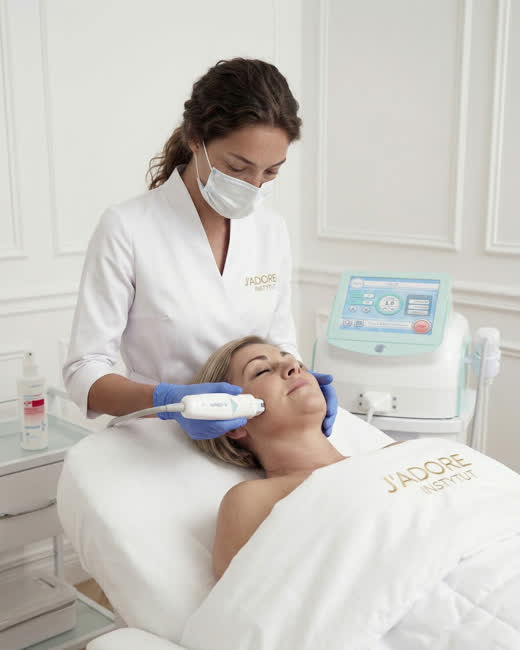
Why plasma causes so much fear
Plasma IQ has had an image problem from the start — actually, two problems. The first is the "right after treatment" photos: skin covered in regularly spaced dark dots that look like a rash or minor burns. Seeing this for the first time, it's hard not to think "that looks like damage." The second problem is imprecise terminology: plasma sounds alarming, and "sublimation" — the term used to describe how the device works — isn't part of everyday vocabulary. The result: many people avoid a treatment that could help them, because imagination fills the information gap with something worse than reality.
Seven myths — one by one
Myth 1: "Plasma IQ is a serious treatment — it hurts like crazy." Pain is one of the first questions we hear in the salon, and one of the most exaggerated fears. In reality, numbing cream is applied before the treatment and left to work for the right amount of time. Most people describe the treatment itself as a feeling of warmth and gentle prickling, not pain. Intensity depends on the area (eyelids are more sensitive than the neck) and on individual pain threshold — but "hurts like crazy" is a clear overstatement that people who've had the treatment simply don't confirm.
Myth 2: "Those scabs after the treatment are burn marks — scars will remain." This is the most common fear — and the biggest misunderstanding about how the treatment actually works. The dark dots you see afterwards are microscopic points of tissue sublimation, not burns. Their regular pattern is deliberate and precisely planned. They disappear on their own within a few days to around two weeks, and the skin underneath regenerates and rebuilds. Scarring after a treatment performed correctly by an experienced specialist is a very rare complication — and far less likely than with surgery.
Myth 3: "The result is instant — or there's no result at all." Both versions of this myth are misleading. First, the full Plasma IQ result builds up gradually — over weeks and months, the skin remodels collagen, regenerates its structure and tightens. The first noticeable changes appear sooner, but the final result is assessed after a longer period. Second, "no result at all" — with the right indications and a correctly performed treatment — isn't backed up by either clinical data or salon experience. The problem usually lies in unrealistic expectations, incorrect indications, or too few sessions for deeper changes.
Myth 4: "This is only for older women — I'm too young/too old." Plasma IQ isn't tied to age or gender. It suits people who want to act preventively (for example at the first signs of drooping eyelids or loss of firmness around the neck), as well as those dealing with deeper, established changes. Men also have this treatment — for both aesthetic reasons (drooping eyelids, expression lines) and functional ones (when excess eyelid skin restricts field of vision). Age isn't the criterion — indications and skin condition are.
Myth 5: "Recovery takes months — I can't afford that." Recovery time after Plasma IQ is one of the most overestimated aspects of the treatment. The dots need a few days of care and sun avoidance, and for a few days to around two weeks the skin may look pink or be slightly swollen — depending on the area and treatment intensity. But being completely out of daily life for weeks isn't the typical scenario. Many people return to work after a few days, using suitable make-up. Planning is what matters: it's best to schedule the treatment when you don't have important events that week — not when you're planning an immediate return to outdoor activities.
Myth 6: "One treatment lasts forever" — and its mirror image: "you have to repeat it all the time." The truth sits in between, and the answer depends on the area, the depth of the changes, and what you want to achieve. For mild changes, one treatment can give a satisfying result for several years, because the collagen remodelled by Plasma IQ stays in place. For deeper changes, or if you want to maintain the result over a longer time, a series of treatments gives a better outcome than a single session. Skin keeps ageing after the treatment, so you can come back for a top-up from time to time. But the idea of "every month, or the result disappears" is a myth, not a medical fact.
Myth 7: "The treatment is the same everywhere — go for the cheapest option." This is a particularly risky myth when it comes to Plasma IQ. Safety and effectiveness depend on three things at once: the quality of the device and its calibration, the specialist's experience and precision, and correct qualification for the treatment. A low price very often means one of these has been cut. For a treatment whose effects last for months, and whose complications — if they occur — are hard to reverse, choosing a salon purely on price is a high-risk strategy.
What really determines the result
Once the myths are out of the way, a practical question remains: what makes one Plasma IQ treatment deliver results that another doesn't? The answer has three parts. First — correct indications. Plasma IQ works best on excess, drooping skin with fine lines — where the problem is one of laxity, not volume. If the problem comes from volume loss (sunken cheeks, for example), plasma isn't the right tool. A good specialist will say this plainly at the consultation, rather than performing the treatment without proper indications.
Second — technique and precision. Plasma IQ isn't a "set-and-forget" treatment: the pattern of points, the spacing between them, the depth and intensity — all of this requires anatomical knowledge and experience. The difference between a pattern that's too dense and one that's too sparse is the difference between overloading the tissue and an insufficient result. The specialist's skill matters here, literally. Third — aftercare. Skin after Plasma IQ is in an intense phase of regeneration and reacts strongly to any stimulus — harsh products, unprotected sun exposure, scratching the dots. Following aftercare instructions closely is part of the treatment, not an optional extra.
One question before you start looking for a salon
Before deciding whether Plasma IQ is right for you, it's worth asking one question: is my problem excess skin and loss of firmness, or is it about volume and skin quality? Plasma IQ addresses the first. If you see drooping eyelids, loose skin on the neck, fine lines around the mouth, or stretch marks on the abdomen — plasma makes sense. If your skin is firm but grey, thin and lacking radiance — you need to work on its quality instead, and other methods are worth considering there.
If you're not sure which category applies to you, that's exactly what the consultation is for. A specialist will see things a mirror doesn't show: tissue structure, thickness, the degree of photodamage, and the real regenerative potential. A good plan matters more than a quick decision.
Plasma IQ vs other methods — when each makes sense
Plasma IQ is one way of working with skin, not the only one — and part of its value is knowing exactly when it works and when a different method gives a better result. For deeper folds and volume loss, biostimulators or fillers stimulate collagen. For hyperpigmentation and uneven texture, lasers, peels and brightening treatments do the job. For a general drop in skin quality and greyness, mesotherapy and hydrating treatments are the answer. Plasma IQ is precise in what it does — and that's its strength, not a limitation. It often delivers the best results as part of a combined plan with other methods, tailored to your specific skin condition.
Collagen biostimulators
These complement plasma's action from within: while Plasma IQ tightens excess skin, biostimulators build the collagen matrix and improve its density — the two effects reinforce each other.
Needle mesotherapy
As a preparatory or complementary treatment: skin that's well hydrated and "fed" with active ingredients regenerates faster and more smoothly after plasma.
Chemical peels
Once recovery is complete — a peel evens out skin tone, which can look uneven after plasma, and deepens the smoothing effect.