Body skin ages differently from facial skin
We think about ageing through the lens of the face — because that's where we look for change in the mirror. Meanwhile, the skin on your arms, knees and décolletage lives under quite different conditions. It's thinner than facial skin, has fewer sebaceous glands (less natural hydration and less of a protective barrier), and spends a lifetime under mechanical strain: stretched, bent, compressed. It's also less well supplied — fewer blood vessels per square centimetre, and more environmental variables at play.
The result? Collagen and elastin in these areas often degrade faster and earlier than in facial skin. Skin on the inner arms loses firmness before the first lines even appear. Knees become "crumpled" and lax before a person even feels they're ageing. And the décolletage — even though it's had sun protection alongside the face for years — reacts differently, because there are no muscles here to keep the skin taut. Instead, there's the breastbone, the movement of breathing, and years of side-sleeping doing their work.
- Arms (upper and inner). Thin skin without solid support from subcutaneous fat. Loss of elastin causes the characteristic sagging often called "wings" — though the real problem isn't excess skin, but a lack of elasticity.
- Knees. Skin in this area is mechanically strained throughout life. When you lose weight, it also loses its point of support — the fat cushion disappears — and becomes "draped", as if there's too much skin for too small a frame. The result is wrinkling and loss of smoothness, seen even in younger people after significant weight loss.
- Décolletage. One of the fastest photo-ageing areas of the body, because it rarely gets covered up — and even less often gets sunscreen. The skin here is thin, without much fat underneath, and the lines of the décolletage deepen with chest movement and sleeping position. Without regular care, the décolletage often reveals age faster than the face after your thirties.
What bioremodelling really is — and what Profhilo Body does
The word "bioremodelling" is far more precise than "revitalisation" or "rejuvenation" — but it's rarely explained. We break it down, because understanding it is key to understanding why this treatment works differently from anything before it.
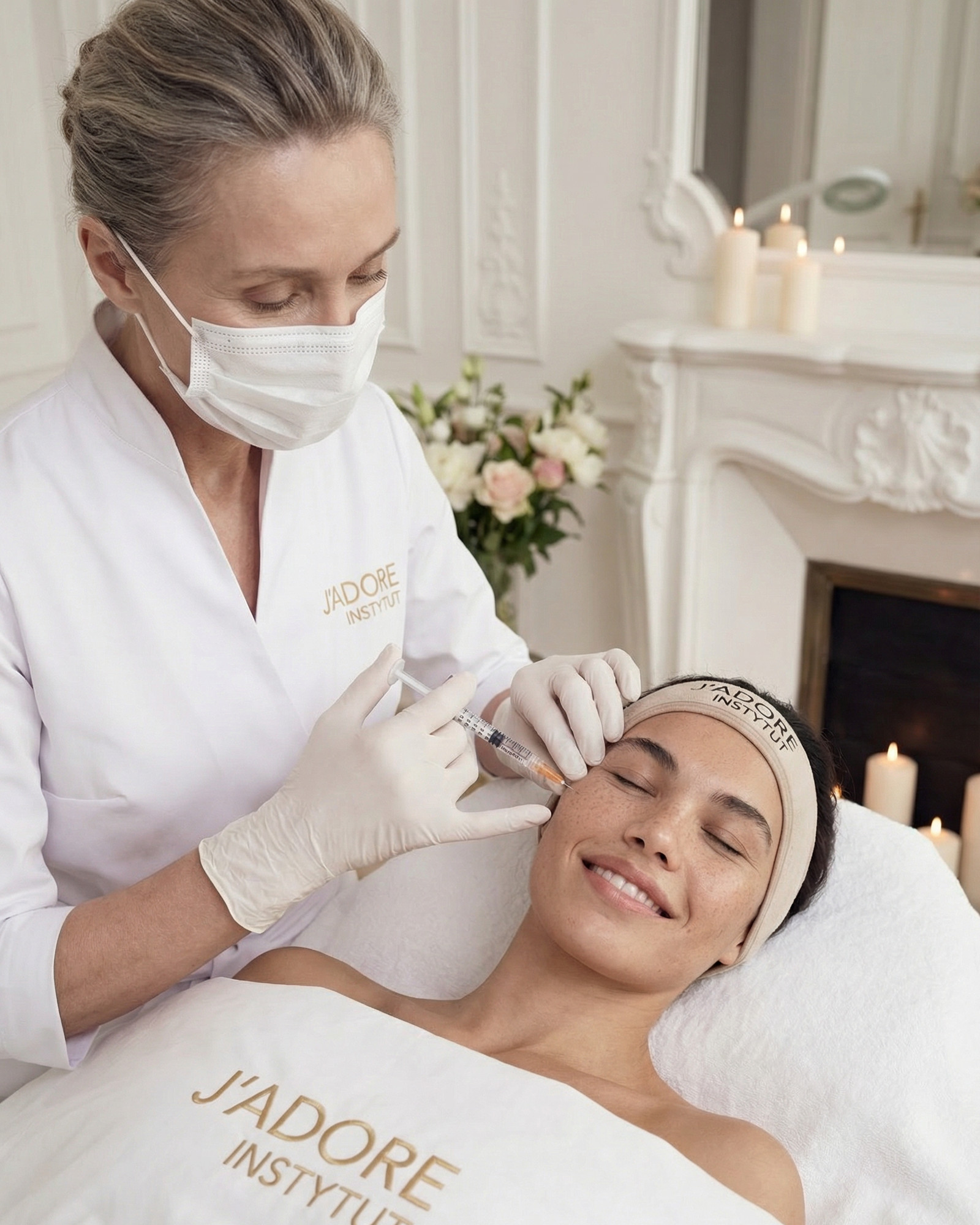
Profhilo Body is based on hyaluronic acid in a particularly pure, concentrated form. It's not a filler — there's no volumetric effect here, and adding volume isn't the point. The formula is designed to spread through the tissue, reaching a much larger area than classic point injections. Once injected, the substance doesn't stay in one place — it migrates and works across a wide surface.
But hyaluronic acid itself isn't the real hero here. The key is the mechanism it triggers. The formula acts on fibroblasts — the cells responsible for producing collagen, elastin and your skin's own hyaluronic acid. In other words: it doesn't deliver ready-made collagen to the skin. It sends a signal — "start producing it". That's the difference between feeding someone and teaching them to cook. The results are slower, but biologically more lasting, because it's the skin's own work, not an external substance.
Filler
Adds volume from outside
- Designed for targeted correction (folds, lips)
- Gives an immediate effect — volume is visible right away
- Doesn't stimulate your own collagen production
- Gradually metabolised by the body
Profhilo Body (bioremodelling)
Triggers biological renewal
- Designed for large body areas
- Migrates through tissue, covers a wide surface
- Stimulates fibroblasts to produce your own collagen and elastin
- Results build over several weeks after the treatment
What the protocol looks like — when and how much
Bioremodelling isn't a one-off "improvement jab". It's a treatment protocol — and although minimally invasive, it needs planning.
- Base series: typically two sessions, four weeks apart. This gives fibroblasts time to respond to the first signal, and allows the second session to reinforce a process already under way.
- Assessing results: full results are usually visible four to eight weeks after the last session — because skin needs time to synthesise new collagen. Results aren't judged "right after".
- Maintenance: after the base series, a maintenance session once a year or every six months, depending on your skin's condition and your goals. Without maintenance, results persist but gradually fade.
- Injections: the formula is delivered at several points on each area (arm, knee, décolletage), following an anatomical map. One body area means a few precise injection points — not a "massage with needles".
Ideal for — and what to realistically expect
Body bioremodelling isn't for everyone — but it suits a far wider group than you might think. Profhilo Body works best where the issue is loss of skin quality and firmness, not excess tissue. In other words: it's a tool for skin that has lost its elasticity — not a tool for reshaping the body.
- Who benefits most: anyone noticing a loss of firmness around the arms, knees or décolletage who isn't looking for a volumising effect; anyone whose skin hasn't "bounced back" after weight loss and fat tissue reduction; anyone with thin, fast-ageing skin in these areas; women and men aged 35–65 for whom body skin matters as much as facial skin.
- What it won't do: Profhilo Body won't reduce arm volume, won't eliminate fat or cellulite, and won't remove deep stretch marks. If the issue is shape, other tools apply (cryolipolysis, endermology). If the issue is cellulite, that's a separate category. Bioremodelling works with skin quality, not body shape.
- Best timing: because results build over several weeks, it's worth planning the series ahead — for example, in spring, so results show by summer. There are no strict seasonal contraindications, though.
It's also worth knowing that Profhilo Body can be combined with other treatments — biostimulators, peels or lasers — when skin needs work on several levels at once. What makes sense in your specific case is decided during consultation, not by a general rule.
What to do next — where to start
If your arms, knees or décolletage are areas you've been noticing — or covering up — this isn't just something to get used to. Body skin condition is just as treatable as facial skin condition. It simply needs different tools.
A sensible starting point isn't deciding on a treatment — it's a consultation, which lets us assess your specific area and your specific skin. Profhilo Body is one of several tools, and whether it's the right one — or whether a biostimulator, body mesotherapy, laser or a combination suits you better — depends on what's actually happening beneath the skin. The best results come from protocols matched to your condition, not schemes matched to trends.