What we mean by ‘needle-free lifting’
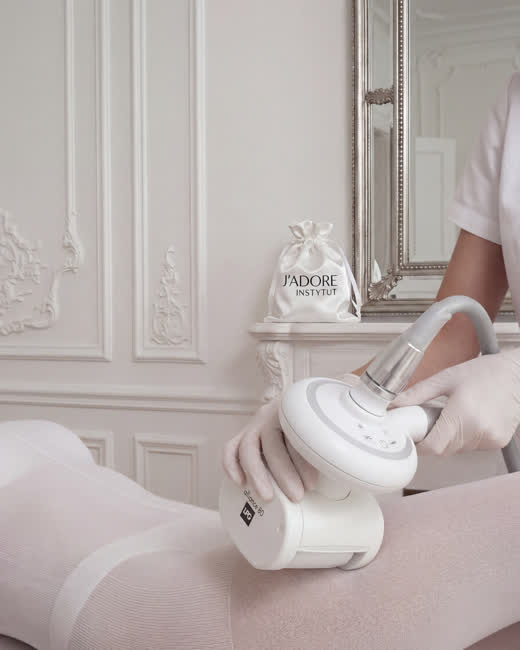
The term ‘needle-free lifting’ is not the official name of any procedure — it is a marketing umbrella covering very different technologies. They have one thing in common: they work on the skin and tissue without breaking the skin’s surface. No punctures, no cuts, no injections. Energy reaches deeper layers through the skin — and works there.
In practice, there are several main types of treatment. Some use energy focused deep within the tissues, while others work on surface skin firmness. Others combine several effects at once. Each mechanism targets a different skin and tissue layer — and each delivers different results. This is why ‘needle-free lifting’ is not one treatment but a family of methods with different strengths.
- Treatments using energy focused deep within the tissue — work on tissue layers that creams and ordinary massage cannot reach; heat triggers a biological response there.
- Treatments that firm the skin’s surface — target layers closer to the surface, improving the elasticity and firmness of the epidermis and dermis.
- Multi-layer treatments — combine both mechanisms, working across several layers at once.
The mechanism: why heat firms the skin
At the heart of most needle-free lifting treatments is the controlled delivery of heat or other energy deep into the skin. To understand why this works, it helps to look at collagen biology.
Collagen is a protein that forms a dense, elastic network of fibres in the skin — its supporting structure. These fibres are coiled like springs. When heated to the right temperature, they contract and tighten — creating an immediate, though subtle, effect. But this is only the first stage.
The second stage is more important: heated tissues treat this stimulus as a signal for repair and rebuilding. The body responds to controlled heat in a similar way to a micro-injury. It activates a regenerative cascade that produces new collagen and elastin fibres for weeks and months after the treatment. The skin becomes denser, more elastic and better supported by deeper structures.
- 01
Thermal stimulus
Energy reaches a specific depth within the tissue. The epidermis is protected by cooling — while heat works deeper down.
- 02
Immediate fibre contraction
Existing collagen fibres contract under the influence of heat. The skin may tighten slightly — an effect visible immediately after the treatment.
- 03
Tissue repair response
Skin cells interpret the stimulus as a signal to repair. Production of new collagen fibres begins.
- 04
Remodelling and maturation
New collagen matures over several months. The skin gradually becomes denser, fuller and firmer.
- 05
Final result
The full result is usually visible after 2–4 months. For many people, it only becomes clearly noticeable then, not immediately after the treatment.
Depth-focused treatments — working beneath the surface
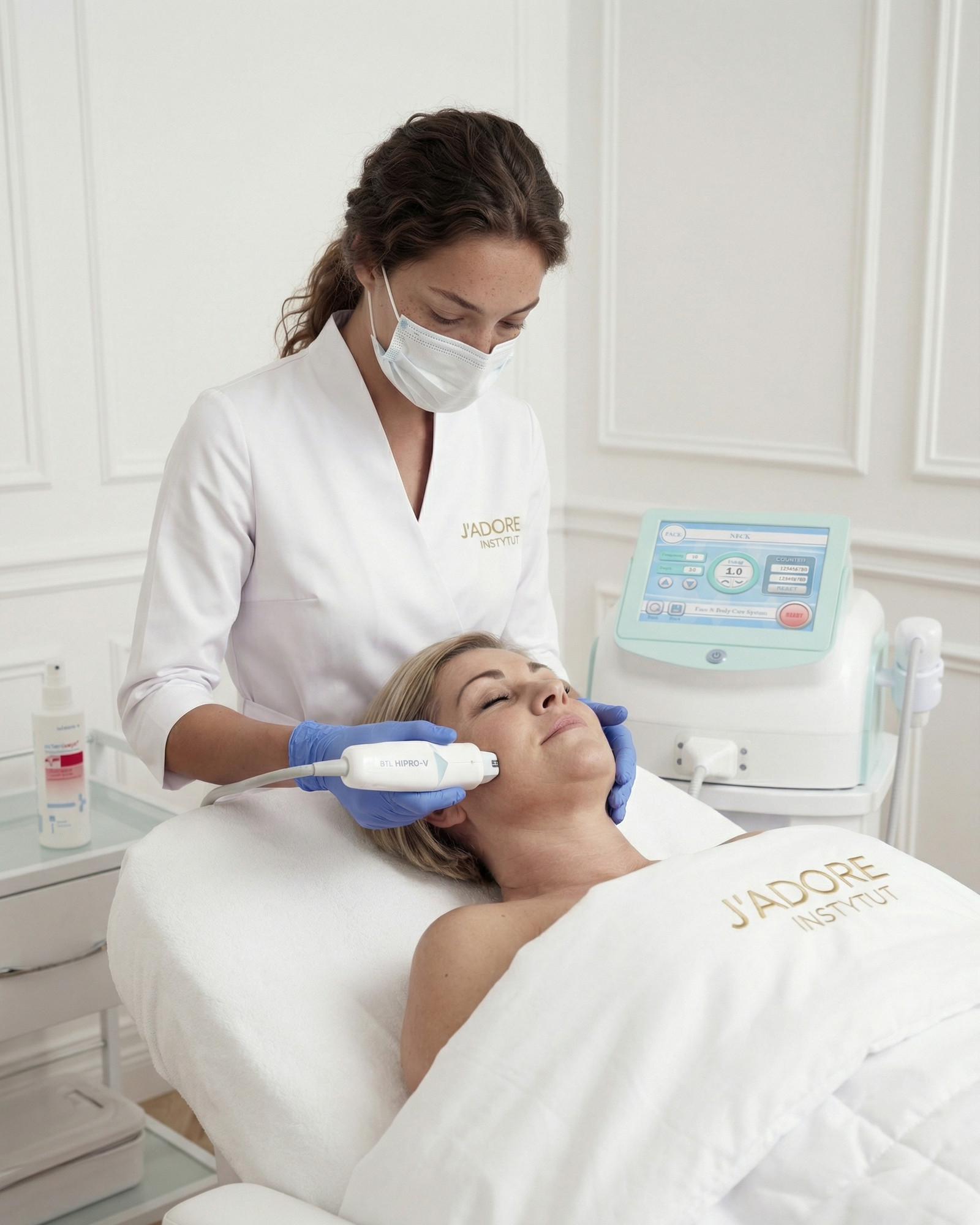
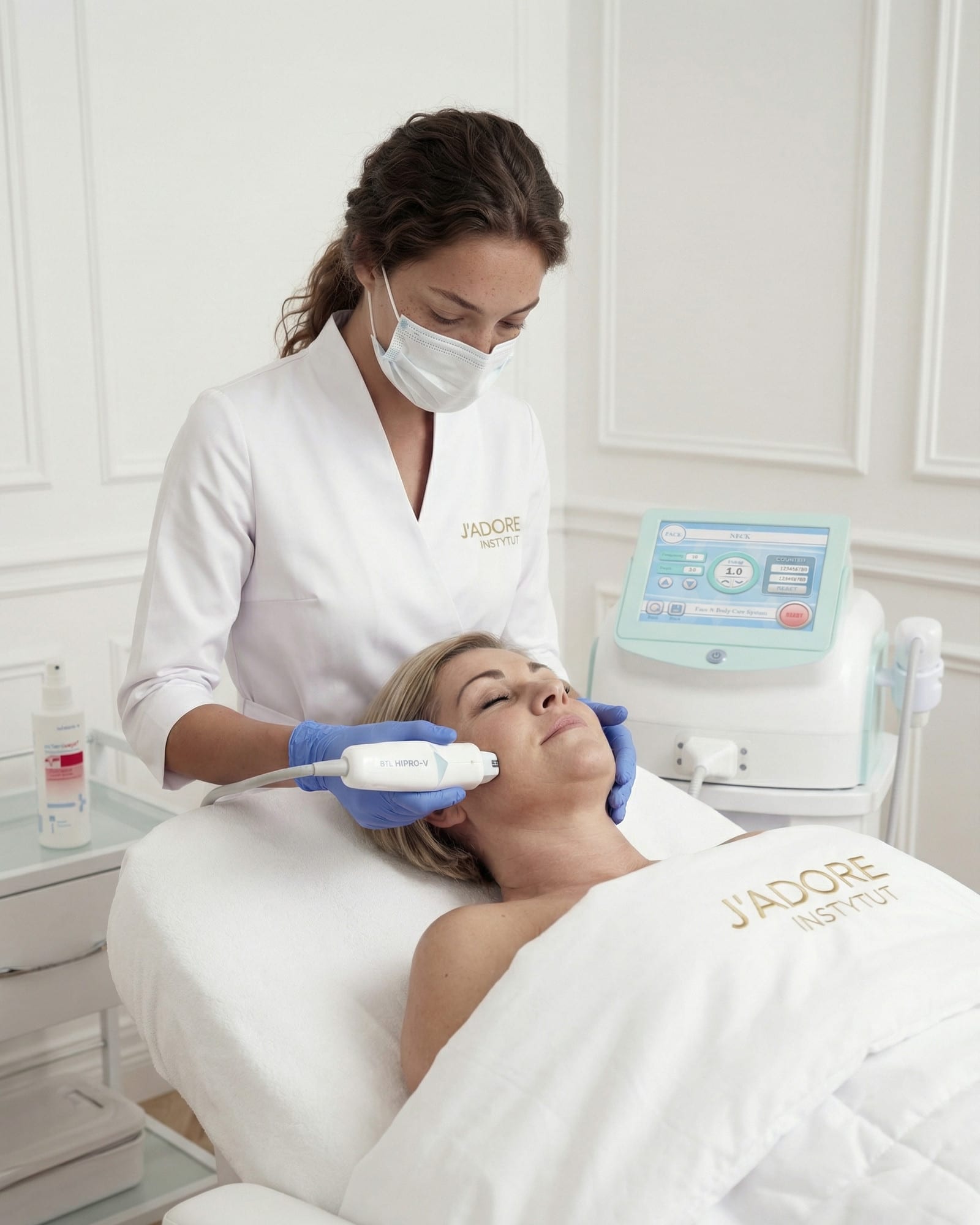
One of the best researched types of needle-free lifting treatment uses methods that deliver energy deep into the tissue, bypassing the epidermis. They work on layers that creams cannot reach and massage cannot affect — at the level of the skin’s deep supporting structure and the superficial musculoaponeurotic layer.
What distinguishes these methods from other facial treatments is their depth of action. Energy is focused precisely within a selected layer — bypassing the surface and reaching areas where the real causes of ‘sagging’ lie. Results may include lifting of the facial contour, improved jawline definition and neck firming — areas particularly difficult to address with other needle-free methods.
Surface-firming treatments — closer to the skin, not deeper
Alongside methods that work deep within the tissue, there is a group of treatments that target areas closer to the surface — the dermis and layers just beneath it. The mechanism is similar (thermal stimulus → repair response → new collagen), but the result is different. It focuses more on skin texture, density, fine lines and overall condition.
Deep tissue stimulation
works deeper — on the supporting structure and fascia
- Lifting of the facial contour and jawline firmness
- Improved neck and chin contour
- Results mainly visible in facial contour and geometry
- Ideal when tissue is affected by gravity
Superficial collagen stimulation
works closer to the skin — on quality and density
- Dermal density and firmness
- Improved texture, radiance and fine lines
- An effect of ‘good skin fatigue’ — work from within
- Ideal when the skin is thin, lax or grey
In practice, many people use both types alternately or in combination — because facial ageing is, as described in the article on facial sagging, a multi-level process. One treatment addresses geometry, while the other improves surface quality. Together, they deliver a more complete result than either treatment alone.
Realistic results: what it can and cannot deliver
This is the point where it is worth leaving marketing behind and speaking plainly. ‘Needle-free lifting’ is not one promise — it includes many treatments with different capabilities. Some deliver clearly visible results for a significant proportion of people, especially when started early enough. Others offer subtle improvements that may be difficult to see in a photograph, but can be clearly felt in the skin.
- What it can deliver: improved firmness and facial contour, lifting of the jawline, improved skin density and elasticity, reduced laxity in the neck and décolletage area, and an overall improvement in skin quality and radiance.
- When the result is most visible: in people starting preventatively or with moderate changes; after a series of treatments rather than a single session; 2–4 months after the last treatment.
- What it will not replace: significant excess skin after major weight loss, very advanced laxity requiring surgical correction, or restoring lost facial volume (this requires other methods).
Needle-free lifting and other methods — what to combine
Needle-free lifting treatments rarely work best in isolation. Facial ageing is — as described in the article on the layers of ageing — a multi-layered process: bone, fat, collagen and skin. Needle-free lifting mainly addresses the third and fourth layers: the supporting structure and skin condition. The remaining layers require other methods.
Collagen biostimulators
An ideal complement: a biostimulator “nourishes” the skin from within and builds its density, while needle-free lifting tightens the supporting structure. Together, they create an effect similar to “rejuvenating” the skin from two directions at once.
Volumetric treatment / fillers
When volume loss is the main concern (sunken temples, “drooping” cheeks), tightening alone is not enough. First, support is restored. Then the skin is tightened. The order matters.
Needle mesotherapy
Mesotherapy delivers nourishing substances deep into the skin. Needle-free lifting stimulates remodelling of the supporting structure. Together, they leave the skin nourished and tightened.
Medical peels
A peel improves the quality of the surface layer. The skin responds better to lifting treatments afterwards. Treatments are often performed as a series or alternately.
When to start and how often to repeat
One of the most common questions is: “is this right for me already, or is it still too early?” The answer is simpler than it seems: needle-free lifting treatments often work best preventatively — before changes become visible, rather than when years of neglect need to be addressed.
This is not a marketing principle — it is the logic of biology. Skin with enough of its own collagen responds better to stimulating treatments. When the supporting structure is already very weakened, stimulation works more slowly and delivers a smaller result. Regularly “reminding” the skin to work is more effective than one intensive intervention after years.