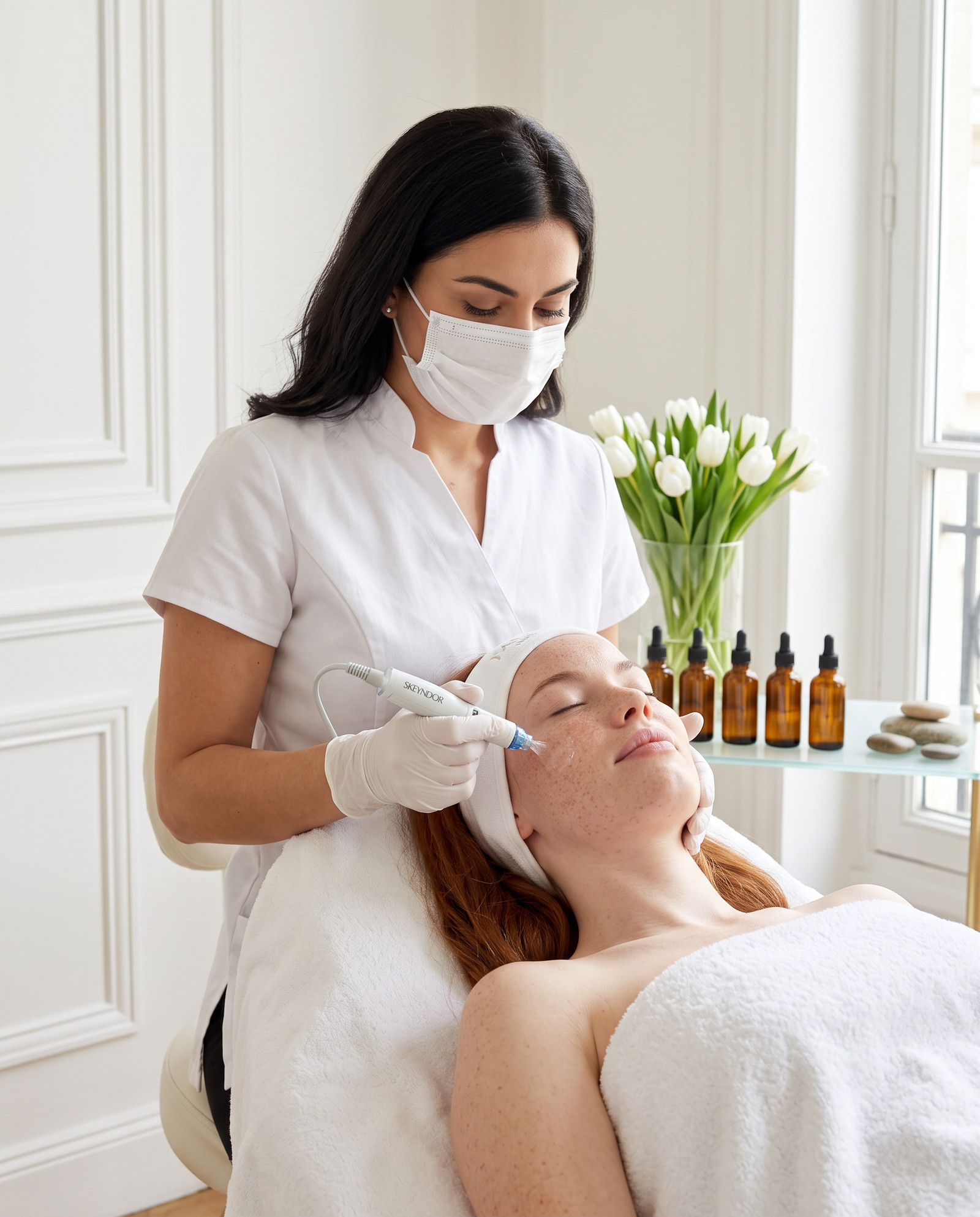
Before an event, choose predictability, not intensity
If this is your first visit, do not plan it the day before an important outing. Even gentle care can reveal a reaction to an ingredient, massage or a new cosmetic. It is safer to test the protocol earlier, and closer to the event, repeat a known procedure after which your skin usually returns to balance quickly. A known reaction is more valuable than the promise of a stronger result.
A banquet treatment should improve hydration, comfort and light reflection. It should not promise remodelling in a few hours. When the goal is to work on texture, hyperpigmentation or signs of photo-ageing, the calendar must be spread out, and you must accept that the result is not a single "glow".
In summer and winter, skin condition changes, not the name of needs
In summer, sun exposure, overheating, sweat and consistency in photoprotection are more important. Skin after a holiday can be dehydrated despite the shine. In winter, dry air, heating and wind weaken the barrier more often. The protocol is matched to the current picture, not to a date on the calendar.
Lines with retinol require a separate assessment of tolerance and UV exposure. They are not an automatic choice just because autumn has begun. If the barrier is irritated, it may first need calming and simpler care.
A series calendar should have a re-evaluation point
- First visit: diagnosis of needs and choice of protocol.
- After a few days: assessment of comfort, hydration and any reaction.
- Before the next visit: checking what home care has changed.
- In the middle of the plan: a decision on whether to continue the same line or change the goal.
- Before an event: only a procedure with a known course and a time margin.
- After the season: assessment of the skin without assuming that everyone needs a stronger treatment.
A break does not erase the effects and does not mean starting everything from the beginning. The pace of work simply changes. The best schedule is flexible: it takes into account holidays, infection, new medications, home care and whether the skin is actually benefiting from subsequent stages.
Global Eyecon concerns the eye area, not every cause of dark circles
A protocol aimed at the eye area can support comfort, hydration and skin appearance, and the manual element helps with temporary swelling. However, it will not change a deep anatomical depression, pigment or chronic swelling with a cause requiring diagnostics. Before an important outing, it makes sense when the problem is known and the skin has previously reacted well to products and massage.
If swelling has appeared suddenly, is one-sided, painful or accompanied by other symptoms, a cosmetic ritual is not the first answer. First, you must explain the cause. The same applies to changes on the eyelids and active eye irritation.
Hydrasensitiv is chosen when the barrier needs peace
After wind, heating, travel or overly active care, the skin may sting when in contact with water and react with redness to products it previously tolerated. At such a moment, a soothing protocol is more useful than another attempt at intensive exfoliation. The goal is to regain comfort and limit reactivity, not a spectacular change in the mirror.
Sensitive skin is not one diagnosis. Redness can result from a damaged barrier, dermatosis, contact allergy or overload from care. The cosmetologist should recognise the limit of their competence and refer you to a dermatologist when the picture requires treatment.
Power Retinol needs a margin and simple home care
A protocol with retinol should not be the first experiment just before an event or a sunny holiday. Previous tolerance to vitamin A, the condition of the barrier, medications, pregnancy and breastfeeding, and the ability to consistently protect against UV are important. Do not add acids or another retinoid at home just to speed up the result.
After the treatment, observe the comfort of your skin. Increasing burning, severe swelling, blisters or oozing are not a desired proof of action. They require contact with the salon, and in case of severe symptoms, appropriate medical consultation.
Uniqcure and hydrating protocols can be a reset point
When the skin is tight, dull and easily highlights dehydration lines, hydrating care can quickly improve comfort and surface appearance. This result is valuable, but it should not be called a lifting or remodelling. Its durability depends on the barrier, environmental conditions and what happens at home after the visit.
In a seasonal plan, such a treatment can serve as a calm beginning: first, improvement of tolerance and ordering the routine, then a decision on whether the skin needs a more active procedure. Not every person has to move to a stronger stage.
A consultation should separate four different care goals
Before choosing a line, name the dominant problem. Does the skin sting and react with redness? Is it dehydrated, even though it still gets oily? Is the main goal the eye area? Or perhaps it already tolerates retinoids and needs to work on texture? Attempting to cover everything with one protocol usually blurs the priority. A cosmetologist can plan subsequent stages, but the first visit should have one clear goal. Thanks to this, the result can be assessed without adding after the fact that the treatment was supposed to do everything at once.
Take a list of cosmetics to the consultation, especially retinoids, acids, anti-acne preparations and topically applied medications. Tell us about recent treatments, sun exposure, allergies and reactions to professional cosmetics. The brand name does not waive contraindications resulting from the composition of a specific line. If you do not know the names, take photos of the labels and show the frequency of use.
Before an important day, leave time to assess the first reaction
If you do not know the protocol, treat the first visit as a compatibility test, not the final preparation. The skin may react with temporary redness, tightness or a breakout, even when the treatment is described as gentle. A margin allows you to return to a simple routine and contact the salon without the pressure of makeup and photos the next day.
Further care can be planned closer to the event only when the course is known. Do not change your cream, serum and treatment at the same time. The fewer new variables, the easier it is to predict the appearance of the skin and determine what actually serves it.
After summer, first assess the barrier and the type of hyperpigmentation
A tan is not a signal that the skin needs a strong retinol immediately. After the sun, it may be dehydrated, more reactive and still exposed to UV. First, comfort, redness, peeling and whether visible spots are superficial or require diagnostics are checked. A soothing or hydrating protocol can precede more active care.
Not every hyperpigmentation should be treated cosmetically. A new, changing or unusual pigmentary change requires dermatological assessment. A treatment should not mask it or delay diagnosis.
In winter, the skin does not always need stronger action
Less sun favours planning some active procedures, but the season does not repair a damaged barrier. Dry air and heating can increase tightness, burning and peeling. If your face reacts to a basic cream, increasing intensity is not a logical first step. First, you must restore the tolerance of daily care.
The winter schedule also takes into account trips to the mountains and the reflection of radiation from snow. Photoprotection remains necessary. A treatment calendar cannot assume that from autumn to spring, UV exposure ceases to exist.
Home care determines whether the effect remains clear
After the treatment, you do not need a whole shelf of products from the same line. You need a few steps matched to the goal: gentle cleansing, barrier protection, photoprotection and possibly one active ingredient introduced according to recommendations. Excess can turn a calm salon effect into irritation that is difficult to interpret.
Before the next visit, note not only the appearance but also the sensations: stinging after washing, tightness during the day, speed of oiliness, tolerance of makeup and new changes. These data help decide whether to repeat the protocol, change the line, extend the interval or end the series.
A good date results from the skin's response, not from a marketing season
Skeyndor can be fitted into different times of the year, but there is no one month suitable for every line. A soothing protocol can make sense after a period of overload, a hydrating one before an event, the eye area before a stage of intensive work, and retinol at a time when exposure and regeneration can be controlled. Each time, the decision starts with the current state.
One criterion remains to be taken: after the treatment, the skin should be closer to the set goal without creating a new problem. If the calendar forces a procedure despite infection, irritation, a tan or a lack of a margin, change the date. A lost reservation is a smaller cost than an unpredictable reaction before an important day.
A single visit and a series meet different expectations
One-off care can improve surface hydration, comfort and freshness of appearance. This is a reasonable goal before an event if the protocol is known. A series makes sense when you observe a recurring problem and want to check the trend: less reactivity, a more stable barrier or gradual work on texture. Do not promise yourself after one visit what requires a change of routine and time.
Before purchasing a series, determine the frequency, the moment of control and the condition for completion. The skin may reach the goal earlier, need a longer interval or stop tolerating an active line after a change in weather or medications. The plan should allow for correction instead of protecting the schedule from reality.
There are situations in which the best date is later
Postpone the visit in case of active infection, cold sores, a fresh sunburn, severe inflammation or an unclear allergic reaction. Report pregnancy, breastfeeding, dermatological treatment, new medications and recent procedures. Not every one of these points excludes every care, but each can change the line, composition or date.
If your skin has suddenly become very reactive, do not try to calm it with subsequent new products. Return to a known, simple routine and explain the cause. A treatment performed only because the date was previously reserved adds another variable at a time when you need a clear picture.
After the visit, do not speed up the next stage
Give your skin time to return to its usual rhythm before you assess the result. On the first evening, it may look better thanks to the massage and hydration; later, the effect stabilises in home conditions. Do not add a peel, brush or intensive retinoid immediately. The lack of an additional stimulus allows you to distinguish the action of the protocol from a reaction to home experiments.
If the effect faded quickly, it does not automatically mean you need more frequent visits. Check your cleansing, heating, sun exposure, the number of new active ingredients, and whether your goal was realistic for surface-level care. Sometimes, the better next step is to adjust your daily routine rather than shorten the interval.
Note the date of the treatment and the product line used. At your next consultation, do not rely solely on the memory of "soft skin". State when improvement appeared, how long the comfort lasted, whether any stinging occurred, and what you applied at home. Such a log helps distinguish a short-term sensory effect from a change that is truly worth maintaining.
How to prepare your own criteria before a consultation
Before booking, write down in one sentence what you want to change and how you will know the result is sufficient for you. Regarding "season and timing", it is easy to adopt advertising language and start evaluating names instead of your own problem. Add three boundaries: what you do not want, how much time you can dedicate to regeneration, and what previous experience influences your current decision. Such a note organises the consultation and helps you notice if the specialist's answer addresses your goal.
When deciding on "Skeyndor before an event and after the season: choose the protocol first", write down the answers literally: the name of the preparation or technique, the person performing it, the plan of stages, the expected reaction, limitations, and the moment of follow-up. If the salon uses general terms, ask for them to be translated into observable facts. A "natural result" can mean something different to everyone; "short regeneration" also requires clarification. A good consultation reduces the number of unknowns, but it does not pretend that biology can be given orders.
When comparing places for the "season and timing" topic, separate the safety standard from the comfort-building extras. A nice waiting room, a cosmetic sample, or an elaborate ritual may improve the experience, but they will not replace qualifications, hygiene, documentation, and aftercare. On the other hand, the medical aesthetics of an interior alone are not proof of competence. Ask about the procedure and how the team behaves when the process is not textbook.
Re-evaluate your decision after gathering all the data
When deciding on "Skeyndor before an event and after the season: choose the protocol first", you do not have to book an appointment the moment the consultation ends. Check the recommendations, read the consent form, and see if the scope of responsibility is clear. If, after the conversation, you still cannot say what problem the procedure is meant to solve, what its limitation is, and who you contact after the treatment, you need answers before starting, not after the fact.
The most useful conclusion from the "season and timing" topic is simple: a good decision remains sensible even without the promise of a quick finish. It takes into account the starting condition, the real limits of the method, and the possibility of changing the plan. This margin is what distinguishes an informed qualification from fitting a client into a free slot in the calendar.