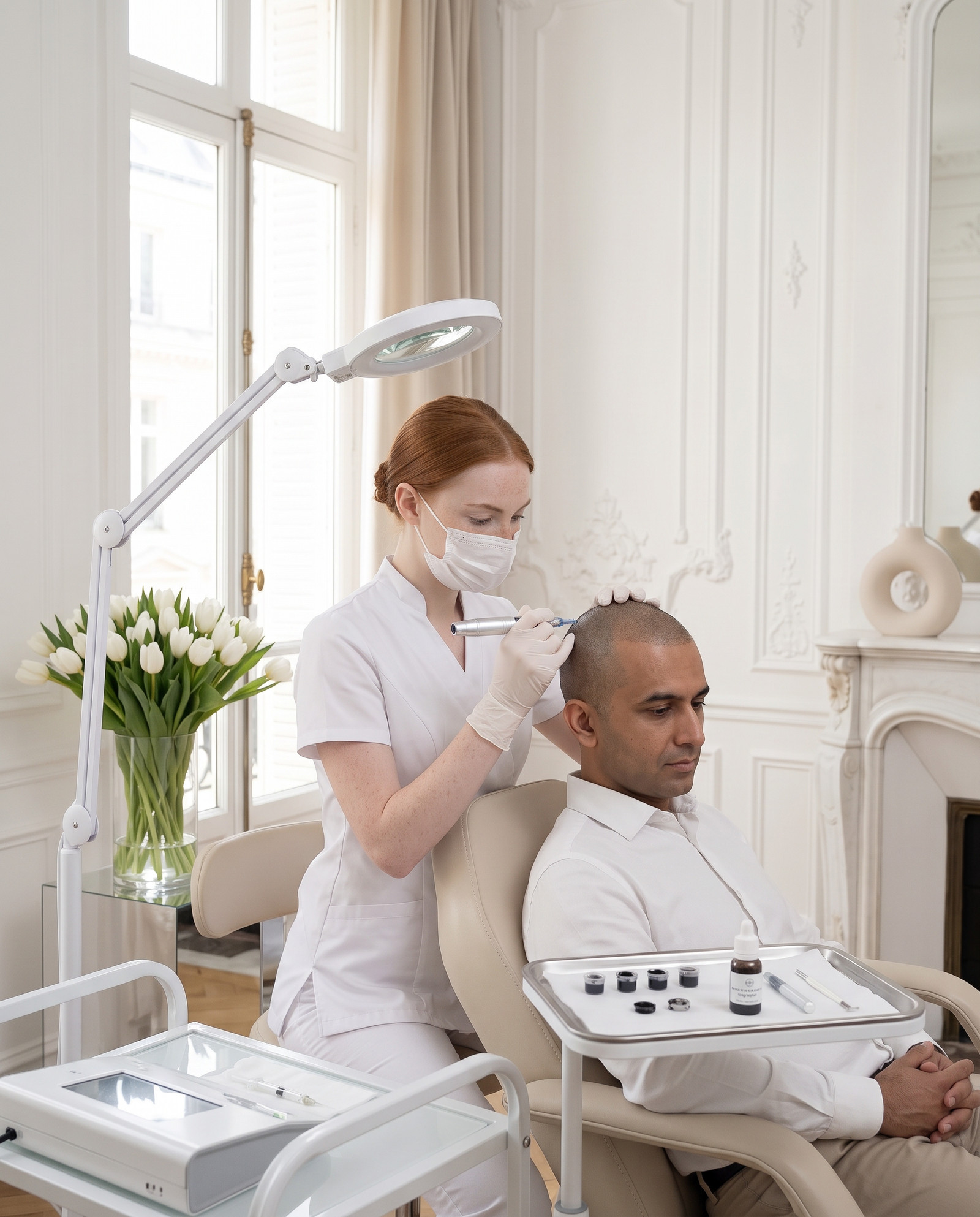
Active infection and damaged skin mean rescheduling.
Before your visit, do not try to "clean" the problem with an aggressive peel, shaving until you bleed, or a strong anti-dandruff agent used for the first time. Such an experiment may reduce visible scaling while damaging the barrier and obscuring the appearance of the condition. Show the skin in its normal state and bring a list of medicinal products. If a doctor has recommended topical therapy, do not stop it just to make the consultation look more aesthetic.
Purulent pustules, folliculitis, oozing, open sores, painful cracks, suspected fungal infection, fresh scratches and sunburn are not areas for pigmentation. Puncturing can exacerbate the condition, spread microbes over a larger surface and make it difficult to assess healing. First, diagnosis and treatment are needed, followed by a calm, undamaged barrier.
Fever, active general infection and feeling noticeably unwell also postpone the visit. The planned area may look healthy, but the body does not need another injury during an illness. Do not mask symptoms with an antipyretic just to keep the appointment. After recovery, the qualification is updated to include new medications and the course of the infection.
Recurrent herpes, even outside the scalp, should be disclosed. An active lesion is a reason for rescheduling and a potential consultation regarding prophylaxis if a doctor deems it necessary. Do not take antiviral medications based on someone else's prescription. The SMP specialist assesses the possibility of the treatment, while therapy is determined by a person with appropriate medical qualifications.
Psoriasis, seborrhoeic dermatitis and eczema require a calm phase and diagnosis.
Scaling is not a single diagnosis. It can result from seborrhoeic dermatitis, psoriasis, contact eczema, fungal infection or irritating skincare. Each condition has a different logic. Pigmenting through an active lesion increases the risk of irritation, uneven retention and more difficult healing. When the picture is unclear, a dermatologist is needed, not an attempt to match a name based on photographs.
In psoriasis, trauma can provoke new lesions at the site of injury in some people, so the history of reactions to scratches or tattoos is significant. A stable disease does not automatically give the green light, and the name of the disease does not mean an automatic refusal forever. The decision takes into account activity, location, treatment and the opinion of the attending physician when needed.
Sudden or scarring hair loss must first be seen by a doctor.
Rapid widening of the parting, round patches, burning, follicle pain, smooth shiny skin, loss of follicular openings or loss of brows may indicate a process requiring diagnostics. Scarring alopecias, in particular, can permanently destroy follicles. Camouflage does not stop the disease, and puncturing an active area should not precede diagnosis.
In androgenetic alopecia, SMP can be an aesthetic element of the plan, but the progression of the process must be taken into account in the line and density. A boundary recreated too low may separate from receding hair years later. For women, pigment between the hair can reduce contrast, but it does not create strand volume. If active follicles exist, it is worth discussing treatment with the appropriate specialist in parallel.
Medications and general illnesses must be named, but you must not change therapy on your own.
- Supplements and over-the-counter medications. Enter them on the list, because the name "natural" does not inform about the impact on clotting, allergies or the metabolism of other agents.
- Composition assessment. Not every supplement is significant, but the decision about its importance is made by the specialist after learning the full composition, not by you hiding it as irrelevant.
- Data preparation. If you do not remember the full name or dose of a preparation, bring the packaging or a photo of the label with you.
Disclose anticoagulants, antiplatelet drugs, immunosuppressants, retinoids, steroids and preparations affecting healing. The reason for their use may also be significant. Do not stop any regular treatment on the instruction of a person without qualifications. If the treatment requires a change in therapy or an assessment of bleeding risk, the decision is made by the attending physician. Sometimes a safer outcome is to forgo SMP.
Diabetes is not a single condition. What matters is control, wound healing, sensation, infections and the recommendations of the attending physician. Autoimmune diseases also differ in activity and treatment. A stable disease may require a documented consultation, whereas a flare-up, a fresh change in therapy or difficult healing argue for rescheduling. A form with a "yes/no" field does not replace a conversation.
Tell us about fainting, epilepsy, severe allergies, heart disease and previous reactions to needle procedures. Not every piece of information will exclude the service, but it affects preparation and the assessment of whether the salon can safely perform it. Hiding an illness for fear of refusal shifts the risk onto you and the staff, and also makes it difficult to provide proper help in the event of an emergency.
Pregnancy and breastfeeding are treated as a time to put the plan on hold.
Postpartum hair loss can be temporary, but one should not assume the cause without assessment. Thickening with pigment too early may be designed for a state that will change on its own in the following months. After breastfeeding ends and the situation stabilises, it is worth looking at the parting, line and skin again, rather than performing the old drawing from memory.
A scar is only pigmented after it has matured and its behaviour has been assessed.
A scar after an FUE or FUT transplant, injury or surgery must be closed, stable and mature. Red, itchy, painful, hardening or enlarging tissue requires assessment, not camouflage. The mere passage of time is not enough if the scar is still changing. A tendency towards keloids should be disclosed even if the previous lesion occurred in a different area of the body.
Scar tissue may take pigment differently, have uneven sensation and require careful building of points. The specialist should show healed examples of similar cases, not just fresh photographs. Camouflage reduces the colour difference, but it does not remove the bump, indentation or tension. A promise of an invisible scar after one session ignores the limitations of the structure.
A suspicious pigmented lesion must not be covered with pigment.
A mole or spot that changes size, shape, colour, itches, bleeds or differs significantly from the others requires dermatological assessment. SMP should not pass through a lesion whose nature we do not know. Pigment can make subsequent observation difficult, and a photo from a phone does not replace an examination. In case of doubt, the plan avoids the area until diagnosis.
This also applies to nodules, chronic scabs and non-healing wounds. Not every lesion is dangerous, but it is not the linergist's job to decide this in the aesthetic chair. A safe boundary of competence consists of stopping the treatment and indicating the right path, not in reassuring the client without grounds.
Sterility includes the needle, pigment, surfaces and the way of working.
The interview should include questions about hepatitis, HIV and other blood-borne diseases, not to stigmatise, but to properly plan care. Standard precautions apply to every person, regardless of their declaration. The salon cannot make basic hygiene dependent on whether the client knows their status. Protection of staff and subsequent clients results from a consistent procedure.
- Sterility of tools. The cartridge in contact with the skin must be sterile, single-use and opened directly in front of the client.
- Protection against contamination. Staff work in gloves, prepare the skin according to the procedure and secure surfaces against cross-contamination.
- Pigment management. The pigment container cannot be a shared vessel into which the tool returns. Residues of the product from one session cannot be stored for the next visit.
Ask for the name of the pigment, batch number, expiry date and documentation of the materials used. Information is important in the event of a reaction and for future refreshing. The slogan "organic" or "natural" does not automatically mean the absence of allergies or safety. What counts is legal origin, composition, proper storage and the ability to trace the batch.
After the treatment, symptoms should be local and gradually fade.
- Post-treatment hygiene. The instructions should precisely specify the time and method of washing the scalp, rather than a general ban on getting it wet.
- Protection and care. You should know what not to apply to the skin and how to effectively protect it from the sun.
- Physical activity. The ban on sports must take into account the individual level of sweating so as not to expose the skin to irritation.
- Communication with the salon. It is worth asking for written instructions on how to proceed so as not to rely on memory after a stressful session and to know which number to call to report reactions.
Redness, a feeling of tightness, mild tenderness and a darker appearance of fresh points are typical. The skin may peel slightly. Aftercare involves washing, sun protection, and avoiding sweating, swimming pools, saunas, scratching, and irritating products for the specified period. Do not use antibiotics, steroids, or disinfectants on your own just because you feel a burning sensation.
Contact the salon quickly for a medical assessment if you experience increasing pain, spreading erythema, noticeable warmth, purulent discharge, an unpleasant odour, fever, chills, or enlarging painful lymph nodes. These symptoms may indicate an infection or other complication. Waiting for the "pigment to settle" is not the correct response to a worsening condition.
Sudden shortness of breath, swelling of the face, tongue or throat, generalised hives with weakness, fainting, confusion, or a rapid deterioration require urgent emergency assistance. Do not drive yourself across the city if your condition is severe. Neurological symptoms, visual disturbances, or severe, unusual headaches also require urgent assessment rather than online photo comparisons.
In Warsaw, the qualification process should conclude with a written safety plan.
Record the date of your medical consultation and the recommended observation period. A general "it is allowed" from many months ago may not correspond to your current skin condition or therapy.
Keep your aftercare card and the pigment batch number even after healing. For future MRI scans, dermatological procedures, laser removal, or consultations at another salon, information about existing micropigmentation may be important for planning. This does not mean every future procedure is forbidden. It means the next specialist should know what is in your skin and when it was introduced.
If a treatment involves several visits, we update questions about infections, new medications, changes in health, healing of the previous stage, and reaction to the pigment before each one. Consent from the first day is not a pass for the entire series. Between appointments, you may have started antibiotics, undergone surgery, sustained an injury, developed a tan, or experienced a skin flare-up. A brief re-interview protects you from having a procedure performed based on outdated data.
Before scalp micropigmentation in Warsaw, prepare a list of medications, illnesses, allergies, treatments, transplants, and reactions to tattoos or PMU. Show your skin without thickening fibres, coloured sprays, or freshly applied topical medications, unless your doctor has advised otherwise. Do not stop your therapy to make your appearance look better during the consultation.
The plan should list the area, the goal, the approximate number of stages, the type of pigment used, aftercare instructions, and how to contact us after the treatment. You must know which symptoms to report to the salon and which require urgent help. If you have a chronic illness, a doctor's opinion may be necessary. A general signature of "no contraindications" does not replace a conversation about a specific therapy.
The most important test for a salon happens before the needle: whether the specialist can refuse when the skin is actively diseased, the hairline is still receding rapidly, or the expectation is for hair regrowth. SMP makes sense in a properly qualified, stable situation. Safety does not mean that every consultation ends with a treatment. It means that every treatment begins with sufficient reasons to perform it.