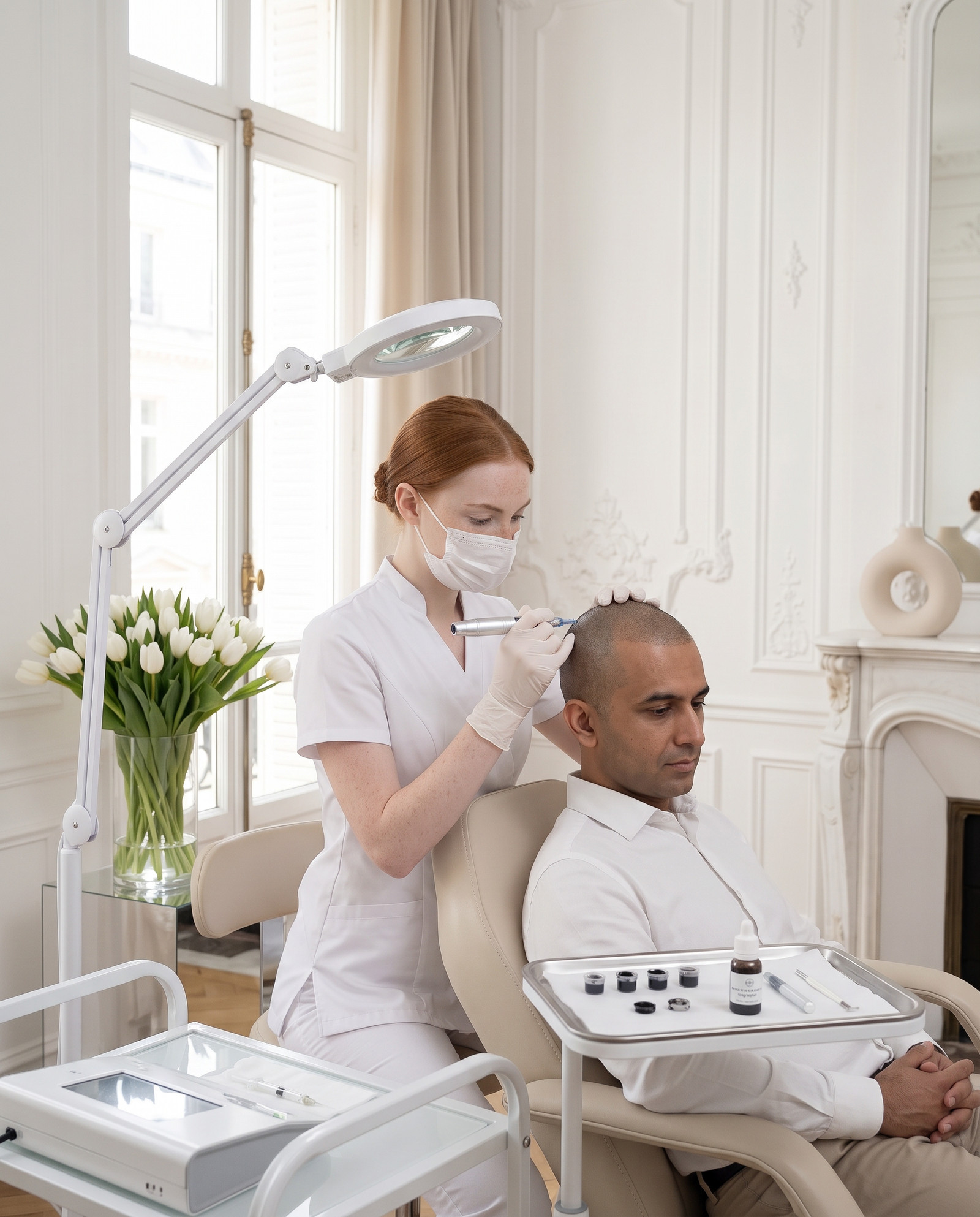
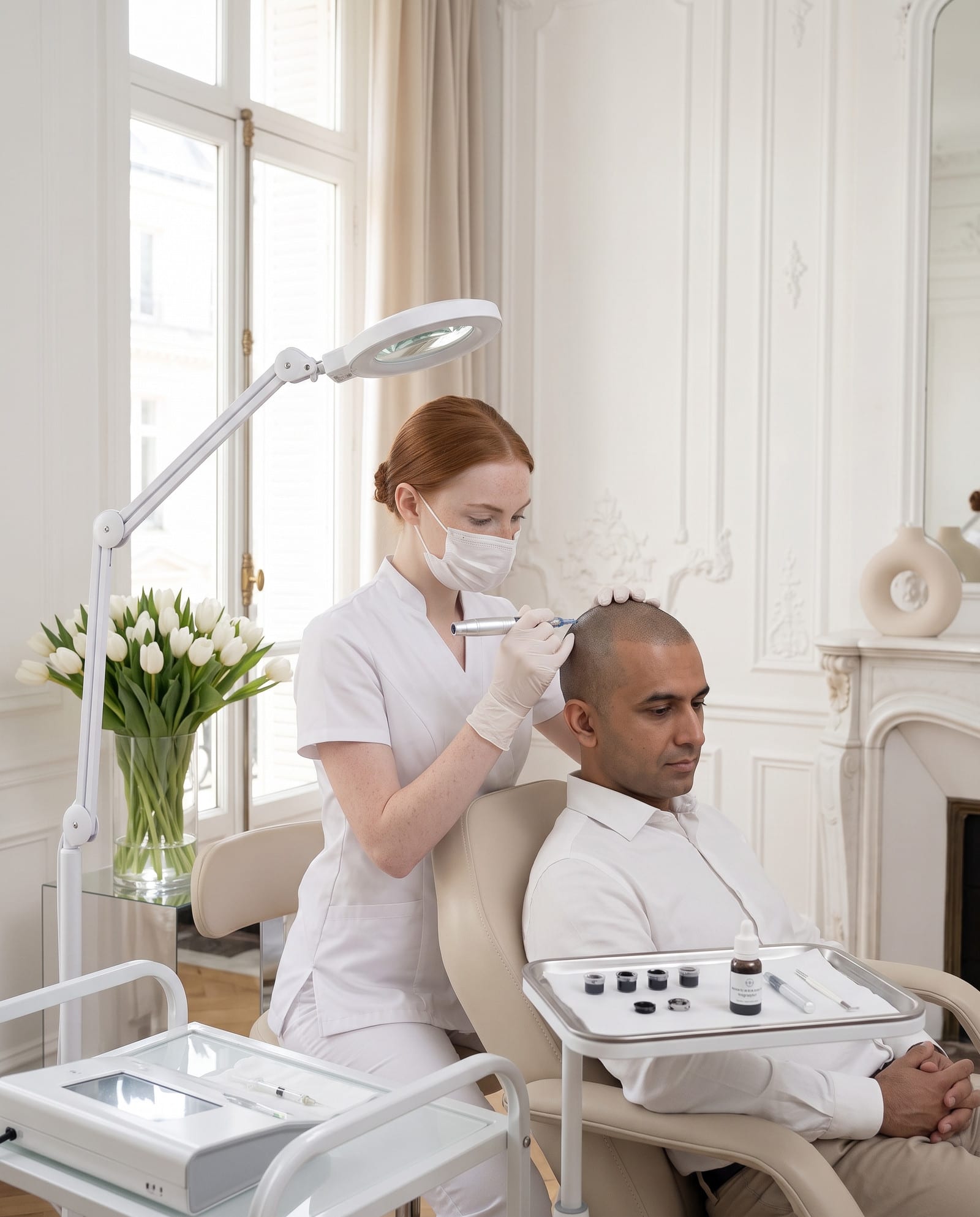
You mostly feel a series of short pricks, not one continuous pain.
Your pain threshold is not a fixed trait. It can change after a poor night's sleep, under stress, during a migraine, after an infection or after sitting for a long time without a meal. Do not try to prove a previously declared result if you feel different on the day of your visit. Your current reaction is more important than what was said during the consultation. The scope can be divided, and the appointment moved without this being considered a failure.
The device places dot after dot, so the stimulus has a rhythm. At first, you may feel light scratching, then warmth and increasing tenderness in areas of repeated passes. The sound of the device and anticipation can increase tension more than the first touch. After a few minutes, some people get used to the repetition, while others find their sensitivity increases over time.
Proper communication distinguishes discomfort from sharp pain. Stinging limited to the treated area is different from a sudden piercing impulse, burning that extends beyond the work area, facial numbness or dizziness. The practitioner cannot assess everything by looking at the skin. They need your description, so a pre-agreed word or gesture for a break increases safety.
The frontal line, temples, crown and occiput may differ in sensitivity.
The scalp is not a uniform surface. Areas closer to the bone, hairlines and zones with denser nerve supply may be felt more clearly. The occiput is often perceived differently than the parting, and working near the ear can amplify sound and vibration. However, it is impossible to create a universal pain map. A spot that is mild for one person may be the most sensitive for another.
- Subtle thickening. Requires precise separation of strands and working on selected gaps between longer hair.
- Shaved head effect. Covers a larger treatment area and involves longer exposure to a repetitive stimulus.
- Scar camouflage. Covers a smaller area, but altered tissue may react to needling in an unusual way.
A scar may be less sensitive, hypersensitive or unpredictable.
During the consultation, touch and visual inspection of the texture provide more information than a photo. The practitioner asks if the area itches, pulls, burns or changes colour. If the scar grows, becomes hard, hurts spontaneously or has keloid features, a medical assessment is needed. Pigment does not heal scar tissue; it can only optically reduce the contrast after proper qualification.
Anaesthesia is not an automatic step for everyone.
Local anaesthetic preparations have indications, contraindications, a specific application method and limitations. Do not apply a cream bought online yourself before coming. The practitioner must know what was used, on what surface and how long the preparation remained on the skin. Excessive amounts, a damaged barrier or improper covering can increase absorption and the risk of adverse effects.
Some procedures are performed without anaesthesia; others allow for a local solution after an interview. The decision depends on the protocol, extent, allergy history, medications and skin condition. Anaesthesia can change the appearance of the tissue, so the specialist also considers the precision of the dotting. The goal is not to completely switch off sensation at all costs, but to have a tolerated treatment without masking signals that require a break.
Pace, position and breaks realistically change comfort.
A long session in one position can cause neck, jaw or back pain regardless of the dotting. The positioning should stabilise your head without forcing a twist. Ask to change the support before your muscles start to tremble. Your movement hinders precision, so biomechanical comfort is an element of quality, not a spa extra.
Short breaks allow you to relax your jaw, drink water if you are thirsty and check if the sensation fades after the device stops. The practitioner can alternate zones instead of working in one spot repeatedly. However, you should not extend the treatment indefinitely if the skin becomes increasingly reactive. Sometimes the right decision is to finish the stage and complete it after healing.
Breathe normally and do not come after a sleepless night, an intense workout or under the influence of alcohol or psychoactive substances. This is not about a "pain threshold raising" ritual, but about the ability to consciously report sensations. If you are prone to fainting during needles, tell us before lying down so the clinic can plan the position and response.
Pain should not be an argument for a deeper dot.
SMP is meant to create tiny shadows resembling follicles, not a deep tattoo. Stronger pain does not prove that the pigment will be more durable or natural. Overly aggressive work can increase trauma, bleeding, dot spreading and the risk of scarring. Technique is assessed by precision, spacing and the healed colour, not by how much the client endured.
A red flag is dismissing sharp pain with the phrase "it has to hurt for it to work". It is equally dishonest to promise a total lack of sensation. A good discussion sounds different: we expect repetitive stinging, we monitor the reaction, we stop at an unusual signal and we do not increase depth just because a person has a high pain threshold.
After the session, typical tenderness should fade, not increase.
After micropigmentation, the skin may be red, tight, slightly burning and sensitive to touch. The dots look darker than after healing. Gentle tenderness should gradually subside. Use only recommended washing and care, do not scratch, do not rub with a towel and do not try to soothe the skin with random oils, cosmetic alcohol or a preparation borrowed from someone else.
Increasing throbbing pain, rapidly spreading redness, clear warmth, purulent discharge, unpleasant odour, fever or deterioration of general condition require urgent contact with the clinic and medical assessment. Do not wait for the scheduled follow-up and do not mask symptoms with a hat. Early recognition of an infection or a strong reaction is more important than preserving the pigment.
Severe facial swelling, shortness of breath, fainting, confusion or a rapidly increasing reaction are indications for urgent emergency help. The cause cannot be recognised remotely. The rule is simple: mild local sensations should decrease over time; a severe, general or rapidly progressing symptom is not part of normal healing.
Before the first session, prepare information, not home experiments.
Tell us about scalp diseases, allergies, medications affecting clotting, diabetes, autoimmune diseases, tendency to keloids, fainting and previous reactions to pigment or anaesthetics. Do not stop medications on your own. If a change in therapy is needed, the decision is made by the attending physician, not the treatment schedule.
- Skin condition. Do not come with active folliculitis, a weeping lesion, a fresh sunburn, an exacerbation of psoriasis or seborrhoeic dermatitis.
- Surface visibility. Do not mask the skin with hair powder or thickening fibres. The specialist must see the actual surface.
- Reporting symptoms. If your head itches, hurts or peels differently than usual, report it before the visit instead of hoping that the pigmentation will "cover the problem".
The fifth visit provides knowledge of the procedure, but the skin may still react differently than the first time.
At the next, including the fifth, visit, the client usually recognises the rhythm of work and more easily distinguishes a normal short prick from a signal requiring a break. They also know whether they are more bothered by the sound of the device, the pressure of the headrest or dotting near the temple. However, this knowledge does not mean you can remain silent. Lack of sleep, irritation after shaving, tension or the sensitivity of a specific part of the head can still change your comfort on a given day.
Late SMP sessions often serve to refine gaps, soften the pigment border or add dots where the skin accepted them more subtly after healing. The cosmetologist does not mechanically repeat the previous scheme: they compare the healed image with photos, assess the shade of the dots and work dot-by-dot in places that actually require it. A smaller scope may be shorter, but precise work at the hairline or between hairs still requires calmly reporting every worrying sensation.
In Krakow, comfort is established before the device is switched on.
Dress in a way that ensures your collar does not press against the back of your head afterwards. Plan a relaxed journey home without a helmet if the salon advises avoiding friction on the fresh area.
If a previous tattoo, blood draw or treatment caused fainting, an allergic reaction or unusually long-lasting pain, describe the experience in detail. Simply saying "I don't handle needles well" does not clarify whether the issue was anxiety, positioning, the product or a late infection. Details allow us to prepare breaks, positioning and stopping criteria, and sometimes indicate the need for a consultation before SMP.
For scalp micropigmentation in Krakow, book a consultation first, especially if treating a large area, a scar, or if you suffer from migraines or have a low pain threshold. Ask for a description of the stage lengths, the possibility of breaks, communication methods and the procedure regarding anaesthesia. The answer should be specific but without guaranteeing zero sensation.
Before starting, indicate the most sensitive area and establish a scale to rate the build-up of discomfort. The first dots can serve as a test of sensation. If the reaction is unusual, the plan can be adjusted or stopped. Consent for SMP is not consent to endure every level of pain until the end of the session.
Keep one thing in mind: predictable stinging that subsides after a break is different from sharp, radiating or increasing pain that persists despite stopping the work. The first type can usually be managed with pace and positioning. The second requires assessment. A natural effect is created through precise dots and calmly healed skin, not by pushing the limits of sensation.