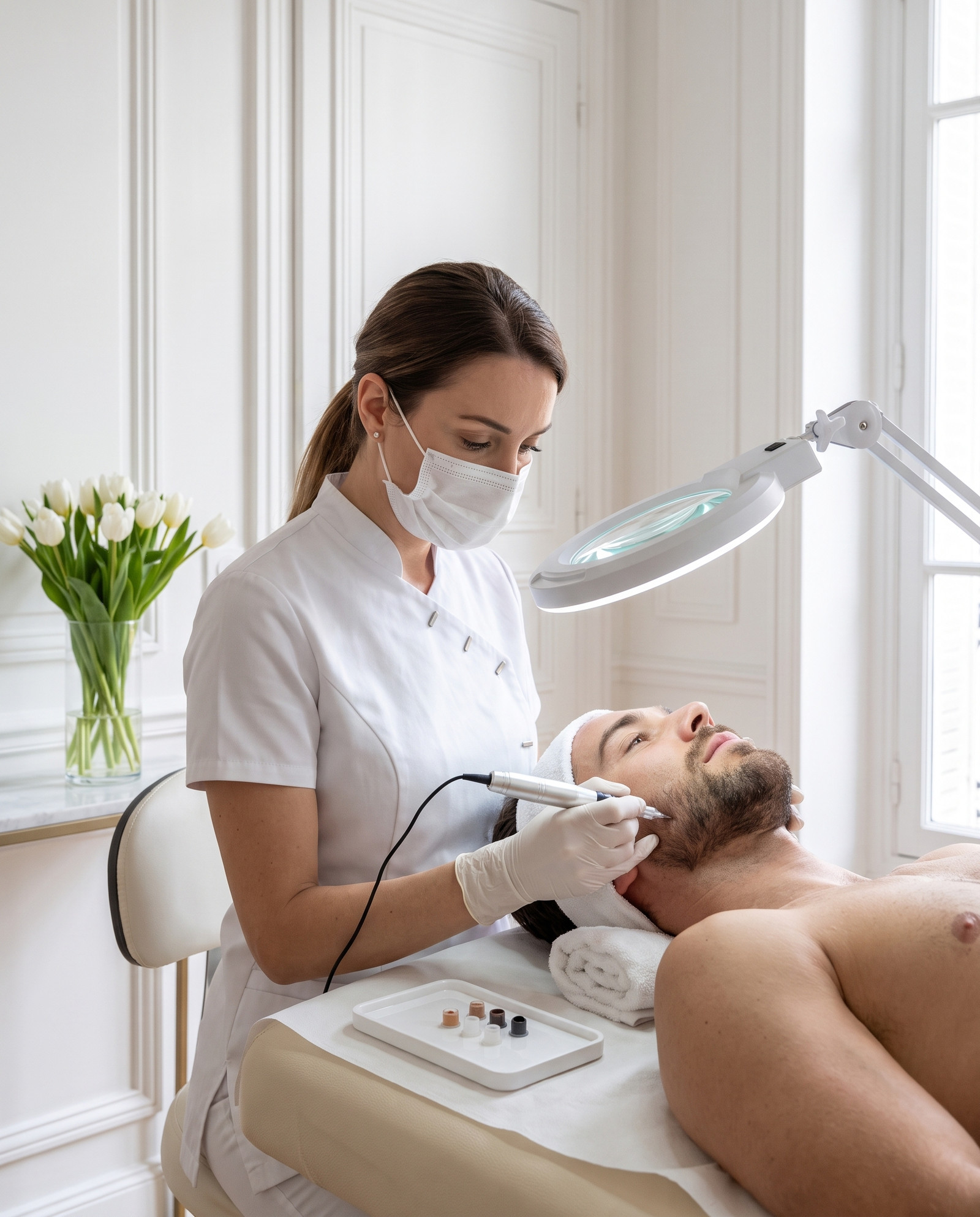
The first stage builds the direction and spacing of the strokes
The linergist first examines the beard line, whorls, and changes in direction on the cheek, chin and jawline. Strokes cannot lie like a parallel grid. They must imitate adjacent hairs, vary in length and disappear at the edge of the pigmented area. For a small gap, the design is local. For extensive thinning, consistency must be maintained over a larger surface, which may require spreading the work out.
The first layer should not be overloaded just to make it look finished when fresh. The skin absorbs pigment unevenly, and lines placed too closely can optically merge into a flat shadow after healing. A sensible start leaves room for building density later. It is easier to supplement an effect that is too light or sparse than to reverse a uniform, heavy patch on the face.
Before starting, it is good to establish how you usually wear your beard. Pigment matched to a few days' growth may look different after growing longer hair or after a clean shave. The linergist should see the natural regrowth, not just a freshly trimmed contour from a barber. Photos from different lengths help choose a density that will not pretend to be a full beard one week and disappear visually the next.
What you see after leaving is a working stage
In the following days, the surface regenerates and may peel gently. Some fragments seem lighter as the pigment is covered by renewed epidermis. The colour sometimes looks as if it has disappeared in places, and later becomes legible again. Do not add cosmetic dye during this time, do not scratch and do not test the lines with a trimmer. Any mechanical removal of a scale may take away part of the freshly deposited pigment.
The perception of fresh work is also changed by the length of natural hair. If the beard was shortened before the treatment to assess the direction, regrowing hair will gradually increase the shadow and decrease the pigment contrast. Do not judge the stroke itself in a magnifying mirror. Check your face from a typical distance, in daylight and with the beard you wear every day. The goal is a coherent image of the entire beard, not a perfect imitation of a single hair in a macro photograph.
A touch-up is planned after about four to six weeks
In J’ADORE materials, a touch-up after about four to six weeks is a standard PMU stage. This interval gives the skin time to complete the healing process and show actual retention. Adding pigment earlier means working on tissue that is still remodelling. It is then harder to distinguish temporary lightening from true loss.
During the check-up, the linergist assesses which strokes have retained sharpness, where the colour has faded and whether the density harmonises with your own hair. They do not automatically repeat the entire first session. They fill in areas requiring more pigment, correct the transition at the border and may slightly modify the shade. A touch-up is not proof of a mistake; it results from the biologically uneven response of the skin.
Come for the check-up according to the recommendation regarding beard length. A beard that is too long obscures healed lines, and shaving just before the meeting can cause redness and minor cuts that hinder assessment. Do not mask gaps with cosmetics. A photo from the end of the first week may be helpful, but the decision to add pigment should be based on viewing calmed skin, not on the lightest day of the process.
A small gap, extensive thinning and a scar have a different plan
A single window in a dense beard requires precise matching of several groups of strokes to the surroundings. Overall thinning involves more zones with variable hair direction, so building the image can be staged. It is not just about the surface. On the cheek, pigment may behave differently than on the chin, which is regularly shaved and oily.
Scar tissue is a separate case. It can be smoother, harder, less elastic or unevenly vascularised. Pigment may settle in it less predictably than in healthy skin with follicles. The maturity of the scar and its texture decide whether work can begin and how cautiously to build saturation. The promise of closing every scar during one meeting ignores tissue differences.
Two people with a similar gap may need a different rhythm. In one, the skin evenly retains pigment; in the other, some lines fade faster due to seborrhoea, friction or the specificity of the scar. The target subtlety also matters. The effect of a short, barely visible beard requires different density than an optical connection with a dark, strong beard.
Do not compare your plan with the number of stages a friend had. Their hair may grow at a different angle, their skin may have a different tone, and the pigmented zone may cover healthy tissue instead of a scar. More sessions are not automatically a sign of better service, just as one visit does not prove efficiency. What counts is the justification: what is to be assessed after each healing and why it should not be done immediately.
Also ask whether the planned "next session" means continuing work on a new zone, or a check-up and touch-up of the same one. These terms are sometimes used interchangeably, although they describe different tasks. For a large area, the second visit may expand the reconstruction, and a later check-up may even out the retention of both parts. A clear schedule should indicate the goal of each meeting, not just their total number.
Care between stages affects the clarity of the assessment
- Surface protection. The fresh area is not shaved until the time indicated in the recommendations, as the blade and friction can disturb the peeling surface.
- Avoiding irritants. Avoid soaking, swimming pools, saunas, intense sweating and irritating products.
- Care rules. Use only recommended care and gentle washing. The goal is not to stop every scale, but to let it leave without scratching.
After healing, you can return to regular shaving because the pigment is in the skin, not on the hair. However, you must tell the linergist about irritation after a razor, folliculitis and new cosmetics used in the area. If you start strong exfoliation between sessions or a rash appears, the retention image ceases to be the only information; the state of the barrier is assessed first.
Daily observation should not turn into touching every stroke. Photograph the area in similar light every few days if you want to track the change, but do not stretch the skin or peel off a dry fragment to check the colour underneath. Healing is a process, not a test of immediate durability. The most reliable comparison is created between the photo before the treatment and the calm skin during the check-up.
A break does not require making up for it with double pigmentation
Contact the salon when increasing pain, clear warmth, oozing, spreading redness or general symptoms appear during the waiting period. These are not signals to speed up pigmentation. They require assessment and, if necessary, medical help. Ordinary temporary darkening and gentle peeling have a different character than growing inflammatory symptoms.
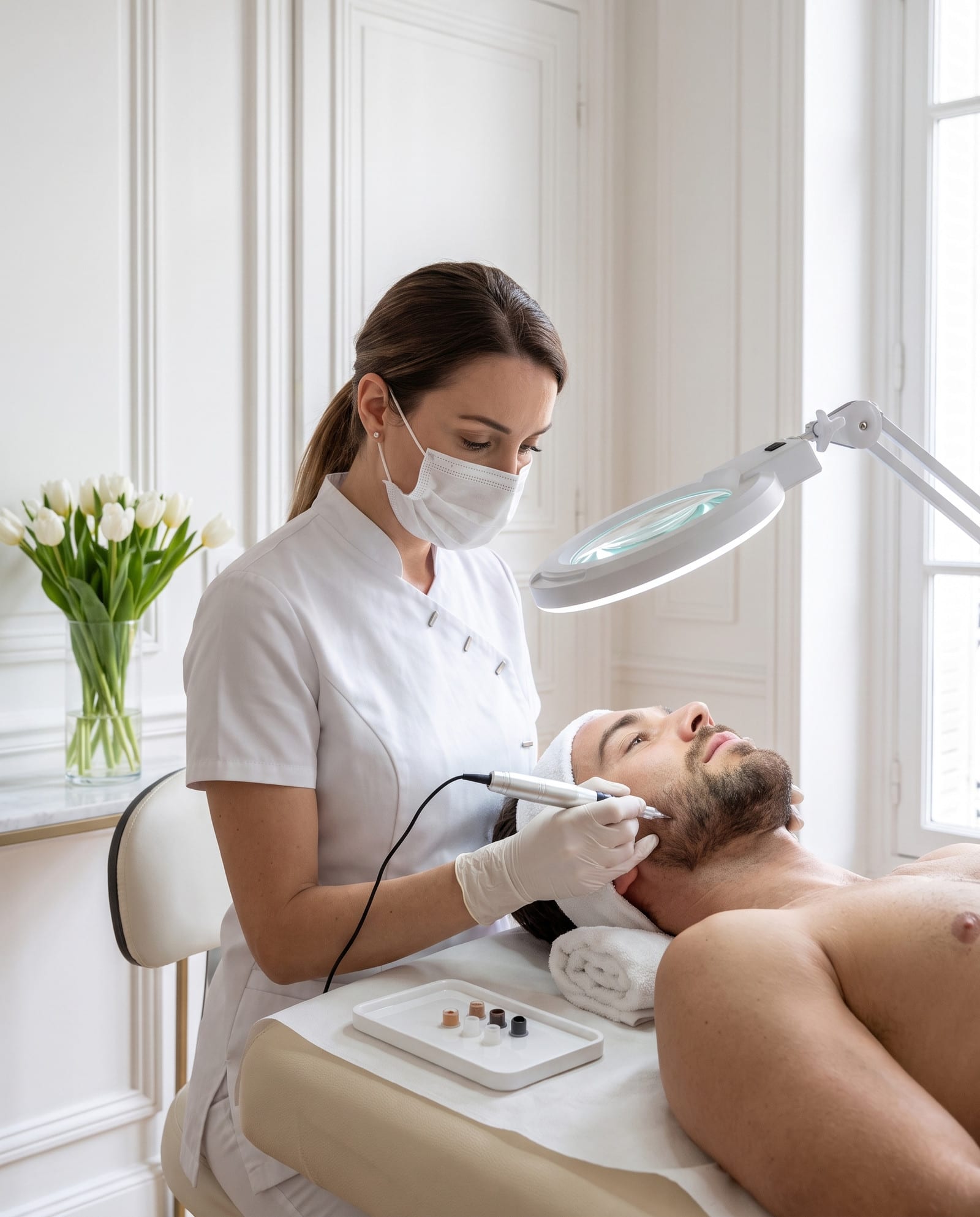
Active alopecia barbae stops the series until stabilisation
After stabilisation, the design takes into account the smooth skin of the patch and the natural distribution of hair around it. The first stage should be conservative to assess how the area accepts strokes. If the disease becomes active again during the series, further needling is stopped. The aesthetic schedule must not hinder diagnostics or observation of the borders of the change.
Refreshing after months differs from a touch-up after healing
A touch-up closes the first reconstruction after assessing healing. Refreshing is a later stage when the pigment naturally fades. It is not performed because a predetermined deadline has passed, but because the strokes lose clarity relative to your own beard. The pace depends, among other things, on the skin, exposure to UV radiation, care and mechanical stress on the area.
The beard also changes: it may go grey, become sparser, or be trimmed differently. When refreshing, it is not enough to repeat the old scheme. You must re-select the shade and density for the current hair. Adding colour that is too dark by memory can make the pigment start to dominate the beard instead of discreetly supplementing its missing fragments.
In Krakow, book an assessment first, then subsequent dates
On the beard reconstruction in Krakow page, you can check the current scope of the service. Before the first pigmentation, the linergist should examine the skin, your own hair direction, scars and any foci of hair loss. Tell them about medications, acne therapy, tendency to keloids, cold sores, clotting disorders and previous pigmentations.
Do not schedule an important event right after the first stage. Fresh colour can be stronger, and the skin needs calm healing without shaving and intense sweating. Leave space for assessment after regeneration and potential additional pigmentation. The first visible effect appears immediately, but the result on which the next decision is based is the healed result.
After each meeting, ask for updated recommendations, even if you remember the previous ones. The scope of work may have changed, and the skin after a touch-up does not have to react identically to how it did after the first pigmentation. Note the check-up date, washing method, restrictions regarding shaving and the contact to the salon in case of a worrying reaction. A well-conducted series is clear even between visits.