Not all wax is the same
To understand why a massage candle does not burn, start with the basics: the difference in raw materials. Ordinary decorative or church candles are usually made from paraffin — a product of petroleum refining. Paraffin melts at a relatively high temperature and retains heat for a long time after melting. If you pour it onto the skin immediately after melting, you will feel intense, unpleasant burning.
Massage candles are made from something entirely different. Most often, they contain soy wax, rice wax or shea butter — often blended and enriched with plant oils such as jojoba, sweet almond and coconut oil. These are not simply “nicer” versions of paraffin. They have fundamentally different thermal properties. Their melting point is much lower. Once melted, the liquid quickly cools to a temperature the skin perceives as pleasant warmth rather than a threat.
Massage candle
designed for contact with the skin
- Soy wax, rice wax or shea butter as a base
- Rich in plant oils and skincare ingredients
- Low melting temperature — safe for the skin
- Immediately releases warmth and absorbs after application
- Works like an intensive massage oil
Regular paraffin / decorative candle
for use as a source of light or decoration
- Paraffin — a petroleum-derived product as a base
- Minimal amount of active ingredients
- High melting temperature and slow cooling
- Forms a hard coating and does not absorb
- Contact with the skin — risk of burns
The physics that protects the skin
The safety of a candle massage does not result from its composition alone. It also depends on physics and application technique. When wax melts in the candle container, it is hot. But when the therapist tilts the candle and releases a stream of melted wax, three things happen between the wick and the skin. Together, they make this temperature safe.
- 01
Cooling in the air
As the wax leaves the container, it immediately begins releasing heat into the air. The greater the distance between the candle and the skin, the more heat it loses — and the therapist controls this precisely.
- 02
Spreading over a large surface
A thin layer of wax has a very low volume-to-surface ratio — heat escapes from it very quickly. A thick stream would be warmer. A thin, spread-out film cools rapidly.
- 03
The skin’s thermal threshold
The skin can absorb a certain amount of heat without pain — this is known as the thermal threshold. A properly selected massage candle works below this threshold. It delivers only as much warmth as the skin perceives as pleasant.
This is why distance is key in a candle massage — the therapist never tilts the candle directly above the skin. Distance is not an aesthetic consideration, but a thermal mechanism. With every centimetre, the wax loses some of its temperature. A well-trained therapist senses this distance instinctively and adjusts it according to skin thickness, body area and your sensitivity.
What massage wax does for the skin
Warmth is not everything. What sets a candle massage apart from other heat treatments is the skincare composition of the wax. Once melted, it becomes an exceptionally rich massage medium. A good-quality candle is not simply a carrier of warmth. It is an oily blend that actively works on the skin.
- Deep hydration. The plant oils in the candle can penetrate the upper layers of the epidermis. For many people, they noticeably improve skin hydration and softness after just one treatment.
- Softening and smoothing. Warm wax applied to the skin may temporarily open the pores and support the absorption of nourishing ingredients. Skin often feels smoother after the treatment.
- Relaxation of muscles and tissues. Warmth works on tense muscles like a compress. It may help them relax, particularly around the back, shoulders and calves. Many people describe the relaxing effect as deeper than that of a classic oil massage.
- Stimulation of circulation. Warmth dilates blood vessels. For many people, this may support better circulation and create a slight feeling of warmth in the skin after the treatment.
- An aromatherapeutic effect. Most massage candles contain essential oils. Their aroma accompanies the whole treatment and acts on the nervous system through the sense of smell.
Where this technique comes from and how it has evolved
Massage using warm wax is rooted in traditional heat rituals — from paraffin baths used in physiotherapy to oriental massages with warming oils applied at an elevated temperature. Combining these two traditions in the form of a separate “massage candle” product is relatively recent. It gained popularity as a spa treatment in the 1990s.
Candle formulas have evolved significantly over the years. Early versions were sometimes simply melted cosmetic waxes, without particular attention to melting temperature or skincare composition. Today’s massage candles are carefully balanced products. The selection of raw materials, oil proportions and melting point are designed with a specific effect on the skin in mind — not only the appearance of the flame.

Can every skin type benefit from a candle massage?
Candle massage is a treatment with broad indications — most people can benefit from it, regardless of age or gender. The warmth and nourishing ingredients work beneficially on dry and sensitive skin, as well as normal or tired skin. The effect of hydration and relaxation is not reserved for any particular group.
- Dry and rough skin — often responds most noticeably. The wax intensely nourishes it and may visibly improve softness and elasticity.
- Tired, lacklustre skin — warmth and massage together stimulate circulation, which may restore a more refreshed appearance.
- Tense muscles, stress, back pain — candle massage on the back is often cited as one of the most effective ways to relieve deep muscle tension.
- People seeking a ritual, not only a “treatment” — candle massage has a distinct sensory and ceremonial dimension that sets it apart from standard treatments.
What a candle massage in the salon looks like — step by step
A candle massage in a professional salon looks different from what videos might suggest. It is not a spectacle — it is a precise ritual with a defined sequence.
- 01
Consultation and candle selection
The therapist asks about your skin condition, any ingredient allergies and the areas to be included in the massage. A candle is selected for your needs — moisturising, relaxing or containing a specific blend of oils.
- 02
Lighting the candle and preparation
The candle burns for several minutes until enough melted wax has collected. This time is also the first part of the ritual — the aroma of essential oils begins to work.
- 03
Wax application
The therapist tilts the candle and applies the wax from an appropriate distance, starting with larger areas of the body. The wax flows in a thin stream — never a pour.
- 04
Massage
Immediately after application, the wax becomes a massage medium. The therapist works with their hands, spreading the warm oil and addressing muscle tension. The technique combines elements of classic massage and Lomi Lomi.
- 05
Finishing — no rinsing
Your skin is not rinsed after the massage — the nourishing ingredients remain and continue to absorb into the skin. This is one element that distinguishes this treatment from a standard oil massage.
Candle massage + sugar peel
A peel before the massage removes dead cells from the epidermis — the wax ingredients can penetrate more deeply and effectively. This combination is particularly recommended for dry, rough skin.
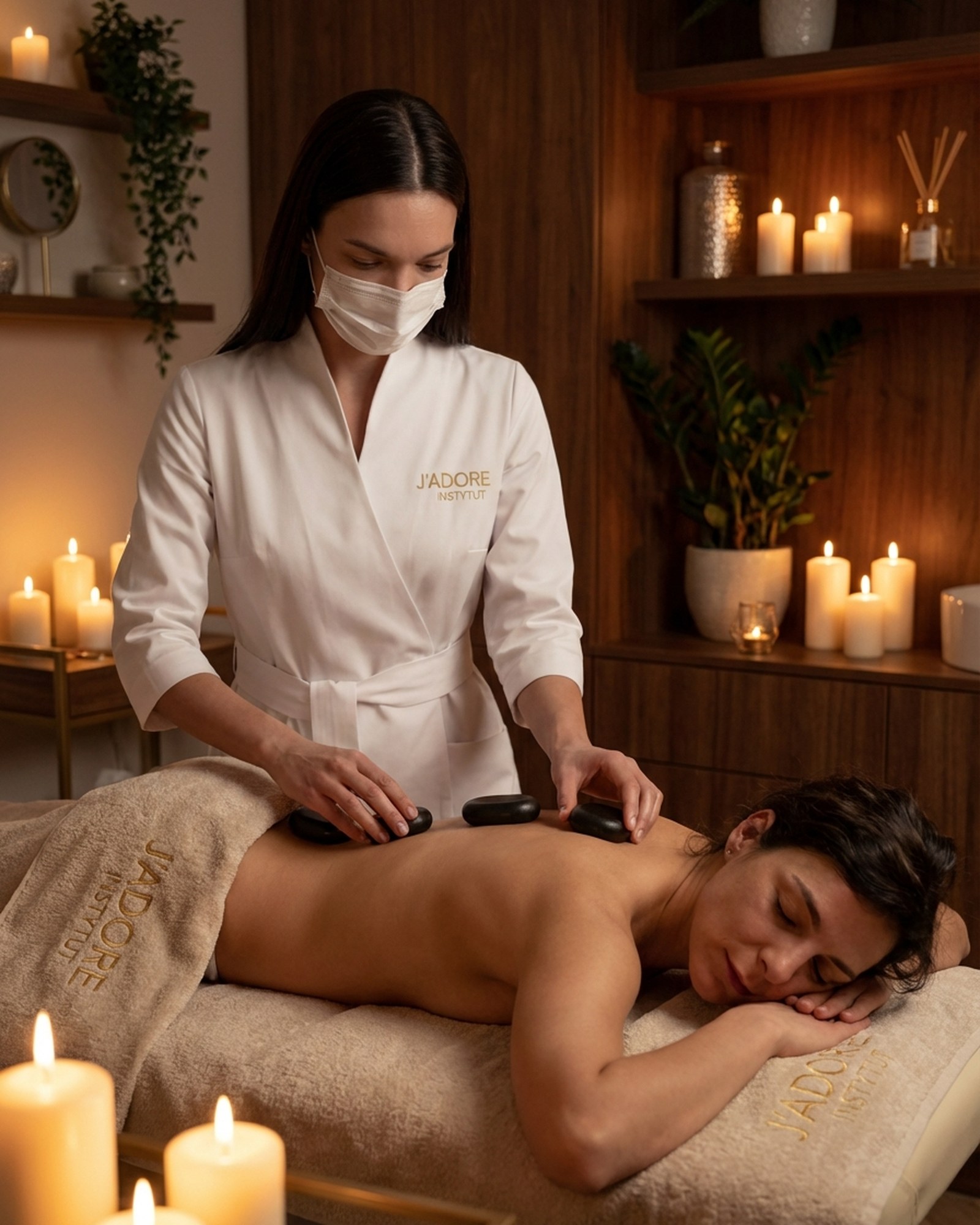
Candle massage + hot stone massage
Two heat-based treatments with different mechanisms — the stones work more deeply on the muscles, while the candle moisturises and envelops the skin. For those with significant muscle tension and very dry skin at the same time.
Candle massage + facial treatment
Body and face in one visit. A candle massage for the back, arms and legs — with separate care for the face. A complete relaxation ritual that rarely disappoints.