Before we start: what a muscle contraction actually is
To understand EMS, you first need to understand how a muscle normally contracts. Every movement — picking up a cup, standing from a chair, running — starts with an electrical signal. The brain sends an impulse through the spinal cord, which travels along a motor nerve to the muscle. At the junction between nerve and muscle fibre, the impulse triggers the release of acetylcholine — a neurotransmitter that "unlocks" the fibre and makes it contract. This all happens in fractions of a second, and repeats dozens of times with every movement.
Electrostimulation skips the first step of that pathway — it delivers an electrical impulse from outside directly to the nerve or muscle, triggering a contraction without any input from the brain. Electrodes attached to the skin generate impulses that pass through the epidermis and subcutaneous tissue, reaching the motor nerves or the fibres themselves. The effect is the same as with a natural contraction: the muscle contracts and relaxes. The difference is that you didn't initiate it — the device did.
What happens to a muscle during an EMS session
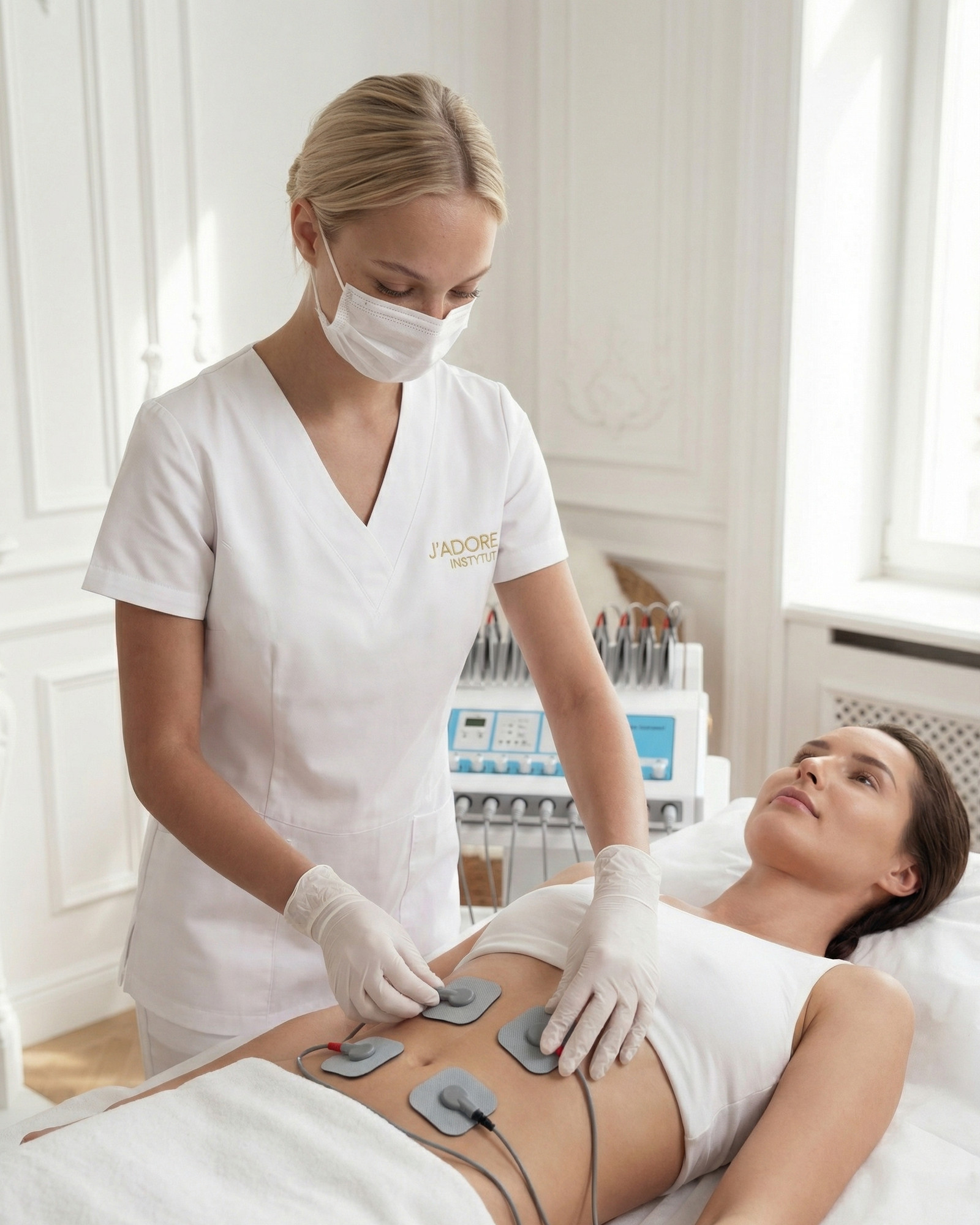
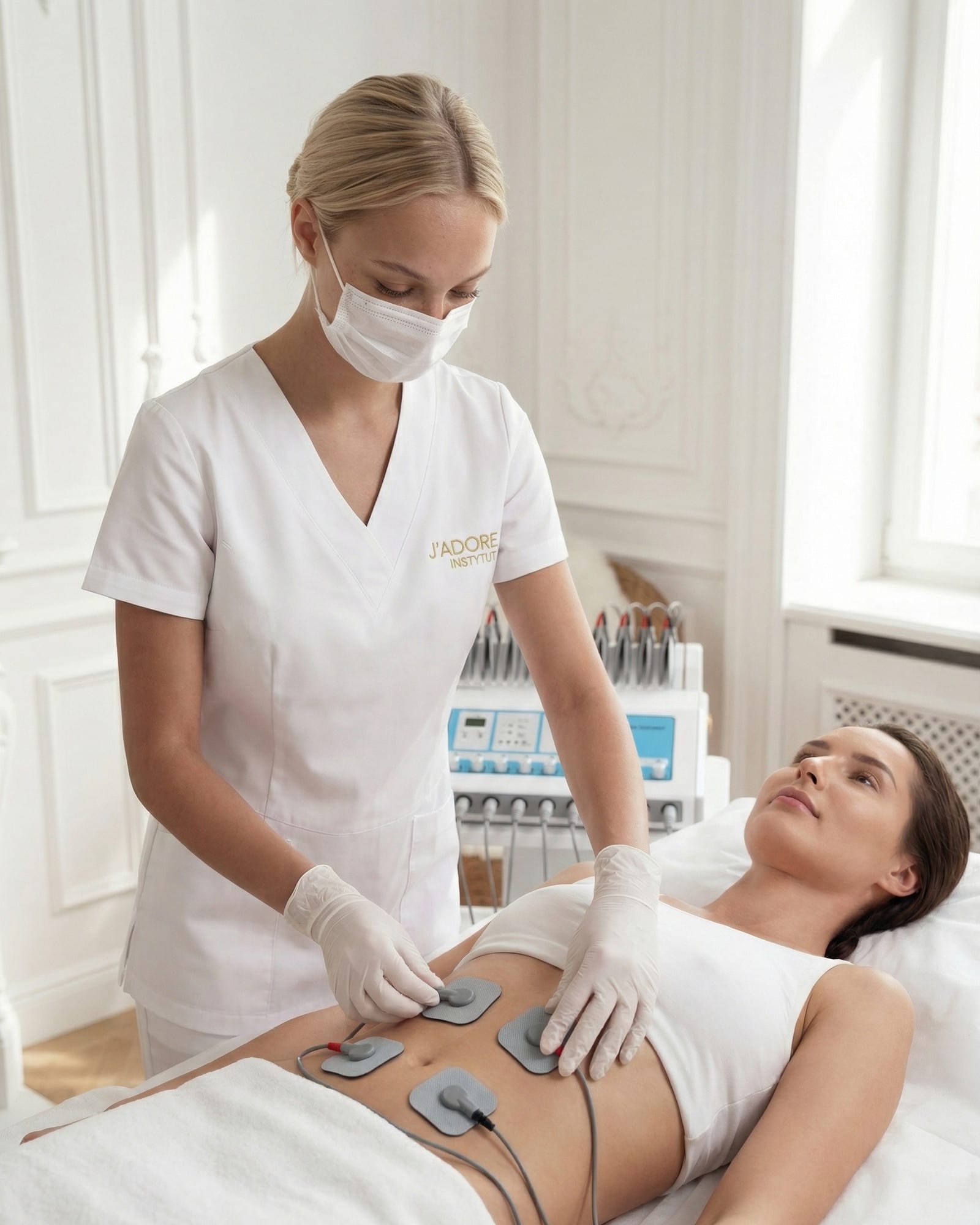
During a typical electrostimulation session, electrodes are placed on the body to cover the chosen muscle groups. The device sends a series of impulses at an adjustable rhythm — the muscle contracts, relaxes, contracts, relaxes. From the outside, the body may look fairly still (though the abdomen or thighs sometimes visibly work). On the inside, quite a lot is happening.
- Muscle fibre recruitment. During intense physical effort, the brain gradually "brings in" more motor units — starting with weaker fibres, and adding stronger ones as the load increases. EMS can force a contraction across a wider group of fibres at once, including some that moderate-intensity exercise might not normally reach.
- Metabolic fatigue. Fibres forced into repeated contractions use up energy and accumulate metabolic by-products — much like with regular training. This is why many people feel muscle soreness the day after a session, which often surprises those used to simply lying down during the treatment.
- Local circulation stimulation. Rhythmic contractions act like a pump — for many people, this improves local blood and lymph circulation in the stimulated area. It's one of the reasons EMS comes up in discussions of swelling and cellulite.
- An adaptive signal for the muscle. Regular stimulation can — for many people — lead to strengthening and improved muscle tone. The mechanism is similar to training: mechanical stress → adaptation → a stronger muscle. The effect depends heavily on intensity, regularity and your starting point.
Where EMS genuinely makes sense — and where it doesn't
Discussions about electrostimulation usually get stuck between two extremes: either "a miraculous workout with no movement", or "a total myth for the gullible". Both are wrong. EMS is a tool with a defined niche — and it's worth knowing where that niche ends.
Where EMS can help
genuine applications
- Toning and strengthening specific areas (abdomen, thighs, buttocks)
- Complementing training when mobility is limited or with chronic pain
- Improving muscle tone in people with low activity levels
- Supporting rehabilitation for weak muscle groups
- Improving local circulation and easing heavy-leg sensations
- Reducing the appearance of cellulite — in some people, after a series of sessions
What EMS won't do
limitations worth knowing
- It will NOT replace regular physical activity for general health
- It will NOT burn fat tissue on its own (without a calorie deficit)
- It will NOT improve cardiovascular fitness or systemic metabolism
- It will NOT "massage away" fat tissue or move it elsewhere
- It will NOT reverse skin laxity caused by collagen loss
EMS and fat tissue — a myth worth clearing up once and for all
The most common question about EMS is: "does it burn fat?" The answer needs a moment of patience, because it's more nuanced than a simple yes or no.
Muscle contractions triggered by EMS use up energy — and that energy comes partly from glucose, partly from fatty acids. In that sense, EMS does play a part in fat metabolism. But a contraction alone can't "localise" fat burning to one specific spot — that's a myth found both in EMS advertising and in the belief that doing sit-ups burns fat from the abdomen. The body draws energy from its reserves system-wide, not "next to the electrode".
The picture changes when talking about devices that combine EMS with other technologies — for example, ones that generate heat or work on tissue in a different way. In such combinations, the mechanisms overlap, and the results can differ from EMS alone. But that's a separate conversation — and a separate category of device.
Why EMS results vary so much from person to person
One person finishes a series of EMS sessions and describes a clear improvement in tone. Another sees no difference. Both may be telling the truth — because an unusually large number of variables affect EMS results at once. Understanding them helps you judge more realistically whether the treatment makes sense for you right now.
- 01
Starting condition of the muscles
The weaker and less active the muscles before the series, the greater the potential for noticeable improvement. People who are already very active physically less often notice a clear "strengthening" effect — because their muscles are already adapted.
- 02
Regularity and intensity of the series
A single session is not enough to judge EMS. Results build up over a series — and fade without continuation or your own activity. This isn't a one-off intervention, but a cycle.
- 03
Lifestyle between sessions
EMS against a backdrop of a sedentary lifestyle and a calorie surplus delivers less than EMS combined with an active lifestyle and healthy eating. Not because it "doesn't work" — but because it's one tool, not a complete programme.
- 04
Equipment quality and settings
Not all EMS equipment is equal. Devices differ in how much you can adjust intensity, in impulse types, and in coverage of the stimulated area. A salon with professional equipment offers different possibilities than home pads.
- 05
Individual tolerance and perception
Sensitivity to electrical stimulation varies a great deal between people. Some feel strong contractions at low intensity; others need more before the muscle "responds". This affects both effectiveness and comfort during the session.
EMS and other treatments — when combining makes sense
Electrostimulation works best when it's one element of a broader approach — not the only solution. In an aesthetic salon, EMS often appears alongside body-contouring treatments, where different technologies complement each other, working at different levels of the body.
Cryolipolysis / laser lipolysis
EMS after a fat-reduction treatment can support muscle tone in the treated area — giving a fuller contouring effect: less fat plus a better-toned muscle underneath.
Cellulite treatments (radiofrequency, vacuum massage)
EMS stimulates local circulation and tones the muscle, which can complement treatments working on connective tissue and lymphatic circulation. Combining these modalities is a common approach in body-contouring programmes.
Lymphatic drainage (manual or device-based)
After an intensive EMS series, muscles can feel tight and local circulation stimulated — drainage can help clear metabolic by-products and reduce the feeling of heaviness after the treatment.
Who shouldn't have EMS — a short list of warnings
Electrostimulation is a safe treatment for most healthy adults — but there are a few absolute contraindications worth knowing in advance.
- Pacemaker or other implanted electronic devices — electric current and electronic devices implanted in the body don't mix. This is an absolute contraindication.
- Pregnancy — EMS on the abdomen and pelvis is contraindicated throughout pregnancy.
- Thrombosis or risk of thrombosis — rhythmic contractions and improved circulation can be dangerous with active venous thrombosis.
- Active skin inflammation, wounds or skin lesions in the treatment area — electrodes should never be applied to broken skin.
- Cancer — particularly in the area of planned stimulation. This situation requires consultation with your treating doctor.
- Epilepsy — electrical impulses can act as a seizure trigger.