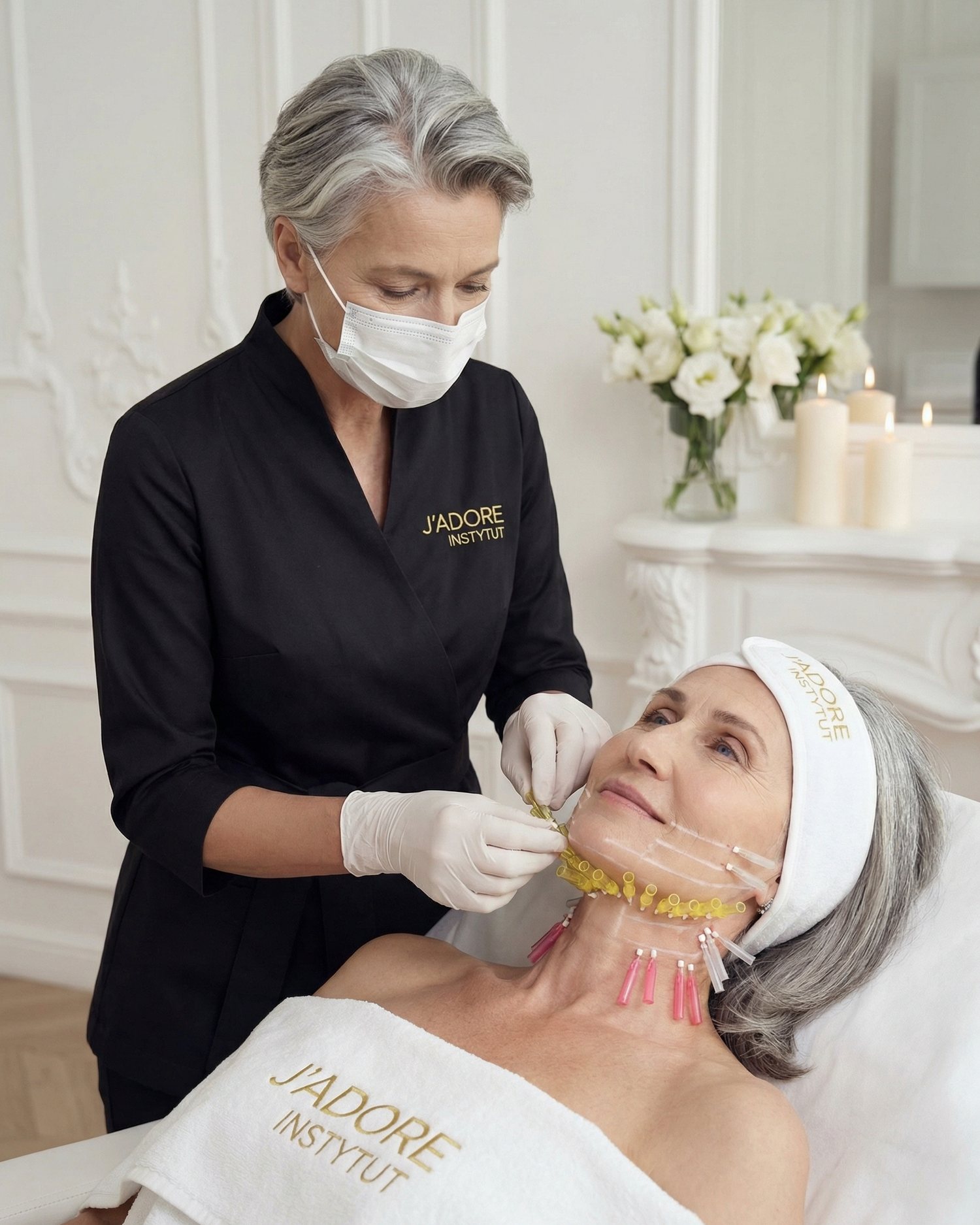

Two methods, two completely different mechanisms
Before we compare the two, it's worth remembering one key difference: needle shaping builds contour through the precise placement of a filling substance, while lifting threads raise tissue mechanically — by physically anchoring it to a higher point. These are two distinct tools. They can produce similar visual results, but they address different "layers" of the problem.
Needle shaping
Contours the face and adds volume strategically
- Precise sculpting of the facial contour, cheekbones and jawline
- Restores lost volume (cheeks, temples, chin)
- Result visible almost immediately, and adjustable
- Medical treatment — the substance is delivered with a cannula or needle
Lifting threads (cog)
Lifts tissue mechanically and stimulates collagen
- Lifts a sagging cheek, jawline and neck
- Micro-hooks (cogs) catch the tissue and "suspend" it
- Additional effect: stimulates your own collagen around the threads
- Medical treatment — designed for pronounced tissue ptosis
Needle shaping, by contrast, doesn't leave any permanent element in the body — the substance degrades gradually and naturally. This is an important psychological distinction for many people: one treatment works through an external substance, the other through threads woven mechanically into the tissue.

How to recognise what you need — a test you can do at home
Not every kind of "sagging" is the same. You can lose volume — the face looks "gaunt" — or you can lose firmness, where the tissue physically drops downward. Both problems look similar in a photo, but they need different solutions. This simple mirror test helps you tell them apart:
- Gently lift your cheek upward with your fingers. If your face instantly regains its "proper" contour and looks the way it did a few years ago, that's a sign of sagging tissue. Direction: lifting threads.
- Look without touching. If your features seem "hidden" and your face looks flat or tired, but the tissue isn't clearly sagging, that points to volume and contour loss. Direction: needle shaping.
- Both at once? Flat and sagging at the same time? Very possible — especially after the age of 45. In this case, the two methods are often combined, in a planned sequence.
- Age and skin condition. Needle shaping works well earlier on, as a precise contour correction. Threads are most effective for noticeable but not yet extreme sagging — excess loose skin can limit the result.
When they make sense together
Needle shaping and lifting threads aren't competitors — they're tools that, combined correctly, reinforce each other's effect. The logic behind combining them stays consistent, though the doctor always decides the order and timing individually:
Threads + needle shaping
Threads lift the tissue and "reset" its position. Needle shaping then precisely contours the face and rebuilds volume. Result: a lifted, properly sculpted face.
Needle shaping + biostimulators
Needle shaping rebuilds contour, biostimulators improve skin quality and density. Result: contour plus better skin — not just geometry.
Threads + biostimulators
Threads lift mechanically, biostimulators strengthen the skin around the threads and extend the result. A popular combination after the age of 45.
Full plan
Needle shaping, threads and biostimulators in a planned sequence. For mature faces, this is often spread across several sessions rather than done all at once.
It's worth remembering that neither method is permanent — results last for a limited time, depending on individual tissue characteristics, lifestyle and skin quality. Maintaining the results is usually an ongoing care plan, not a one-off intervention.