

 A treatment room at J'adore
ADVANCED HAIR STYLING
Dreadlocks aren't a temporary style — they're a longer-term decision: matted, felted strands that become part of you over time. Done well, they look deliberate and cared for, not "neglected": even thickness, a considered number of locks, a clean scalp and hair that stays in good condition despite the matting.
At J'adore Instytut, dreadlock formation and maintenance is handled by a hair stylist. We offer dreadlock formation from scratch, regular root maintenance and repair, extensions (wool and synthetic dreadlocks) and safe removal — always with the aim of a lasting result that doesn't compromise your scalp or hair along the way. Below you'll find everything worth knowing before you decide on dreadlocks.
formation is often a long session (or several); regular maintenance visits follow for regrowth
Dreadlocks aren't one service
The word "dreadlocks" covers several quite different visits. Formation from scratch means creating the locks in your own hair — the longest and most labour-intensive stage. Root maintenance is regular upkeep: as the roots grow out smoothly, we periodically weave them back into the lock so it holds from the scalp. Repair rescues loosened, merging or weakened dreadlocks. Extensions add length and volume (wool or synthetic dreadlocks), and removal is a safe unravelling or shortening when you want to return to loose hair.
That's why the first conversation at the salon doesn't start with "let's do it" — it starts with the question "what result, and for how long". Only then do we settle on thickness, number, length and whether we're working with your own hair or adding extra material. That's the difference between dreadlocks that look neglected after a month and dreadlocks that become your signature look.
How it works
A dreadlock forms through felting, not gluing or tying. Every hair is covered in cuticle scales arranged like roof tiles — when strands rub against each other, the scales catch onto one another and the hair gradually binds into a dense structure. Techniques the stylist uses — twisting, backcombing, crochet hooking — don't do anything artificial. They speed up and organise a process that hair starts on its own once it stops being combed. That's also why we avoid conditioners and silicones during the process: they smooth the scales, and smoothed cuticles have far less to catch on.
This is why a dreadlock matures over time and isn't finished on the day of your visit. The first few weeks bring the loosest stage — daily head movement, washing and drying gradually pack it from the inside until the structure becomes dense and compact. At the same time, something else happens: smooth, unfelted hair grows in at the scalp, and its scales haven't had a chance to catch yet. We periodically weave this regrowth back into the lock — hence root-maintenance visits; this isn't a fix for something gone wrong, it's a built-in part of the care process. How quickly all this progresses depends on your hair's structure, thickness and how readily it felts — it varies from person to person.
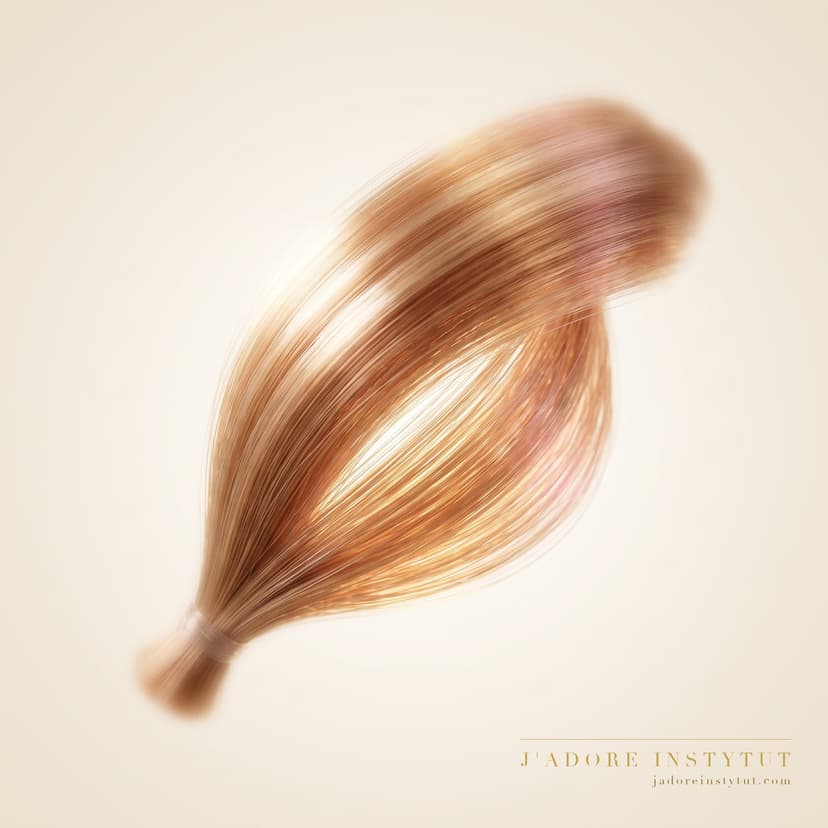
Interesting fact: hair scales are arranged directionally, from root to tip — and this single detail explains everything. Wool felts on exactly the same principle: sheep's fibre also has scales, which is why a wool jumper can felt in the washing machine while a cotton T-shirt never will. Dreadlocks are the same physics, just guided on purpose.
ADVANCED HAIR STYLING
Dreadlocks for women and men
For women, dreadlocks are often a playground for style — from very thin, "elfin" locks to thick and bold ones. Add coloured wool, ornaments, beads, and long dreadlocks that can be styled up in dozens of ways. These are classic dreadlocks for women — a striking, individual hairstyle.
What we work with
For men, dreadlocks are usually simpler and more substantial — more often thick locks, sometimes with short shaved sides. The goal is a strong, striking character with minimal daily upkeep. These are dreadlocks for men: a long-lasting, low-maintenance style that just needs regular root maintenance.
What we work with
Interesting fact: dreadlocks form because hair wants to felt in its natural state — tangled, uncombed hair packs itself into locks on its own. The stylist isn't "working against nature" — they guide the process: giving it even thickness, shape and direction, then helping the locks mature where chaos alone would leave a matted mess.
Dreadlocks and the condition of your hair and scalp
Even the most beautiful dreadlocks can't hold up on an irritated scalp or very damaged hair. That's why we take care of both before we start matting — and throughout the whole time you wear them:
Forming dreadlocks on active dandruff, seborrhoea or scalp inflammation is a straightforward way to worsen the problem and make washing difficult — we treat that skin first, and only form dreadlocks once it's healed. Also watch out for locks that are too tight and heavy, pulling hard on the roots: prolonged, excessive tension at the roots (similar to overly tight braids) can, over time, weaken hair and thin it along the hairline. A good stylist chooses thickness and weight so the lock holds without stressing the follicles — and will tell you plainly if it's better to wait.
The visit

Consultation
we assess the length, density and condition of your hair, and the state of your scalp, and settle on the thickness, number and length of the dreadlocks (and whether to add extensions). This is where we match a realistic result to your hair.
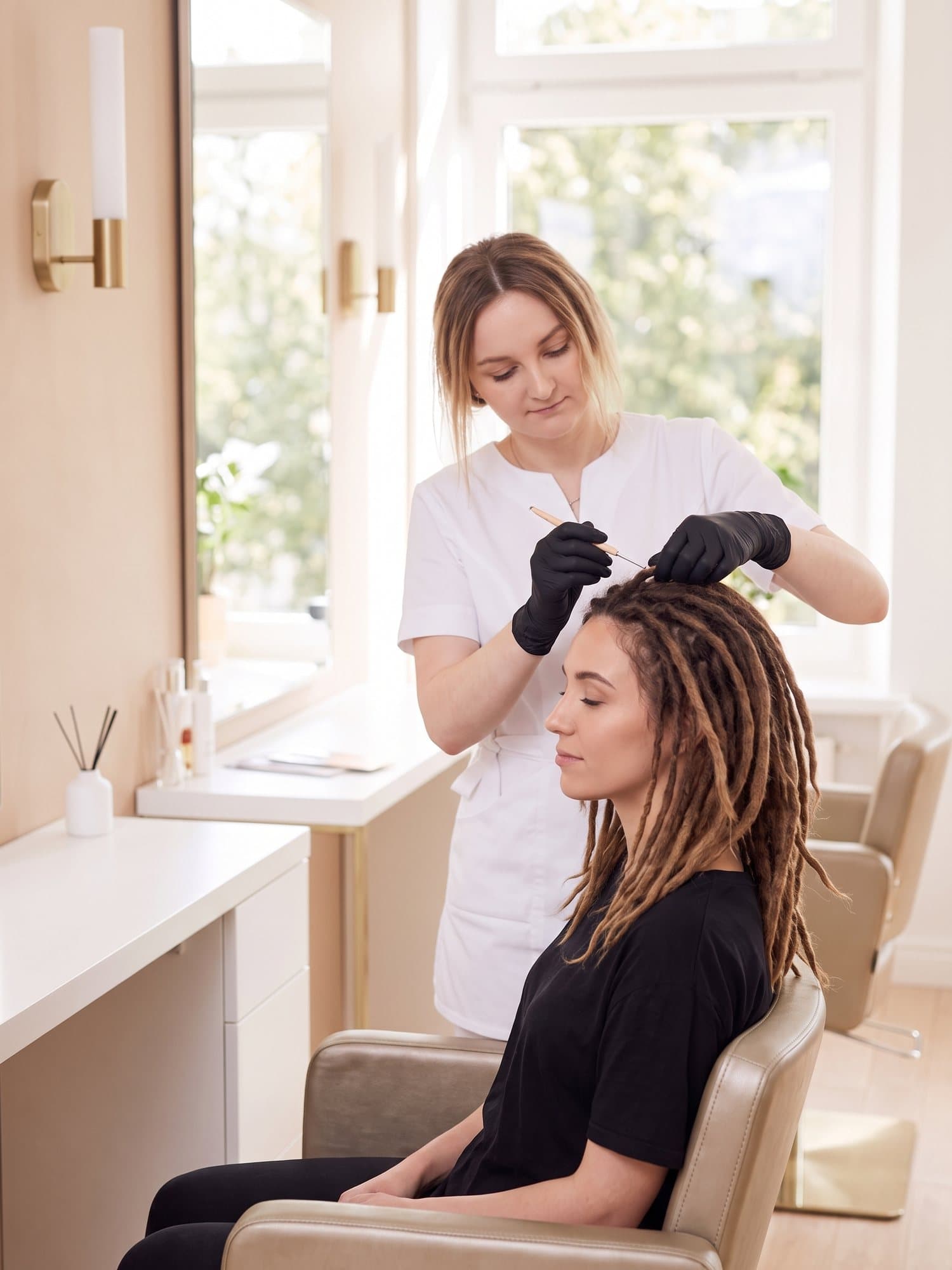
Hair preparation
thorough washing without conditioners or silicones, sometimes sectioning the hair into even parts so the locks come out a consistent thickness.

Forming the locks
we mat and felt the strands using a technique matched to the desired effect; for extensions, we weave in the material (wool or synthetic). This is the longest stage of the whole visit.
Finishing the roots and ends
we refine the lock at the scalp and at the tips, so the dreadlocks hold their shape.
Care instructions
we show you how to wash, dry and sleep with your dreadlocks during the first weeks, while they're "maturing".
What to expect
Most important: fresh dreadlocks need to mature. Right after formation, they're at their least compact — they can be stiff, may frizz slightly at the roots, and can loosen a little. Over the first few weeks the lock gradually tightens and "packs" until it reaches its final, dense look. This is a normal stage, not a failed style.
The most common thing I hear in the first week is "I think they're loosening up." That's completely normal — a fresh lock is at its loosest and only packs together over time. Give the locks a few weeks and don't nervously "fix" them at home — maturing is part of the process, and too much fiddling can only loosen them further.
Portfolio
A record of the work in our salons — the place where we publish treatment frames and, after photo sessions, results.
A record of results — in preparation. We publish photographs of our clients only with their consent.
Dreadlocks and your lifestyle
Contrary to appearances, dreadlocks are low maintenance day to day — you don't need to style them every day. A few simple habits, though, help the lock mature nicely and keep the scalp healthy.
Dreadlocks do need washing, despite the myth. Use a shampoo free of silicones and conditioners (these loosen the lock), focus on the scalp and rinse thoroughly. A clean scalp means healthy dreadlocks.
A lock dries more slowly than loose hair. Blot out water with a towel and finish drying (with a cool airflow or by air-drying) — moisture trapped in a thick lock can smell musty.
A scarf or headband at night protects fresh locks from loosening and frizzing, and saves your pillowcase. This matters most during the first few weeks of maturing.
Roots grow in smoothly, so come back periodically for root maintenance — this keeps the dreadlocks holding from the scalp and looking well cared for. Without it, they gradually "pull away" from the roots over time.
Classic conditioners, masks and heavy oils on the length loosen and "unstick" dreadlocks and build up inside the lock. Direct your care to the scalp, not the lock itself.
A light oil or balm applied to the scalp alone eases dryness and itching between washes — without weighing down the lock. A healthy scalp is the foundation of good-looking dreadlocks.
ADVANCED HAIR STYLING · Dreadlocks
Dreadlocks are an enjoyable, lasting change, but in a few situations it's better to wait or start with extra caution:
From the stylist's perspective
The most commonly overlooked issue: scalp condition. Dreadlocks won't "cover up" a problem — if anything, on irritated skin, the lock only deepens it and makes washing harder. If I see active dandruff or inflammation, I say so plainly: let's treat this first, then we'll create beautiful dreadlocks. That's not making things harder — it's looking after your hair.
This isn't a complete list — we'll discuss your hair type, scalp condition and treatment history individually at consultation.
Dreadlocks
These are three very different approaches to hairstyling — differing in durability, commitment and whether they're permanent. They sometimes complement each other, but they meet different needs:
long-term style
this is a longer-term decision; removal requires a separate visit (unravelling or shortening)
locks for weeks, not permanently
not lasting like dreadlocks; once unravelled, you go back to loose hair
a one-day style
the effect disappears after washing — this is a temporary style, not a longer-term change
Dreadlocks pair well with colouring and styling — you just need to plan the order. The stylist decides what and when, but the logic stays the same:
A simple rule for choosing: want a lasting, striking change for the longer term → dreadlocks. Want a strong lock, but only for a few weeks → African braids. Want a hairstyle for one evening, no commitment → occasion updo. Of the three, dreadlocks are the most serious decision — which is why an honest consultation before starting matters so much.
Dreadlock variants
The term "dreadlocks" covers several variants — differing in whether we work with your own hair or add material, plus the final effect and the maintenance involved. The stylist matches the variant to your hair, your expectations and how often you want to refresh the lock.
Locks formed in your own hair; the effect is fully "yours" and matures and densifies over time.
Dla kogoA longer-term change, if your hair is long enough.
Soft, warm to the touch, lightweight; add length and volume, and take colour well.
Dla kogoLength and fullness with a natural, soft character.
Strong, durable and smooth; often in bold, intense colours.
Dla kogoA strong, colourful effect with great durability.
Weaving in regrowth and rescuing loosened locks; keeps dreadlocks looking well cared for.
Dla kogoRegular refreshing between formations.
Unravelling or shortening the lock, with care to preserve as much healthy hair as possible.
Dla kogoA return to loose hair or a change of style.
Fact: Where do differences in effect and durability come from? From the variant chosen (your own hair vs added material), the thickness and number of locks, and your home care and rate of hair regrowth. That's why the same dreadlocks can "wear" differently on two people — it comes down to choosing the right variant and the stylist's skill, not just the name on the price list.
Price list
Checking free hours…
See also
The result lastsvery long-lasting effect; requires periodic maintenance at the salon and at homeJ’adore Instytut
Please note. Dreadlock formation and maintenance is a hairdressing and styling service (matting and felting hair, plus its care); durability and results depend on hair type, technique and home care. This text is for information only. Thickness, number, length and variant are determined by the stylist during consultation.


