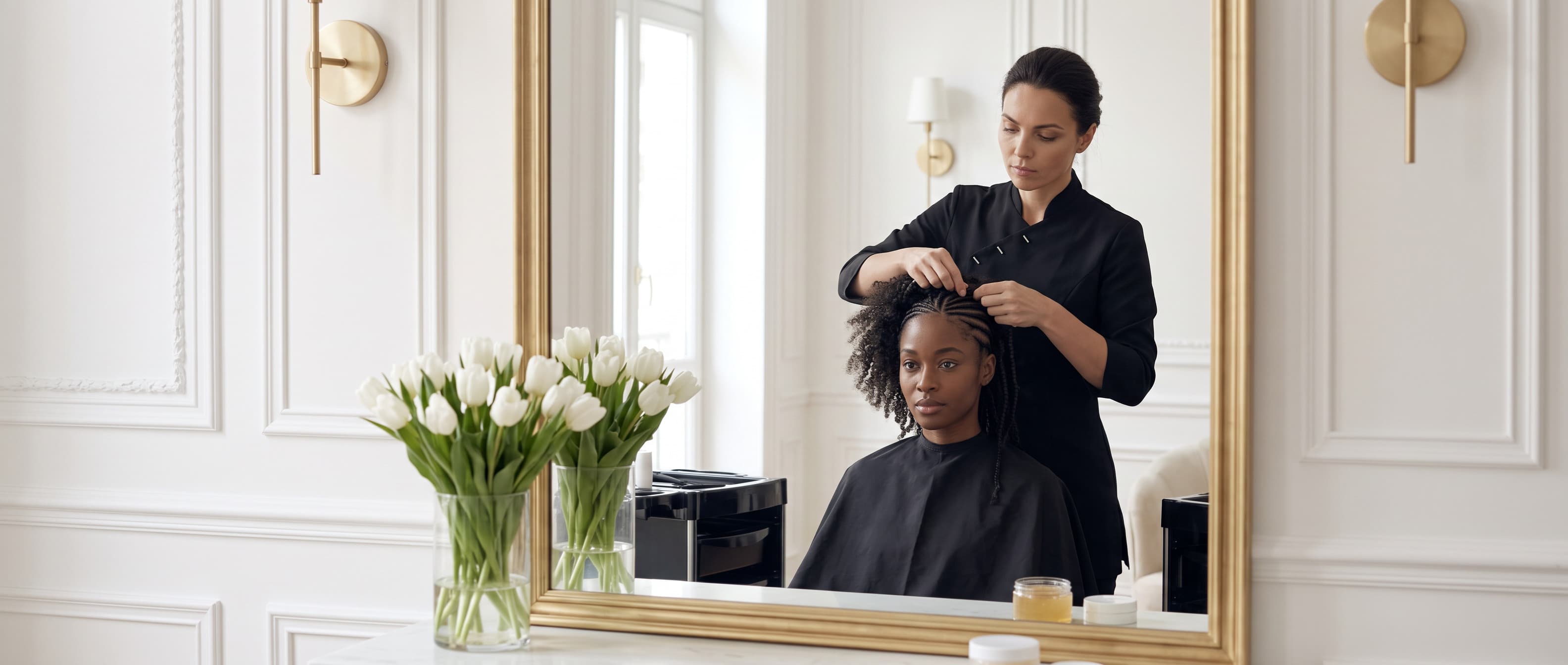
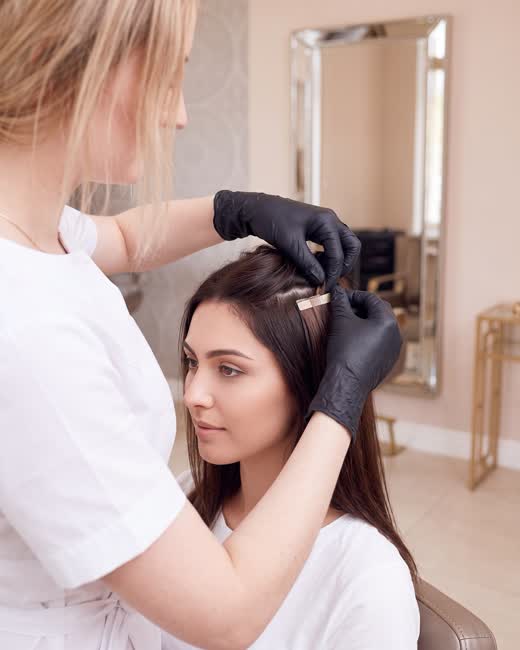
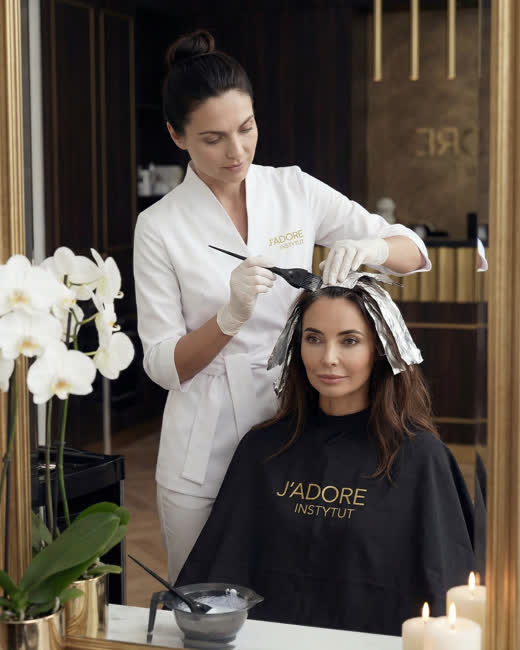
A treatment room at J'adore
ADVANCED HAIR STYLING
African braids are one of the most practical and striking styles you can wear — small, tightly plaited braids that either sit flat against the head (cornrows) or hang freely (box braids). Once plaited, they hold for weeks: no daily styling needed, and they work brilliantly for holidays, hot weather, sport and swimming.
You can have them done on your own hair or with added extensions (kanekalon) — this adds length, colour and volume that natural hair doesn't always allow. Patterns can be simple or geometric and highly personalised — from classic straight rows to decorative designs covering the whole head. At J'adore Instytut, African braids are done by an experienced hair stylist. It's a time-consuming, multi-stage style — plaited patiently, section by section — but the result lasts for weeks. Below you'll find everything worth knowing before your visit.
single visit; after a few weeks, take-down and optional refresh
Cornrows, box braids, extensions
The term "African braids" covers several different techniques, each giving a distinct look and feel to wear. The choice depends on the length and density of your hair, the look you want, and how long you'd like to wear it.
Fun fact: African braids are one of the oldest hair styling techniques in the world — for centuries, plaiting patterns carried meaning and identity, not just decoration. Today they're back as a style that's both practical and decorative: it holds for weeks, and the row pattern can be designed like a piece of art.
How it works
A cornrow starts from a classic three-strand plait, but with one key difference: at every crossing, the stylist adds a fresh section of hair from the marked row into the plait. This means the braid doesn't hang loose — it sits flat against the scalp and is anchored along its entire length, not just at one point. Box braids work the opposite way: the head is divided into sections, the plait starts at the root and hangs freely straight away, so each braid is held only by its own section of hair. With extensions, kanekalon is woven in from the very start — from the first crossings, it goes in together with your own hair, and it's the extension material that gives length, colour and thickness.
What keeps the plait holding for weeks is friction between the interwoven strands. Each crossing presses down on the one before it, so no strand has room to slip out — the finer and denser the plaiting, the more of these locking points, and the more stable the whole braid. The same property has a flip side: because the braid is anchored along its whole row, tension in the plait transfers directly to the hair follicles — which is why tension should always be even and moderate, never maximum. Over time, new growth at the root gradually lifts the braid and changes the angle at which it pulls on the scalp — that's the signal it's time to take the braids down.
Fun fact: the English word "cornrows" comes from rows of corn in a field — the parallel plaited rows on the head line up exactly like ploughed crop rows. In the Caribbean, the same style is sometimes called "canerows", after rows of sugar cane, since that crop dominated the local landscape. The name is simply a description of what you see.
Ideal for
The women's zone and the men's zone
African braids for women are most often box braids and cornrows in longer variants, frequently done with extensions for length, colour and volume. Patterns tend to be richer and more decorative, and the style itself is treated as a full look for weeks — for holidays, a festival, or a change of image.
What we work with
African braids for men are mainly cornrows — small braids close to the scalp, practical for sport and hot weather, often in simple or geometric patterns. Extensions are used less often, and the effect is usually more minimalist and purposeful: neat, off the face, without daily styling.
What we work with
Safety
African braids are safe and can be worn without damaging your hair — on one condition: they're plaited with care, not force. Tension is the most important factor.
A braid should be stable, not stretched to its limit. A mild feeling of tension right after the visit will pass; sharp pain, burning or "pulling" of the scalp is a sign the plait is too tight.
If you have a delicate, reactive scalp or a tendency to irritation, let us know before plaiting — we'll adjust braid thickness and tension so it stays comfortable.
Very damaged, dry or weakened hair copes less well with dense plaiting and the weight of extensions — sometimes it's worth strengthening it first, and plaiting later.
Red flag: braids that pull and hurt · Braids plaited too tightly cause tension and pain in the hair follicles — and with long-term, regular wear under excessive tension, there's a real risk of traction alopecia (weakening and loss of hair in the areas under most pull, especially along the hairline and temples). If your scalp burns, "throbs", or keeps you awake from tension, that's not "the price of longevity" — it's a sign the braids are too tight. Tell us straight away. A good stylist would rather plait with care than risk your hair.
Contraindications
African braids are a safe style, but there are situations where it's best to postpone, or to take care of your hair and scalp first.
This isn't a complete list — we'll assess your hair and scalp condition individually during consultation and decide together whether it's the right time for braids.
The visit
Consultation
we assess your hair's length, density and condition, discuss the type of braids (cornrows / box braids), the pattern, and any extensions and colour. We'll agree on roughly how long the visit will take.
Hair preparation
washing and combing, then sectioning. Clean, well-prepared hair plaits more evenly and comfortably.
Plaiting
section by section, patiently and evenly; with extensions, we weave in the kanekalon as we go. This is the most time-consuming stage — dense, fine plaiting is a relaxed, unhurried session.
Finishing
securing the ends, checking tension and pattern symmetry, refreshing the scalp.
Aftercare guidance
how to wash, hydrate and sleep in braids so they last well and don't strain your hair.
Portfolio
A record of the work in our salons — the place where we publish treatment frames and, after photo sessions, results.
A record of results — in preparation. We publish photographs of our clients only with their consent.
Aftercare
African braids don't need daily styling, but they do need aftercare — mainly for the scalp and hydration. Well cared-for braids last for weeks and come out without damaging the hair.
Sleep in a silk or satin bonnet, or on a satin pillowcase — this reduces friction, frizzing and loosening of the braids. It's the simplest way to make them last longer and hold their shape.
The scalp between braids benefits from hydration — a light oil or spray prevents dryness and itching. Don't overdo it: too much can weigh down and loosen the plait.
You can wash your scalp without undoing the braids — gently, with an applicator at the roots — and dry thoroughly. Avoid harsh scrubbing, which loosens the braids.
This is one of the biggest advantages of braids — training, the pool and hot weather don't harm them. After exercise, it's worth refreshing and drying the scalp.
Don't keep braids in for too long "just in case". After a few weeks, regrowth and loosening increase tension at the root — that's the sign it's time to take them down, wash and nourish your hair.
Strong pain, scalp burning or "throbbing" right after the visit signals a plait that's too tight — don't wait, tell us. It's better to loosen the braids than to risk weakening your hair.
African braids
African braids are often confused with other styles we offer that do something completely different. Here's a quick guide to help you find what you're actually looking for:
plaited for weeks
not permanent — a temporary style that's later taken down
a permanent, matted form
not braids — a different technique and a different philosophy of wear (long-term, not for weeks)
longer, thicker hair
doesn't create braids — it adds length and thickness to loose hair, not a plait
Combine with
African braids work well as part of a broader styling plan — it's just worth planning the order, so you don't strain your hair or waste the effect. Details are decided by the stylist during consultation, but the general logic stays the same:
Extensions and materials
With African braids, you're not choosing "off-the-shelf product" — the stylist selects the material and thickness to suit the result, your hair length and how comfortable it feels to wear. The key decision is: extensions or your own hair.
A lighter, more natural effect; less strain on the scalp. Length and volume are limited to what you have.
Dla kogoWhen your hair is long and thick enough, and you want a lighter feel.
Adds length, colour and volume; available in many shades, including bold colours. Lightweight and easy to plait.
Dla kogoShorter or thinner hair, a strong decorative effect, coloured accents.
Thinner braids = a finer, more decorative effect and longer plaiting time; thicker braids = quicker and lighter, less "dense" in look.
Dla kogoMatched to your hair type, the look you want, and the time you have for your visit.
Fact: Where do the differences in time and feel come from? The finer and denser the plaiting, and the more extensions used, the longer the visit and the heavier the finished style. What matters isn't "how many braids", but matching them to your hair and comfort — so they hold well without weighing down or pulling.
Price list
Checking free hours…
From the magazine
Editorial pieces on how this treatment works in practice — what happens during the session, how to prepare, where the limits are and what the first days after look like.
See also
The result lastsa few weeks with proper careJ’adore Instytut
Please note. African braids (cornrows, box braids, plaiting with or without extensions) are a hairdressing and styling service; the result, longevity and comfort depend on your hair type, length and condition, the plaiting technique, and home care. This text is for information purposes. Details, the choice of variant (extensions, pattern, length), and an assessment of scalp and hair condition are decided by the stylist during your visit.
Home care
Cosmetics matched to what your skin needs after a treatment — so the clinic effect lasts longer.
 hair regenerationOlaplexBROAD SPECTRUM CHELATING TREATMENT 370mlView in the shop(opens in a new tab)
 hair regenerationKevin MurphyYoung.Again Dry Conditioner Oil 100mlView in the shop(opens in a new tab)
 hair regenerationDSD de LuxeTravel PackView in the shop(opens in a new tab)
 hair regenerationSesdermaSESKAVEL Keratin Shampoo 200 mlView in the shop(opens in a new tab)