

 A treatment room at J'adore
MICROPIGMENTATION (PMU)
A scar itself often doesn't hurt — what hurts is that it keeps catching the eye. A pale, "pearly" line after surgery, a white patch left by a burn, reddish or discoloured acne marks, silvery stretch marks — all of them differ from the surrounding skin mainly in colour, and that contrast is exactly what makes them so visible. Scar camouflage is medical micropigmentation: a PMU specialist introduces pigment into the skin, precisely matched to the tone of your healthy skin, so the scar blends in and stops standing out.
This isn't "makeup for looks" — it's a calm step towards not thinking about your scar every time you look in a mirror, go swimming or wear something sleeveless. At J'adore Instytut, the treatment is performed by a qualified PMU specialist experienced in medical micropigmentation. Two things matter here more than anywhere else, so we state them upfront: we only work on a mature, fully healed and stable scar (usually no sooner than around a year after it formed), and camouflage evens out colour — it does not flatten a raised scar or fill a sunken one. Below you'll find everything worth knowing, including the honest truth about what this treatment does and doesn't do.
1 session + a mandatory touch-up after around 4–6 weeks (sometimes a series for larger scars)
What this actually is
Scar camouflage is medical micropigmentation — a PMU specialist uses fine needles to introduce pigment into the scarred skin, matched to the tone of your healthy skin. The aim is one thing: to reduce contrast. It's the colour contrast — a pale line on darker skin, or a reddish mark on lighter skin — that makes the eye instantly "find" the scar. Once the scar's colour moves closer to its surroundings, it stops drawing the eye, even though it's still physically there.
And here comes the most important sentence on this page: camouflage works on colour, not on surface. It won't fill a sunken scar, flatten a raised keloid, or "smooth out" texture. If a scar is uneven to the touch, its shadow and sheen will remain — that's a matter of shape, not colour. That's why, for scars with noticeable texture, we combine camouflage with device-based treatments that work specifically on the surface (more on that below). This is an honest way of framing things, not fine print.
Good to know: the brain detects a scar mainly through contrast — the boundary where colour or brightness suddenly changes. Our eyes are "designed" to spot edges, which is why even a small but high-contrast scar can stand out more than a larger one that matches skin tone. Camouflage doesn't remove the scar — it softens that edge, and the eye simply stops stopping there.
How it works
Scar tissue is different from the skin around it: collagen fibres line up in parallel, hair follicles and glands are absent, and the network of blood vessels tends to be sparser. That's why a scar reflects light differently and takes pigment differently — it can hold it more weakly, unevenly, or in a shade that doesn't quite match the colour chosen. The PMU specialist introduces pigment shallowly, in layers, matching the tone to the healthy skin around it — working on the scar's colour, not its structure. The collagen fibres stay exactly as they were; pigment doesn't rebuild or flatten them.
This is where the condition we never skip comes from: a scar must be mature and inactive. A fresh scar changes colour for months — from red through pink to lighter tones — and is still remodelling, so a colour matched today would stop suiting the background within a few months. On a calm, stabilised scar, the process is predictable: some pigment comes away during healing along with light scabbing, fresh skin covers the colour for a few weeks, and the real result only becomes visible once it settles — which is why the touch-up at around 4–6 weeks is part of the treatment. After that, pigment fades, often faster on scar tissue than on healthy skin, so camouflage needs periodic refreshing.
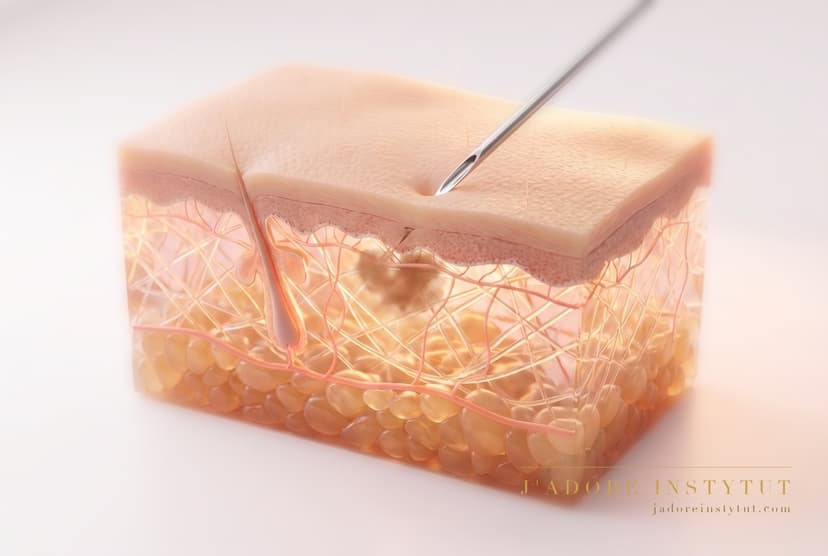
Good to know: in healthy skin, collagen fibres form a dense network woven in many directions — in a scar, they line up in parallel, almost like a bundle. It's this change in architecture, not the colour itself, that gives a scar its characteristic sheen: parallel fibres reflect light more in one direction than the surrounding tissue does. Pigment can even out colour, but it doesn't change that structure — which is why, for shiny, raised scars, we talk about combining methods.
Ideal for
What this treatment *won't* do: it won't remove the scar or change its texture — it won't fill a sunken area, flatten a raised one, or "smooth" the surface. It also doesn't treat the underlying cause (such as acne or an illness) and doesn't replace your doctor's guidance. It gives a visual result — evened-out colour — and that's exactly what it's designed for. If the scar's texture bothers you most, that's a sign you need (also, or mainly) a different tool.
A mature scar first
This is the foundation of the whole approach, and we don't deviate from it. A scar isn't "ready" the moment a wound heals — for many months it keeps remodelling and changing colour: it can be red, then pink, and only over time does it fade and stabilise. Pigmenting it too soon makes no sense, because the background we're matching colour to is still "moving". That's why we stick to a few conditions:
For women and for men
Scar camouflage in women most often addresses surgical scars (such as after a C-section, or breast or thyroid procedures), pregnancy stretch marks, and hyperpigmented acne marks. It's often about feeling at ease with exposed skin — décolletage, abdomen, arms, the beach — and no longer reaching for concealer every day. We choose a warm-toned colour, with an eye on how it will fade.
What we work with
Scar camouflage in men most often addresses surgical scars, scars from sport and accidents, and acne marks. Men usually just want the scar to "drop off the radar" — without it looking like something's been done. We keep it discreet, focusing on a natural tone match, without a makeup-like effect.
What we work with
Scars from surgery, burns, injuries or acne affect both women and men — which is why we offer camouflage to both. The principle stays the same (evening out the colour of a mature, healed scar); what differs is which scars you tend to bring in, and what you expect from the result.
What to expect
Contraindications
Medical micropigmentation breaks the skin, so some contraindications are permanent and others are temporary — in the latter case, we simply postpone the treatment until the situation passes. For scars from major surgery, burns or skin conditions, we discuss each case individually, involving your treating doctor if needed.
From the PMU specialist's chair
There are two things I repeat most often. First: this scar really can wait — a few months' difference doesn't change the result, and it gives us confidence we're working on mature, calm skin. Second: if you have a tendency towards keloid scarring, let's talk about it openly before the treatment. Breaking the skin can trigger a keloid, so I'd rather err on the side of caution here — your safety matters more than any timeline.
This isn't a complete list — the type and age of your scar, any medication, skin conditions and previous treatments will be reviewed individually at consultation, in coordination with your treating doctor if needed.

What to expect
Most importantly: don't judge what you see right after the treatment. Fresh camouflage goes through several stages before showing how the colour will really "settle" — and the middle of this process can feel stressful if no one's warned you. Scar tissue sometimes reacts differently from healthy skin, so we stay in touch with you and don't draw any conclusions before the touch-up.
I always warn clients: in the second week, it'll feel like "almost nothing's left". That's the most normal stage — skin covers the pigment during healing, and colour returns after around 3–4 weeks. On a scar, pigment sometimes "takes" unevenly in places — that's not a mistake, just the nature of scar tissue. That's what the touch-up is for: I complete the colour wherever the scar took it less well. That's why we never judge the result before then — and I stay in touch with you along the way.
For the first few days, don't get the scar area wet — no sauna, pool, long hot baths or intense sweating. Water and steam soften scabs and wash out fresh pigment.
This is crucial: don't pick off scabs. Pigment comes away with the scab — leaving a gap in the colour there, which is especially visible on a scar. Let them fall off on their own.
Apply the healing ointment exactly as your PMU specialist advises — a thin layer, with clean hands. Don't use acid- or retinol-based products on the area until it's fully healed.
Scars are especially sun-sensitive. Avoid sun exposure during healing, and once healed, daily SPF 50+ on the scar isn't a whim — it protects both the scar itself and the pigment colour from fading quickly.
If the scar is somewhere exposed to friction (a belt, a strap, the décolletage), choose looser clothing while it heals. Mechanical irritation of fresh camouflage worsens the result.
If the scar heals differently from what you expect, or something concerns you — get in touch with us, and if needed, consult your treating doctor. With scars, it's worth having a low threshold for "I'd better ask".
The result lasts a long time, but it fades naturally — over time the colour lightens, and that's when we refresh it. On scars, the fading rate can be less predictable than on healthy skin (it depends on the type of scar, its condition, sun exposure and aftercare), so we don't set a refresh plan "in advance" — we watch how your scar holds colour and respond accordingly.
Portfolio
A record of the work in our salons — the place where we publish treatment frames and, after photo sessions, results.
A record of results — in preparation. We publish photographs of our clients only with their consent.
Scar camouflage
This is the most important distinction on this whole page — and it decides what you actually need. A scar can bother you because of its colour (it stands out from your skin tone) or its texture (it's raised, sunken, uneven to the touch) — often both. Camouflage works exclusively on colour. Texture calls for completely different tools that deliberately disrupt and rebuild the skin to even out its surface. We often combine these with camouflage — first improving texture with device-based treatments, then, once the scar has healed and stabilised, evening out colour with pigment.
evens out the scar's COLOUR
doesn't flatten raised areas, fill sunken ones, or change texture
rebuilds texture from within
doesn't "match colour" to the skin — that's not its job
resurfaces the skin's surface
won't even out a discoloured scar's colour the way pigment does
Combine with
For scars with texture, the best result comes from a plan, not a single treatment. Order and spacing are decided at consultation (and, if needed, in coordination with your doctor), but the logic stays the same: texture first, then colour, always on a scar that's healed and calm.
I most often hear: “I want this scar not to be visible at all”. Then I ask one thing — what bothers you most about it: that it is a different colour, or that it is raised / indented? If it is the colour — camouflage will help a great deal. If it is the shape — pigment alone will not be enough, and I would rather say so outright than promise an effect I cannot deliver. For many people the best result comes from a combination: first the texture (laser / RF), then, on a settled scar, colour camouflage.
Pigment and approach
There's no single "scar colour" or one method for everyone — your PMU specialist chooses the pigment and approach after assessing your specific scar and skin tone; it's not picked "from a catalogue". A pale, discoloured scar is approached differently from a hyperpigmented one, and differently again from stretch marks. We usually work in a few directions:
Colour matched to your healthy skin tone — the basic tool of camouflage, so the scar blends into its surroundings.
Dla kogoPale, discoloured surgical and burn scars; silvery stretch marks.
Instead of "painting over" with one colour, we build a tone close to your skin in layers — this gives a natural result and avoids a "patchy" look.
Dla kogoAny scar visible day to day; skin with an uneven tone.
A small test on a section of the scar, observing how it takes the colour once healed — because scar tissue can be unpredictable.
Dla kogoEvery first attempt at camouflaging a given scar.
Completing and evening out the colour once healed — particularly important on scars, since they take pigment less evenly than healthy skin.
Dla kogoEvery first camouflage treatment — this is a standard, planned step.
Fact: Why more subtle at the start? Scar tissue can be thinner, firmer or more sensitive, and its response to pigment less predictable than healthy skin. That's why we start gently and top up the colour at the touch-up — it's easier to add more than to take away. On scars, sometimes more than one "top-up" is needed, especially over a larger area; that's not a mistake, just a trait of scarred skin.
Price list
Checking free hours…
See also
The result lastslong-lasting; pigment fades naturally over time and needs refreshingJ’adore Instytut
Disclaimer. Scar camouflage is an aesthetic-reconstructive treatment (medical micropigmentation) that introduces pigment into the skin. It does not treat an underlying condition or injury, does not remove the scar and does not change its texture (raised or sunken areas) — it gives a visual result of colour matching, so the scar contrasts less with healthy skin. We perform it on a mature, fully healed and stable scar (usually no sooner than around a year after it formed), following a consultation and — where relevant — with approval from your treating doctor (surgeon or dermatologist). The result is long-lasting and requires refreshing; pigment fades naturally and is not permanent "forever". This text is for informational purposes. The treatment is performed by a qualified PMU specialist experienced in medical micropigmentation.
Home care
Cosmetics matched to what your skin needs after a treatment — so the clinic effect lasts longer.
 post-treatment regenerationCell Fusion CDermagenis pH Biome SerumView in the shop(opens in a new tab)
 sun protectionDermaQuestSunArmor SPF50 30 mlView in the shop(opens in a new tab)
 post-treatment regenerationMedMelanoSkinbiotic Elixir Probiotic Repair Serum 50 mlView in the shop(opens in a new tab)
 sun protectionSesdermaREPASKIN Silk Touch Color SPF50View in the shop(opens in a new tab)
 post-treatment regenerationVagheggiEmozioni Plus — Anti-Stress Face Mask 75mlView in the shop(opens in a new tab)
 sun protectionCell Fusion CAquatica Sunscreen 100 SPF 50+/PA++++View in the shop(opens in a new tab)
 post-treatment regenerationMesoesteticMesohyal Post-Procedure Gel CreamView in the shop(opens in a new tab)
 sun protectionSesdermaRepaskin Silk Touch Color Facial SPF50View in the shop(opens in a new tab)


