

 A treatment room at J'adore
LASER THERAPY / HIGH-TECH / REMOVAL
Broken capillaries on the nose and cheeks, diffuse redness, unwanted hair that "resists" other lasers, sun spots, sagging skin firmness — these are very different problems, yet they often show up together on one face. ZYE YAG is a multifunctional Nd:YAG 1064nm laser (Vydence Medical) with four interchangeable fibre-optic handpieces — each optimised for a different indication. Instead of four separate devices, we work with one, choosing the handpiece to match the problem.
Its hallmark is deeper penetration and safety across all skin phototypes (I–VI) — even where IPL or shorter-wavelength lasers can be risky. At J'adore Instytut, the treatment is performed by a doctor or experienced cosmetologist. Below you'll find everything worth knowing before your first visit.
usually a series of several sessions; the number depends on the indication and handpiece
How it works
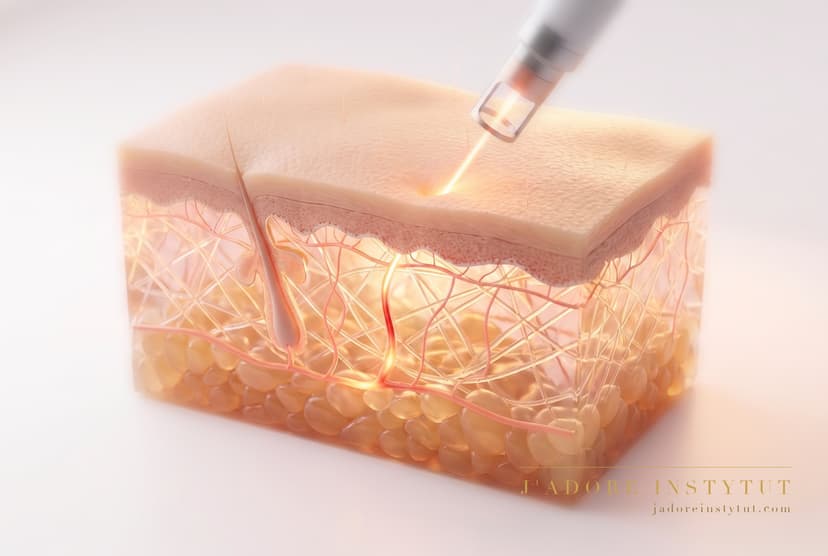
ZYE YAG is an Nd:YAG laser with a 1064 nm wavelength. In short: it emits a beam of light absorbed by a specific "target" in the skin — depending on the handpiece, this can be haemoglobin in a broken capillary, melanin in a hair follicle or pigmented spot, or water in deeper layers (for renewal and firming). The absorbed light converts to heat, which acts selectively on that target, sparing the surrounding skin. This phenomenon is called selective photothermolysis.
The key feature of the 1064 nm wavelength is deeper penetration than IPL or shorter-wavelength lasers — and lower affinity for melanin in the epidermis. The practical result: the laser reaches deeper-lying vessels and is safer on darker skin, where other technologies more easily cause hyperpigmentation.
One platform, but four interchangeable fibre-optic handpieces — each suited to a different task. That's why we call ZYE YAG a multifunctional laser: in a single visit, a specialist can switch handpieces and address different concerns on the same skin.
Ideal for
Not every skin change is suitable for laser treatment "on the spot". Moles, pigmented lesions of uncertain nature, or active inflammation require assessment first — we refer you to a doctor when needed, before proceeding with laser.
Women's area and men's area
For women, the most common reason is broken capillaries, redness and skin tone — the desire to "calm" red, uneven skin and restore an even tone. This is the classic zye-yag for women approach: working with the VL handpiece on capillaries, LT on firmness, plus improving sun spots.
What we work with
For men, the main concerns are unwanted hair (back, neck, chest), post-shave redness and broken capillaries, along with darker skin tones that many lasers can't handle. This is zye-yag for men: the Nd:YAG 1064 nm is particularly well-suited here, working safely on phototype IV–VI.
What we work with
Why Nd:YAG for dark skin? Shorter wavelengths and IPL strongly "see" epidermal melanin, so tanned or naturally dark skin is more prone to burns and hyperpigmentation. The 1064 nm wavelength is "more transparent" to the epidermis — making it one of the safest choices for phototypes IV–VI.
Safety
With laser treatment, results and safety depend on several factors worth asking about in every salon:
At J'adore, the treatment is carried out by a doctor or experienced cosmetologist, who first assesses the type of change, skin phototype and contraindications. A questionable pigmented lesion is referred to a doctor — laser doesn't "diagnose" moles.
The same broken capillaries on the face and legs require different work; darker skin requires different settings. This choice belongs to the specialist — there's no single "setting for everything".
A fresh tan (sun, sunbed, self-tanner) drastically increases the risk of burns and hyperpigmentation. This is the most common reason to postpone the treatment.
After laser treatment, skin is light-sensitive — SPF 50+ is mandatory, every day, regardless of season.
Red flag: laser "on a tan" and without a health history · If someone offers a treatment on freshly tanned skin and doesn't ask about photosensitising medication, isotretinoin or a tendency to cold sores — that's a warning sign. Skipping a health history before laser treatment carries a real risk of burns and hyperpigmentation. A good salon will ask, and postpone the appointment if needed.
LASER THERAPY / HIGH-TECH / REMOVAL
Contraindications
Some contraindications are permanent, others temporary — in that case, we simply postpone the treatment until the situation resolves. With laser treatment, we're especially careful about sun exposure and photosensitising medication.
From the specialist's chair
The most commonly postponed reason is sun exposure. "I was on holiday for a week and want to go straight for capillary treatment" — unfortunately, no. A fresh tan and laser treatment are a recipe for hyperpigmentation. It's better to wait until your skin tone returns to its base than to fix hyperpigmentation later.
This isn't a complete list — we'll go through your medication, health conditions, phototype and previous treatments individually during consultation.

What to expect
Key point: laser results can be "delayed" and staged. A broken capillary may first darken before it's absorbed; hyperpigmentation may temporarily deepen; skin firmness and tone build over weeks and throughout the whole series, not after one treatment.
The most common "it's not working for me" I hear comes after a single capillary treatment. That's normal — sometimes the vessel needs to darken first before it disappears, and some cases need another session. Laser treatment is about series and patience, not a single "shot".
Results last longer when you protect your skin from the sun and avoid getting a fresh tan between sessions. Without SPF, new broken capillaries and hyperpigmentation will simply reappear — laser removes what's there, but doesn't "immunise" you against the future.
Portfolio
A record of the work in our salons — the place where we publish treatment frames and, after photo sessions, results.
A record of results — in preparation. We publish photographs of our clients only with their consent.
ZYE YAG and your lifestyle
The most common questions aren't about the treatment itself, but about what comes after: sun, pool, sauna, training, makeup. There's one rule — for the first few days, skin is sensitive to light and heat, and a tan and laser treatment don't mix.
This is the most important rule with laser treatment. Skin must be untanned before the treatment, and protected afterwards. Sun and sunbeds right after laser treatment risk hyperpigmentation. SPF 50+ daily — no exceptions.
Self-tanner "colours" the epidermis and confuses the laser — stop using it several days to about two weeks before your visit, until it's completely gone.
Heat and chlorine irritate freshly treated skin. Skip the sauna, pool and hot baths for 1–2 days, until the redness fades.
Intense, "warming" circulation right after the treatment worsens redness. Light movement is fine; save intense training for the next day.
Stop strong active ingredients (acids, retinol, peels) for a few days before and after the treatment — gentle care and barrier hydration matter more right now.
For most indications, you return to daily life straight away; makeup usually from the next day, once the skin has settled. Don't force-cover or pick at scabs from capillary/lesion treatment.
ZYE-YAG (Nd:YAG)
These methods do different things and don't replace one another. For broken capillaries, redness and skin tone, the choice is usually between Nd:YAG laser and IPL/DYE-VL; for wrinkles and volume — entirely different tools:
deeper and on dark skin
won't fill a "resting" fold or relax an expression line
superficial redness and radiance
reaches deeper vessels less effectively; caution on dark/tanned skin
wrinkles and volume
won't close a broken capillary, reduce hair growth or eliminate redness
Combine with
Where the problem is complex (redness + uneven skin tone + laxity), we combine ZYE YAG with other treatments. The specialist decides the order and intervals during consultation, but the general logic stays the same:
The most common question: "laser or IPL for my broken capillaries?". A simple rule we apply during consultation: superficial, diffuse redness → IPL/DYE-VL; single, thicker, deeper capillaries and leg spider veins → Nd:YAG. And on darker or recently tanned skin, Nd:YAG is almost always the safer choice.
Four handpieces
You don't choose the handpiece "off the shelf" — the specialist selects it based on the problem, area and skin phototype. Often, more than one is used in a single visit.
Heat absorbed by haemoglobin closes the dilated capillary. Thanks to the deeper penetration of 1064 nm, it reaches where shorter wavelengths and IPL cannot.
Dla kogoFacial spider veins, diffuse redness, rosacea, small leg spider veins.
Light targets melanin in the hair follicle and weakens the bulb. The 1064 nm wavelength bypasses epidermal melanin, so it also works on dark skin.
Dla kogoPermanent hair reduction, especially phototype IV–VI; complements diode hair removal.
Controlled heat in the deeper layers of the skin stimulates collagen production — without disrupting the epidermis (no ablation).
Dla kogoLaxity, improved firmness and texture, "laser peel" / photo peel.
A handpiece with extended capabilities — allows precise work on the face and body, and combines indications in a single treatment.
Dla kogoCombined treatments and larger areas.
Fun fact: the same 1064 nm wavelength that closes a broken capillary can also weaken a hair follicle and warm the dermis enough to trigger collagen renewal. It's not four different lasers — it's one laser and four ways of working with tissue.
Fact: Why do prices differ? Based on area (nose alone vs full face vs legs), number of sessions in the series (broken capillaries usually take a few visits, hair removal takes more) and handpiece type/indication. That's why we determine pricing and the series plan during consultation — there's no single "laser treatment" price.
Price list
Checking free hours…
See also
The result lastsdepending on the indication — results build and are maintained through a seriesJ’adore Instytut
Note. ZYE YAG is a multifunctional Nd:YAG 1064nm laser (Vydence Medical). This text is for information only and does not constitute medical advice. Indications, handpiece and parameter selection, and contraindications are determined by a specialist during an individual consultation; where skin changes require diagnosis, we refer you to a doctor. The treatment is performed by a doctor or experienced cosmetologist.
Home care
Cosmetics matched to what your skin needs after a treatment — so the clinic effect lasts longer.
 post-treatment regenerationCell Fusion CDermagenis pH Biome SerumView in the shop(opens in a new tab)
 sun protectionDermaQuestSunArmor SPF50 30 mlView in the shop(opens in a new tab)
 sensitive skinSesdermaSERENITY mask 50 mlView in the shop(opens in a new tab)
 post-treatment regenerationMedMelanoSkinbiotic Elixir Probiotic Repair Serum 50 mlView in the shop(opens in a new tab)
 sun protectionSkeyndorProtective cream SPF 50+ – Age Photo DefenseView in the shop(opens in a new tab)
 post-treatment regenerationVagheggiEmozioni Plus — Anti-Stress Face Mask 75mlView in the shop(opens in a new tab)
 sun protectionCell Fusion CAquatica Sunscreen 100 SPF 50+/PA++++View in the shop(opens in a new tab)
 post-treatment regenerationMesoesteticMesohyal Post-Procedure Gel CreamView in the shop(opens in a new tab)


