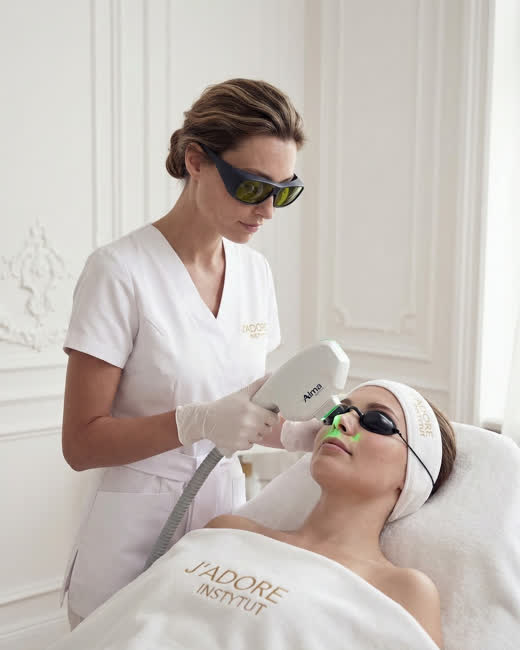
A treatment room at J'adore
LASER THERAPY / HIGH-TECH / REMOVAL
A small red "cherry angioma" on the décolletage that appeared a few years ago and keeps slowly growing. A brown seborrhoeic wart on the neck that no clothing can hide.
A soft skin tag catching on your collar. Yellowish xanthelasma on the eyelids that make your face look tired. These are benign lesions — but they can be irritating and disrupt the smoothness of your skin. Removing skin lesions at J'adore Instytut is not "burning off a mole by eye" — it is a medical treatment preceded by a dermatoscopic assessment. Every lesion is first examined by a doctor / dermatologist (with dermatoscopy). Only once we're confident the lesion is harmless do we decide to remove it and choose a method — usually electrocoagulation (high-frequency current), sometimes Plasma IQ or laser. Below you'll find everything worth knowing before you book a visit.
usually 1 session per lesion (larger or numerous ones may need a repeat)
How it works
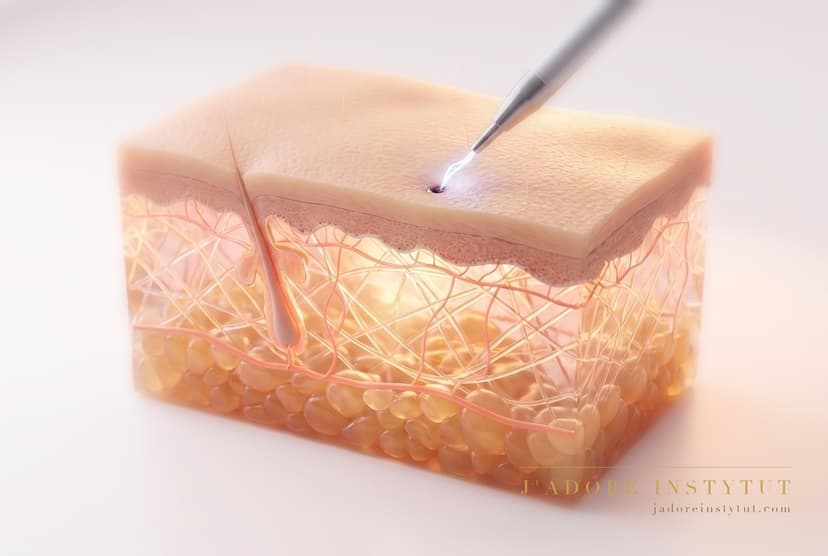
Most small lesions are removed using electrocoagulation — high-frequency (HF) current. A thin electrode (needle) touches the lesion; current passes through the tissue, causing local heating and coagulation — a controlled "searing" of proteins. The lesion is destroyed precisely, leaving the surrounding skin untouched. The treatment is superficial and precise: one lesion takes literally a few seconds.
After the treatment, a small scab forms where the lesion was — this is a normal, expected reaction. The scab falls off on its own within a few days, revealing healing skin underneath. Don't pick at it — it protects the healing process and determines whether any mark is left behind.
For certain lesions, your doctor may choose a different technology: Plasma IQ (a plasma arc that vaporises the epidermis without contact and also tightens the skin — useful for loose eyelid skin, for example) or Nd:YAG laser. The logic stays the same: precise, superficial, and respectful of healthy tissue. Your doctor decides on the method during consultation.
Which lesions we remove
We only remove benign lesions, confirmed by dermatoscopy. Most commonly these are:
A mole that grows, darkens, has irregular edges or uneven colour, itches, bleeds, or heals then returns — this is not something to remove "for looks". We do not remove such lesions with aesthetic methods — we refer you for further diagnostics and, if needed, surgical removal with histopathological examination. Dermatoscopy exists precisely to catch this.
Dermatoscopy
This is the core of safety in this treatment. A doctor always examines every lesion under a dermatoscope first — a non-invasive examination that magnifies and illuminates the lesion, revealing structure invisible to the naked eye. Only once the doctor is confident the lesion is benign do we decide on removal and method.
Why does this matter so much? Because aesthetic methods (electrocoagulation, plasma, laser) destroy the lesion thermally — no tissue remains for examination under a microscope. So if there's any shadow of doubt about whether a lesion is truly harmless, aesthetic removal is not appropriate — that lesion should go for surgical removal with histopathology instead.
From the doctor's chair
The most common request: "just burn it off, it's only an ugly mole." I understand — but that's exactly why I reach for the dermatoscope first. In 95% of cases, it really is a harmless lesion, and we remove it there and then. That remaining few per cent is why this step is non-negotiable.
Women's needs and men's needs
For women, it's mostly about the aesthetics of exposed areas and the face — décolletage, neck, and the eye area. Lesions are often small, but visible in photos and in a dress neckline. The goal: clear, smooth skin with no trace of the treatment. This is classic skin lesion removal for women.
What we work with
For men, lesions on the neck, back, torso and arms dominate — cherry angiomas, seborrhoeic warts, and skin tags rubbing against a collar or backpack. What matters is speed and discretion: one visit, a small scab, back to daily life. This is skin lesion removal for men.
What we work with
Did you know: red "cherry angiomas" have nothing to do with diet or a "bad liver", despite what internet myths claim — they're simply small, benign growths of blood vessels that naturally increase with age. A removed one won't come back, but new ones may appear elsewhere. This is normal.
Safety
With skin lesion removal, three things determine the result and safety — and they're worth asking about at any clinic:
This is question number one. At J'adore, we never remove a lesion without a prior dermatoscopic assessment by a doctor. Removing a lesion "on the spot, by eye" risks missing something that should have gone for diagnostics.
Qualifying a lesion — especially a pigmented one — is the job of a doctor / dermatologist after dermatoscopy. They assess whether the lesion can be removed aesthetically at all, and by which method. The removal itself is carried out by a doctor or experienced (medical) cosmetologist, only after positive qualification. This is never a back-room decision.
A small scab, no picking, and strict SPF 50+ aren't cosmetic extras — they're what determines whether a mark or discolouration is left behind.
The golden rule at J'adore · Diagnosis before aesthetics. We first answer the question "can this lesion even be removed in a cosmetology-aesthetic setting?" — and only then, "what's the best way to remove it?" Never the other way round.
LASER THERAPY / HIGH-TECH / REMOVAL
Contraindications
Some contraindications are permanent, others temporary — in which case we simply postpone the treatment. Final qualification is always carried out by a doctor after dermatoscopy.
From the doctor's chair
I say this often: "if a lesion is changing, this isn't the moment for cosmetic removal — it's the moment for diagnosis." Aesthetics can wait. Safety can't.
This isn't an exhaustive list — we'll go through your medication, health conditions, any tendency to keloid scarring, and previous treatments individually at your consultation.

What to expect
Most importantly: a small scab will form where the lesion was — and that's a good sign. It's a natural stage of healing. The scab protects the skin underneath and falls off on its own. The less you disturb it, the cleaner the skin will look afterwards.
The most common mistake after treatment is picking at the scab "because it looks unsightly". That's exactly when a mark can form. The scab is a dressing your skin made itself — let it fall off on its own, and in most cases, nothing will be left behind.
With Plasma IQ on the eyelids, healing is more noticeable — swelling and small "dots" can last from several days to about two weeks. This method comes with real social downtime, which we tell you about at consultation, so you can plan your visit ahead of time.
Portfolio
A record of the work in our salons — the place where we publish treatment frames and, after photo sessions, results.
A record of results — in preparation. We publish photographs of our clients only with their consent.
Lesion removal and your daily life
The most common questions aren't about the treatment itself, but about healing: bathing, swimming, make-up, sun, sport. There's one rule — protect the scab and healing skin for a few days, and after the treatment, always keep up with sun protection.
This is the most important rule: don't pick at or soak the scab for long periods. Let it fall off on its own — it decides whether a mark is left behind. Use the recommended regenerating cream.
Freshly healed skin discolours easily. Avoid sun and sunbeds, and protect exposed areas with SPF 50+ for several weeks — this is key to preventing dark patches.
Don't apply make-up to the treated area for 1–2 days. Make-up elsewhere on the face is fine.
Sauna, swimming and long hot baths soften the scab and encourage infection — skip them until the skin has healed.
Intense exercise and sweating aren't advisable with a fresh scab. Light activity is fine — just avoid friction on the treated area (a backpack on a fresh scab, for instance).
After removing minor lesions, you're back at work the same day. The exception is Plasma IQ on the eyelids — plan a few days for the swelling to settle.
Skin lesion removal — electrocoagulation (HF current)
These are three different tools for a similar goal — removing a lesion — but each suits different situations. The choice belongs to the doctor, after dermatoscopy:
precise removal of minor lesions
does not tighten larger areas of skin and does not replace an eyelid lift
sublimation + skin tightening
comes with longer, more visible healing — requires planning for downtime
vascular lesions and selected pigmentation
these are different indications than classic warts or skin tags — not a one-tool-fits-all solution
Combine with
Lesion removal is often the first step to "tidying up" your skin — followed by work on its quality, tone or firmness. The doctor decides on order and timing, but the general logic stays the same: heal the lesions first, work more broadly afterwards.
Patients often ask "which method is best?" None — and all of them, depending on the lesion. A cherry angioma on the décolletage clears fastest with electrocoagulation; loose eyelid skin usually calls for Plasma IQ; a spread-out capillary is often a job for laser. So the methods don't compete — I choose the tool for the lesion, not the lesion for the tool.
Removal technologies
Under the heading "skin lesion removal" sit several technologies. You don't choose from a menu — the doctor selects the right one for the lesion type, its location and your skin, always after dermatoscopy.
A thin electrode coagulates the lesion precisely with current — destroying it thermally without affecting the surrounding tissue. Superficial and highly precise.
Dla kogoCherry angiomas, seborrhoeic warts, skin tags, xanthelasma and other minor benign lesions.
A contactless plasma arc sublimates (vaporises) micro-areas of the epidermis, while the surrounding skin contracts — giving an added tightening effect. Healing is more visible and takes longer.
Dla kogoLoose eyelid skin, minor superficial lesions, situations where we also want to tighten the skin.
Light energy absorbed by the target (such as a capillary) converts to heat and destroys the lesion. The doctor selects the handpiece and settings to suit the lesion type.
Dla kogoVascular lesions (cherry angiomas, capillaries) and selected localised pigmentation.
Fact: Where do price differences come from? From the number and type of lesions removed (one versus a dozen or so), the technology chosen, and whether the lesion needs one session or a repeat. Larger or more numerous lesions simply mean more work. We only set the exact price — and a series plan, if needed — after dermatoscopy, once the doctor sees exactly what and how we're removing. We don't quote a price "off the top of our heads" without a consultation.
Price list
Checking free hours…
Gift voucher
Buy a voucher for this treatment in the J'ADORE online boutique — an elegant gift, redeemable at the salon of your choice.
Voucher pricePLN 299
Buy the voucher (opens in a new tab)Purchase and payment take place in the J'ADORE online store. The voucher is valid for 12 months from purchase and covers the selected treatment variant.
From the magazine
Editorial pieces on how this treatment works in practice — what happens during the session, how to prepare, where the limits are and what the first days after look like.
See also
The result lastsa removed lesion does not regrow in the same spotJ’adore Instytut
Medical information. Skin lesion removal is a medical procedure — at J'adore Instytut it's always preceded by a dermatoscopic assessment, and a doctor / dermatologist decides on qualification and method. This text is for information only and does not replace a consultation or diagnostics. Any pigmented lesion, or one that raises any concern, requires prior assessment; suspicious lesions are removed surgically with histopathological examination, never with aesthetic methods.
Home care
Cosmetics matched to what your skin needs after a treatment — so the clinic effect lasts longer.
 post-treatment regenerationCell Fusion CDermagenis pH Biome SerumView in the shop(opens in a new tab)
 sun protectionDermaQuestSunArmor SPF50 30 mlView in the shop(opens in a new tab)
 sensitive skinSesdermaSERENITY mask 50 mlView in the shop(opens in a new tab)
 post-treatment regenerationMedMelanoSkinbiotic Elixir Probiotic Repair Serum 50 mlView in the shop(opens in a new tab)
 sun protectionSkeyndorProtective cream SPF 50+ – Age Photo DefenseView in the shop(opens in a new tab)
 post-treatment regenerationVagheggiEmozioni Plus — Anti-Stress Face Mask 75mlView in the shop(opens in a new tab)
 sun protectionCell Fusion CAquatica Sunscreen 100 SPF 50+/PA++++View in the shop(opens in a new tab)
 post-treatment regenerationMesoesteticMesohyal Post-Procedure Gel CreamView in the shop(opens in a new tab)