What's in cocoa that makes it work
Cocoa is one of the most chemically complex ingredients found in nature. The cocoa bean contains over six hundred different chemical compounds — and some of them genuinely affect the body in measurable ways. Not all of them, and not for everyone in the same way. This article focuses on the ones that appear most often in research and in treatment rooms.
- Flavonoids (mainly flavanols). The most extensively studied group. Cocoa is one of the richest dietary sources of flavanols — compounds with a documented effect on blood vessel elasticity and blood flow. They work by stimulating nitric oxide production, which dilates vessels and supports circulation. For skin, better blood flow can translate into a healthier tone and better tissue oxygenation for many people.
- Theobromine. An alkaloid related to caffeine, but milder and longer-acting. It gives a gentle lift, dilates peripheral vessels and has a mild diuretic effect. This is partly why chocolate gives a feeling of "warmth" without the nervous edge coffee can bring. In cosmetology, theobromine appears in anti-cellulite formulas because it stimulates circulation in subcutaneous tissue.
- Phenylethylamine (PEA). A compound the body produces naturally, including during physical exercise and falling in love. Cocoa contains trace amounts. It's metabolised very quickly and doesn't cross the blood-brain barrier in significant quantities — but theories about its effect on mood haven't disappeared from the literature. It may be part of the reason behind the "chocolate for sadness" legend.
- Magnesium. Cocoa is a surprisingly rich source of magnesium — a mineral responsible for nerve conduction, muscle relaxation and cortisol regulation. Magnesium deficiency is linked to irritability and tension. This is one of the more concrete mechanisms through which cocoa can — in some people, in the right amounts — influence how you feel.
- Tryptophan. An amino acid and precursor to serotonin. Cocoa contains moderate amounts, but how much reaches the brain depends on several factors — including the presence of carbohydrates (hence the popularity of chocolate paired with sugar). Serotonin doesn't act instantly. Its synthesis is a process, not a momentary spike.
Mood, serotonin and the placebo effect — where does it all fit?
The popular belief is: chocolate raises serotonin, so it improves mood. That's a simplification — but not a complete lie. The mechanism is more complex and multi-layered, and the science remains inconclusive.
First: cocoa alone doesn't raise serotonin instantly. Serotonin doesn't cross the blood-brain barrier — you can't "eat" it. What you can do is supply its precursors (tryptophan) and conditions that favour its synthesis. This is where carbohydrates come in: the sugar in chocolate triggers an insulin release, which clears the blood of amino acids that compete with tryptophan — effectively clearing tryptophan's path to the brain. In other words, sugar may be the "carrier" for tryptophan, not chocolate itself. Dark chocolate without sugar works differently from a typical chocolate bar.
Second: there's also endorphin release and ritual. Many researchers point out that the pleasure of eating chocolate is largely an associative, dopamine-driven effect — our brain has learnt that pleasure follows a bar of chocolate, and it rewards us with dopamine at the mere sight of the wrapper. This isn't "placebo" in the negative sense — it's real neurochemistry. But it doesn't come directly from cocoa.
What cocoa does for skin — from the outside
So far, we've talked about eating cocoa. But cocoa applied to skin — as a mask, a compress, or cocoa oil used during a massage — works through entirely different mechanisms. Here, direct contact with active ingredients, skin absorption and the physical effect of the massage itself all come into play.
- Cocoa butter. Rich in fatty acids (oleic, stearic, palmitic), it forms a protective film on the skin's surface that limits transepidermal water loss (TEWL). After applying cocoa butter, skin can feel softer and hydrated for a long time — not because it was "hydrated from the outside", but because the fatty film slows moisture evaporation from deeper layers.
- Topically applied flavonoids. Their absorption through skin is limited compared to the dietary route, but some research suggests flavanols may act as topical antioxidants — neutralising free radicals in the outer layer. For skin exposed to oxidative stress (sun, pollution, stress), this may offer some protective benefit.
- Theobromine in anti-cellulite formulas. Here, lipolysis and microcirculation come into play. Theobromine may locally stimulate fat breakdown and improve blood flow in subcutaneous tissue. The effects are usually subtle and depend on consistent use — but the mechanism is realistic and supported by in vitro research.
- The scent of cocoa and its aromatherapeutic effect. The aroma of chocolate — even without skin contact — can lower cortisol levels and promote a sense of relaxation. This isn't magic, it's olfaction: the olfactory system has a direct connection to the amygdala and hippocampus, the brain's centres for emotion and memory. This is why a chocolate massage works as a complete ritual — not just the body, but the nervous system too receives the signal to relax.
Chocolate massage: what actually works, and what's ritual
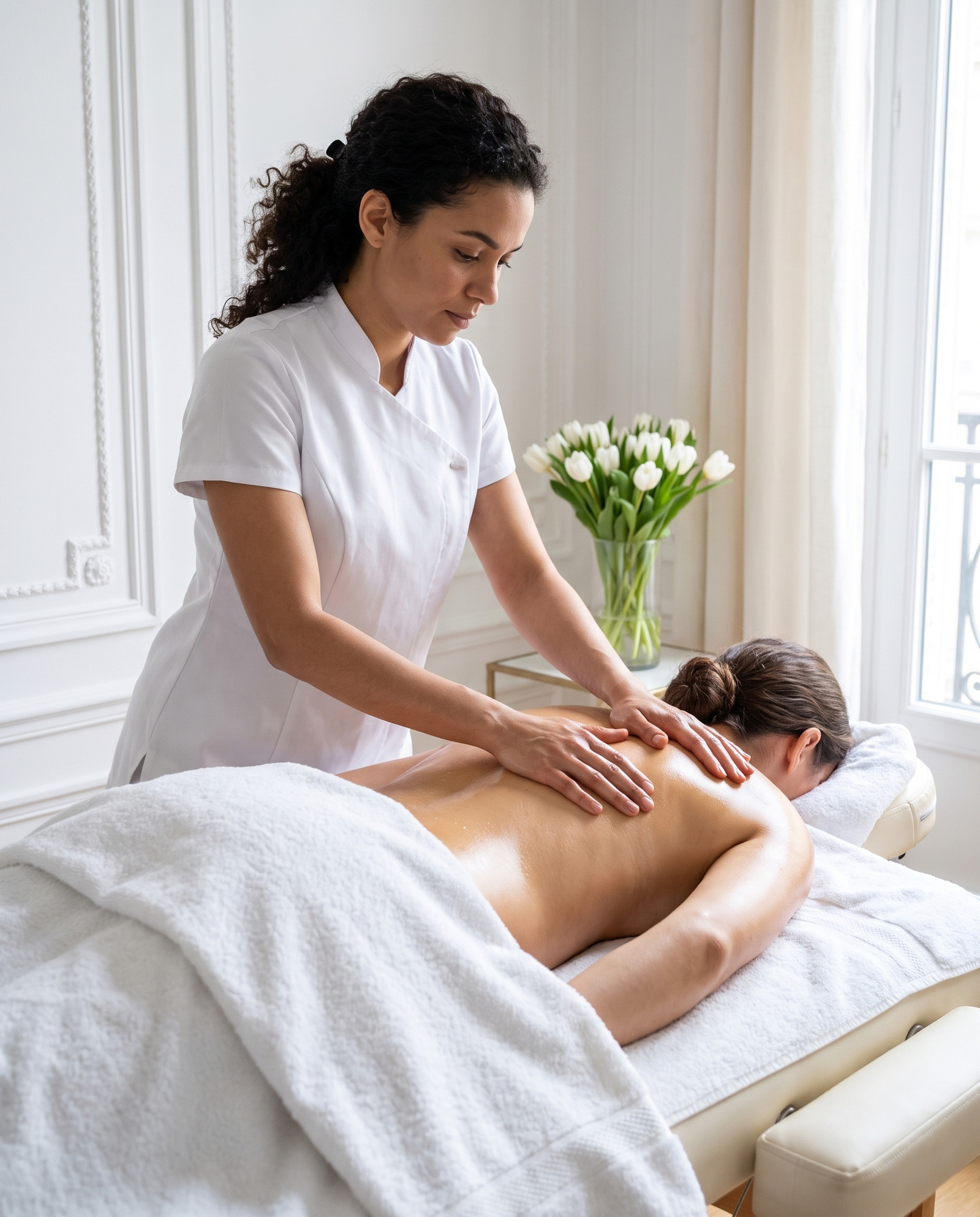
A chocolate massage combines several mechanisms at once — and this combination is exactly why its effects can feel so pronounced. It's not just about the formula's ingredients. It's about the sum total: touch, warmth, aroma, breathing, time and attention to the body.
Biochemical effect (cocoa)
what the ingredient does
- Cocoa butter hydrates and seals the skin barrier
- Flavanols may act as local antioxidants
- Theobromine stimulates circulation in skin and subcutaneous tissue
- Cocoa aroma activates the limbic system and may lower cortisol
Mechanical effect (massage)
what the technique does
- Warms tissue and releases muscle tension
- Stimulates lymph flow and clears toxins from tissue
- Regulates the nervous system (parasympathetic = rest)
- Improves skin elasticity through mechanical "stretching"
The effect you feel after a good chocolate massage is the sum of both columns. Skin is warm and hydrated, the body is relaxed, the nervous system switches into recovery mode, and the aroma of cocoa acts as a remembered signal of pleasure. This isn't placebo — it's an intelligent combination of stimuli that works precisely because it engages several channels at once.

Who benefits most, and when it's worth reaching for cocoa
A chocolate massage and cocoa-based treatments aren't equally significant for everyone — it's worth knowing which situations and skin types respond best.
- Dry, dull skin. Cocoa butter is an excellent emollient for skin that loses moisture quickly and feels rough to the touch. After a massage with a rich cocoa formula, skin often looks and feels different immediately.
- People under significant stress. The aromatherapeutic effect of cocoa, combined with relaxation massage techniques, can be particularly effective for anyone with chronic nervous tension. This isn't "a luxury indulgence" — it's a concrete effect on the autonomic nervous system.
- Anti-cellulite treatments, as a complement. Theobromine can support the effects of a draining massage — but it's best seen as a supporting element, not the main act. Results build gradually and depend on regularity.
- After intense physical exercise. Cocoa delivered post-workout — through skin or diet — can support recovery. Magnesium relaxes muscles, flavanols have anti-inflammatory potential, and massage speeds up the clearance of metabolites from tissue.
Chocolate massage + sugar scrub
The scrub removes dead skin cells and prepares skin to better absorb cocoa butter. This combination is most often recommended as a body ritual — skin feels exceptionally smooth and soft afterwards.
Chocolate massage + paraffin hand treatment
The warmth of paraffin and cocoa butter on hands is a particularly recommended pairing in autumn and winter, when hand skin is often irritated and dry.
Relaxation massage (aromatherapist) + cocoa inhalation
A targeted effect on the nervous system — through skin, scent and touch at once. Recommended for burnout, chronic stress and sleep disturbances.
Body contouring massage + theobromine formula
For those seeking both relaxation and drainage support. Theobromine supports microcirculation, and the contouring technique strengthens skin firmness.
What remains after it all
Let's return to the question in the title: does chocolate really improve mood? The answer is yes — but not through one simple mechanism. Several act together, on different levels. Magnesium, flavanols, tryptophan, theobromine, ritual, taste, aroma and dopamine-driven associations combine to create something most of us experience as real and worthwhile.
The same logic applies to skin. A chocolate massage isn't "magic" — it works because cocoa ingredients and massage technique act on several channels at once. Skin comes away hydrated, the body relaxed, the nervous system calm. This isn't an illusion. It's a well-designed ritual — and there's quite a lot of science behind it.
So next time you reach for a bar of chocolate — or book a chocolate massage — you'll know that what you feel is backed by more than pleasant associations. And that science and pleasure aren't mutually exclusive.