Before choosing a method — understand your scars
This is a fundamental step that most people overlook. Not all scars are the same — a method that works very well for one type may be ineffective for another. A dermatologist or experienced cosmetologist will assess your scar type during consultation. It is still worth knowing what you are dealing with:
Atrophic (indented) scars — the most common type of acne scar
These scars form where the skin sinks in. There is not enough collagen and tissue to fill the defect. They are divided into three subtypes:
- Ice pick scars: Narrow, deep and sharply defined — like punctures made with an awl. They are the deepest and most difficult to treat. They extend into the deep layers of the dermis and sometimes into the subcutaneous tissue
- Boxcar scars: Wider, with sharp vertical edges — like miniature rectangular craters. They may be shallow (0.1-0.5 mm) or deep (>0.5 mm). They are easier to treat than ice pick scars
- Rolling scars: Broad and shallow, with gently sloping edges — creating a “rolling” skin texture. They are caused by fibrous bands pulling the skin downwards. They respond best to treatment
Hypertrophic scars
Raised, firm and red — an excess of scar tissue confined to the area of the original wound. They are less common after acne and more common after injuries and burns.
Keloids
Similar to hypertrophic scars, but they grow BEYOND the boundaries of the original wound. They are genetically determined and difficult to treat. They are more common in people with darker skin tones. Please note: keloids may worsen after aggressive stimulating treatments — consultation with a dermatologist is essential.
Post-inflammatory discolouration (PIH/PIE)
Technically, these are not scars, but they almost always accompany them. PIH (post-inflammatory hyperpigmentation) refers to brown marks caused by excess melanin. PIE (post-inflammatory erythema) refers to red-purple marks caused by damaged blood vessels. PIH/PIE may fade on their own over months or years, but treatments speed up the process.
Method 1: Dermapen (microneedling)
How it works
Dermapen is a device with oscillating micro-needles (12-36 needles). They puncture the skin at a controlled depth of 0.25-2.5 mm, at up to 1800 punctures per second. Each puncture creates a microchannel that:
- Triggers the healing cascade — inflammatory, proliferative and remodelling phases
- Stimulates the production of collagen I and III, as well as elastin
- Breaks down old, disorganised collagen fibres within the scar
- Allows active ingredients to penetrate the skin (PRP, hyaluronic acid, vitamin C)
Which scars it treats
- Rolling scars — the best response, as it breaks down fibres pulling the skin downwards
- Shallow boxcar scars — good improvement after a series of treatments
- Ice pick scars — moderate effectiveness. Requires deep settings (2.0-2.5 mm) or combination with other methods
- PIH/PIE — helps, especially when combined with depigmenting serums
Treatment parameters
- Depth: 0.5-2.5 mm (depending on the area and scar type)
- Duration: 30-45 minutes (face)
- Pain: 3-5/10 after EMLA anaesthetic cream
- Downtime: 2-5 days (redness, mild swelling, exfoliation)
- Sessions: 3-6 treatments every 4-6 weeks
- Improvement: 40-70% scar reduction after completing the full series (studies in the Journal of Cutaneous and Aesthetic Surgery)
Strengths
- Safe for ALL skin phototypes (I-VI Fitzpatrick) — minimal risk of discolouration
- Lower cost compared with laser treatment
- Shorter downtime than ablative laser treatment
- Can be combined with PRP (platelet-rich plasma) — a synergistic effect
Limitations
- For deep ice pick scars — Dermapen alone is not enough
- Requires more sessions than laser treatment for a comparable result
- Does not work on keloids (may worsen them!)
Method 2: Fractional laser (iPIXEL Er:YAG)
How it works
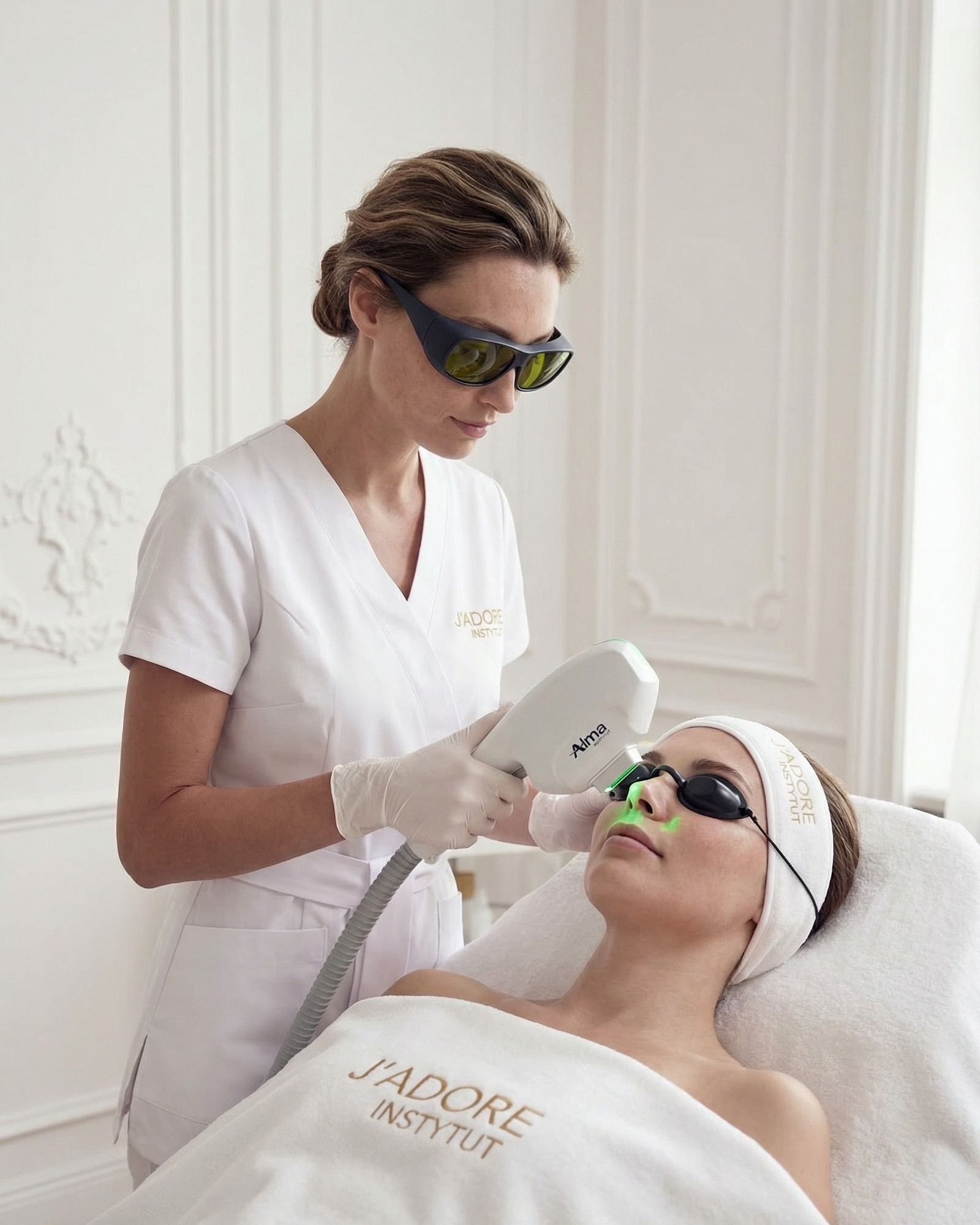
An ablative fractional laser (e.g. iPIXEL Er:YAG 2940nm) emits a laser beam divided into thousands of microbeams (pixels). Each penetrates the skin and vaporises microcolumns of tissue. Untreated skin remains between the columns. This dramatically speeds up healing compared with a classic ablative laser (CO2 full field).
Mechanism:
- Ablation (vaporisation) of damaged scar tissue
- Thermal stimulation of deep collagen
- New skin “grows” from unaffected islands — a remodelling effect
- Controlled penetration depth — from 50 to 250+ micrometres
Which scars it treats
- Ice pick scars — the BEST method. Ablative laser reaches deeper and works more precisely than needles
- Deep boxcar scars — very good response, smoothing the edges
- Rolling scars — effective, although Dermapen is also competitive here
- Hypertrophic scars — a fractional laser can flatten them (confirmed by studies)
Treatment parameters
- Duration: 20-40 minutes (face)
- Pain: 5-7/10 (stronger than Dermapen — anaesthesia is required)
- Downtime: 5-10 days (intense redness, swelling, exfoliation, “raw” skin for several days)
- Sessions: 3-5 treatments every 6-8 weeks
- Improvement: 50-80% scar reduction after the full course
Strengths
- The deepest penetration — reaches areas needles cannot reach
- Most effective for deep scars (ice pick, deep boxcar)
- Simultaneously improves skin texture, pores and tone
- Results are visible sooner than after Dermapen
Limitations
- Longer downtime — 5-10 days of genuinely visible marks
- Higher risk of PIH in darker skin phototypes (IV-VI) — requires caution
- Higher cost per session
- Requires an experienced operator (energy settings, pixel density)
Method 3: Microdermabrasion
How it works
Microdermabrasion mechanically exfoliates the epidermis using corundum crystals (traditional) or a diamond tip (newer). It removes the layer of dead epidermis and the upper part of the living epidermis. This stimulates renewal and accelerates cell turnover.
Which scars
- PIH (hyperpigmentation) — effective, accelerates the exfoliation of excess melanin
- Very shallow textural irregularities — smooths the surface
- Very shallow boxcar scars — minimal improvement
Treatment parameters
- Duration: 20-30 minutes
- Pain: 1-2/10 (virtually painless)
- Downtime: 0-1 day (mild redness)
- Sessions: 6-10 treatments every 2-4 weeks
- Improvement: 10-25% for scars (greater improvement in texture and skin tone)
Strengths
- Painless and safe
- No downtime — you can return to work immediately
- The most affordable option
- Good for maintaining results after more intensive treatments
- Excellent for PIH and overall improvement in skin tone
Limitations
- It does not work on deep scars. Full stop. Microdermabrasion does not reach the dermis, where the problem of atrophic scars lies
- Ineffective for ice pick and deep boxcar scars
- Requires many sessions for a visible result
Comparison table
- Parameter: Best for — Dermapen: Rolling scars, shallow boxcar scars — Laser iPIXEL: Ice pick scars, deep boxcar scars — Microdermabrasion: PIH, shallow irregularitiesParameter: Best forDermapen: Rolling scars, shallow boxcar scarsLaser iPIXEL: Ice pick scars, deep boxcar scarsMicrodermabrasion: PIH, shallow irregularities
- Parameter: Penetration depth — Dermapen: 0.5-2.5 mm — Laser iPIXEL: 50-250+ μm (ablation) — Microdermabrasion: Epidermis onlyParameter: Penetration depthDermapen: 0.5-2.5 mmLaser iPIXEL: 50-250+ μm (ablation)Microdermabrasion: Epidermis only
- Parameter: Pain — Dermapen: 3-5/10 — Laser iPIXEL: 5-7/10 — Microdermabrasion: 1-2/10Parameter: PainDermapen: 3-5/10Laser iPIXEL: 5-7/10Microdermabrasion: 1-2/10
- Parameter: Downtime — Dermapen: 2-5 days — Laser iPIXEL: 5-10 days — Microdermabrasion: 0-1 dayParameter: DowntimeDermapen: 2-5 daysLaser iPIXEL: 5-10 daysMicrodermabrasion: 0-1 day
- Parameter: Number of sessions — Dermapen: 3-6 — Laser iPIXEL: 3-5 — Microdermabrasion: 6-10Parameter: Number of sessionsDermapen: 3-6Laser iPIXEL: 3-5Microdermabrasion: 6-10
- Parameter: Intervals — Dermapen: Every 4-6 weeks — Laser iPIXEL: Every 6-8 weeks — Microdermabrasion: Every 2-4 weeksParameter: IntervalsDermapen: Every 4-6 weeksLaser iPIXEL: Every 6-8 weeksMicrodermabrasion: Every 2-4 weeks
- Parameter: Scar reduction — Dermapen: 40-70% — Laser iPIXEL: 50-80% — Microdermabrasion: 10-25%Parameter: Scar reductionDermapen: 40-70%Laser iPIXEL: 50-80%Microdermabrasion: 10-25%
- Parameter: Safety for phototypes IV-VI — Dermapen: High — Laser iPIXEL: Moderate — Microdermabrasion: HighParameter: Safety for phototypes IV-VIDermapen: HighLaser iPIXEL: ModerateMicrodermabrasion: High
- Parameter: Cost per session — Dermapen: Medium — Laser iPIXEL: High — Microdermabrasion: LowParameter: Cost per sessionDermapen: MediumLaser iPIXEL: HighMicrodermabrasion: Low
- Parameter: Combination with PRP — Dermapen: YES (synergy) — Laser iPIXEL: YES (after healing) — Microdermabrasion: NOParameter: Combination with PRPDermapen: YES (synergy)Laser iPIXEL: YES (after healing)Microdermabrasion: NO
Combining methods — the future of scar treatment
The best results do not come from one method. They come from intelligent combinations. Dermatologists and cosmetologists increasingly use multimodal protocols:
Dermapen + PRP (Vampire Facial)
Microneedling combined with the delivery of platelet-rich plasma through microchannels. PRP contains growth factors that accelerate regeneration and neocollagenesis. Studies published in the Journal of Cosmetic Dermatology showed a 62% improvement in acne scars after 3 Dermapen + PRP sessions, compared with 45% with Dermapen alone.
Fractional laser + chemical peel
Laser as the main remodelling method + TCA peel (trichloroacetic acid) applied locally to ice pick scars (the TCA CROSS technique). The local peel is introduced deep into the scar. It stimulates substantial collagen production from the base.
Dermapen + laser (alternating protocol)
A Dermapen session, followed by a laser session after 6 weeks, then Dermapen again. This combines the benefits of both methods while minimising cumulative downtime.
Microdermabrasion as a complement
After a series of Dermapen or laser treatments, regular microdermabrasion (every 4–6 weeks) maintains the results and improves skin tone.
Aftercare: 80% of success happens AFTER the treatment
You may have the best treatment in the world. But if you neglect aftercare, the results will be poor. Rules after scar treatments:
- SPF 50 every day, without exception — skin is photosensitive after the treatment. One UV exposure can cause discolouration that may take months to reverse.
- Intensive moisturising — hyaluronic acid, ceramides, panthenol. Dry skin heals more slowly.
- No make-up for 24–48h (up to 72h after laser treatment) — pores and microchannels remain open, increasing the risk of blackheads and infection.
- Do not touch, scratch or exfoliate — peeling skin after laser treatment is normal. Let it shed naturally.
- Avoid active ingredients for 5–7 days — retinol, AHA/BHA and high-concentration vitamin C may cause irritation.
- Do not exercise intensely for 48h (sweat + open microchannels = bacteria)
- Drink water — hydration from within supports regeneration.
When NOT to have scar treatments
Not every moment is suitable:
- Active acne — stabilise your skin first (pharmacological treatment), then address the scars. Treatment on inflamed skin = new scars.
- Summer without SPF discipline — if you know you will not wear sunscreen religiously, postpone treatments until autumn/winter.
- Pregnancy and breastfeeding — most treatments are contraindicated.
- Accutane (isotretinoin) — wait 6–12 months after completing treatment (skin is too thin and heals slowly).
- History of keloids — consultation with a dermatologist is essential before any stimulating treatment.
Your action plan
- Identify your scar type — take close-up photographs in natural light.
- Book a consultation — a specialist will assess the depth, type and extent of your scars.
- Set realistic expectations — 100% scar reduction does not exist. A 50–80% improvement is an excellent result.
- Plan a series — a single treatment is not enough. The cumulative effect of sessions matters.
- Invest in aftercare — SPF, moisturising, patience.
At J'ADORE INSTYTUT in Warsaw and Krakow, we offer all three methods: Dermapen, iPIXEL Er:YAG fractional laser and microdermabrasion. During consultation, we select a protocol for YOUR scars — not a general scheme. Sometimes it is Dermapen with PRP. Sometimes laser. Sometimes a combination. Always individual.
Because your scars have their own story. And we know how to write its next chapter.