Hair only lives in one place
To understand why washing products have limited impact on hair loss, it helps to start with anatomy. The hair you see — the shaft rising above the skin's surface — is a fully keratinised structure. In other words, it's dead. It has no nerves, no blood vessels, no living cells. You can oil it, smooth it, give it shine — but you cannot "nourish" it in the biological sense, because there's nothing left to nourish. It's a bit like caring for a nail from the outside and expecting that to change its growth rate.
Hair's life happens entirely in the hair follicle — a small structure embedded in the dermis, surrounded by blood vessels and nerve endings. This is where cells divide and differentiate. This is where new hair forms. This is where the length of the growth cycle gets decided. The hair follicle is an organ — it responds to hormones, nutritional status, stress and blood circulation. That's why, in treating hair loss, what matters is what reaches the follicle — not what we wash the shaft with.
The hair growth cycle — and where it gets disrupted
Every hair on your head follows a constant cycle with three phases. This matters, because most forms of hair loss are really a disruption in the balance between phases — not a sudden, catastrophic destruction of follicles. Understanding the cycle makes it easier to see why treatment results take time to appear, and why shampoo is not the right tool here.
- 01
Anagen — the active growth phase
The follicle works, the hair grows. In someone with a healthy scalp, hair spends two to six years in this phase — the longer it lasts, the longer the hair grows. Around 85–90% of hair sits in anagen at any given time. When this phase shortens, hair becomes thinner and shorter.
- 02
Catagen — the transitional phase
A brief episode lasting just a few weeks. The follicle "winds down", the hair stops growing, but it hasn't fallen out yet. Only a small percentage of hairs are in this phase at any time.
- 03
Telogen — the resting and shedding phase
The old hair is gradually pushed out by a new one growing from below. Losing around 50–100 hairs a day is entirely physiological — it's simply natural turnover. The problem starts when too many follicles enter this phase at once, or stay in it too long.
Normal hair shedding, then, isn't a system failure — it's a normal part of the process: regeneration through replacement. What's concerning is when the ratio of growing to shedding hair reverses: when follicles shorten anagen en masse, when new hair grows in thinner than before, when shedding clearly and persistently outpaces growth. These are exactly the proportions trichology looks at — not the shampoo, which only reaches the shaft of a hair that's already on its way out.
The real causes of hair loss — what a shampoo's ingredient list won't tell you
This is where we get to the heart of the matter. Hair loss has causes — and they almost always lie inside the body, not on the surface of the scalp. Shampoo can support the condition of the shaft, cleanse the scalp and create an environment that favours growth. But it cannot reverse the mechanisms driving hair loss from within. Here are the most common ones.
- Androgenetic hair loss (AGA). The most common form — it affects both women and men. The mechanism: in genetically susceptible follicles, the hormone DHT (a derivative of testosterone) gradually shortens the anagen phase, leading to miniaturisation. Hair becomes progressively thinner and shorter, until the follicle stops producing a terminal hair. This is a progressive process that no shampoo will stop, because the cause lies in the follicle's biology and in a hormone circulating in the blood.
- Nutritional deficiencies. The hair follicle is one of the fastest-dividing structures in the body — it needs a steady supply of iron, zinc, biotin, vitamin D and protein. When these are lacking in the blood, the body cuts supply to "less urgent" structures — and hair is one of the first casualties. A biotin shampoo on the shaft won't correct a biotin deficiency in the body.
- Stress and telogen effluvium. Severe or chronic stress — physical (illness, surgery, childbirth) or psychological — can push large groups of follicles into the resting phase at the same time. The effect shows up with a delay of a few weeks to a few months, and often resolves on its own once the trigger is gone. But it won't resolve any faster by changing your shampoo.
- Hormonal disorders. Thyroid function, insulin metabolism, post-pregnancy changes, menopause — all of these are hormonal shifts that directly affect the follicle cycle. Hair loss is often the first sign of something worth investigating with a blood test, before buying yet another specialist shampoo.
- Scalp condition and microbiome. Excess oil, dandruff, folliculitis — conditions on the scalp can hinder growth and worsen shedding. This is the one area where external care can genuinely make a difference: a good shampoo that regulates oil production or soothes inflammation really can help. But this is the exception, not the rule.
Where does the belief that shampoo helps come from?
It's worth asking where this logic came from in the first place — after all, millions of people have bought "anti-hair-loss" shampoos over the years with real hope. The answer has several layers, and it's not just that advertising lies (though the messaging can mislead). There are a few mechanisms that make switching shampoos appear effective.
First, telogen effluvium — the most common form of sudden, severe shedding — resolves on its own. Someone changes their shampoo at the peak of shedding, and a few weeks later the shedding eases. They conclude the shampoo worked. In reality, the body simply came out of the stress phase and reset the follicle cycle by itself. Correlation in time isn't cause and effect.
Second, shampoos can genuinely reduce shaft breakage — and fewer broken hairs on the brush is a visible difference. The trouble is that breakage and shedding are two separate phenomena, even though they look similar. When hair stops breaking, we get a subjective sense that it's "falling out less". The mistake is an easy one to make, and manufacturers don't always help avoid it.
What actually works — and what a root-cause approach looks like
A sensible approach to hair loss starts with one question: what's the cause? This isn't a question you'll find the answer to on a shampoo shelf — it's a question for trichology and, when needed, dermatology or endocrinology. In a consultation, this can be assessed: through trichoscopy (checking the condition and phase of the follicles), through blood tests (iron, ferritin, thyroid, hormones), and through an assessment of scalp condition. Only with that information does choosing a method make sense.
Shampoo / external care
works on the shaft and the scalp surface
- Protecting and smoothing the hair shaft
- Regulating oil production and scalp inflammation
- Improving hair appearance and shine
- Removing excess sebum (creating an environment for growth)
Working at the source — the trichological approach
addresses the cause within the follicle and the body
- Diagnosing follicle and scalp condition
- Identifying deficiencies and hormonal disorders
- Treatments that stimulate circulation and nourishment to the follicles
- Supplementation or treatment targeted at the cause
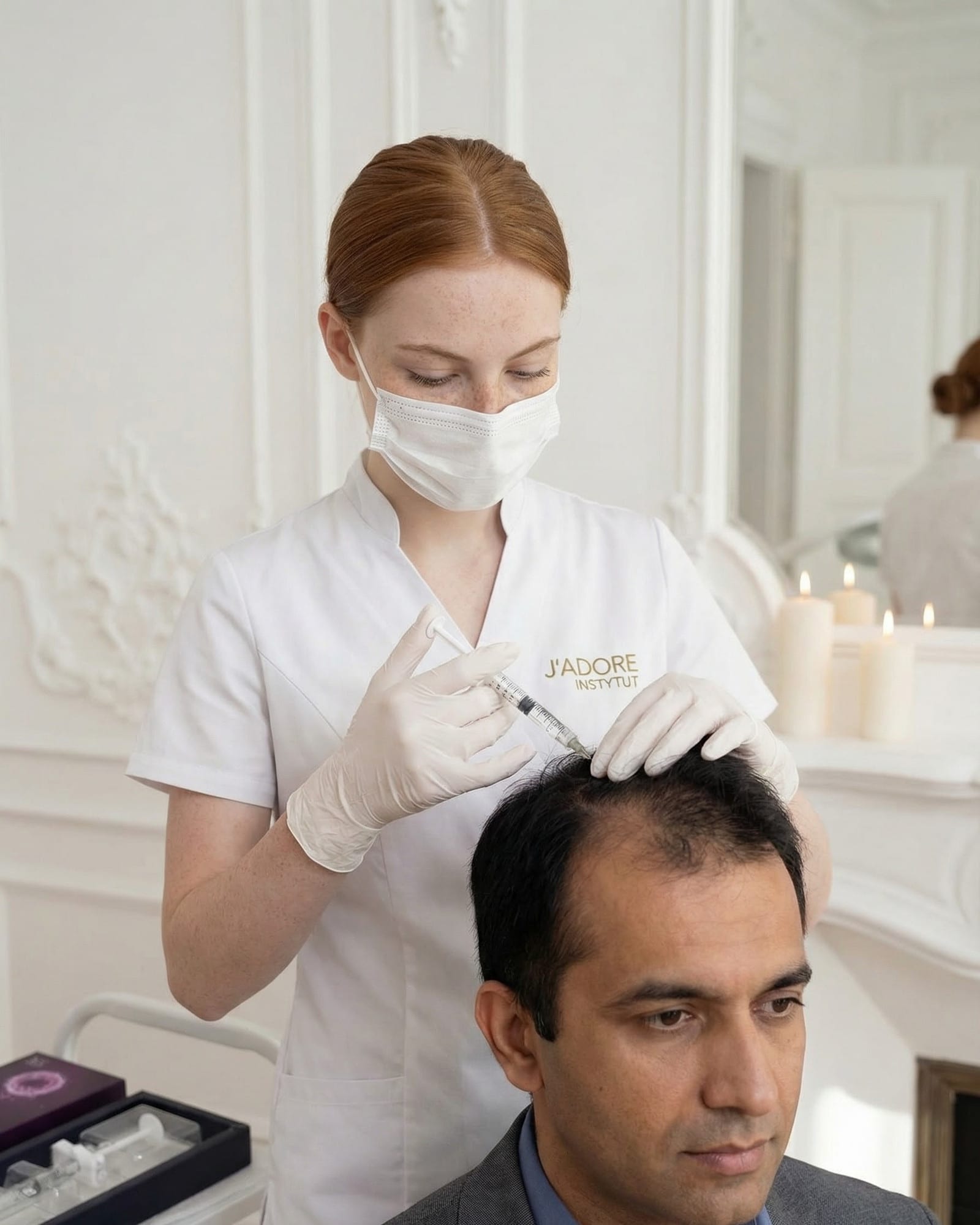
A trichology consultation gives access to methods that work directly where the problem begins — around the follicle and in the scalp's blood supply. Some are stimulating treatments that improve local nourishment and follicle activation; others are therapies targeted at specific mechanisms of hair loss. None of these work overnight — the hair cycle is measured in months, and for many people the first visible results appear after several sessions in a series. But this is the only approach with a real chance of reaching where the hair actually grows.
Combine, don't replace — where care fits into the full plan
Saying shampoo "doesn't help" would be an oversimplification. Proper external care still makes sense — as support, not as a solution. A scalp that's clean, calm and free of excess sebum is a better environment for growth. Good-quality conditioners and masks reduce the risk of shaft breakage, which helps preserve the length and density of the hair that's already grown. The benefits are simply different from "stopping hair loss".
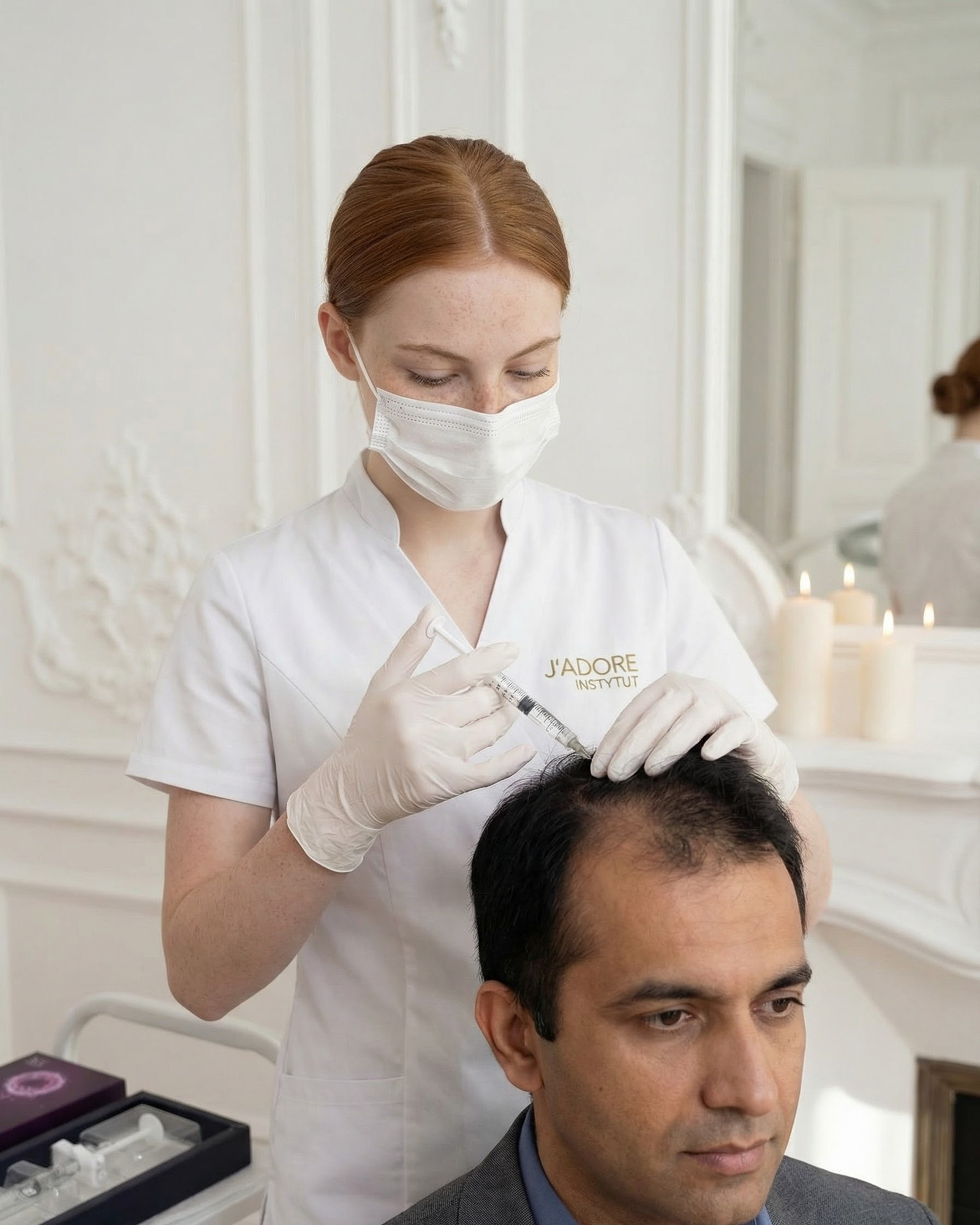
Scalp mesotherapy
Delivers nutrients directly to the area around the follicles — bypassing the epidermal barrier that shampoo cannot cross.
Platelet-rich plasma (PRP)
Growth factors from your own blood plasma stimulate dormant follicles and improve their blood supply — addressing the follicle's biology, not the surface of the shaft.
Scalp laser therapy
Photobiomodulation stimulates follicle cell activity and improves microcirculation — a method based on working deep within the scalp.